
TLDR — Podcast Recording Tips That Work (2026)
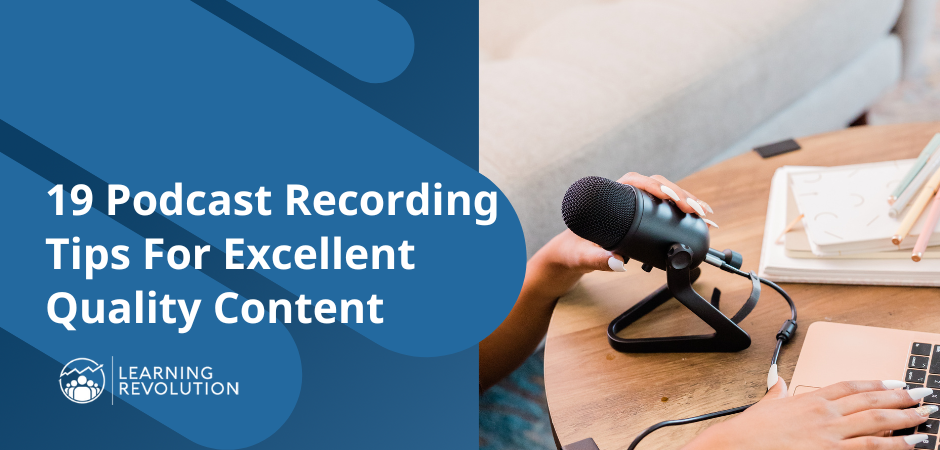
After hosting more than 450 episodes of the Leading Learning Podcast, we’ve learned these lessons through real trial and error. Use these quick, practical podcast recording tips to improve your audio quality and create professional content.
1. Use a quality mic: Choose a mic that fits your format so your podcast audio stays clear and consistent.
2. Wear headphones: Hear your true voice and catch issues before they affect your recording.
3. Use a script or outline: Keep your podcast structured and avoid filler or rambling.
4. Warm up your voice: Sound more confident and natural when the recording starts.
5. Invest in basic gear: A good mic, stand, pop filter and headphones instantly improve audio quality.
6. Eliminate background noise: Record in a quiet room and remove anything that hums or distracts.
7. Soundproof your space: Use soft furnishings or acoustic panels to reduce echo and reverb.
8. Create a noise profile: Capture 10 seconds of silence so you can remove hiss during editing.
9. Record in RAW formats: Use WAV or AIFF for cleaner editing and higher-quality podcast production.
10. Control your breathing: Maintain a steady mic distance and use a pop filter to reduce plosives.
11. Use a fast internet connection: Stable WiFi or wired internet keeps online podcast recording smooth.
12. Mute silent participants: Reduce ambient noise during group or roundtable podcasts.
13. Use professional software: Tools like Audacity or Adobe Audition give you cleaner control.
14. Record separate tracks: Capture each participant on individual tracks for easier editing.
15. Let your guests speak: Keep the conversation natural and avoid unnecessary interruptions.
16. Use audio cues: Mark mistakes with silence or a clap so you can find them faster in editing.
17. Do a test run: Check your mic, levels and environment before the real podcast recording.
18. Control sound effect levels: Use effects lightly so they support your content instead of overpowering it.
19. Remove distractions: Close extra tabs, silence notifications and focus fully on your session.
20. Stay hydrated: Keep your voice strong and consistent during long recordings.
Online Podcast Recording Tips
Use a dedicated online recording tool: Platforms like Riverside, SquadCast and Zencastr record each guest locally for higher-quality podcast recording online.
Record each participant on separate tracks: Makes editing easier and improves overall podcast sound quality.
Follow internet speed guidelines: Aim for 25 Mbps download and 10 Mbps upload for smooth virtual podcast interviews.
Close noisy apps: Shut down heavy tabs, sync apps and background processes to avoid lag or audio cuts.
Use reliable platforms: Choose remote recording tools designed for online podcast recording to avoid compressed audio and dropouts.
Recommended Tools, Mics and Equipment: Blue Yeti USB, Sennheiser MKE 600, Rodecaster Pro II, XLR mics, pop filters, noise-cancellation headphones, microphone stands, Audacity, Adobe Audition, Riverside, SquadCast and Zencastr.
In an audio podcast, your only point of contact with your listeners is your voice. Unlike video content, you can’t engage them with visuals, additional information, or annotation.
Their eyes are free to roam around, meaning they’re just a small distraction away from hitting the stop button on your content.
So, keeping your listeners hooked to your podcast is quite challenging.
But it becomes impossible if your audio, your only connection with your listeners, isn’t clear or poorly recorded.
So, in this article, we’ll share several proven podcast recording tips to help you create professional content that keeps your listeners engaged till the end.
Let’s dive in.
What Does High-Quality Podcast Production Look Like?
The biggest quality of a high-class podcast recording & production is that your listener never has to struggle to hear your words.
Your audio should be clear, crisp, distraction-free, and loud enough to be easily understandable.
But podcast quality is not just about your recording equipment.
As you’ll see in this article, podcast recording quality has much to do with your voice, distance from the mic, and how you talk to your guests.
Podcast production in general has evolved significantly since the arrival of AI recording and editing tools. According to a research conducted in 2025, 63% of podcasters already use AI tools in their podcast production process.
But here’s the gist of it all.
Even if you’ve chosen the best podcast hosting platform, if your listener has to do anything other than play your podcast to hear you clearly, your recording quality isn’t up to the mark.
Use this as a benchmark for your podcasts.
Podcast Recording & Production Tips To Create Professional Audio Content
Based on our years of podcasting experience, here are some of the most critical recording tips to help you create outstanding podcasts.
Podcast Recording Tip #1: Use A Quality Podcasting Mic
Your podcast quality heavily relies on your mic. But mic selection isn’t as straightforward as you think because mic types vary according to your content.
For example, omnidirectional mics that capture sound from all angles work better for a group podcast with multiple participants. In comparison, solo shows use shotgun mics that cancel the surrounding sounds, capturing input from the front only.
Then there are all-rounder mics that do the job for all kinds of content. But of course, they’re not as high quality as specialized mics.
So, list your preferred podcast formats, and invest in the most suitable mics for your needs and budget.
Here are some of our recommendations for the best podcasting mics.
- Blue Yeti USB – Among the most popular and affordable podcasting mics
- Sennheiser MKE 600 – Excellent shotgun mic for professional podcasters. Perfect for solo and interview podcasts.
- Rodecaster Pro II: High-end audio recording system with analog inputs, integrates with camcorders, and is ideal for podcasts with multiple participants.
Podcast Recording Tip #2: Wear Headphones
Most people are surprised by how different they sound in recordings. That’s because we can’t hear our actual voices while speaking. Instead, we hear a blend of our external and internal voices, which is slightly different from what others hear when we speak.
So, to get a true sense of how you sound, wear headphones when recording your podcasts. If you have a guest, have them wear one as well.
This helps you listen to your podcast from your audience’s perspective and gives you a better idea of your voice tone and speed. In addition, wearing headphones helps you determine if you’re too loud or need to move closer to the mic. Plus, several research studies show that wearing headphones increases focus and minimizes distractions.
Podcast Recording Tip #3: Use A Script
If you think your favorite podcasters have all those amazing facts at their fingertips and record flawless podcasts without preparation, let me tell you a secret – they use scripts.
Podcast scripts help you minimize errors, improve fluency, and structure your content to maximize listener engagement.
So whether you’re a beginner or an experienced podcaster, use some form of script to make your podcasts more professional.
Don’t confuse podcast scripts with movie or drama scripts where every word is carefully written and followed.
Podcast scripts are usually divided into segments and include bullet points to help you stay on track. However, solo podcasters covering unfamiliar topics may also go for word-for-word scripts.
You can read more about this in our detailed podcast scripting guide.
Podcast Recording Tip #4: Warm Up
Warming up your vocal cords before recording a podcast is essential for delivering clear, engaging content.
When preparing for a show, it’s easy to get caught up in the key points you want to cover. But if you don’t take the time to warm up your voice, you’ll sound tired and unprepared when you start recording.
Virginia Tech Professor Greg Justice shares a fun way to warm up your voice before a podcast in this video so you hit the ground running.
Podcast Recording Tip #5: Invest In The Right Podcasting Equipment
We’ve already discussed mics. But they’re just one part of your podcasting equipment. If you want to produce professional content that engages your listeners and keeps them hooked till the end, you must invest in a popper podcasting equipment setup.
The right equipment enhances your podcast production quality and makes a strong impression on your listeners.
Here are some of the critical tools and gadgets you’ll need:
- A high-performance laptop
- Professional mics
- Microphone stand
- Mixer
- Noise cancellation headphones
- Pop filter or windscreen
- Video cameras and lighting (if you record video podcasts)
All of these things (plus a few others) combine to improve your podcast recording quality. However, if you’re on a limited budget and can’t immediately build a complete podcast recording setup, start with professional XLR mics and headphones because they impact your content quality the most.
But eventually, you’d want to get all the critical recording equipment to improve your podcast quality.
Podcast Recording Tip #6: Eliminate Background Noise
Unless you’re an established podcaster, you’re probably using a makeshift arrangement somewhere in your house to record your content.
There’s nothing wrong with it.
In fact, many podcasters, including Marianne Paiva, a professor at the University of Chicago and a professional podcaster, regularly use their closets for recording podcasts.
But make sure there are no unnecessary noise sources in your recording space. For example, a noisy machine or equipment, a pet, or a talkative team member.
Usually, your mic, mixer, and laptop should be the only machines in your recording space. Remove everything else, put your phone on airplane mode, and remove every potential noise source from your surroundings.
Plus, add soft couches, cushions, and carpets to the space to reduce reverb (this is why closets are perfect for recording.)
Podcast Recording Tip #7: Soundproof Your Room
You don’t want the sound of someone shouting on the street or kids playing in the backyard to feature in your podcast.
This is why soundproofing your recording space is critical to cutting off all outside noise.
So, apart from choosing a room away from a busy street and shutting off its doors, you can minimize outside noise in your recordings in several ways.
For example, you can place rectangular acoustic foam panels on your walls or ceiling to absorb noise or cover the walls and windows with thick curtains.
However, installing soundproofing insulation in the walls and ceiling is a more sustainable solution. But it’ll cost more, of course.
Most DIY soundproofing techniques won’t cut off all outside noise. But they’ll do the job perfectly if you use a high-quality noise-cancellation mic with them.
Podcast Recording Tip #8: Create A Noise Profile
Even after soundproofing your room, eliminating all noise sources inside, and using a noise-cancellation microphone, your recording might still have some hiss or other ambient noise.
Don’t worry, you can remove it with any modern sound editing software.
But to make it easier for the software to remove this noise, create a base-level noise profile of your surroundings.
You can do that by turning on the recording and staying silent for 10-15 seconds. Then, use your sound editing software to create a noise profile from this recording segment.
Once you record your podcast and start editing, you can use your software’s noise reduction feature to remove the hiss captured in your noise profile, making your content even more polished.
Podcast Recording Tip #9: Record In A RAW Format
Your podcast’s recording quality heavily relies on its original recording format. If you directly record your content in a compressed format, you’ll have little room for editing and polishing it.
So, the best practice is to record the original podcast in a raw format like WAV or AIFF. These formats have higher bit depth and sample rates, resulting in much higher quality recording.
They also give you much more flexibility in the editing phase. You can adjust their compression rate, remove noise, add effects, and even reduce their size without compromising sound quality.
Plus, every audio editing software supports raw formats, meaning you can edit them anytime.
However, raw recordings take up more space making them less ideal for downloading or streaming. But even the downgraded versions sound great when your original recording is in a raw format.
So, keep the original, unedited raw format recording in a separate folder and make copies of the edited version in lower-sized formats like MP3 or ACC.
Podcast Recording Tip #10: Control Your Breath And Body Movement
When you record in a quiet room with high-quality mics, sometimes your body is the only source of unwanted noise.
For example, if you’re too close to the mic or breath heavily, it can become an annoying part of your recording. To avoid this, try not to get too close to the mic when speaking. In addition, use a pop filter and a windscreen with your mic.
A pop filter, in particular, effectively filters the sound of your breath and the additional sound that comes out when pronouncing consonants like P, B, T, and D.
Also, limit your body movement because it can create noise in your recordings, especially if you’re using a collar mic. Sit in a relaxed posture, and don’t move things around too much on your laptop table.
Podcast Recording Tip #11: Use A Fast Internet Connection
Nothing’s more frustrating for your audience than listening to a podcast interview with constant lags and inaudible sound.
So, if you’re conducting an online interview podcast, ensure you and your guest have fast internet connections.
If you’re using WiFi, move closer to the internet router and ask your guest to do the same. Also, close any applications using the internet during your interview.
But sometimes the problem is with your laptop, not the internet connection. If your computer isn’t fast enough or has multiple background apps running, your recording might suffer lags.
So, close everything to ensure you capture the best possible sound quality for your listeners.
Podcast Recording Tip #12: Mute Silent Participants
We see this problem in most roundtable or group podcasts. When you have multiple podcast participants, leaving their mics open all the time can add unnecessary noise to your content.
While one of the participants speaks, the other might be yawning, moving things around, checking their phones, or saying things like “yea,” “hmm,” etc.
And even the silent participants don’t make any noise, their mics record the ambient sounds that you’ll have to remove during editing.
So, mute the silent participants to minimize this noise. You can do that using a mixer or your podcast recording software.
However, only do that if your guests aren’t actively engaging and exchanging ideas on a topic. Because frequently switching mics on and off have a noticeable effect on your recording.
Podcast Recording Tip #13: Use Professional Podcast Recording Software
Audio recording software plays a pivotal role in your podcast production process. It not only records the content in your desired format but also allows you to visually monitor your recording, apply effects, control input levels, and provide you with a range of options to fully control how your podcast sounds.
You’ll also use this software to edit and polish your content. So make sure it has the effects and filters to create your desired content.
You can use software like Adobe Audition, Audacity, or a cloud solution like Restream to record your podcast. Each tool has pros and cons. But generally, specialized offline software provides better features and higher processing capabilities.
Podcast Recording Tip #14: Use Dedicated Tracks For Participants
If you’re doing an interview podcast or have multiple guests in a show, make sure you record them in separate tracks or channels using your podcast recording software.
This makes it much easier to edit your content, remove or enhance the parts by specific speakers, and make any changes compared to a single-channel recording.
Podcast Recording Tip #15: Let Your Guests Speak
Few things are more frustrating for podcast listeners than hosts who don’t let their guests speak.
It’s your show, but your listeners also want to hear your guests. Interrupting them repeatedly is bad etiquette and hurts your listener’s experience. Be even more careful when conducting online interviews and wait for your guest to finish.
Podcast Recording Tip #16: Use Audio Cues For Editing
Editing long podcasts can be a hassle, especially if you can’t immediately identify the parts you have to remove or modify.
This is why leaving audio cues by making a loud sound or staying silent for a few seconds that leaves a visible mark in your recording graph is an excellent way to quickly identify such spots during editing.
When you make a mistake or think you might want to edit a part, describe it in your recording. For example, “remove the part where I mentioned brand XYZ”. Then make a noise or stay silent for a few seconds to be visible in the recording software.
This way, you can edit such parts faster or tell your editor/VA to find them easily.
Podcast Recording Tip #17: Practice Before The Show
No matter how many years you’ve been podcasting, it’s always better to do a dry run before the actual podcast kicks off.
This not only warms you up for the show but also allows you to test your equipment, take a look at the script, and get a quick demonstration of your podcast recording.
When doing a dry run, turn on the recording software to identify any unusual sounds or extra noise in the sound graph.
Also, save and listen to the test run in a raw format to know exactly how it sounds to your audience.
Podcast Recording Tip #18: Control Sound Effect Levels
Sound effects make your content more engaging and add life to your show. But using them too frequently can be counterproductive. Only use effects to spice up your content, not overshadow it.
So, keep the volume levels of your sound effects in check so they don’t make your main content inaudible. Plus, use them sparingly to add a bit of spice to your content.
Podcast Recording Tip #19: Remove Distractions
Like most creators, you probably have a million browser tabs open at any time. But science says it’s not only bad for your productivity but also negatively impacts your ability to focus in the long run.
Naturally, it also distracts you during your podcast. So, before hitting the record button, close your email inbox or any social media tabs to focus on your podcast.
Plus, put your phone away, hang a “Do Not Disturb” sign on your door, and remove every possible distraction to ensure nothing interferes with your podcast recording.
Podcast Recording Tip #20: Take Breaks And Stay Hydrated
Recording a podcast takes time and effort and is often quite tiring. So, giving yourself regular breathers during the show, drinking a glass of water, or taking a quick walk around is essential to refresh yourself.
Research shows that staying hydrated improves your voice quality. So, get a glass of water before the show to loosen your mouth and settle your vocal cords, enhancing your content flow and clarity.
How To Record a Podcast Online (Without Losing Quality)
Online podcast recording means you and your guests are not in the same room and you’re relying on a digital platform to capture everyone’s audio and video.
It’s convenient and perfect for interviewing experts anywhere in the world, but it’s also more challenging than recording in person because internet speed, device performance, background noise, and software quality directly impact your podcast recording quality.
A small glitch can ruin an interview, so you need the right setup to keep your podcast sounding clean and professional.
Here’s how you can ensure the highest recording quality in online podcasts.
1. Choose a Dedicated Online Recording Tool
Use a platform made for podcast recording, not a normal meeting app. Tools like Riverside, SquadCast and Zencastr record each person locally on their own device.
This avoids the compressed, low-quality audio you get from standard video calls and gives you high-quality podcast audio even if someone’s internet freezes for a moment.
These tools are built for podcast recording online and give you cleaner, more consistent files.
2. Record Each Participant on Separate Tracks
Always record your podcast interview in separate tracks.
This gives you full control during editing so you can fix volume levels, remove background noise from one guest and polish each voice individually.
Multi-track recording is one of the biggest differences between normal online calls and professional podcast recording.
3. Follow Clear Internet Speed Guidelines
For smooth online podcast recording, aim for at least 25 Mbps download and 10 Mbps upload on both sides.
This helps avoid audio cuts, lag, and video drops.
If a guest has weak internet, ask them to move closer to the router or use a wired connection.
Stable internet is especially important for video podcast recording and virtual podcast interviews.
4. Close Noisy Apps and Background Processes
Before you hit record, close everything you don’t need.
Extra tabs, cloud sync apps, automatic updates and even open documents can slow the device and interrupt the recording. Ask your guests to do the same.
Use headphones, mute notifications and silence your phone so your recording stays clean.
5. Use Reliable Remote Recording Platforms
If you want the best results, choose tools built for online podcast recording.
- Riverside for high-quality audio and video
- SquadCast for remote interviews with multiple guests
- Zencastr for simple browser-based recording
Each of these platforms captures local files, supports separate tracks, and protects your podcast from internet dropouts.
Ready To Record Your Next Podcast?
Don’t underestimate the importance of your podcast recording quality. With so much competition from other creators and brands, you must ensure your content quality stands out and communicates your message clearly. Most of the tips we’ve shared in this article are quite easy to apply and don’t require a large investment. It’s only about disciplining yourself and focusing on small things that combine to make a world-class podcast.
Frequently Asked Questions (FAQs)
1. Why do you wear headphones when recording a podcast?
Headphones help you hear your true voice and catch issues like volume spikes, mic distance, and background noise instantly.
2. What is the best way to record audio for a podcast?
Use a dynamic mic, record in WAV, stay 5–7 inches from the mic, and capture each speaker on a separate track.
3. What is the ideal internet speed for online podcast recording?
For stable online recording, aim for at least 10 Mbps upload and 25 Mbps download for both host and guest.
4. How can I record a video podcast with noise cancellation?
Use AI tools like Adobe Podcast or Riverside to clean audio and record in a quiet, treated room.
5. What features are critical for modern podcast recording platforms?
Look for multitrack recording, local backups, AI noise removal, echo control, and simple guest links.
6. How do I improve podcast audio quality?
Use a good mic, record in RAW formats, treat your room, and remove hiss with noise-reduction software.
7. How do I ensure crystal-clear video and audio quality in my podcast recordings?
Use separate mics, soft lighting, stable WiFi, and record local files instead of relying on cloud-only streams.
8. What is the best way to record a podcast interview?
Record each guest on a dedicated track using tools like Riverside or SquadCast to avoid internet glitches.
9. How can I record a podcast online without losing quality?
Choose a platform that records locally on each device and uploads high-quality audio in the background.
10. What makes a podcast sound professional?
Clean audio, controlled mic technique, consistent loudness, and tight editing make the biggest difference.
11. Why does my podcast audio sound bad?
Most issues come from mic distance, untreated rooms, cheap USB mics, or recording in compressed formats.
12. What software should beginners use to record a podcast?
Audacity and Riverside are beginner-friendly options that give you clean, high-quality audio.
13. How close should you be to the microphone when recording a podcast?
Stay 5–7 inches from the mic to balance clarity and minimize breath or plosive sounds.
14. How do I reduce background noise in my podcast?
Record in a quiet room, use a dynamic mic, add soft furnishings, and run noise-reduction in post-production.
15. How do I record a podcast with video?
Use a tool that captures synced video and audio, then always record at least 1080p with soft lighting.

ABOUT YOUR HOST
Learning Revolution founder Jeff Cobb is an expert in online education and the business of adult lifelong learning. Over the past 20+ years he has built a thriving career based on that expertise – as an entrepreneur, a consultant, an author, and a speaker. Learning Revolution is a place where Jeff curates tips, insights, and resources to help you build a thriving expertise-based business.
Table of Contents
Related Posts
7 Best Skool Alternatives in 2026 (For Community-Led Learning Businesses)
Skool vs Thinkific (2026): My Comparison & Verdict After Using Both
How Much Money Does YouTube Pay For 1 Million Views (2026)