

TL;DR: Podia Review: A Community-First Online Learning Platform
Podia is a community-first all-in-one creator platform that lets you sell courses, coaching, and digital products through your online community. It rebuilt itself in June 2026 with community as the core experience.
What Podia Offers:
– Community home feed, spaces, group chat, and member-to-member messaging
– Online courses with video, drip, quizzes, and certificates
– Virtual and in-person events with registration and calendar sync
– Email marketing with broadcasts and basic automation sequences
– Coaching sessions, digital downloads, and membership plans
– Website builder with landing pages, blog, and custom domain
– Affiliate program (Shaker and above)
Three paid plans, no free plan, 14-day free trial:
Mover $42/mo annual, 5% transaction fee, entry-level limits
Shaker $84/mo annual, 0% transaction fee, recommended for most creators
Earthquaker $150/mo annual, 0% transaction fee, unlimited products, videos, and spaces
Best for: Beginner to mid-tier course creators, coaches, and consultants who want community, courses, email, and a website under one roof without complexity or a high price tag.
Not for: Creators who need structured learning design with progression controls, advanced email automation and behavioral triggers, or sophisticated community infrastructure. Thinkific, Kajabi, or Circle serve those needs better.
Try Podia for Free
I’ve been a paid Podia user since 2018, when it was a simple tool for selling courses and digital downloads. That was long before the all-in-one positioning it carried until June 2026.
That’s when Podia made its biggest repositioning move to date.
From an all-in-one course marketing platform, Podia reimagined itself as a community-first platform where courses, coaching, and other digital products are built around the core community experience.
I think they made the right call.
AI has made information cheap. People now pay for connection, accountability, and access to someone who has done the work themselves.
The question is whether Podia has delivered on that promise, and whether it’s now worth using as a community platform with courses, coaching, and other products built around it.
I’ve spent time inside the new Podia since the relaunch. In this review, I’ll share my verdict and tell you who should use it.
Read: The best online course platforms for professionals
What Is Podia Today

Podia is now a community-first creator platform. You sell online courses, coaching, consulting, and digital downloads through your own online community.
It’s still an all-in-one platform. You can sell elearning products, build a website and landing pages, and run email marketing and basic automation from the same account.

But now, community holds the central role.
When someone joins your Podia course, they land in a shared home feed where they can access their courses, join community spaces, register for events, browse other members, and message you or each other directly. Everything lives in one place.
A member who buys a course gets added to your email list, gets access to the relevant community space, and lands in the home feed automatically.
I see Podia as an entry-level to mid-tier all-in-one platform. It’s easy to use and gets an edupreneur business running without much setup.
It lacks feature depth, though. As your elearning or marketing needs get more sophisticated, you’ll find it limiting.

What Can You Do With Podia
- Build and sell online courses with video, drip content, quizzes, and completion certificates
- Create a community home feed where members access everything in one place
- Organize your community into spaces with granular access controls per plan, product, or individual member
- Enable member-to-member chat and group chats of up to 10 people
- Host virtual and in-person events with registration, calendar sync, and file attachments for attendees
- Sell digital downloads including ebooks, templates, audio files, and bundles
- Offer coaching sessions with payment handled by Podia and scheduling handled by an external tool
- Build and publish a website with landing pages, a blog, and a custom domain
- Send email broadcasts and set up automated campaigns triggered by product sign-ups, plan choices, event registrations, and tags
- Run an affiliate program with custom commission rates per product (Shaker and above)
- Create subscription plans with free trials, monthly or annual billing, and tiered community access
- Accept payments via Stripe on every plan and PayPal on Shaker and above, with support for one-time payments, subscriptions, and payment plans
- Sell product bundles and, on Shaker and above, offer upsells at checkout
Podia Pricing and Free Trial (2026)
Podia has no free plan. It discontinued the free plan in 2024, and new accounts now get a 14-day free trial with full access to every feature and no credit card required. The trial used to run 30 days, so older reviews still quote that number.
After the trial, you choose from three paid plans:
- Mover: $42/mo annual ($49/mo monthly), 5% transaction fee on all paid sales
- Shaker: $84/mo annual ($99/mo monthly), 0% transaction fee
- Earthquaker: $150/mo annual ($179/mo monthly), 0% transaction fee
For a full breakdown of what each plan costs at your revenue level, including the break-even between Mover and Shaker, read my detailed Podia Pricing Guide.
| Plan | Billed monthly | Billed annually (per month) | Transaction fee | Key limits |
|---|---|---|---|---|
| Mover | $49 | $42 | 5% | 100 subscribers, 50 products, 25 spaces |
| Shaker | $99 | $84 | 0% | 500 subscribers, 150 products, 100 spaces |
| Earthquaker | $179 | $150 | 0% | 1,000 subscribers, unlimited products and spaces |
Here’s how the three plans compare feature by feature.
| Feature | Mover | Shaker | Earthquaker |
|---|---|---|---|
| Transaction fee | 5% | 0% | 0% |
| Email subscribers at base price | 100 | 500 | 1,000 |
| Customers | Unlimited | Unlimited | Unlimited |
| Products | 50 | 150 | Unlimited |
| Videos | 500 | 1,000 | Unlimited |
| Community spaces | 25 | 100 | Unlimited |
| Assistants (team seats) | 0 | 1 | Unlimited |
| Affiliate marketing | No | Yes | Yes |
| Upsells | No | Yes | Yes |
| PayPal | No | Yes | Yes |
| Zapier | No | Yes | Yes |
| Included on every plan | |||
| Courses, downloads, coaching, events | Yes | Yes | Yes |
| Website, blog, custom domain | Yes | Yes | Yes |
| Sales tax handling (230 countries) | Yes | Yes | Yes |
| Email & chat support | Yes | Yes | Yes |
Shaker at $84/mo annual is where Podia makes financial sense for most creators. Mover’s 5% transaction fee costs more than the price gap between the two plans once you sell about $840 a month, and Mover also leaves out affiliates, upsells, PayPal, and Zapier.
Earthquaker removes the caps on products, videos, and spaces but puts you at $150/mo annual, which is above Kajabi Basic at $143/mo. Its email allowance still stops at 1,000 subscribers before extra charges apply. Move to Earthquaker only if you’re hitting Shaker’s limits.
Podia vs. Thinkific, Kajabi, Skool and Circle
Here’s a quick comparison that shows what makes Podia different.
Podia competes with Thinkific and Kajabi as a course and all-in-one platform, and with Skool and Circle as a community-first course platform.
The same theme runs through all four comparisons. Podia gets the job done at a lower price and with less complexity, and some of these platforms become better fits as you scale and your needs go deeper.
| Podia | Thinkific | Kajabi | Skool | Circle | |
| Core purpose | Community-first all-in-one platform for selling courses, coaching, and digital products | Course-first platform with structured learning design and student analytics | Marketing-first all-in-one platform with advanced funnels, email automation, and CRM | Simple community platform with courses and a built-in Discovery marketplace | Advanced community infrastructure with courses, events, AI tools, and optional email |
| Positioning | Broad coverage at lower complexity and lower cost. Best value for early to mid-stage creators. | Deepest course and learning features in this group. Weaker on community and email. | Most powerful marketing stack. Most complex to set up. Highest price by a wide margin. | Simplest platform in this group. Fewest features. Strongest for audience discovery. | Deepest community infrastructure. More complex than Podia. More expensive once email is added. |
| Best for | Early to mid-stage creators who want community, courses, email, and a website in one place without complexity | Creators where course quality and structured learning outcomes are the primary measure of success | Scaling creators who depend on advanced email automation, launch funnels, and a full marketing stack | Audience-first creators who want simplicity and organic community discovery above all else | Advanced community builders who need deep infrastructure, AI tools, and sophisticated member management |
| Not right for | Creators who need deep learning design, advanced marketing funnels, or sophisticated community infrastructure | Creators who want community at the center or need advanced email marketing built in | Creators who are just starting out or don’t yet need the marketing depth Kajabi is built around | Creators who need email marketing, a website, digital downloads, or coaching without a separate stack | Creators who want simplicity and all-in-one value at a lower price without paying for add-ons |
Podia vs Thinkific
Thinkific goes deeper on course design with lesson prerequisites, completion gating, and lesson-level analytics that show where students drop off. Podia goes deeper on community and bundles email marketing that Thinkific limits to higher plans. For pure course delivery with structured learning outcomes, Thinkific wins. For a creator who wants community, courses, and email marketing together at a lower price, Podia wins.
Read my detailed Thinkific vs. Podia comparison
Podia vs Kajabi
Kajabi’s email automation, funnel builder, and CRM are significantly more advanced than Podia’s. If your business runs on sophisticated launch sequences and behavioral triggers, Kajabi handles that better. Podia handles community management better, costs less, and is much easier to use for beginners.
Read my Kajabi vs Podia comparison
Podia vs Skool
Skool is the simplest option in this comparison, with community, courses, gamification, and a Discovery directory on both of its plans. It has no email marketing, no website builder, no digital downloads, and no coaching product type. For a creator who only needs community and simple courses, Skool works. For anyone who needs more, Podia is the better choice.
Podia vs Circle
Circle is a more advanced community platform with deeper infrastructure, AI tools, courses, and a website builder. Email marketing is a paid add-on at $99 a month for 10,000 contacts. Circle’s Professional plan is $89/mo annual with a 2% transaction fee. Once you add email, Podia Shaker at $84/mo with no transaction fee and email included is cheaper and simpler for most creators at this stage.
Read: The best online community platforms for course sellers and coaches
Podia Features (2026): What Exactly Can You Do With This Platform
Below I share my experience with Podia’s core features. Its strength throughout is simplicity, and its limits show up once you need depth.
Feature #1: Community and Home Feed
The community is the biggest change in the new Podia and the feature I find most compelling about the platform’s direction.
Every member lands in the shared home feed, whether they bought a course, signed up for a plan, or joined for free. From there they can access their courses, browse community spaces, register for events, see other members, and message you or each other directly.

The community itself is organized around Spaces.
You can create as many spaces as your plan allows and control exactly who sees each one. A space can be open to all members, restricted to a specific paid plan, tied to a specific product, or limited to individual members you select manually.
That level of access control is useful for running tiered communities where free and paid members coexist on the same platform. Open spaces are visible to every account holder, so use restricted spaces for anything paid.
Your members can message each other directly in 1:1 chats or group chats of up to 10 people. You can schedule posts in advance so your community stays active even when you’re not online.
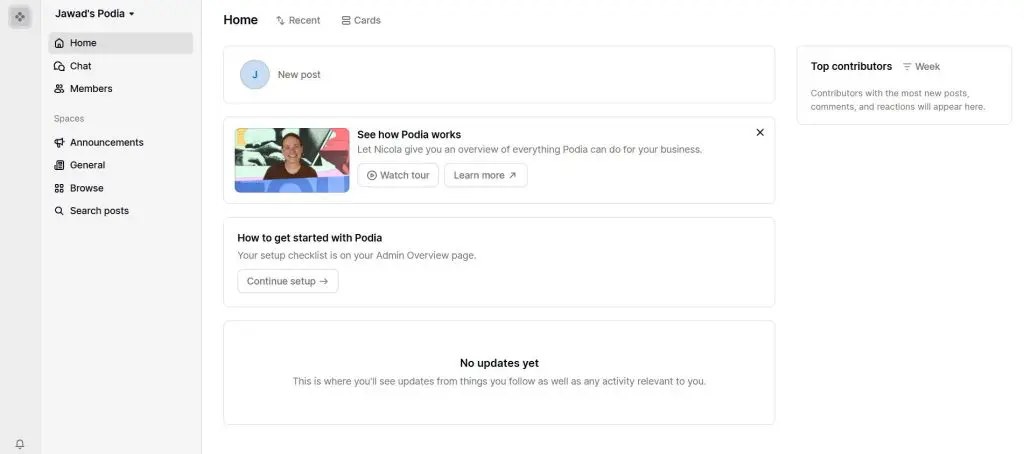
The Top Contributors widget surfaces your most active members, which you can leave on to encourage engagement or turn off entirely if that kind of gamification doesn’t fit your community’s tone.
The home feed has a right-hand sidebar showing recent products, upcoming events, top contributors, and a customizable links box. You can pin important posts to the top of the feed so they don’t get buried as the community grows. Welcome messages appear the first time a new member logs in, which gives you a clean way to orient people when they arrive.
Podia’s community shows its limits in engagement tooling. It has no gamification beyond the Top Contributors widget, which means no leaderboards, points, streaks, or automated engagement sequences.
Circle and Mighty Networks go much deeper on all of those. Skool’s built-in Discovery directory also gives communities organic visibility that Podia doesn’t offer.
Still, Podia’s community works well for anyone who wants a functional, well-integrated community that keeps members connected to their courses and products.
Feature #2: Online Courses
Podia’s course builder covers everything a straightforward course business needs. You create a course, organize it into modules and lessons, add your content, and publish.
The setup is fast and the interface is clean.

Each lesson starts as a blank canvas where you add content using a slash command that pulls up image, GIF, video, file, and audio options.
No preset lesson types force you into a format.
A lesson can be a single video, a mix of video and downloadable worksheets, an embedded PDF presentation, a text walkthrough with images, or any combination you want.

This works well for the most common creator scenarios. For example, a coach selling a six-week program can drip lessons weekly so students don’t skip ahead. Or a consultant selling a skills course can mix screen recordings with downloadable frameworks in the same lesson.
Quizzes are included and sit inside the course builder alongside lessons. You can add as many quiz questions as you need and show students their results on completion. Podia generates a certificate automatically when a student finishes the course.
But Podia’s course builder doesn’t give you as much control over your content as some of the more specialized platforms. It can’t require a minimum video watch time before it marks a lesson complete. You also get no learner analytics showing where students drop off, which lessons have the lowest completion rates, or which quiz questions most students get wrong.
If you’re running a certification program, a compliance training course, or any program where you need to verify that students completed the work, Podia’s course tools are not built for that. Thinkific handles all of those scenarios better.
But for most edupreneurs selling a practical skills course or a coaching program to a general audience, along with an active community, Podia’s course builder is more than enough.
Feature #3: Live and In-person Events
Podia added in-person events in the June 2026 relaunch and renamed webinars to Events. It’s a practical upgrade for creators who run live experiences alongside their courses and community.
You create an event, choose virtual or in-person, set a date and time, and add registrant-only details like the meeting link or venue address. Virtual events work with YouTube Live, Zoom, Google Meet, or any other live video platform.
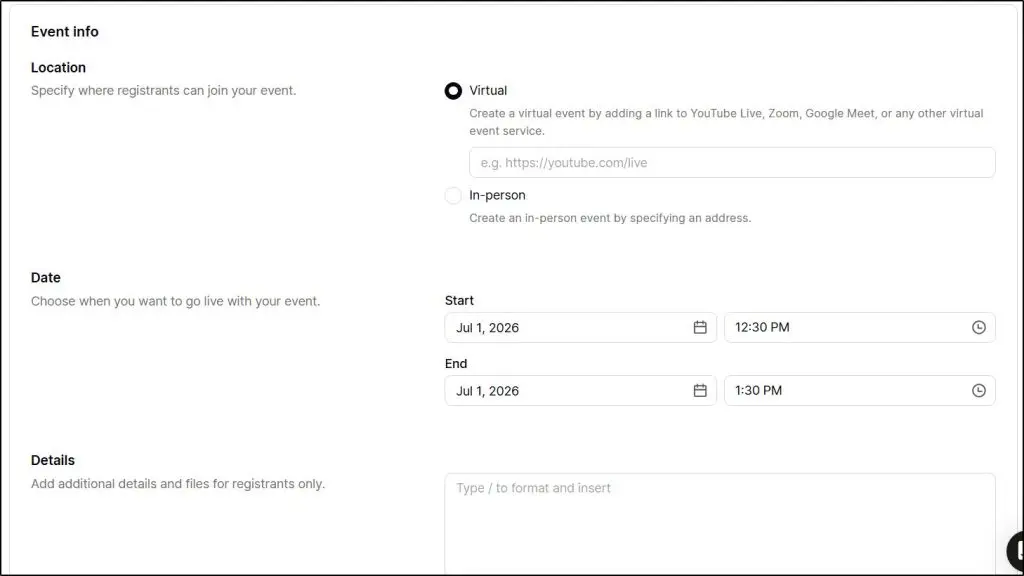
Events can be free or paid, single-day or multi-day. If you’re running a paid workshop, a retreat, or a recurring monthly call, the setup covers all of those without any workarounds.
Podia displays all times in each attendee’s local time zone automatically, which removes a friction point for anyone running events across multiple countries.
Attendees can subscribe to your event calendar so upcoming events sync to their Google Calendar, Outlook, or Apple Calendar without them having to add each one manually.
Podia manages registration, payment, and communication around the event but the live session itself runs on an external platform.
Feature #4: Coaching
In Podia you can create a coaching offer, set a one-time or recurring fee, and connect it to an external scheduling tool like Calendly or Acuity.
The buyer pays through Podia’s checkout and then books their session through your scheduler. Payment happens before booking, which protects your time and keeps no-shows low.
Podia doesn’t host the live session itself, so you’ll run it on Zoom or another external tool.
It also doesn’t track sessions, manage client notes, or give you any view of coaching history. It gives you the selling interface for the session and gets out of the way.
Feature #5: Memberships
Podia memberships let you charge a recurring monthly or annual fee for access to a plan that includes community spaces, products, or both.
A member pays, gets automatically enrolled in the spaces and products attached to that plan, and lands in the home feed. Podia handles cancellations and renewals automatically.
You can use this feature for running a paid community with a library of courses included, or a coaching offer where members get access to new content each month.
In my experience, Podia handles simple single-tier or two-tier membership setups well. But it can’t handle complex multi-tier logic with different drip schedules, conditional access rules, or corporate seat management.
For most beginners and mid-tier edupreneurs, that is enough control.
Feature #6: Digital Downloads
Digital downloads are one of Podia’s strongest features.
You upload a PDF, PPT, CSV, or any other file or collection of files, set a price, and Podia handles hosting, checkout, and delivery.
Ebooks, templates, audio files, presets, worksheets, and toolkits all work without any additional setup. You can bundle downloads with courses, coaching, or membership plans, and on Shaker and above you can set up upsells at checkout to increase order value.
The only meaningful limitation is that Podia has no licensing system or advanced file protection.
For most creators selling knowledge products to a general audience, that’s not a problem. But for software creators selling licensed assets or photographers selling high-value files with usage restrictions, you’d want a more specialized tool.
Feature #7: Email Marketing And Automation
Podia gives you the tools to build an email list and run basic automations from inside the platform.
Building your list
You can add an email opt-in form to any page on your Podia website. Users fill it in, they get added to your audience, and you can trigger a campaign from that point.
Beyond forms, your list builds automatically every time someone buys a product, joins a plan, registers for an event, or creates an account on your Podia.
Podia also gives you landing pages built into the website builder. You can create a standalone page for a lead magnet, a free mini-course, or a waitlist, drive traffic to it, and collect emails without any third-party tool.
Welcome and nurture sequences
Once someone is on your list, you can trigger an automated campaign based on how they got there. Each campaign is a series of emails you write in advance, spaced however you choose. You control the number of emails in the sequence and the delay between each one in days.

You can add new emails to an existing campaign at any time and create as many separate campaigns as you need, each triggered by a different entrance condition.
Broadcast emails
Broadcasts are one-off email campaigns to your full list or a filtered segment. You can filter by product ownership, plan subscription, event registration, waitlist status, or tag. A broadcast goes out immediately or you can schedule it for a specific time.
But the automation logic in Podia is linear. Every campaign follows a fixed sequence from start to finish. It has no conditional branching, so you cannot send one email to people who clicked a link and a different email to people who didn’t.
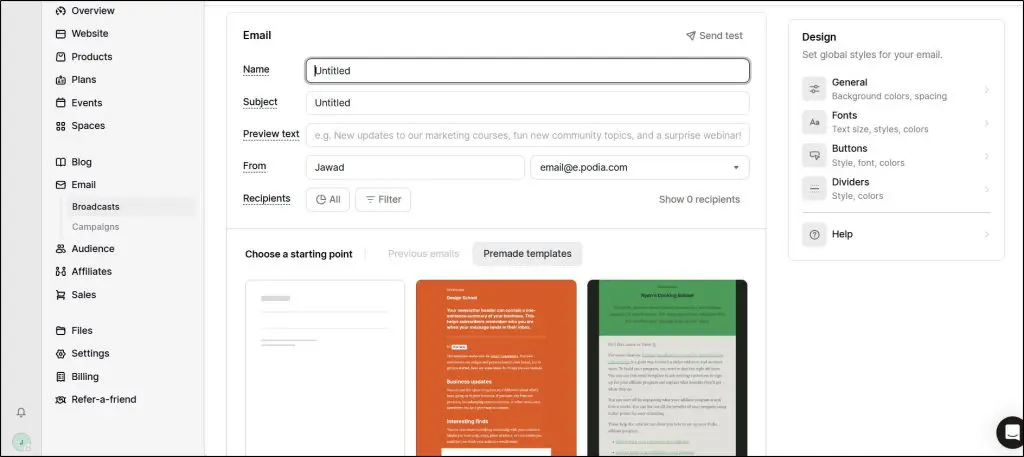
Podia also has no behavioral triggers based on opens, clicks, or page visits, so a sequence can’t change direction based on what a contact does. Each plan includes a small subscriber allowance, 100 on Mover, 500 on Shaker, and 1,000 on Earthquaker, and you pay more as your list grows past it.
So, like most other Podia features, its email marketing tools are a great fit for beginners. But advanced users will need Kajabi or a dedicated email marketing software.
Feature #8: Website Builder
Podia’s website builder lets you create a professional-looking site for your courses or coaching offers without touching code or paying for a separate tool.
When setting up your site, you can pick a color palette and a template type (a blank site, an email landing page, a link page, or a full multi-page website) that can be changed later as well.

Its drag & drop editor makes it easy to add or remove sections from your site. You can add common elements like About, Call to action, Community, Email form, Events, Links, Products, or Testimonials, and each one populates with your actual content automatically.
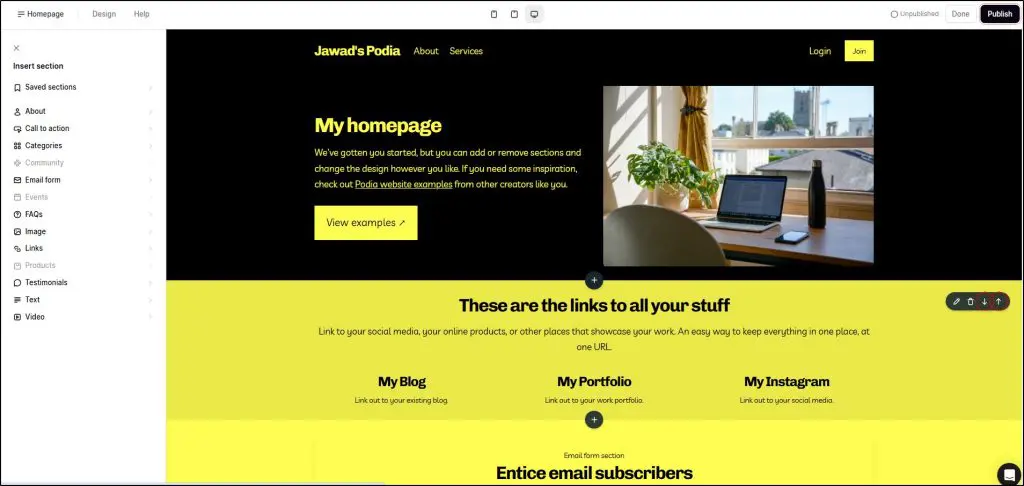
Podia also added a theme editor that lets you customize the logged-in member area with background colors, text colors, selection colors, and online status indicators.
Ten built-in themes are included and every element is customizable. This means your public website and your members’ logged-in experience can both carry your brand consistently.
Your site also comes with a blog built in.
You can write posts, set categories, add featured images, and configure basic SEO settings including post URL and meta description. Blog posts can be converted into email broadcasts directly, which keeps content and email connected without any extra steps.
Of course, you won’t get the same flexibility as a WordPress site, but for a course or coaching brand site, Podia offers enough features in my opinion.
Podia’s Pros and Cons Summarized
Before I share my verdict, here are the main strengths and weaknesses I’ve covered so far.
| Strengths | Weaknesses |
| One of the fastest platforms I’ve used to go from zero to a live creator business | No learning progression controls (students can skip lessons and still get a certificate) |
| Buyers, event registrants, and plan subscribers connect to the right spaces and lists automatically | Linear email automation only (no branching, behavioral triggers) |
| Community is central (home feed, spaces, group chat, and member messaging work as a real product experience) | Thin analytics across courses, email, community, and sales (enough to see what’s happening, not enough to understand why) |
| Covers courses, community, email, events, coaching, downloads, and a website under one login at an affordable price | Community lacks gamification, leaderboards, and automated engagement tools beyond Top Contributors |
| Support is human, fast, and practical | Website builder works within a fixed section structure, with no theme overrides and no plugin ecosystem |
| Free migrations included. Podia moves your courses, products, and email list at no cost | Mover plan carries a 5% transaction fee that makes it expensive to stay on once sales pick up |
| No transaction fees on Shaker and above | Earthquaker at $150/mo puts you in Kajabi’s price range without Kajabi’s marketing depth |
| Small email allowance (100 to 1,000 subscribers by plan), with extra charges as your list grows |
Do I Recommend Using Podia?
If you’re a beginner or a mid-tier course creator, coach, or consultant, I’d recommend Podia. It handles courses, coaching, community, and email under one roof at a price that makes sense when you don’t need advanced features.
But as you scale and your needs go deeper, you will eventually need to migrate. Kajabi is the move for sophisticated email automation and funnels, Thinkific for structured learning design, and Circle or Mighty Networks for advanced community tooling.
How soon that happens depends on how fast your business grows and in which direction. Some creators run successful businesses on Podia for years, and others hit the ceiling much sooner. Choose for the stage you’re in now and plan to revisit the decision as you grow.
But for what Podia offers, it’s a platform you can use with confidence.
Frequently Asked Questions (FAQs)
Can I migrate my existing courses and students to Podia?
Yes. Podia offers free migrations on all paid plans. Their team manually moves your courses, digital products, and email list from another platform. The process is guided and Podia sets clear expectations on timeline and scope before you start.
Does Podia handle international taxes automatically?
Podia calculates and applies taxes where required but does not remit them on your behalf. You are responsible for filing and paying taxes in the relevant jurisdictions. If automatic tax remittance matters to your business, Teachable handles that through its Teachable:pay system.
Can I use my own custom domain on Podia?
Yes. All paid plans include a custom domain. You point your domain to Podia and your website, checkout pages, and member area all run under your brand.
Does Podia have a mobile app for my members?
Podia does not currently offer a mobile app for members. They access your Podia through a mobile browser. If a native app matters for your audience, Circle and Mighty Networks both include iOS and Android apps on every plan, with fully branded apps on their custom-priced tiers.
Can I run an affiliate program on Podia?
Yes, but only on the Shaker and Earthquaker plans. Mover does not include affiliate marketing. On eligible plans you can set custom commission rates per product and track affiliate performance from your admin dashboard.
What payment processors does Podia support?
Podia supports Stripe on all plans. PayPal is available on Shaker and Earthquaker only, so Mover is Stripe-only. Both processors handle one-time payments, subscriptions, and payment plans.
Can I offer free trials for my membership plans?
Yes. When creating a subscription plan, you can add a free trial period. Members get full access during the trial and are charged when it ends. You can set the trial length to whatever works for your offer.
What happens to my content if I cancel Podia?
Your site goes offline immediately on cancellation. Podia retains your account and content for 180 days before permanently deleting it. That window gives you time to export your student email list and download your course content before everything is removed.
Can I sell in multiple currencies?
Podia processes payments in your account’s base currency and has no native multi-currency checkout. International buyers pay in your currency and their card provider handles the conversion.
Does Podia integrate with external tools?
Podia integrates natively with Stripe, PayPal, and scheduling tools like Calendly and Acuity. For everything else, Podia connects through Zapier on Shaker and above. You can also embed content from external platforms, including YouTube, Vimeo, Spotify, Typeform, and Google Slides, directly inside course lessons and community posts.
How long is Podia’s free trial?
Podia offers a 14-day free trial with access to every feature and no credit card required. It previously ran for 30 days.
Does Podia offer refunds on its plans?
Podia refunds a plan charge if you ask within 72 hours of being billed. It doesn’t pro-rate unused time, and refunds take 5 to 10 business days to process.
Table of Contents
Related Posts
Podia vs Teachable (2026) | Which Platform Is Right For You?
Podia vs Thinkific (2026): I’ve Used Both, Here’s My Verdict
New Podia Pricing (2026): Use Fee Calculator To Find Actual Costs (No Free Plan)