

TL;DR: Skool vs Mighty Networks | Which Community Platform Should You Choose
Both Skool and Mighty Networks are community-first platforms. On both, the community is the product, not an afterthought added to a course tool. But that’s where the similarity ends.
Skool bets that simplicity, a frictionless feed, and behavioral engagement mechanics create the most active communities. One feed, one leaderboard, fast launch, built-in organic discovery.
Mighty Networks bets that creators need flexible architecture to build something that truly feels like their own brand. Multiple Spaces, deep customization, native live streaming, quizzes in courses, and the infrastructure for complex multi-program communities.
I recommend Skool for most coaches, solopreneurs, and early-stage creators. Its discovery engine, gamification depth, and simplicity make it the ideal starting point.
I recommend Mighty Networks for bigger and more structured communities. It’s perfect when you need multiple distinct programs, premium branding, or an audience that expects a polished platform experience that clearly belongs to you.
Try Skool for Free | Try Mighty Networks for Free
Comparing Mighty Networks vs. Skool | My Personal Experience
I’ve been using Skool since 2021 as a member inside other creators’ communities and as a consultant helping clients build their own.
I’ve also used Mighty Networks for years and watched it go through periods of stagnation, aggressive feature development, and a significant shift in how it handles customer support.
Both Skool and Mighty Networks serve the same broad use case, paid communities But they make completely opposite bets about what creators actually need.
Skool strips away complexity and uses behavioral mechanics to boost community participation.
In contrast, Mighty Networks gives creators the full toolkit to build more structured, branded, and flexible online communities.
Both approaches have their pros and cons for different use cases.
In this detailed first hand review, I’ll help you decide which approach suits you more.
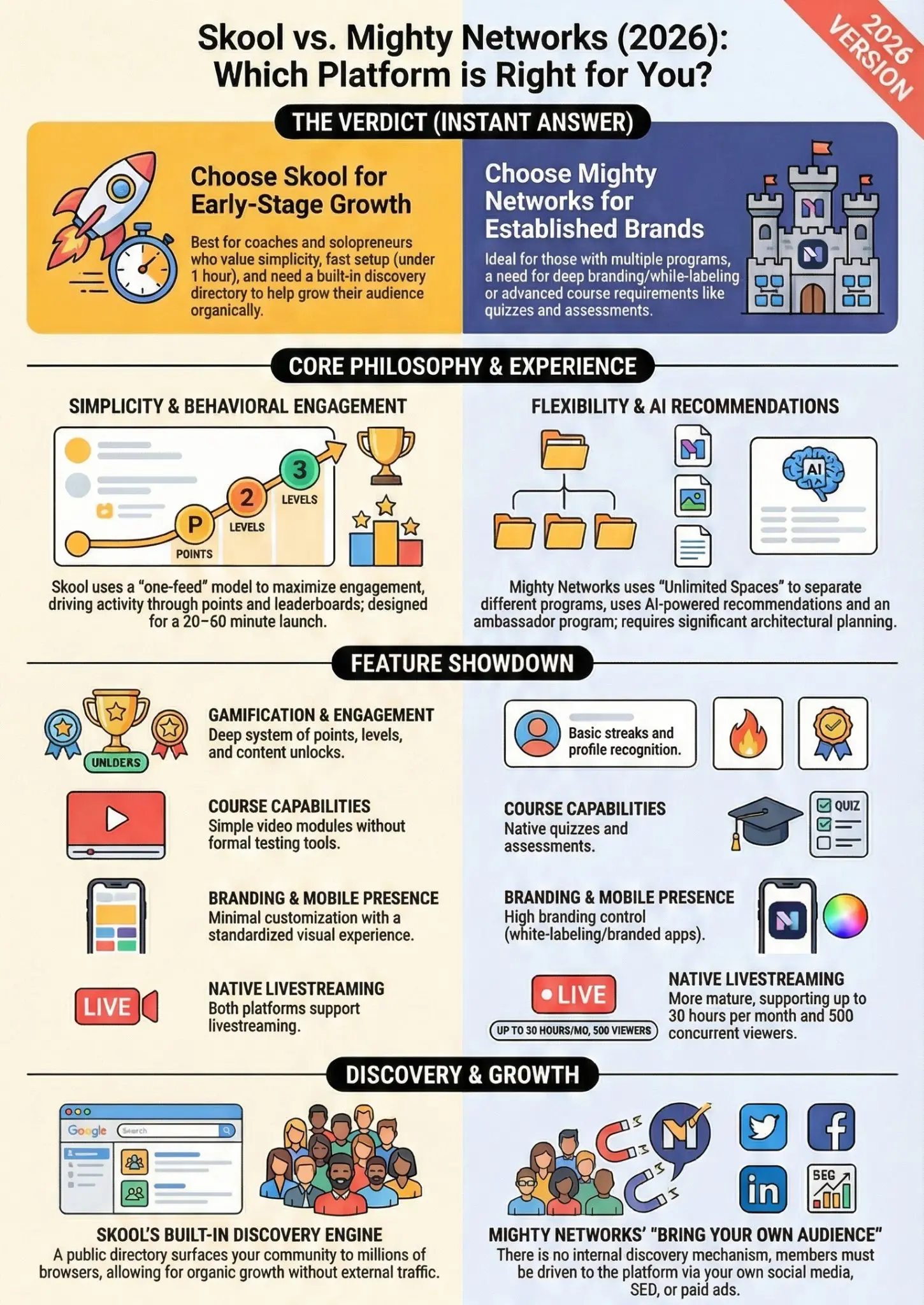
The Main Differences Between Skool and Mighty Networks
Before we dive deeper, let me highlight the main differences between Skool and Mighty Networks to help you understand where exactly they stand.
| Skool | Mighty Networks | |
|---|---|---|
| Best for | Coaches, solopreneurs, early-stage creators | Established creators with multi-program communities |
| Platform philosophy | One feed, maximum simplicity | Flexible Spaces, maximum configurability |
| Starting price | $9/mo (10% fee) or $99/mo (2.9% fee) | $41/mo (3% fee) |
| Transaction fees | 10% Hobby / 2.9% Pro | 3% Community / 2% Courses and above |
| Discovery engine | Yes, public directory | No |
| Community architecture | One feed with categories | Unlimited Spaces, independent access per Space |
| Gamification | Deep: points, levels, leaderboard, content unlocks | Basic: streaks, profile recognition |
| Engagement mechanics | Behavioral participation loops | AI content recommendations, ambassador program |
| Course features | Basic modules, drip scheduling, no quizzes | Modules, drip, quizzes, multi-media |
| Native livestreaming | Yes | Yes, more mature, up to 30 hrs/mo on Business |
| Branding control | Minimal | Strong, white label on Business |
| Branded mobile app | No | Yes, via Mighty Pro |
| Ease of setup | Fast, 20–60 minutes | Steeper, requires architectural planning upfront |
| Automation | Minimal, Zapier/webhooks | Better on Business via Zapier |
| Platform maturity | Growing fast, newer | 10+ years established |
| Try Skool for Free | Try Mighty Networks for Free |
Looking for the best online course platforms? Here are my top picks
What Is Skool?
Skool is an online community platform built around a central activity feed, gamified member participation, and a public discovery directory.
Its community features are the main product, supported by courses and live events.
When you log in to Skool, the platform gives you three tabs: Community, Classroom, and Calendar.
Everything is organized under these tabs.

What stands out most about Skool is its behavioral architecture. Every major design choice targets one outcome: getting members to participate more.
The feed surfaces activity immediately so there’s no navigation friction between a user logging in and contributing. Points reward every post and comment. Levels give members a visible progression system that makes consistent contribution feel meaningful over time.
The public leaderboard makes participation social, competitive, and visible to everyone in the group.
Together, these mechanics mean Skool communities feel active quickly, even at modest member counts, because the platform is engineered to surface and reward contribution.
I’ve helped clients build paid communities of several hundred members without an existing email list, purely through consistent activity and Skool’s recommendation engine surfacing them to the right audience.
That kind of organic reach path doesn’t exist on Mighty Networks.
Where Skool falls short is equally clear.
One community per workspace. And limited e-learning features, for example, no quizzes or assessments in the course area.
Still, Skool is a solid community platform for beginners with good enough course features.
Read my complete Skool review for a more in-depth analysis
Main Skool features:
- Central feed with categories and topic tagging
- Gamification: points, levels, leaderboard, content unlocks
- Classroom for course modules, lessons, drip content
- Native live streaming on all plans
- Event calendar for recurring sessions and calls
- Public discovery directory
- Stripe payments for recurring memberships
| Skool Strengths | Skool Weaknesses |
| Fastest setup in the category | One community per workspace |
| Deepest gamification system available | Minimal branding, homogeneous visual experience |
| Built-in discovery drives organic member growth | No quizzes or assessments in course tools |
| Frictionless feed: members land directly in the conversation | No branded mobile app |
| Behavioral mechanics create self-sustaining participation | Approval step on Hobby plan hurts course conversion |

Read: Skool vs. Circle | Which Is The Better Online Community Platform
What Is Mighty Networks?
Mighty Networks is a community platform built around flexible Spaces architecture, brand control, and the infrastructure to run multiple programs or audience segments under one roof. It also lets you sell online courses and run live events.
Mighty Networks has been in this space since 2010, predating Skool by nearly a decade. That maturity shows in its feature depth and in the complexity creators encounter when they first open the platform.

The Spaces model is what separates Mighty Networks from Skool most clearly. A Space is essentially a separate community with its own feed, branding, access rules, and member permissions, all living inside one Mighty Network.
A creator running a free public community for leads, a beginner paid program, and an advanced mastermind can manage all three from one dashboard, gate each by purchase or membership tier, and give each a distinct look that reinforces its value.
I’ve worked with clients who built this kind of layered community architecture on Mighty Networks and the member experience it creates is meaningfully more premium than what a single Skool feed can deliver.
Mighty Networks also offers native livestreaming with up to 30 hours per month and 500 concurrent viewers on the Business plan.
The course tools Mighty Networks include modules, lessons, quizzes and tests, a real differentiator from Skool. And if brand identity matters to your business, Mighty Networks gives you actual design control: logos, brand colors, layout styles, white-label email on Business, and fully branded iOS and Android apps through the Mighty Pro tier.
Where Mighty Networks frustrates me is the interface complexity and support quality. It also has a real learning curve because of its extensive features.
Setting up a well-organized Mighty Network requires thinking through your architecture before you launch. If you get it wrong, members find the navigation confusing.
Mighty Networks also shifted heavily toward AI-based customer support in recent years, and the change has made it harder to get fast, helpful answers when something goes wrong.
Still, compared to Skool, Mighty Networks is more suitable for formal structured communities. If you have an existing audience and want to organize it using a tiered community program, Mighty Networks will let you do it much more effectively.
For beginners with no existing audience, it’s a bit of an overkill.
Read my detailed Mighty Networks review for a more in-depth analysis
Main Mighty Networks features:
- Unlimited Spaces with independent branding and access control
- Native livestreaming on all plans
- Course builder with quizzes and multimedia on Courses plan
- Built-in ambassador and referral program
- Custom member profile fields for networking
- AI-powered content recommendations
- White label and SSO on Business plan
- Custom branded mobile apps on Mighty Pro
| Mighty Networks Strengths | Mighty Networks Weaknesses |
| Multiple Spaces for multi-program communities | Steep learning curve, complex interface |
| Real design control: logos, colors, layouts | No discovery engine — you bring all traffic |
| Native livestreaming with in-platform viewers | Transaction fees on every plan |
| Quizzes and assessments in course tools | Support quality has declined, AI-heavy now |
| Custom branded apps via Mighty Pro | Significant price jumps between tiers |
| 10+ years of platform development | Gamification far weaker than Skool’s system |

Skool vs Mighty Networks Pricing: What You Will Actually Pay
Short answer: Skool is cheaper to start and simpler to predict. Mighty Networks has more plan options but charges transaction fees on every tier, making the true cost higher than the headline price suggests.
Skool Pricing
Skool has two plans.
- Hobby at $9/month gives you the full platform: unlimited members, courses, calendar, community, and Stripe payments. Skool takes 10% of all revenue. One admin, no custom URL. That 10% makes Hobby the most expensive option at any meaningful revenue level.
- Pro at $99/month drops the fee to 2.9% and adds auto-approval for new members and custom URLs.
On Hobby, every new member requests access and waits for manual approval before purchasing a course.
That cooling-off period kills impulse conversions. If you’re selling courses to people who find you through external traffic or Skool’s directory, Pro is effectively required.
Mighty Networks Pricing
Mighty Networks offers four main plans plus Mighty Pro (custom pricing, branded app).
- Community Plan: $41/month annually ($49 monthly). Unlimited members and Spaces, events, chat, native live streaming, posts, mobile access. Charge for memberships in 100+ currencies. No course creation, no automation. 3% transaction fee.
- Courses Plan: $99/month annually ($119 monthly). Adds course creation with quizzes and multimedia, advanced analytics, downloadable member data, Zapier integration. Transaction fee drops to 2%.
- Business Plan: $179/month annually ($219 monthly). Adds white-label email, SSO, unlimited hosts, automated questions and polls, higher content and streaming quotas. Still 2% transaction fee.
- Growth Plan sits above Business with more advanced automations and analytics.
- Mighty Pro is custom pricing with a branded iOS and Android app built by Mighty’s team. This is enterprise-level investment, not relevant for most creators in the early stages.
All Mighty Networks transaction fees sit on top of Stripe or PayPal processing fees (typically 2.9% + $0.30 per transaction in the US).
How Much You’ll Actually Keep
Beyond pricing tables, let me show you how much of your revenue will you actually retain as a Skool or Mighty Networks user, through a couple of hypothetical scenarios.
Scenario 1: Recurring membership at $49/month with 200 members = $9,800/month revenue
| Plan | Monthly fee | Transaction fee | Platform cost | You keep |
| Skool Hobby | $9 | 10% ($980) | $989 | $8,811 |
| Skool Pro | $99 | 2.9% ($284) | $383 | $9,417 |
| MN Community | $41 | 3% ($294) | $335 | $9,465 |
| MN Courses | $99 | 2% ($196) | $295 | $9,505 |
| MN Business | $179 | 2% ($196) | $375 | $9,425 |
Scenario 2: Higher-ticket membership at $197/month with 50 members = $9,850/month revenue
| Plan | Monthly fee | Transaction fee | Platform cost | You keep |
| Skool Hobby | $9 | 10% ($985) | $994 | $8,856 |
| Skool Pro | $99 | 2.9% ($286) | $385 | $9,465 |
| MN Community | $41 | 3% ($296) | $337 | $9,513 |
| MN Courses | $99 | 2% ($197) | $296 | $9,554 |
| MN Business | $179 | 2% ($197) | $376 | $9,474 |
Mighty Networks Courses keeps the most revenue in both scenarios, but the difference from Skool Pro is small. The practical takeaway: if you’re on Skool Hobby generating more than $1,000/month, upgrade to Pro immediately. The revenue difference pays for the upgrade within weeks. Beyond that threshold, neither platform has a meaningful pricing advantage over the other — so your decision should rest entirely on features and fit.
Looking for the best platforms to build an online community? Here are my top picks
Skool vs Mighty Networks Community Features
Short answer: Skool wins on engagement depth and organic growth. Mighty Networks wins on structural flexibility and brand control. Which matters more depends on where your community business is right now.
How Skool Handles Community
On Skool, a member logs in and lands directly in the community feed. No navigation decision required.
Posts, wins, questions, and discussions are immediately in front of them.
That single design choice is why Skool communities tend to feel active faster than Mighty Networks communities of comparable size.
The gamification layered on top of that immediacy creates genuine behavioral habits. Points, levels, and the public leaderboard work together to make participation feel meaningful and visible.
I’ve seen Skool communities with 80 active members feel more alive than communities on other platforms with 300 enrolled, because the mechanics are engineered to reward showing up consistently, not just completing a purchase.
However, Skool\s limitations show up when your business needs distinct spaces for different programs or membership tiers.
You either need to pay $99/month per separate Skool workspace or ask members to manage multiple logins. At two or three programs, that adds up and fragments the member experience.
Read: Skool vs Teachable | Which Platform Is Right For Community & Courses
How Mighty Networks Handles Community
Mighty Networks’ Spaces model is the structural answer to Skool’s one-community ceiling. Each Space is a separate community area with its own feed, design elements, and access rules inside one account.
A creator running a free entry community alongside two paid programs can segment members cleanly, give each group a distinct experience, and manage everything from one dashboard.
The engagement experience inside a Mighty Networks Space is also solid.
Members can post, comment, message directly, access courses, and join live sessions without leaving the platform.
Where Mighty Networks lags is in the organic participation mechanics. There’s no system equivalent to Skool’s leaderboard and level structure. Discussion activity in a Mighty Network depends more on the creator actively seeding content, running structured challenges, and consistently prompting conversation.
I’ve managed communities on both platforms.
On Skool, I spend significantly less time manually driving participation because the platform’s mechanics do much of that work. On Mighty Networks, engagement is more deliberate. It responds to consistent facilitation rather than running on its own momentum.
If you have a small community size, this problem gets magnified because you don’t have enough community participants to build momentum.
For larger audiences, this isn’t as big a problem.
Community Features Side by Side
| Feature | Skool | Mighty Networks |
| Default view on login | Community feed | Network home / Space feed |
| Multiple community spaces | No, one per workspace | Yes, unlimited |
| Gamification depth | Deep: points, levels, leaderboard, unlocks | Basic: streaks, profile recognition |
| Discovery engine | Yes, public directory | No |
| Native livestreaming | Yes, added 2025 | Yes, more mature |
| Branding control | Minimal | Strong, white label on Business |
| Direct member messaging | Yes | Yes |
| Custom member profiles | Standard | Better, custom fields |
| Ambassador/referral program | Limited | Yes, tiered |
| Mobile app | Skool app (not branded) | Mighty app + branded on Pro |
| Automation | Minimal | Better on Business |
| AI content recommendations | Basic | Yes, more developed |
Skool vs Mighty Networks Course Features
Short answer: Mighty Networks wins on course tools. Skool’s Classroom is sufficient for community-supported learning programs. Mighty Networks is better when you need assessments, quizzes, or more structured content delivery as part of your curriculum.
Skool’s Classroom handles video-based content well enough for most coaching programs where community carries the primary learning value.
Skool courses come with modules, lessons, drip scheduling, and basic completion tracking.
However, there are no quizzes, tests, or certificates.
If your members need to demonstrate knowledge or if professional development documentation matters to your audience, Skool can’t deliver that.
Mighty Networks has a dedicated Courses plan that adds quizzes, tests, multimedia course content, and the ability to create standalone courses separate from community Spaces.
The learning environment is more structured, which matters when curriculum is central to the member experience rather than supplementary to it.
Neither platform is the right home for a serious LMS use case. If structured learning with detailed per-student analytics, compliance controls, and certificate generation is your core business model, Teachable handles that better than either platform in this comparison.
Read: Skool vs Kajabi | Which Platform Is Right For You
Comparing the Main Features of Skool and Mighty Networks
If you’re primarily interested in community and course tools, you can skip directly to the verdict. In this section I’ll cover the remaining feature categories.
Feature #1: Discovery and Audience Growth
Short answer: Skool has a built-in discovery engine that can generate organic growth without any marketing spend. Mighty Networks has no discovery mechanism — every member you have comes from your own external channels.
Skool’s public community directory gets millions of monthly visitors. People browse it by topic and join communities that match their interests. I’ve had clients build paid communities of several hundred members without a social following or an email list, purely through consistent posting and Skool’s algorithm connecting them to the right audience.
That path simply doesn’t exist on Mighty Networks.
On Mighty Networks, your community is effectively a private website. Nobody finds it through Mighty Networks itself.
Every member arrives from your YouTube channel, your SEO content, your podcast, your social following, or a paid campaign.
If you already have an established audience to bring over, that’s not a problem as Mighty Networks is excellent at serving an existing community. If you’re starting from scratch, Skool’s discovery engine is a meaningful structural advantage.
Feature #2: Audience Engagement Mechanics
Short answer: Skool’s engagement systems are more automatic. Mighty Networks gives you more tools to engineer interaction, but you have to actively use them.
This is a dimension most comparisons gloss over, and it’s worth slowing down on because it determines how much work you personally have to do to keep your community alive.
On Skool, engagement mechanics operate in the background without requiring constant facilitation. The leaderboard and point system create natural competition and recognition. As members accumulate points and climb levels, they develop a visible identity within the community.
That identity has real psychological weight as members who have earned Level 5 or Level 7 status show up consistently because their standing in the group is something they’ve built and don’t want to lose.
New members join, see the leaderboard, and immediately understand what participation looks like and that it’s rewarded.
The whole system runs itself once it has momentum.
Skool also recently introduced a member matching or “connections” feature that nudges members toward each other based on shared interests and goals.
I’ve seen this accelerate early relationship formation in communities where the host isn’t yet well-known, because it creates peer bonds that don’t depend on the creator’s presence.
Mighty Networks approaches engagement differently and, in some ways, more deliberately. Its AI recommendation engine surfaces content and discussions to members based on their activity and interests inside the network.
If a member has been active in a specific Space or topic area, Mighty Networks surfaces more of that content to them, which can pull previously passive members back into active discussion.
The platform also supports articles, polls, and question prompts with scheduling options, so you can build a content calendar that generates conversation without requiring you to manually post every day.
Mighty Networks also has a built-in ambassador program with bronze, silver, and gold tiers.
Active members earn ambassador status and are incentivized to invite others, which creates a peer-driven growth mechanism that Skool’s affiliate system doesn’t directly replicate.
For creators who want their most engaged members to become advocates, this is genuinely useful.
Feature #3: Branding and Visual Identity
Short answer: Mighty Networks wins clearly. Skool gives you a logo and cover image. Mighty Networks gives you actual design control over how your community looks and feels.
Every Skool community looks almost the same. The layout, navigation, and overall visual experience is identical across the platform.
If brand identity is important to your business and if you want members to feel like they’ve entered your space rather than a generic forum, Skool will frustrate you.
Mighty Networks gives you logos, brand colors, layout styles, cover images per Space, and white-label email on Business so your members receive communications from your brand rather than Mighty Networks.
For premium, high-ticket communities where the visual experience reinforces membership value, that control is meaningfully different from what Skool offers.
Mighty Pro extends this further with fully branded iOS and Android apps in the app store under your name.
That’s a real business decision point for creators whose community is their primary product and whose members are paying significant monthly fees.
Feature #4: Live Events and Sessions
Short answer: Both platforms support live sessions, but Mighty Networks’ event infrastructure is more mature. For high-volume livestreaming with members watching inside the platform, Mighty Networks is the stronger option.
Skool’s Calendar creates recurring or one-time events visible inside the community with member notifications. It also has native livestreaming which works well for regular community calls and informal sessions.
Most of my clients who run more important or complex sessions still route through Zoom because of participant familiarity, but Skool’s native option handles the basics.
Mighty Networks offers in-platform live streaming at a higher scale (up to 30 hours per month with 500 concurrent viewers) on the Business plan.
Feature #5: Skool vs Mighty Networks Payments and Monetization
Short answer: Mighty Networks handles complex monetization architectures more cleanly. Skool handles straightforward recurring membership pricing simply and well.
Mighty Networks lets you charge for access to individual Spaces, bundle Spaces into membership tiers, run paid challenges, and create a layered value ladder inside one account.
That flexibility suits creators who want different pricing levels, for example, a free entry Space, a $49/month core membership, a $199/month premium tier without managing separate platforms or accounts.
Skool’s payment setup is simpler and less flexible.
One membership price, Stripe-powered, clean execution. For a single-offer community, that simplicity works extremely well.
For creators building a tiered membership with multiple access levels, Mighty Networks handles the structure better.
Feature #6: Member Data and Platform Portability
Short answer: Mighty Networks on the Courses plan and above gives you full data ownership. Skool is more restrictive about member contact data for organically joined members.
On Mighty Networks from the Courses plan up, you have access to downloadable member data including emails, engagement metrics, and participation history. If you ever need to migrate platforms or run a re-engagement campaign through ActiveCampaign or Kit, you have what you need.
On Skool, accessing email addresses for members who joined organically through the discovery directory is restricted. Members you invited directly are accessible.
Members who found you through Skool’s directory and joined independently live in Skool’s system, not yours. I always advise clients building on Skool to capture email addresses independently through a separate tool like ConvertKit from day one, because platform portability on Skool requires pre-planning that many creators don’t think about until they want to move.
My Verdict: Skool or Mighty Networks?
Short answer: For most creators and edupreneurs, Skool is the right choice. Mighty Networks makes sense when you’ve outgrown Skool’s single-community structure.
I recommend Skool if you’re launching your first paid community, if you don’t yet have a large existing audience, if your business runs on one primary membership offer, if daily member participation and peer connection are the core value you’re selling, or if you want to let the platform do some of the audience growth work for you through its discovery directory.
For most coaches, online course creators, and professionals looking to build an engaged community, Skool is the right starting point.
Mighty Networks is for bigger and more structured communities.
I recommend it if you already have a sizeable audience or you’re running multiple distinct programs that need separate spaces and pricing.
It also makes more sense if your members are paying premium prices and the visual quality of their experience needs to reflect that and if native livestreaming with a large in-platform audience is central to your content mode.
One thing I tell every client building on either platform: capture your member email list independently from day one. Use ConvertKit, Kit, ActiveCampaign, or any tool you already have.
Both platforms give you community infrastructure, not a customer relationship you fully own. The community lives on the platform. The relationship lives in your email list.
Don’t conflate the two.
Frequently Asked Questions About Skool vs Mighty Networks
Is Skool better than Mighty Networks?
Skool is better for early-stage creators who want to launch fast, grow through the built-in discovery engine, and keep things simple enough that the platform isn’t a distraction. Mighty Networks is better for established creators running complex communities with multiple programs, distinct audience segments, and premium-tier members who expect a polished, branded experience. For most creators starting out, that answer is Skool.
How much does Mighty Networks cost compared to Skool?
Mighty Networks starts at $41/month billed annually on the Community plan, with a 3% transaction fee. Skool starts at $9/month with a 10% fee on Hobby, or $99/month with a 2.9% fee on Pro. Mighty Networks’ Courses plan at $99/month with a 2% fee is the most direct comparison to Skool Pro. At comparable revenue levels, both retain nearly identical amounts of your membership income.
Does Mighty Networks have a discovery engine like Skool?
No. Mighty Networks has no internal discovery directory. Every member you enroll comes from your own channels — SEO, social media, YouTube, a podcast audience, email through ConvertKit or Kit, or paid advertising. Skool’s public directory surfaces active communities to millions of monthly browsers by topic. For creators without an existing audience, that gap is significant.
Does Mighty Networks have gamification like Skool?
Mighty Networks added basic gamification including streaks and profile recognition, but Skool’s system is in a different category. Skool’s leaderboard, points, and level hierarchy are more developed and more effective at creating daily participation habits. If member engagement metrics drive your renewal rates and retention, Skool’s gamification depth is a material advantage.
Which platform handles multiple programs or cohorts better?
Mighty Networks, clearly. Its Spaces architecture creates separate community areas with independent access control, branding, and pricing inside one account. Skool gives you one community per workspace, so multiple programs means multiple subscriptions at $99/month each plus separate member logins.
Does Mighty Networks have native livestreaming?
Yes. All Mighty Networks plans include native livestreaming: 5 hours/month on Community and 30 hours with 500 viewers on Business. Skool added native streaming in 2025 on all plans, but Mighty Networks’ implementation is more mature and handles larger audiences better.
Can you get a branded mobile app on Skool or Mighty Networks?
Mighty Networks offers custom branded apps through Mighty Pro — your community gets its own iOS and Android presence in the app store under your brand name. Skool offers no branded app. Your community lives inside the Skool app.
Which platform is easier to set up?
Skool is faster by a wide margin. Most communities are live within an hour. Mighty Networks requires planning your Space architecture before you launch — get it wrong and members find the navigation confusing. Get it right and the result is a polished, premium platform experience. But the investment is real.
Does Mighty Networks charge transaction fees?
Yes, on every plan. 3% on the Community plan and 2% on Courses, Business, and Growth. These stack on top of Stripe or PayPal processing fees of roughly 2.9% plus $0.30 per transaction. Factor both into your revenue model when comparing true platform cost.
What are the alternatives to Skool and Mighty Networks?
Circle is a community-first platform with Spaces architecture similar to Mighty Networks and better native automation, worth evaluating if you want Mighty Networks-level structure with a slightly lower learning curve. Kajabi adds email marketing, sales funnels, and deep automation for creators who want a single platform to run their entire business. Teachable is purpose-built for structured course delivery with community as a supporting tool.
Table of Contents
Related Posts
Skool vs. Teachable (2026): Comparing Their Pricing, Community & Course Features
Skool vs Kajabi (2026): I’ve Used Both, Here’s My Comparison & Verdict
Skool vs Circle (2026): I’ve Used Both, Here’s My Choice