

TL;DR: Kajabi Coaching Review (2026): Is It Good Enough For Coaches?
Kajabi Coaching lets you sell, schedule, and deliver one-on-one and group coaching inside Kajabi’s all-in-one platform. It’s a strong choice when coaching is one of several things you sell, and an expensive one when coaching is all you do.
• What you get. Single sessions and packages, a built-in scheduler, live video with recordings, session notes, group rooms, and private client portals through Backstage.
• What sets it apart. The marketing around the coaching. Landing pages, email, funnels, and checkout sit in the same account as your sessions.
• What’s missing. Contracts and e-signatures, structured goal and habit tracking, and the client metrics that dedicated coaching tools offer.
• Pricing. Coaching comes with every plan. Basic costs $143/month, Growth costs $199/month, and Pro costs $399/month on annual billing.
• Free trial. 14-day free trial on Kajabi’s site, with a 30-day money-back guarantee.
• Use it if you’re building an audience and want to sell coaching alongside courses, memberships, or a community.
• Skip it if you only sell coaching. A dedicated coaching platform gives you deeper client management for a fraction of the price.
Try Kajabi Coaching For Free
Coaching is part teaching, part project management, and part customer service. You serve several clients at once, each at a different stage, and you still have to market and grow the business around them.
That’s why most coaches end up with a patchwork of tools. One handles scheduling, another handles video, and others cover payments, email, and notes. When those tools don’t talk to each other, the admin eats into the hours you could spend coaching.
Kajabi’s answer is to put all of it in one account. I’ve been a Kajabi customer for years, and I recommend it often. I also tell coaches plainly when it’s the wrong tool, because for many online coaching businesses it is.
In this review, I evaluate Kajabi strictly as a coaching platform. I’ll cover what it gives a working coach, what it leaves out, and when a dedicated coaching tool serves you better.

Kajabi Coaching Snapshot (2026)
| What coaches ask | Kajabi’s answer |
|---|---|
| Coaching formats | One-on-one sessions, multi-session packages, and group coaching |
| Scheduling | Built-in Kajabi Scheduler, manual booking, or Calendly and Acuity |
| Live video | Built in, with recordings. Zoom and Google Meet also work |
| Group size | Up to 200 participants on video, with up to 20 breakout rooms of 10 |
| Client portal | Backstage gives each one-on-one client a private portal |
| Notes | Private coach notes and client notes on each session |
| Contracts and e-signatures | Not offered in the coaching product |
| Goal and habit tracking | No structured tracking |
| Payments | One-time, recurring, and payment plans, with no revenue share |
| Marketing | Website, landing pages, funnels, and email included |
| AI | Session summaries and voice memo transcripts in Backstage, plus the Cofounder assistant |
| Starting price | $143/month on annual billing or $179/month paid monthly |
| Free trial | 14-day free trial and a 30-day money-back guarantee |
Quick Verdict | Is Kajabi A Good Coaching Platform?
Kajabi is a good coaching platform for a specific kind of coach. If coaching is one income stream among courses, memberships, and digital products, Kajabi lets you run all of them from one login, and its marketing tools will help you fill your calendar.
If coaching is your whole business, I wouldn’t buy Kajabi for it. At $143/month and up, you’d pay for a website builder, an email platform, and a course builder you may never use. You’d also go without the contracts, intake workflows, and progress tracking that dedicated coaching platforms include at a far lower price.
So the decision depends less on Kajabi’s coaching features and more on your business model. The rest of this review will help you place yourself.
What Is Kajabi Coaching?
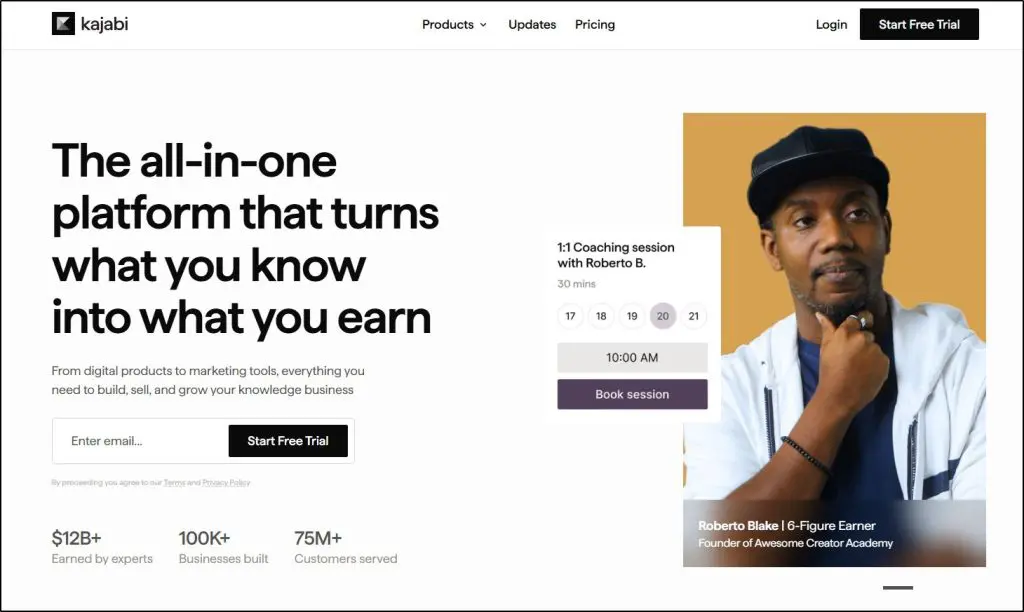
Kajabi Coaching is a product type inside Kajabi. You create a coaching program the same way you’d create a course, attach it to an offer with a price, and sell it from your Kajabi site.
It now has two parts.
- Coaching: The core product. It’s built around scheduled sessions, either one-on-one or in groups, with agendas, live video, notes, and resources.
- Backstage: A newer, always-on client portal for premium one-on-one work. Each client gets a private space with selected lessons, recorded sessions, voice memos, and chat.
Around both sits the rest of Kajabi. That means a website, landing pages, email marketing, sales funnels, checkout, courses, memberships, and a community. For a coach, that surrounding system is the main reason to choose Kajabi over a dedicated tool.
Kajabi says coaches have run more than 20,000 one-on-one sessions and earned more than $300 million through the platform. Those are Kajabi’s own figures.
What Coaches Need From A Platform And How Kajabi Scores
Before the feature tour, here’s the checklist I use when I evaluate any coaching platform, with my rating for Kajabi on each point.
| What a coach needs | How Kajabi handles it | My rating |
|---|---|---|
| Sell packages and get paid | Offers, checkout, subscriptions, payment plans, and upsells | Strong |
| Let clients book without email back-and-forth | Built-in scheduler with confirmations and reminders | Good |
| Meet clients on video | Built-in live video with recordings | Strong |
| Run group programs | Large live rooms, breakout rooms, and a community | Strong |
| Onboard clients with contracts and intake forms | General forms only. No contracts or e-signatures in the coaching flow | Weak |
| Support clients between sessions | Backstage portal, chat, voice memos, and automated emails | Good |
| Track goals, habits, and progress | Session notes only. No structured tracking | Weak |
| Attract new clients | Website, landing pages, lead magnets, email, and funnels | Excellent |
| Keep costs in line with a small practice | Starts at $143/month on annual billing | Weak |
That table sums up Kajabi for coaches. It’s excellent at the business around coaching and average at the coaching workflow itself.
Kajabi Coaching Features | What You Get And Where It Falls Short
Let me give you a realistic account of Kajabi’s coaching features based on my experience of using it for my clients.
1. Coaching Programs: Single Sessions And Packages
You can create two kinds of coaching product on Kajabi.
- Single sessions: A client buys one session with you. This works well as a bonus or an upsell for a course, or as a paid discovery call. For example, a business coach can let clients book a session whenever they need one.
- Packages: A client buys a series of sessions upfront. For example, a wellness coach who meets a client weekly for six weeks would build a package with six sessions.
Here’s the session setup screen.
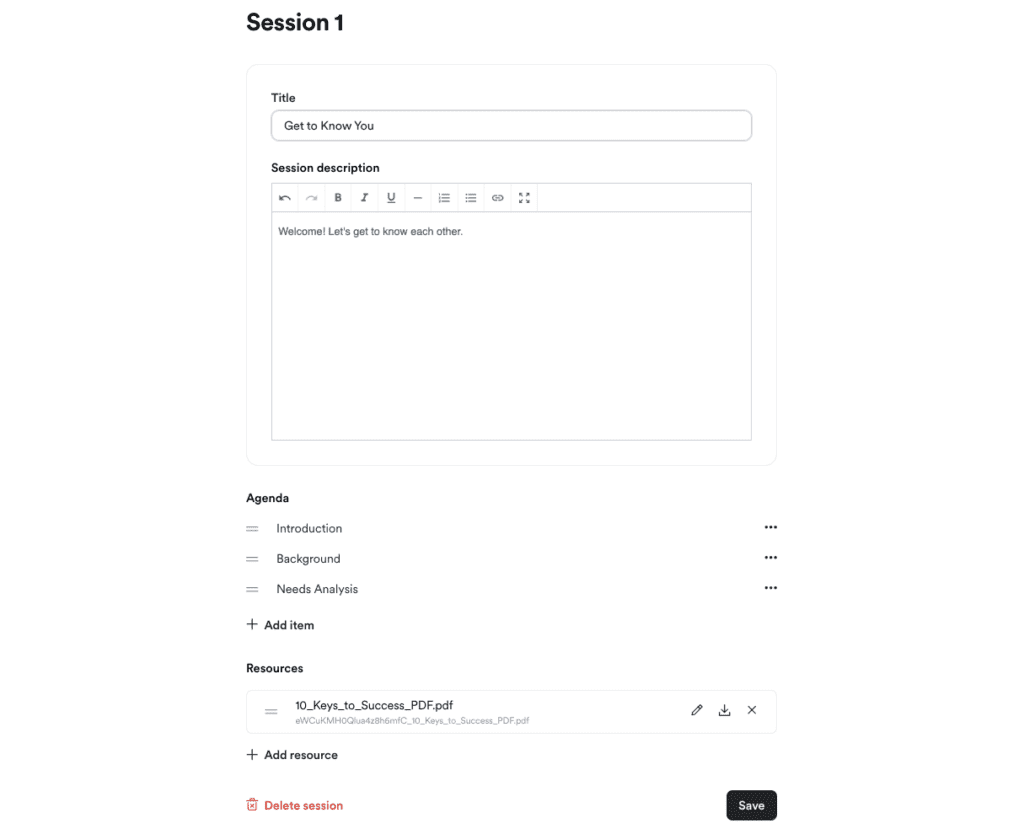
Each session has a title, a description, an agenda, and resources. In a package, you see every session listed in order, so you can design the program once and deliver it the same way to each client.
You can also sell the same program at different prices through separate offers, such as a pay-in-full price and a payment plan.
Where it falls short. Every coaching program counts toward your plan’s product limit. Basic allows five products in total, across coaching, courses, memberships, and downloads. A coach with three programs, a course, and a lead magnet has already used all five.
2. Scheduling
Kajabi gives you three ways to handle bookings. You can use the built-in Kajabi Scheduler and let clients pick from your availability, connect a tool like Calendly or Acuity, or book sessions manually.
Clients book from their own dashboard, and Kajabi sends confirmations and reminders automatically. That removes most of the scheduling email that slows a practice down.
Where it falls short. Kajabi’s coaching page says little about advanced scheduling, such as buffers between sessions, pooled availability across several coaches, or round-robin booking. If you run a team of coaches, test this carefully during your trial. A solo coach will find the built-in scheduler enough.
3. Live Video And Session Recordings

Kajabi includes live video, so you can meet clients inside the platform without Zoom. Your client clicks into the session from their dashboard, and you both land in the same room.
You can attach recordings and resources to a coaching product afterward, so clients can review a session between calls. If you prefer your current setup, you can link Zoom or Google Meet in place of Kajabi’s video.
For a coach, this removes two subscriptions and one common source of client confusion, which is hunting for the right meeting link.
Where it falls short. Built-in video is convenient, and a dedicated meeting tool still offers more controls. If your clients are corporate teams who live in Microsoft Teams or Zoom, you’ll probably keep using those.
4. Group Coaching
Group coaching is where many coaches move from selling hours to selling programs. In my experience, it’s the most practical way to grow your income without adding more one-on-one calls to your week.
Kajabi handles groups well. It says a live room holds up to 200 participants on video, with up to 20 breakout rooms of 10 people each. That covers workshops, masterminds, and group programs of almost any size.
You can pair a group program with a Kajabi community, so members keep talking between sessions. I cover the feature in my Kajabi Communities review, and my guide on building a community around your coaching explains why that matters for retention.
Where it falls short. Cohort courses, which move a group through scheduled content with live sessions, need the Growth plan. Basic and Growth also include only one community. Dedicated tools like CoachAccountable go further on group accountability, with shared goals and group metrics.
5. Client Management And Notes
Each client has a profile that shows the programs they’ve bought and their upcoming, past, and pending sessions. You can filter clients by program and by whether they’re still active.
You can keep private notes on each session, and clients can add their own. When a client buys another package, the new sessions join the same profile, so the full history stays in one place.
Where it falls short. This is Kajabi’s weakest area as a coaching tool, and it’s the one that matters most to serious practitioners.
- No contracts or e-signatures. You’ll need a separate tool for coaching agreements.
- No dedicated intake workflow. You can build a form in Kajabi, but it isn’t tied to the coaching flow the way it is in Paperbell or Satori.
- No structured progress tracking. Kajabi has no goals, habit trackers, action items, or client metrics. Notes are free text.
- No pre-session check-ins. Tools like upcoach and CoachAccountable prompt clients before each call. Kajabi doesn’t.
If your coaching method depends on measurable accountability, such as executive coaching with stakeholder feedback or health coaching with daily habits, Kajabi won’t cover it out of the box.
6. Backstage: A Private Portal For Each Client
Backstage is Kajabi’s newest coaching feature, and it addresses part of that gap. It gives every one-on-one client a private, branded portal.
- A personal program: Pick lessons from courses you’ve already built and place them in a client’s path. The same material gets a new context for each person.
- Recorded sessions: The portal stores each recorded live session with a summary of key points and action items.
- Voice memos: Record a short note between sessions. Your client gets the audio and a transcript.
- Direct chat: Message the client inside their portal.
- Assignments: Give each client tasks and show them what’s next.
This suits high-touch, premium coaching. For example, a consultant with eight clients on retainer can give each one a tailored path through an existing course library, then follow up with a two-minute voice note after every call. That’s a meaningful upgrade over a shared folder and an email thread.
Backstage comes with every Kajabi plan, and Kajabi sells additional seats for $49 a month.
Where it falls short. Clients reach Backstage through a web browser, including on their phones, so it sits outside the Kajabi mobile app for now. The seat pricing also needs checking against your client numbers before you build your offer around it. Backstage also serves one-on-one work, so it doesn’t replace a group program.
7. Payments, Packages, And Upsells
Kajabi’s selling tools are stronger than those in most coaching platforms. You can charge a one-time fee, a recurring subscription, or a payment plan, and you can bundle coaching with a course or a membership in a single offer.
Kajabi takes no percentage of your coaching revenue. That matters on high-ticket programs, where a platform fee of a few percent adds up fast. You still pay card processing.
Each coaching program also has an upsell option. When a client completes a session, you can show a button that leads to another offer. If they buy, the new sessions join their existing client profile automatically. It’s a simple way to turn a single session into a package.
If you’re unsure what to charge, our free online coaching price calculator can help you set your rates.
Where it falls short. If Kajabi Payments is available in your country and you use Stripe or another outside processor, Kajabi adds a fee of 2% on Basic, 1% on Growth, and 0.5% on Pro. The fee doesn’t apply to PayPal. Kajabi also collects sales tax without filing it for you. My Kajabi pricing guide covers both in detail.
8. Marketing Tools To Fill Your Calendar
Most dedicated coaching platforms assume clients are already arriving. Kajabi helps you find them, and this is the best argument for using it.
- Website and landing pages: Build a coaching site with your own domain and a sales page for each program.
- Lead magnets and forms: Offer a free guide or assessment and collect email addresses.
- Email marketing: Send broadcasts and automated sequences to your whole list, including people who haven’t bought yet.
- Funnels: Connect a landing page, an email sequence, and a checkout into one path from first visit to booked client.
- Automations: Trigger emails when someone books, pays, or completes a session.
For example, you could offer a free self-assessment, follow it with a five-email sequence, and invite readers to book a paid discovery session. All of that runs inside Kajabi. With a dedicated coaching tool, you’d need a separate website and email platform to do the same.
This is also how Kajabi supports a full value ramp. A free resource leads to a low-priced course, the course leads to group coaching, and group coaching leads to premium one-on-one work. Kajabi can sell and deliver every step.
Where it falls short. Advanced automations with conditional filters and your own affiliate program both start on Growth. Basic also caps your list at 2,500 contacts. If you already have a website and an email platform you’re happy with, this whole advantage shrinks.
9. AI For Coaches
Kajabi has added several AI tools. Three of them matter to a coach.
- Session summaries and transcripts: In Backstage, Kajabi summarizes each recorded session and transcribes your voice memos. This is the most useful AI feature for a coach, because it saves the note-taking that follows every call.
- Cofounder: An AI assistant inside Kajabi that asks about your expertise and helps you shape it into offers. It can suggest a program structure, draft a sales page, and recommend pricing and bundles. It comes with every plan.
- Kajabi MCP: A connection that lets Claude or ChatGPT build pages, emails, and offers in your Kajabi account as drafts for you to review.
Kajabi is clear about one boundary, and I think it’s the right one. The AI in Backstage handles transcription and summaries only. It never responds to clients on your behalf.
Kajabi has also announced Expert Agents, which include an AI teaching assistant for courses and a sales agent for offer pages. Its pricing page lists them as coming soon.
Where it falls short. Basic includes no monthly AI credits, and Kajabi’s pricing page doesn’t spell out which actions use them. I’d also keep AI away from the coaching relationship itself. Clients pay a coach for judgment, attention, and accountability. Use AI to cut your admin, and review every summary before a client sees it.
10. Reporting
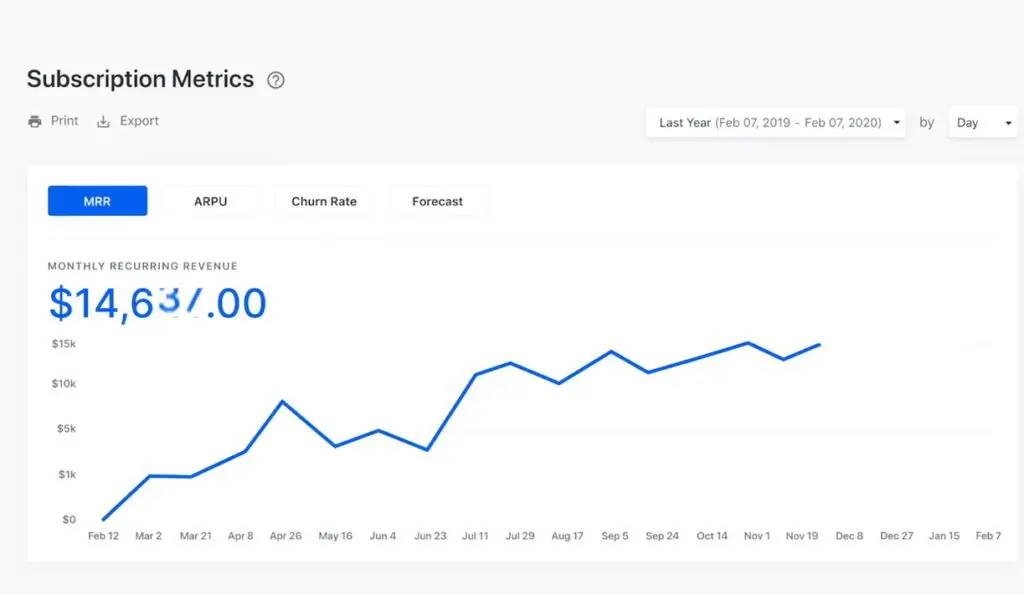
Kajabi’s reporting covers the business side of a coaching practice. You can see active clients, completed sessions, and revenue for each program. If you sell coaching by subscription, you can track recurring revenue and churn.
You can also see which offers connect to each program and who has access.
Where it falls short. These are business reports. Kajabi doesn’t report on client outcomes, such as goal completion or engagement between sessions. If you need to show a sponsor or an employer measurable progress, a tool like Simply.Coach or CoachAccountable fits better.
Kajabi Coaching Pricing | What Will It Cost A Coach?
Kajabi doesn’t sell coaching separately. Every plan includes Coaching and Backstage, along with the rest of the platform. Kajabi has no free plan, and it offers a 14-day free trial with a 30-day money-back guarantee.
- Basic: $143/month on annual billing or $179/month paid monthly. 5 products, 2,500 contacts, 1 community
- Growth: $199/month on annual billing or $249/month paid monthly. 50 products, 25,000 contacts, cohort courses, affiliates, and advanced automations
- Pro: $399/month on annual billing or $499/month paid monthly. Unlimited products, 100,000 contacts, 3 communities, and your own branded app
| Feature | Basic | Growth | Pro |
|---|---|---|---|
| Products (courses, coaching, downloads) | 5 | 50 | Unlimited |
| Contacts | 2,500 | 25,000 | 100,000 |
| Communities | 1 | 1 | 3 |
| Websites | 1 | 1 | 3 |
| Admin users | 2 | 11 | 26 |
| AI credits | 0 | 500 | 1,000 |
| Cohort courses | ✗ | ✓ | ✓ |
| Affiliate program | ✗ | ✓ | ✓ |
| Advanced automations & webhooks | ✗ | ✓ | ✓ |
| Remove Kajabi branding | ✗ | ✓ | ✓ |
| Custom code editor | ✗ | ✗ | ✓ |
| API access | ✗ | ✗ | Yes ($25/mo value) |
| Branded mobile app | ✗ | ✗ | Included ($199/mo value) |
| Kajabi Payments fee | 2.9% + $0.30 | 2.8% + $0.30 | 2.7% + $0.30 |
| Fee with 3rd-party gateway | 2% | 1% | 0.5% |
| Kajabi MCP | ✓ | ✓ | ✓ |
| Marketing emails, landing pages and funnels | Unlimited | Unlimited | Unlimited |
Which plan suits a coach. A solo coach with one or two programs and a small list can run on Basic. You’ll want Growth once you add cohort programs, affiliates, or more than five products.
How that compares. Dedicated coaching platforms cost far less than Kajabi, and these four are the ones I’d put on a shortlist next to it. Some coaches also pair a coaching tool with one of the online community platforms for the group side.
| Platform | Starting price | Best for |
|---|---|---|
| Kajabi | $143/month, annual billing | Coaches who also sell courses, memberships, or a community |
| Paperbell | $80.83/month, annual billing | Solo coaches who want packages, scheduling, contracts, and payments in one simple flow |
| upcoach | $49/month, annual billing | Group programs with curriculum, check-ins, and client worksheets |
| CoachAccountable | $20/month for 2 clients | Structured, metric-driven coaching and accountability |
| Teachable | $29/month, annual billing | Course creators who want simple coaching with intake forms and milestones |
The price gap only closes when you add up what Kajabi replaces. If you already pay for a website, an email platform, a course platform, and a scheduling tool, one Kajabi plan can cost less than the total. If you don’t need those, you pay for tools that will sit unused. I compare all of these in my guide to the best online coaching platforms.
Kajabi Coaching Pros And Cons
| Pros | Cons |
|---|---|
| Coaching, courses, memberships, and community in one account | Expensive if coaching is all you sell |
| Built-in live video with recordings | No contracts or e-signatures |
| Group rooms for up to 200 with breakout rooms | No goal, habit, or progress tracking |
| Backstage gives each client a private portal | Backstage runs in a browser, outside the mobile app |
| No revenue share, even on high-ticket programs | Extra fee for outside payment processors |
| Website, email, and funnels to attract clients | Cohort courses and advanced automations need Growth |
| Upsell after a completed session | Each coaching program counts toward your product limit |
| AI session summaries and voice memo transcripts | No monthly AI credits on Basic |
Who Should Use Kajabi For Coaching?
I rate Kajabi 8 out of 10 as a coaching platform. It loses points because its coaching workflows and client tracking are basic next to upcoach and CoachAccountable.
- You sell coaching alongside courses or a membership. Choose Kajabi. It’s the best platform I know for a coaching business built around an audience.
- You’re moving from one-on-one work to group programs. Choose Kajabi Growth. The live rooms, community, and cohort courses fit that shift.
- You run premium one-on-one engagements and own a content library. Kajabi with Backstage is worth testing.
- You only sell one-on-one coaching. Choose a dedicated tool such as Paperbell. You’ll pay less and get contracts and intake built in.
- Your method depends on tracked goals and accountability. Choose CoachAccountable or upcoach.
- You’re starting out with a handful of clients. Start with free tools like Calendly and Zoom, and invest in a platform once the practice pays for it.
Overall, I recommend Kajabi to coaches who are building a wider expertise business and want one system for marketing, sales, and delivery. I don’t recommend buying it for its coaching features alone. For the full picture of the platform, read my Kajabi review, and plan the rest of your business with our free creator tools.
Kajabi Coaching FAQs
Is Kajabi good for coaches?
Kajabi is good for coaches who also sell courses, memberships, or a community. It combines coaching delivery with a website, email, and checkout. If you only sell coaching, a dedicated coaching platform offers deeper client management at a lower price.
How does coaching on Kajabi work?
You create a coaching program as a single session or a package, attach it to an offer with a price, and sell it from your Kajabi site. Clients book through the Kajabi Scheduler, meet you on built-in video, and find their notes and resources in their dashboard.
Does Kajabi Coaching include video calls?
Yes. Kajabi includes built-in live video, so you can meet clients inside the platform. You can also use Zoom or Google Meet if you prefer.
Can I run group coaching on Kajabi?
Yes. Kajabi says a live room supports up to 200 participants on video, with up to 20 breakout rooms of 10 participants each. You can pair a group program with a Kajabi community.
What is Kajabi Backstage?
Backstage is a private portal for each one-on-one client. It holds selected lessons, recorded sessions with summaries, transcribed voice memos, assignments, and direct chat. It comes with every Kajabi plan, and additional seats cost $49 a month.
Does Kajabi Coaching work with Calendly?
Yes. You can use Kajabi’s built-in scheduler or connect a third-party scheduling tool such as Calendly or Acuity. You can also book sessions manually.
Does Kajabi take a cut of my coaching revenue?
No. Kajabi takes no revenue share on any plan. You pay card processing fees, and Kajabi adds a fee of up to 2% if you use an outside payment processor where Kajabi Payments is available.
Can clients sign a coaching contract in Kajabi?
Kajabi’s coaching product doesn’t include contracts or e-signatures. Most coaches on Kajabi send agreements through a separate e-signature tool before the first session.
Does Kajabi’s AI talk to my coaching clients?
No. In Backstage, Kajabi’s AI transcribes voice memos and summarizes recorded sessions. It doesn’t respond to clients on your behalf.
Which Kajabi plan do I need for coaching?
Coaching and Backstage come with every plan. Basic suits a solo coach with up to five products. Growth adds cohort courses, affiliates, and advanced automations.

Jeff Cobb, Founder of Learning Revolution
Jeff Cobb is an expert in online education and the business of adult lifelong learning. Over the past 20+ years he has built a thriving career based on that expertise – as an entrepreneur, a consultant, an author, and a speaker. Learning Revolution is a place where Jeff curates tips, insights, and resources to help you build a thriving expertise-based business. Learn more about Jeff Cobb here.
Table of Contents
Related Posts
Kajabi Pricing (2026): Use Fee Calculator To Find Actual Cost
How To Use Kajabi Integrations via Zapier, Webhooks & MCP
Kajabi Mobile App Types And How to Use Them