
What’s your dream scenario for your online course or coaching business?
A few one-off sales now and then? A handful of mid-ticket offers each month? Or a consistent stream of high-ticket clients who keep coming back?
If it’s predictable high-ticket sales, you won’t get there in one leap. Those kinds of sales demand trust, proof, and a clear journey of growing value.
Selling four, five, or six-figure e-learning programs to complete strangers doesn’t work.
That’s why the world’s top edupreneurs and marketers use a strategy called the Value Ladder. It’s a way to guide learners from a free intro resource to your highest-value offer, step by step, and essentially turning them from strangers into loyal customers.
It’s similar to the Value Ramp concept we’ve often discussed here on Learning Revolution. However, the Value Ladder is a more tactical approach with actionable steps compared to the holistic and strategic nature of the Value Ramp.
In this guide, I’ll share what a Value Ladder is, how it supports your online course, coaching, consultancy business, and how to build one to help you scale your business and free up more time by selling higher value offers.
Let’s get started.
What Is a Value Ladder
A Value Ladder is the path you design to guide your customer from discovering your work to purchasing your highest-value offer. It helps you build trust, prove your expertise, and grow your revenue—one step at a time.
It works perfectly for selling online education and training products like courses, coaching, memberships, and consultancy services.
According to Salesforce, it takes 6-8 interactions to turn a lead into a customer.
A value ladder does exactly that for your business (it allows you to repeatedly connect with your prospects at different stages of their journey).
Here’s how it works.
From the customer’s side, it feels like a natural journey.
They start with a free resource, get a quick win, and become more confident that you know what you’re doing.
Then they take the next step: a low-cost product, maybe a short course or digital guide. If that helps them even more, they move on to something deeper—a group program, a full course, or coaching.
From your side, it’s a structure.
You’re not trying to sell your most expensive offer right away. You’re creating a sequence where each step gives more value than the last, and commands a higher price.
It’s intentional.
You don’t overwhelm them with everything at once. You give them what they need right now, and you lead them toward what they’ll need next.
For example, if you teach new freelancers how to land clients, your Value Ladder might start with a free checklist.
Then you offer a $49 course on writing proposals, followed by a $200 client-getting blueprint, and finally a $2000 coaching package that helps them build a full-time freelance business.
At each level, you solve a bigger problem for your customers, giving them more value. You show up with the right solution at the right time.
That’s what makes a Value Ladder work.
It aligns your products with your customer’s journey, and turns strangers into repeat, high-value buyers.
4 Key Benefits of a Value Ladder for Your Learning Business
If you’re only offering one product at one price, you’re missing both revenue and relationships.
A value ladder helps you serve more learners, earn more over time, and build a business that doesn’t rely on lucky launches or one-off sales.
Here’s why it works so well for online course creators, coaches, and digital product sellers:
1. Maximize Customer Lifetime Value
Selling to a warm lead is always easier than selling to a stranger. A value ladder gives your students and clients a reason to stick around. As they grow, you meet them with the next level of support, moving from free to low-ticket to high-touch. This structure increases revenue per customer without aggressive tactics.
2. Meet Learners at Every Stage
Not everyone is ready to drop $2,000 on a coaching program. Some just want a free checklist. Others are looking for deep support. A well-built ladder makes sure you’re not leaving anyone behind. You meet people based on their budget and their commitment, and nurture them until they’re ready for more.
3. Build Trust at Every Step
People rarely buy premium offers without experiencing value first. A value ladder turns cold leads into loyal customers by giving them small wins early on. Each step builds proof, trust, and momentum. As learners succeed, they naturally want the next level.
4. Create Scalable, Predictable Growth
Disconnected offers create confusion for you and your audience. A value ladder solves that. It gives you a clear product path and lets your funnel do the heavy lifting. Your freebie grows your list. Your low-ticket product funds your ads. Your mid-tier program builds loyalty. Your premium offer closes with ease.
Value Ladder vs. Sales Funnels: What’s The Difference
A value ladder is the big-picture journey you design to take a potential customer from discovering your work to buying your highest-value offer.
It maps out your products or services in ascending order of price and depth, starting with a free resource and moving up to premium programs like group coaching, masterminds, or one-on-one consulting.
A sales funnel, on the other hand, is the specific system you use to sell one step of that ladder. It includes your landing page, email sequence, checkout process, and any upsells or downsells attached to that offer.

A ladder has different products or offers at every step. Each product or offer at each step of the ladder has its own funnel or set of funnels designed to move people toward that specific offer.
Your $97 course might have its own funnel. Your $997 coaching program might have another. But both sit on different rungs of the same ladder, working together to grow trust, impact, and revenue.
ClickFunnels is one of the best tools to create sales funnels for your value ladder
The 6 Main Stages Of A Value Ladder For Online Courses And Coaches
Each stage of your value ladder reflects a deeper level of trust and a higher level of transformation.
The client moves from curiosity to confidence to full commitment. And for every step, you need a funnel designed to help them take the next one.
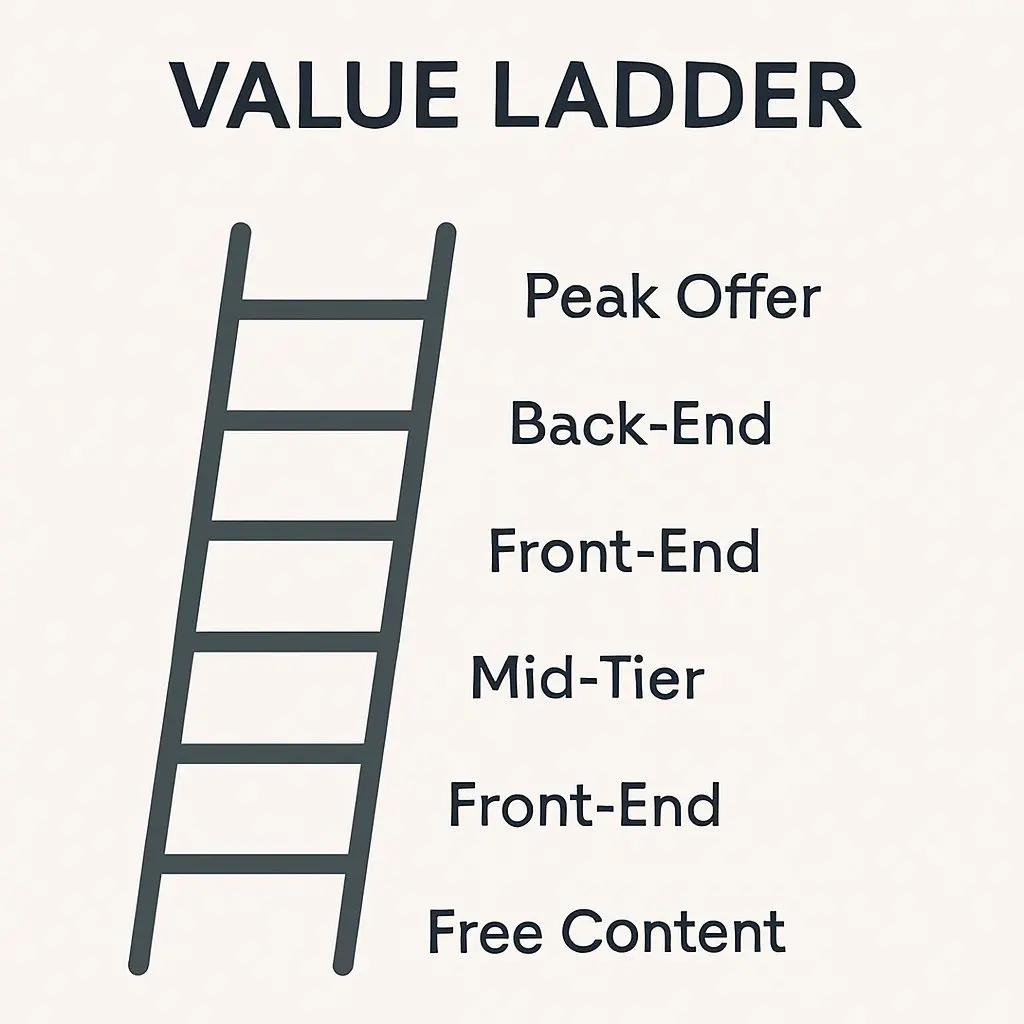
Let’s break this down using the example of a solo email consultant who helps SaaS companies improve retention and lifetime value through smarter email strategy.
Value Ladder Summary Table
| Stage | Format | Value Type | Role |
| Free Content | Blog posts, YouTube videos, social media | Awareness | Drive traffic, build trust, and bring people to your lead magnet page |
| Lead Magnet | Free guide, checklist, template, or webinar | Intro value | Convert visitors into subscribers and deliver a first, useful result |
| Front-End | Low-ticket product ($10–$100), mini course, paid workshop | Skill intro | Get your first small commitment and show them you’re worth buying from |
| Mid-Tier | Flagship course, group coaching, or membership ($200–$1000) | Guided transformation | Deliver deeper learning or progress in a structured way |
| Back-End | High-ticket coaching, done-for-you service, or consulting ($2K–$10K) | Hands-on help | Work closely with your best clients to deliver tailored results |
| Peak Offer | Retainer, licensing, or performance-based deal | Ongoing results | Build long-term revenue from your top clients through scalable solutions |
You can’t execute a value ladder manually as it involves automation, funnels, and emails. Thinkific is an ideal platform to do it for you, without being too advanced.
Value Ladder Stage #1: Free Content (Awareness)
This is the starting point of your value ladder. At this stage, you’re not asking for anything, not even an email. You’re simply creating useful content that helps your ideal customer solve small problems, discover new ideas, or take the first step toward a bigger goal.
This could be a blog post, YouTube video, podcast episode, Instagram carousel, or a free webinar. The goal is to generate awareness and build trust, so when they’re ready for more, they already see you as the expert.
If you’re an email marketing strategist and consultant, your blog posts and videos could be about topics like “SaaS Email Marketing Trends”, “Critical Email Sequences For SaaS”, “7 Email Personalization Tactics”, “How To Increase Email Response Rates”, etc.
In other words, this stage is about building a solid content marketing strategy to fuel your value ladder.
This is where SEO, organic social content, and podcast interviews also come in. Or you can speed things up with Facebook, YouTube, or Google ads that drive traffic to your free lead magnet.
Essentially, anything that generates consistent awareness and invites your prospects to learn more about your topic comes at this stage.
Once you get qualified traffic to your landing page or website, your lead magnet takes over, and the rest of your value ladder begins.
Value Ladder Stage #2: Free Offer (Lead Magnet)
Your free content has made an impression. But it isn’t strong enough to turn your audience into buyers immediately.
This is why you need to build trust with a free high-value resource, a lead magnet, in exchange for their email addresses.
Your job is to deliver an “aha moment” that proves you know your stuff.
Here’s an example of a lead magnet from Amy Porterfield’s site.
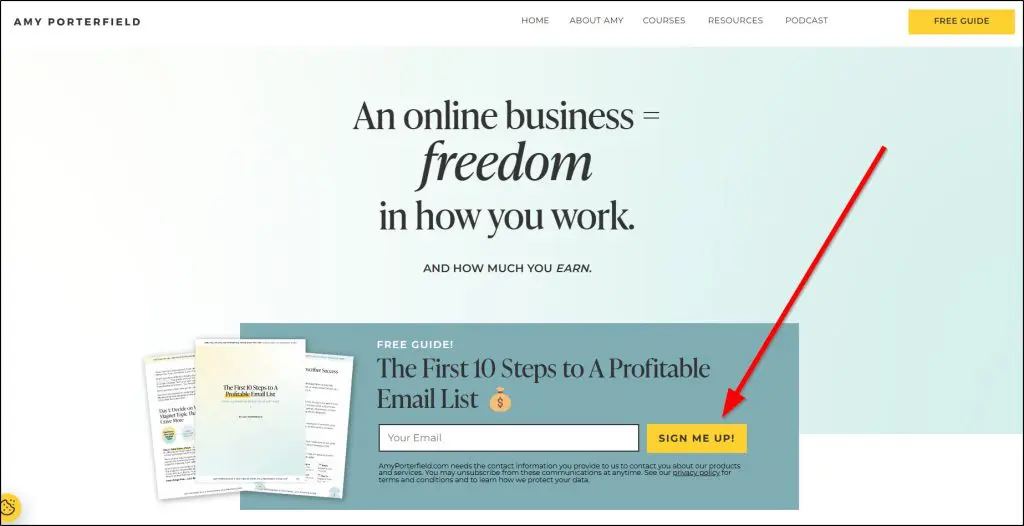
You could offer a lead magnet like “7 Onboarding Email Mistakes That Hurt Retention.”
As soon as a prospect downloads this free offer in exchange for their email address, they’re added to your funnel
Sample Funnel: Landing page → Opt-in → Welcome email sequence → Educational content
How do you decide if a prospect or lead is ready for the next step of the funnel?
Transition to next step: Happens when they open and engage with your emails. You might include a soft CTA like: “Want my teardown of your onboarding flow?”
If they don’t move on, keep nurturing. Many stay on your list for weeks or months before they’re ready to buy.
Stage #3: Entry-Level Offer (Front End)
This is your trust-building sale. A low-cost offer lets them experience your paid content with little risk. It filters serious prospects from the curious.
We usually call it a tripwire product, and it can even be the second stage of your value ladder.
Remember, Amy’s lead magnet I showed you in the last step? Here’s a tripwire on her site.
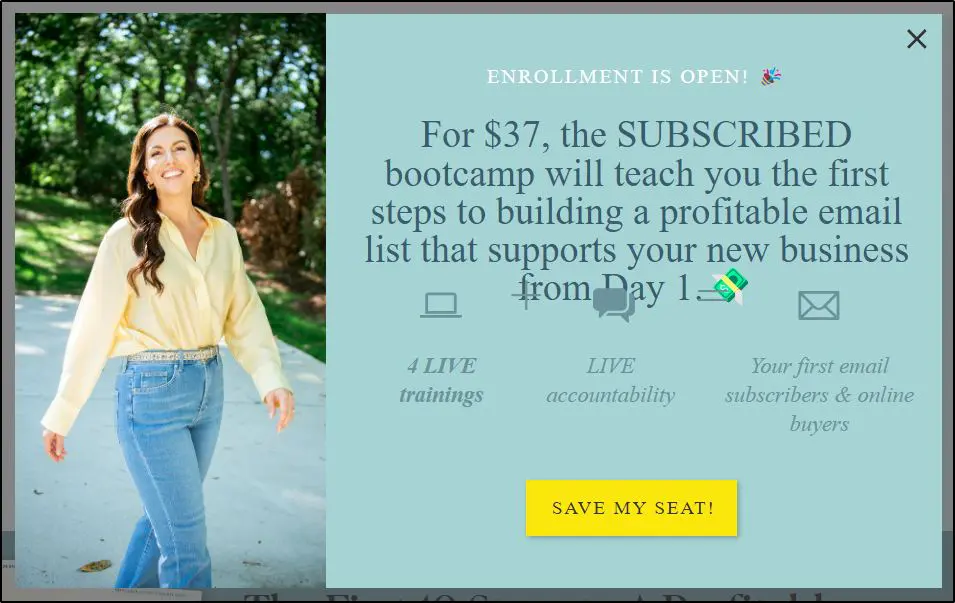
See, it’s not free.
But it’s affordable and offers enough value to attract the right kind of buyers.
Continuing with the email strategist example, you could offer a $97 mini-course or a $47 email teardown of their onboarding sequence
Sample Funnel: Sales page → Order bump (e.g., onboarding checklist) → Thank you page → Invite to workshop waitlist
Transition to next step: Triggered when they complete the course or see results from your teardown. Send a follow-up email with: “Want help applying this across your entire lifecycle?”
If they don’t move on: Tag them. They’ve paid once, so you can retarget with future mid-tier offers or promotions.
Value Ladder Stage #4: Core Offer (Middle)
Now the relationship deepens. You’re not just giving tactics, you’re guiding strategy. This is where many consultants focus their time.
Example: A $1,500 live workshop where you co-create a SaaS retention strategy
Funnel: Application page → Pre-qualify with form → Strategy call → Deliver workshop
Transition to next step: Happens when they start to implement and ask for help — “Can you just do this part with us?” This is your cue to pitch the high-ticket sprint.
If they don’t move on: Offer post-workshop support packages or async audits. Some clients stay here for a while, and that’s okay.
Value Ladder Stage #5: High-Ticket Project (Back End)
This is where the serious work happens. You’ve proven your thinking and helped them make progress. Now they want you involved more closely.
Example: A $10K–$15K Retention Optimization Sprint over 6 weeks
Funnel: Email invitation → Case study or testimonial → Strategy call → Proposal → Close
Transition to next step: Usually triggered by results — they see real impact and ask, “What would ongoing support look like?” You respond with a custom retainer.
If they don’t move on: Offer occasional check-ins or QBR-style consulting to keep them warm.
Value Ladder Stage #6: Flagship Offer (Peak)
Only a few clients reach this level. They’re investing in you as a partner. This is where you provide your full brain and systems.
Example: A $30K+ Done-For-You Consulting Retainer for 3–6 months
Funnel: Invitation only → Referral or relationship → High-stakes discovery call → Executive buy-in → Proposal
Transition to onboarding: This step usually comes with a long lead time, procurement, and internal selling. You’ll need to support your internal champion with slides, forecasts, and outcomes.
If they don’t move on: Keep them close. They’ve seen your value, you might get called in again when a new initiative starts, or they change roles.
Each step isn’t just a product — it’s a checkpoint. Some clients pause. Some drop off. But with a well-structured ladder, your best clients keep climbing, and your business grows from momentum, not just cold outreach.
If you’re ready to go all-in, Kajabi is the best platform for combining courses and marketing automation. It will help you build these funnels easily.
Don’t Build the Whole Value Ladder Before You Start
It’s easy to overplan your Value Ladder and wait till you have everything figured out.
You sketch out every step from free YouTube videos to $10,000 consulting and feel like it all needs to exist before you launch.
That’s how many course creators get stuck. They build and tweak for months without ever making a single offer.
You don’t need a perfect ladder from the start. You just need one strong step.
Get real-world validation first.
Start with your mid-tier offer. This could be a self-paced course, a live workshop, or a group program, usually priced between $100 and $1,500.
This is where your audience starts seeing real transformation, and where you start getting meaningful feedback.
Why mid-tier?
Because it sits at the intersection of action and insight. Low-ticket products don’t always attract serious buyers.
High-ticket offers require too much trust upfront.
But mid-tier offers help you prove your method to people who are motivated enough to invest and give you a path to improve before scaling.
But to get traction, you need traffic.
That starts with free content—blog posts, YouTube, podcasts, or social media—or with paid ads that drive leads directly to your offer. Either way, you’re building awareness and drawing the right people into your world.
Once your offer is validated and converting, build around it.
Create a lead magnet that flows naturally into it, then an entry offer that separates buyers from freebie hunters. Add a backend offer for your best students. Layer on content marketing or scale with ads.
Let the ladder grow as your business grows, one step, one offer, one win at a time.
7 Steps To Build A Value Ladder For Your Learning Business
Building a value ladder isn’t a weekend project. For most course creators and coaches, it takes months or even years to shape fully.
And that’s exactly how it should be.
You don’t need to create every step before launching or scaling. In fact, if you already have a lead magnet and a solid mid-tier course, that’s your foundation. Don’t change what’s already working.
Instead, start thinking about the bigger picture. What’s missing above or below? Where do your students go next? What entry point is missing for people who don’t trust you yet?
The goal here is twofold:
- Maximize revenue from your existing customers by giving them a clear path to keep growing with you
- Lower the barrier for new prospects to engage with your brand by offering easier, low-risk starting points
The steps below will help you build out your ladder piece by piece. Just know, every step can eventually house multiple offers, and your ladder will likely evolve with time.
So read on with that mindset.
Step 1: Understand What Your Audience Actually Needs
You can’t build a value ladder unless you know what problems you’re solving. And those problems aren’t always obvious.
They live in your audience’s questions, struggles, and unfinished Google searches.
So whether you’re just starting out or already have a product, this step is the same: listen, observe, and document.
If You Already Have an Audience or Customers:
- Survey your list: Ask, “What’s your biggest challenge right now with [your topic]?”
- Look at refund or support requests: These often reveal mismatched expectations or unmet needs.
- Analyze course drop-off: If you have an online course, see where people stop. That’s where they get stuck.
- Run a short 15-min call with a few customers to dig deeper into what they want next.
If You’re Just Starting Out:
- Join the conversations: Hang out in Facebook groups, Reddit threads, YouTube comment sections, or TikTok where your ideal learners are active.
For example, if you’re a fitness coach looking to launch a course or coaching program, this Reddit thread is a goldmine of raw and brutally honest customer feedback.
- Instead of manually researching audience sentiments, you can use Perlexity, an AI platform that lets you research Reddit and other forums and find raw insights.
- Search like a detective: Use Google, YouTube, and Amazon to find the top search queries, content, or books—and see what people are complaining about.
- Talk to 3–5 people: Ask them how they’ve tried to solve their problem, what didn’t work, and what they wish existed.


No matter where you are:
Start a “Problem Bank” doc. Write down:
- Exact phrases people use to describe their problem
- What they say they want
- What they actually need to move forward
This becomes the raw material for every step of your ladder.
If your offers don’t match these real problems, no funnel will fix it. Understanding your audience is the foundation, not just for your ladder, but for your business.
Step 2: Map the Levels of Problems You Can Solve
Once you know your audience, your next move is to organize the layers of problems they face. Think of this as sketching out the full transformation journey, from beginner struggles to advanced goals.
Your value ladder is built around solving different levels of these problems.
Start with what your audience asks you about. Then dig into what they actually need at each stage.
Let’s say your audience is freelance designers:
- First, they might ask: “How do I get my first client?”
- Later: “How do I raise my rates without losing clients?”
- Eventually: “How do I turn this into a studio or agency?”
That’s a ladder.
Here’s how you can map out your audience’s problems and identify value ladder opportunities:
1. List common pain points: Scroll through your inbox, DMs, social comments, surveys, or client calls. Write down the 10–15 questions or complaints that come up the most.
2. Sort them into levels: Group the problems based on how far along someone is in their journey. You’re looking for:
- Starter problems – Easy wins, common fears, early confusion.
- Intermediate problems – Growth challenges, process upgrades.
- Advanced problems – Scaling, automation, mindset shifts.
3. Assign potential outcomes to each level: Ask yourself what specific result can I help them achieve at this stage? Each result becomes a potential product or service.
4. Validate with real people: Run polls, post Instagram questions, or ask your email list:
“If you’re struggling with [X], what’s your biggest frustration right now?”
The responses will help you confirm demand.
You’re not building all these offers yet. You’re just mapping what your full ladder could look like, so you can choose the right entry point in the next step.
Step 3: Build Your First Offer
Now that you’ve mapped out the different levels of problems your audience faces, it’s time to choose just one of them and turn it into your first offer.
You’re not building the whole ladder yet.
You’re picking one solid step, one solution that solves a real, urgent problem your audience already knows they have. This becomes the center of your ladder, the core product around which everything else will eventually orbit.
Start by going back to your audience research. Look for the problem that people complain about the most. Not the biggest or most complex problem, just the one they’re most aware of and most eager to solve right now.
That’s your entry point.
Now turn that problem into something people can buy.
Let’s say your audience is freelance writers struggling to get clients. Don’t jump to a $5,000 consulting package. Start with a $97 workshop on creating a portfolio that lands inbound leads. Or a $297 course on how to pitch agencies with confidence. Pick a format that you can create quickly, without hiring a team or building complex systems.
Your job is to create a result, not just content. So focus your offer on a clear outcome. Not “Social Media Content Planning,” but “Plan 30 Days of Client-Attracting Content in One Hour.” That kind of promise gets attention, drives sign-ups, and gives you validation that this step belongs in your ladder.
Once this offer sells and gets feedback, you’ll have proof that your value ladder is grounded in what your audience actually wants, not just what you hope they’ll buy.
Step 4: Validate Your First Offer With a Simple Funnel
You’ve got your first offer, now it’s time to see if your audience actually wants it.
Don’t waste weeks building fancy funnels, long email sequences, or pixel-perfect designs. Right now, your job is to test the offer in the wild. Keep it fast, focused, and real.
Start with a simple sales page.
Use Thinkific, which gives you everything you need in one place — sales funnels, email marketing, landing pages, payment processing, a built-in blog, and full product creation tools.
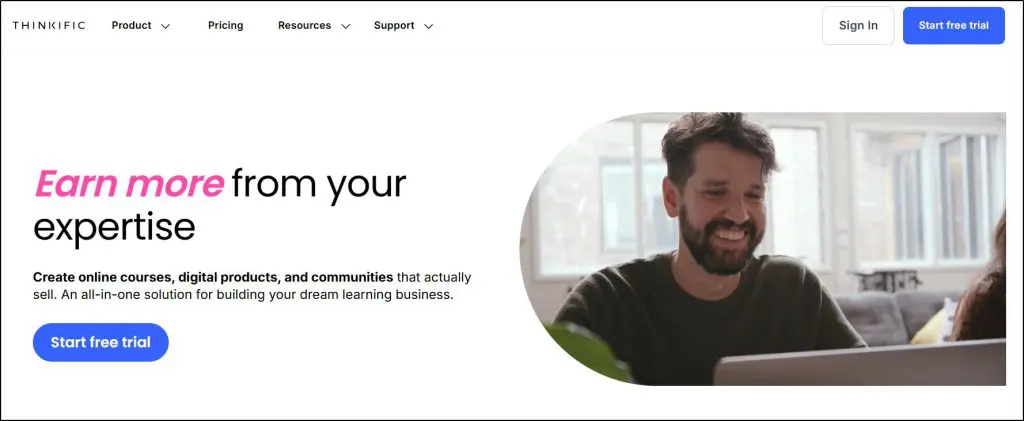
Get a Free 30-Day Thinkific Trial
It’s a 360° solution for validating, selling, and scaling your learning business, even if you’re not tech-savvy.
Create your sales landing page with:
- A bold headline with a clear promise
- A few bullet points that speak directly to your audience’s pain points
- A strong call-to-action to buy, book, or enroll
Once your page is live, start getting traffic. You can:
- Run small ad campaigns ($5–$20/day) on Facebook, Instagram, or Google
- Post in relevant Facebook groups, LinkedIn, or Twitter
- Share it with any audience you already have (even a small one)
You don’t need 100 sales, you need traction.
If even 3 out of 10 people buy, you’re onto something.
But if no one clicks or converts, treat it as market feedback. Improve your copy. Reposition the promise. Adjust the price.
Let’s say you’re selling a $97 workshop called Inbox to Income that teaches email service providers how to craft high-converting launch sequences. Your funnel might be:
Facebook ad → Thinkific landing page → payment → bonus delivery
Once this offer is validated, you don’t have to rebuild anything. You can refine the same funnel and scale it — run more ads, boost outreach, and keep selling the product on autopilot.
Want to level up? Build a more complete funnel around it, like a webinar funnel:
Paid ads → registration page → live or evergreen webinar → product pitch → email follow-up → conversion
That’s the power of starting small, validating fast, and scaling smart — all using the same platform and a product that your audience has already proven they want.
Step 5: Build Your Value Ladder Around Your Validated Offer
Once your first offer is working — meaning people are buying it, completing it, and saying, “That was worth it” — now it’s time to think bigger.
This step is about turning that one validated offer into the center of a full value ladder.
Start by mapping out what comes before and after.
Before: What’s the easiest way someone could say yes to you? That’s your entry point. It could be:
- A free downloadable guide
- A webinar or video lesson
- A mini course or low-cost product ($7–$50)
This becomes the “bait” that gets people into your world and warms them up for the main offer.
Most creators already have a lead magnet at this stage. That’s great — now that you’ve validated the core offer, you can tweak or upgrade your lead magnet to better qualify your leads. You now know what your buyers want, so create a freebie that attracts more of the right people, not just anyone.
For example, if you’re an email strategist and your core offer is a $497 course on writing high-converting launch sequences, your lead magnet could be a free “7-Day Welcome Sequence Template.”
Or a low-cost workshop on turning subscribers into buyers. Both are directly aligned with the core problem you solve, and they attract leads who are far more likely to buy your main offer.
After: What’s the natural next step for someone who completes your current offer? A deeper level of support? A personalized plan? A mastermind?
That’s your backend offer, typically a higher-priced product ($500–$5000+) for people who want more access or a bigger transformation.
For the same strategist, a logical next step might be a $2500 group coaching program where you audit their emails, rebuild segments, and optimize sequences together live. For your top clients, you might offer $7500+ custom strategy retainers or licensing packages.
You can also introduce upsells or order bumps around your existing offer (maybe a template pack, a live Q&A, or a bonus mini training).
These help increase average order value without creating brand-new products.
At this point, you’re not launching everything at once. You’re designing the path. One offer at a time, based on what your audience tells you they need next.
Step 6: Build Funnels That Match Each Step of Your Ladder
Once your value ladder starts taking shape, each step needs a funnel, not just a product page or a checkout button, but a clear path that guides the customer to say yes.
The funnel you build depends on where the offer sits in your ladder and how much trust is needed before someone buys.
For Free Content & Lead Magnets
Start simple. The job here is to convert traffic into subscribers.
Here’s a basic funnel:
- A blog post, YouTube video, or social media post that addresses a specific pain point
- A link to a landing page with a clear headline and opt-in form
- A confirmation page with an optional upsell or next step
You can improve this with a short email sequence (3–4 emails) that educates, builds rapport, and points to your first paid product. Thinkific lets you do all of this — landing page, email automation, and lead capture — in one place.
For Low-Ticket Offers ($10–$100)
Trust is still forming here, but now you’re asking for money, so your funnel needs more persuasion.
Here’s what a typical low-ticket funnel looks like:
- Landing page with copy focused on transformation, testimonials, and bonus stack
- Checkout page with urgency or limited-time pricing
- A follow-up email sequence for cart abandoners and upsells
If you’ve already validated your offer, this is the stage to test cold traffic ads. Keep budgets small and watch metrics like cost-per-click and cost-per-sale.
For Mid-Tier Offers ($200–$1000)
Now you’re selling a deeper transformation, which means the funnel must do the heavy lifting.
A strong mid-tier funnel includes:
- A lead magnet or free workshop/webinar that solves a surface-level problem
- An email sequence that shares case studies, common objections, and behind-the-scenes insights
- A long-form sales page with FAQs, guarantees, and video testimonials
- Option to split pay or limited-time bonuses to encourage action
This type of funnel may take 2–4 weeks to create, but once it’s working, you can automate and scale it. Again, Thinkific can host the course, deliver the emails, and even track signups and payments — no outside tools required.
For High-Ticket Offers ($2000+)
At this level, funnels are about conversations, not clicks.
Here’s a simplified version of a high-ticket funnel:
- A short application or lead form
- A nurturing email sequence with testimonials, authority-building content, and qualification filters
- A booking page for a 1:1 discovery call or strategy session
- A call script that focuses on diagnosing the problem and pitching the right-fit solution
Only a small percentage of your audience will reach this step. But the funnel must still function like clockwork, filtering out tire-kickers, pre-framing the value, and making the offer feel like the natural next step.
Step 7: Scale What’s Working, One Step at a Time
Once a funnel is converting, even at a small scale, your next move is to scale it.
But scaling doesn’t mean throwing money at ads and hoping for the best. It means doubling down on what’s already proven to work and doing it intentionally.
Start by identifying your best performer
Which step in your ladder is getting the most traction? Is it your lead magnet that’s bringing in consistent signups? Is your $97 mini-course converting at 5% on cold traffic? Maybe your webinar is booking quality calls?
That’s your starting point.
Scale with traffic and systems
- If your lead magnet is winning, run cold traffic ads to it. Use Facebook, YouTube, or Google Search, depending on where your audience spends time. A well-targeted ad campaign can bring a steady stream of new subscribers every day.
- If your low-ticket product is converting well, build an upsell sequence behind it. Add an order bump or a limited-time bonus offer. Test different ad creatives and scale the ones getting the best cost per acquisition.
- If your mid-tier offer is humming, automate the funnel. Use Thinkific to run evergreen webinars, drip email sequences, and build urgency into your campaigns with limited-time bonuses or countdown timers.
- If you’re closing high-ticket clients from sales calls, hire a setter or train someone to pre-qualify leads so you can take more calls or reclaim your time.
Don’t scale the broken parts
Resist the urge to scale what hasn’t been validated. If a funnel isn’t converting yet, more traffic won’t fix it — it’ll just burn your ad budget. Instead, optimize before you amplify.
Scaling isn’t the final step. It’s the ongoing process of expanding what works — and letting the rest catch up. By the time you’ve scaled one rung of your ladder, the next opportunity usually reveals itself.
That’s how you build a business that grows without burning out.
Are You Ready to Build a Value Ladder for Your Online Course Business?
Selling digital products, especially as they rise in price and depth, isn’t just about putting up a sales page and hoping for the best.
There’s psychology involved. Timing. Trust. And strategy.
That’s why so many course creators and coaches get stuck selling low-ticket offers. They’re easier to sell, sure. But they rarely lead to a sustainable, scalable business.
You need systems that guide the right people toward your highest-value offers, without overwhelming or losing them along the way.
That’s exactly what the Value Ladder helps you do.
It gives your business structure. It helps you meet learners at every stage from the first touchpoint to full transformation. And it gives your audience a reason to keep moving forward with you.
You don’t need to have it all figured out.
You just need to take the first step with the end in mind.
Because the sooner you map the journey, the sooner you’ll start attracting better-fit customers, selling with more ease, and building a business that grows with every step your learners take.
Table of Contents