
TL;DR: Camtasia Review | Is It Still The Best Screen Recorder For E-Learning? (2026)
Camtasia is still the most complete tool for recording and editing screen-based lessons, and the 2026 version adds SmartFocus auto-zooms, dynamic captions, and tighter text-based editing.
Best for: Software tutorials, training videos, and course lessons built around your screen.
Biggest strength: Cursor effects, callouts, and a timeline that make on-screen steps easy to follow.
Biggest catch: In-video quizzes only work through TechSmith’s player, Screencast, or a SCORM package. Upload an MP4 to Thinkific, Kajabi, or YouTube, and the quizzes disappear.
Pricing: Yearly plans from $39, and most course creators need Essentials at $179.88/year. Every plan includes Snagit.
Free options: Camtasia Online records in the browser at 1080p for free, and the desktop editor runs without a time limit but watermarks exports until you buy.
My verdict: Buy Essentials if you teach on screen and want polished lessons. Skip it for talking-head videos or podcast-style editing, where Descript fits better.
Try Camtasia for free
Camtasia has been one of my go-to tools for recording and polishing course videos for a long time. TechSmith first released it in 2002, and I’ve used it pretty much from the start, so I’ve watched it grow from a basic screen recorder into a full suite for e-learning video.
The question in 2026 is whether Camtasia still earns a yearly subscription when AI editors and free recorders show up every month. My answer depends on how you teach. For screen-based lessons, Camtasia remains the tool I trust most. For other kinds of video, you have cheaper or better options, and I’ll say so as we go.
In this review, I cover what Camtasia does well, where it falls short, what each plan costs, and which screen recording or video editing tool makes more sense if Camtasia isn’t the right fit.

Compare the best Camtasia alternatives here
Camtasia Review: Quick Verdict
Camtasia is the best all-in-one tool for screen-based teaching. Recording, cursor highlighting, callouts, and the timeline all work toward one goal, which is making on-screen steps easy for a learner to follow. No general video editor makes that job as fast.
The e-learning extras need more care than most reviews admit. In-video quizzes only play inside TechSmith’s Smart Player, on Screencast, or in a SCORM package for an LMS. Most creators sell on platforms like Thinkific or Kajabi, which play a standard video file, so the quizzes never reach the student. Use your course platform’s quiz tool there instead, and treat Camtasia’s quizzes as a feature for LMS and corporate training work.
| Camtasia is a good fit if you | Look elsewhere if you |
|---|---|
| Record software tutorials, walkthroughs, or slide-based lessons | Mostly film yourself talking to a camera |
| Want callouts, zooms, and cursor effects without learning Premiere | Want to edit video mainly by editing a transcript |
| Deliver training to companies that use a SCORM-compliant LMS | Need quizzes inside videos on Thinkific, Kajabi, or YouTube |
| Also need a screenshot tool, since Snagit comes with every plan | Want a one-time purchase instead of a yearly subscription |
| Have a computer with 16 GB of RAM for long projects | Edit on a low-powered laptop or from cloud-synced folders |
Camtasia Pricing Plans
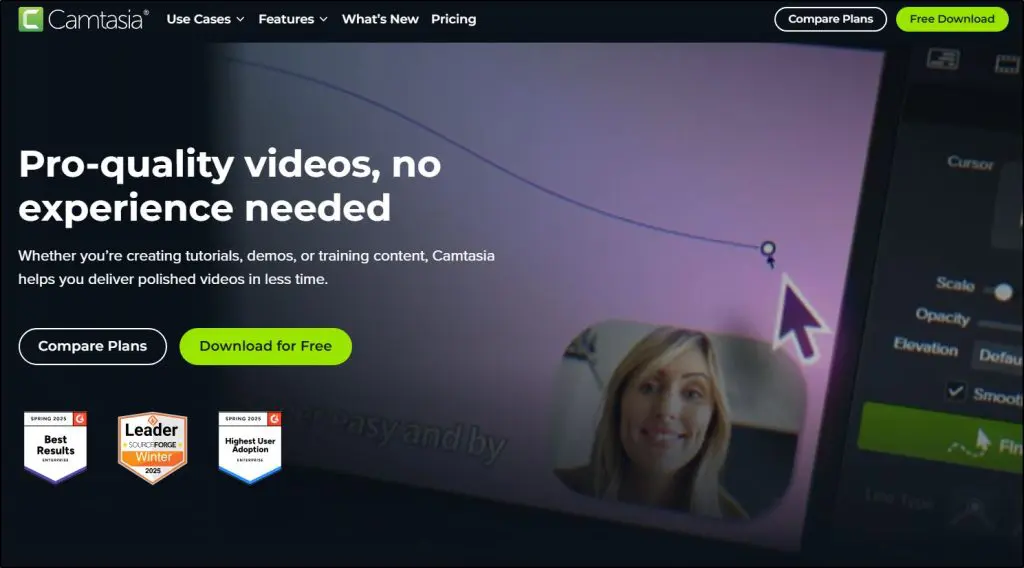
Camtasia sells four individual plans, all billed yearly, and each one works on Windows and Mac. TechSmith moved to subscriptions only with Camtasia 2025, so you can no longer buy a one-time license. Every plan comes with a 14-day money-back guarantee.
| Plan | Billed annually (per year) | Billed annually (per month) | Key limits |
|---|---|---|---|
| Starter | $39 | $3.25 | Snagit plus watermarked Camtasia Editor |
| Essentials | $179.88 | $14.99 | Camtasia Editor, Audiate, Snagit |
| Create | $249 | $20.75 | Adds AI scripts and voiceovers |
| Pro | $599 | $49.92 | Adds AI avatars, translation, stock assets |
| Feature | Starter | Essentials | Create | Pro |
|---|---|---|---|---|
| Camtasia Editor | Watermarked | ✓ | ✓ | ✓ |
| Snagit screen capture | ✓ | ✓ | ✓ | ✓ |
| Audiate text-based editing | ✗ | ✓ | ✓ | ✓ |
| Captions and filler word removal | ✗ | ✓ | ✓ | ✓ |
| Quizzes and SCORM export | Watermarked | ✓ | ✓ | ✓ |
| AI scripts and voiceovers | ✗ | ✗ | ✓ | ✓ |
| AI avatars, translation, and dubbing | ✗ | ✗ | ✗ | ✓ |
| Stock assets | Starter library | Starter library | Starter library | 100 million+ |
| Screencast sharing | 25 videos | 25 videos | 25 videos | Unlimited |
Which Camtasia Plan Should You Buy?
| Plan | Buy it if | Skip it if |
|---|---|---|
| Starter ($39/year) | You mainly want Snagit for screenshots and quick screen recordings | You plan to publish edited videos, since Camtasia Editor exports carry a watermark |
| Essentials ($179.88/year) | You publish course lessons and want text-based editing, captions, quizzes, and SCORM export | You need AI voiceovers for videos you don’t narrate yourself |
| Create ($249/year) | You write scripts faster than you can record them and want 200+ AI voices | You’re happy narrating your own lessons |
| Pro ($599/year) | You localize courses into other languages or want AI avatars and premium stock assets | You sell in one language and appear on camera yourself |
Does Camtasia Have a Free Plan or Free Trial?
TechSmith gives you two ways to start without paying. Camtasia Online is a free browser recorder that captures your screen and webcam at 1080p, adds a custom look, and shares a link with no watermark. Editing beyond that means sending the project to the desktop app.
The desktop trial works differently for each app in the bundle. Camtasia Editor has no time limit, but every export carries a watermark until you buy a plan. The Audiate text editor runs for 7 days, Snagit for 15 days, and the trial includes only the starter asset library.
Camtasia Features: How Good Are They for Course Creators?
Camtasia has a lot of different features for course creators, coaches, presenters, and educators.
Let’s take a quick look at them before diving deeper
| Feature | What it does | Limitation |
|---|---|---|
| Screen and camera recording | Records screen, webcam, microphone, and system audio together, up to 4K at 60fps | Media must sit on a local drive, not a cloud-synced folder |
| Cursor effects and SmartFocus | Highlights clicks and adds automatic zooms that follow the action | Auto-zooms still need a manual check on busy screens |
| Timeline editing and annotations | Cuts, callouts, shapes, transitions, and reusable themes | Long multitrack projects slow down on 8 GB machines |
| Text-based editing and AI cleanup | Edits through the transcript in Audiate, removes filler words and noise, and generates captions | Audiate runs as a separate app from the main editor |
| AI scripts, voices, and avatars | Writes scripts, voices them with 200+ AI voices, and creates avatar videos | Voices need Create, and avatars and translation need Pro |
| In-video quizzes | Adds multiple choice, true/false, fill-in-the-blank, and short-answer questions | Works only in Smart Player, Screencast, or SCORM, not in MP4 or YouTube |
| SCORM export | Packages a video, its quizzes, and captions for an LMS gradebook | One video per package, not a full course authoring tool |
| Sharing and collaboration | Publishes to Screencast, YouTube, and local files, with Camtasia Online collaboration | Screencast holds 25 videos below Pro |
Let’s not discuss them in more detail.
Feature #1: Screen and Camera Recording
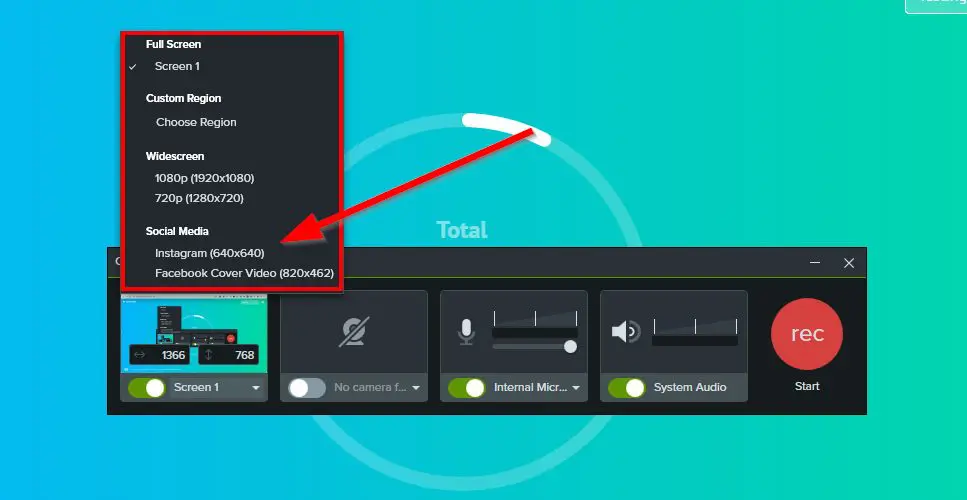
Camtasia’s recorder captures your full screen, a region, or a single window, plus your webcam, microphone, and system audio, all as separate tracks you can edit later. Recording runs at up to 4K and 60 frames per second on every plan, which keeps small text in software demos sharp.

The Rev workflow helps when you want a finished look quickly. After recording, Rev lets you pick a layout, adjust the camera, screen, and background layers on the canvas, and drop in a branded frame. Camtasia also lets you set a vertical canvas such as 1080 by 1920 before you record, so a lesson clip for Instagram or Shorts needs no resizing later.
Limitation: Camtasia doesn’t support recording or editing from cloud-synced folders like OneDrive, iCloud, or Dropbox, so keep projects on a local drive. TechSmith recommends 16 GB of RAM, and long 4K recordings push slower laptops hard.
Feature #2: Cursor Effects, SmartFocus, and Annotations
Here Camtasia earns its price for teaching. Cursor highlighting, click effects, and cursor path smoothing make every step of a software demo visible, even on a phone screen. SmartFocus, improved in Camtasia 2026, adds automatic zooms that follow your actions, which saves a lot of manual keyframing.
Callouts, arrows, highlight boxes, and blur tools let you point at exactly what matters on screen. If you teach Excel, design tools, code, or any software, these features turn a raw recording into a lesson learners can follow without pausing.
Limitation: Automatic zooms occasionally land on the wrong area of a busy screen, so plan to review and adjust them. The effects library leans practical rather than flashy, which suits teaching but not stylized social video.
Feature #3: Timeline Editing, Themes, and Templates
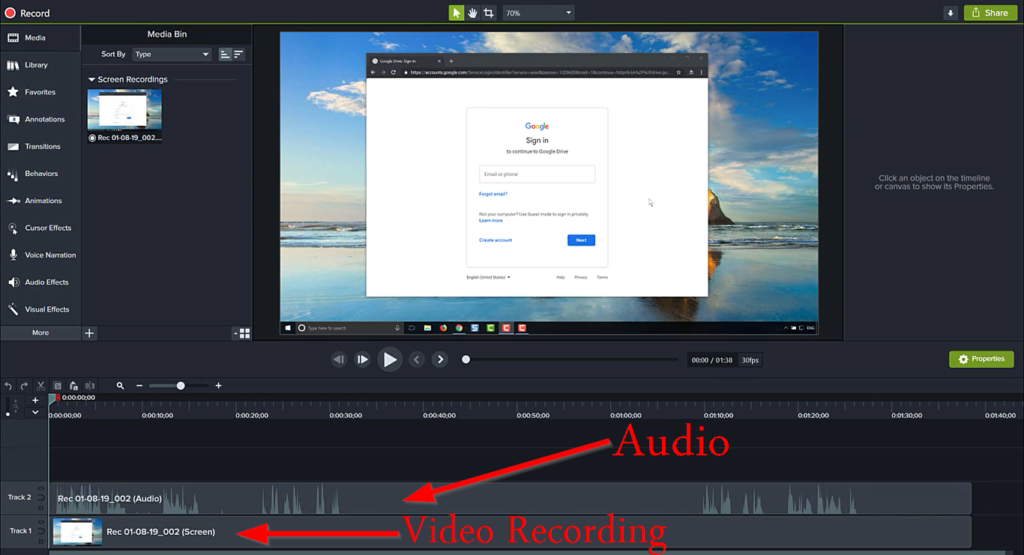
Camtasia’s timeline feels familiar within an hour. Cut, split, and rearrange clips, add title cards and chapter markers, and build a lesson in sections you can reuse. Themes store your brand colors, fonts, and logo, and templates let you apply the same intro, lower thirds, and outro to every lesson in a course.

I find this consistency matters more than any single effect. A course where every lesson opens the same way feels professional, and templates make that possible without a designer.
Limitation: Camtasia handles a few tracks well but isn’t built for multicam shoots, color grading, or heavy motion graphics. For that kind of production, a full editor like Premiere Pro or DaVinci Resolve fits better.
Feature #4: Text-Based Editing and AI Cleanup
From Essentials up, Camtasia transcribes your narration and lets you edit through the text in Camtasia Audiate. Delete a sentence in the transcript, and the matching audio and video go with it. Audiate also removes filler words like “um” and “uh” automatically, and Camtasia generates unlimited captions, with dynamic captions added in 2026.
Every plan, including Starter, includes background noise removal and webcam background removal. Together, these tools cut the editing time for a narrated lesson dramatically, especially if you record in batches.
Limitation: Audiate runs as a companion app rather than inside the main editor, so the round trip adds a step. Descript still offers a smoother transcript-first workflow, especially for talking-head and podcast-style content.
Feature #5: AI Scripts, Voiceovers, Avatars, and Translation
Create adds AI script generation from a prompt, script improvement, and voiceovers with more than 200 voices, with control over mood, speed, and accent. Pro adds avatar videos with 49 styles, script translation, audio dubbing, image generation, and AI titles, chapters, and descriptions.
These tools make sense for a specific situation. If you sell a course in several languages, or you want to update lessons without re-recording your voice, they can save real production time.
Limitation: AI voices sound fine for short explainers but tire the ear over a long lesson, and avatars still look synthetic. Most solo course creators get more trust from their own voice and face, so I wouldn’t upgrade for these features alone.
Feature #6: In-Video Quizzes
Camtasia lets you add quizzes at any point in a video, with multiple choice, fill-in-the-blank, short-answer, and true/false questions, plus open-ended survey questions. Quizzes work scored or unscored, and you decide whether viewers see their results.
For learning, quizzes inside a video help break up passive watching and check understanding at the moment it matters. TechSmith supports quizzes through the Smart Player, Screencast, and SCORM packages.
Limitation: Quizzes don’t survive a plain MP4 upload or a YouTube embed. Most course platforms, including Thinkific, Kajabi, and Teachable, play standard video files, so build your quizzes in the platform instead. Camtasia quizzes make the most sense when you deliver through an LMS or Screencast.
Feature #7: SCORM Export for LMS Delivery
Camtasia can package a video, its player, captions, table of contents, and quizzes as a SCORM package. Upload the package to an LMS like TalentLMS or Moodle, and quiz scores flow into the gradebook. TechSmith notes that SCORM is the only delivery option that both keeps quizzes and reports scores.
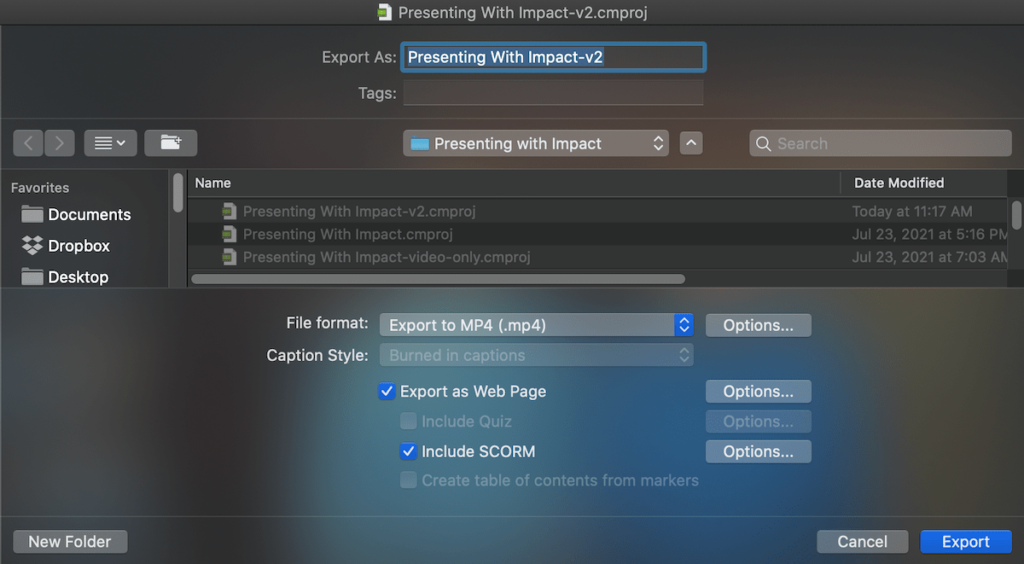
SCORM matters most when you sell training to companies, associations, or schools that track completions in their own LMS. For a direct-to-learner course on a creator platform, you can skip it.
Limitation: Each SCORM package holds one video, so Camtasia doesn’t replace a full authoring tool like Articulate or Adobe Captivate for branching scenarios and multi-slide modules.
Feature #8: Sharing, Screencast, and Collaboration
Camtasia exports local MP4 files and publishes directly to YouTube and Screencast, TechSmith’s video hosting service. Screencast adds viewer comments and notifications, and the 2026 Camtasia Online workflow lets collaborators review a project in the browser before you finish it in the desktop editor.
Limitation: Plans below Pro host only 25 videos on Screencast, and Camtasia offers nothing like real-time multi-editor collaboration. For full course hosting, upload your videos to your course platform instead.
For Mac users, read my ScreenFlow vs Camtasia comparison
Camtasia System Requirements
| Component | Minimum | Recommended |
|---|---|---|
| Windows | Windows 10 64-bit, version 20H2 or later | Windows 11 64-bit, version 23H2 or later |
| Mac | macOS 14 | macOS 26 or later on Apple silicon (M1 Pro or newer) |
| Windows processor | Intel Haswell or AMD Ryzen 2000 series, with AVX2 support | Intel 12th Gen or AMD Ryzen 4000 series or newer |
| Memory | 8 GB RAM | 16 GB RAM or more |
| Storage | 4 GB free space | SSD with 4 GB or more free |
Store media on a local drive. TechSmith doesn’t support cloud-synced folders during recording or editing, and that single setting causes many of the crashes people blame on Camtasia.
Camtasia Pros and Cons
| Pros | Cons |
|---|---|
| Built for screen-based teaching, with cursor effects, callouts, and SmartFocus zooms | Quizzes don’t work in MP4 uploads or YouTube embeds |
| Records screen, webcam, mic, and system audio as separate tracks up to 4K | Subscription only since 2025, with no one-time license |
| Text-based editing, filler word removal, and unlimited captions from Essentials | Audiate runs as a separate app from the editor |
| Snagit included with every plan | Needs 16 GB of RAM for smooth long projects |
| SCORM export reports quiz scores to an LMS | Not built for multicam or heavy production |
| Short learning curve compared with Premiere or Resolve | AI avatars, translation, and premium assets cost $599/year |
Is Camtasia Worth the Money?
Essentials costs $179.88 a year, roughly $14.99 a month, and it bundles three tools, Camtasia Editor, Audiate, and Snagit. Snagit alone covers screenshots for guides, handouts, and slides, so the bundle holds up well for anyone who uses all three.
The value drops if you don’t teach on screen. Talking-head creators pay for cursor tools and SCORM export they never touch, and Mac users who edit only occasionally may prefer ScreenFlow as a one-time purchase at $199. Creators on a tight budget can start with ScreenPal from $4/mo billed annually and move up later.
My rule of thumb is simple. If a third of your course content shows a screen, Camtasia pays for itself in editing time within the first course.
Camtasia vs Alternatives
| Tool | Best for | Starting price | Where it beats Camtasia | Where Camtasia wins |
|---|---|---|---|---|
| Camtasia | Screen-based course lessons | $179.88/year (Essentials) | Not applicable | Not applicable |
| Descript | Talking-head videos and podcasts | Free, or $16/mo billed annually | Smoother transcript editing and collaboration | Cursor effects, quizzes, and SCORM |
| ScreenFlow | Mac users who want a one-time license | $199 one-time | No subscription, fast on Mac | Windows support, quizzes, and SCORM |
| ScreenPal | Budget recording and simple edits | Free, or $4/mo billed annually | Much lower price | Editing depth and polish |
| Loom | Quick async video messages | Free, or $15/user/mo billed annually | Instant sharing and viewer analytics | Real editing and course-ready output |
| Adobe Captivate | Full e-learning authoring | $39.99/mo | Branching scenarios and multi-slide modules | Ease of use and video editing |
For a deeper comparison, see my full list of Camtasia alternatives and my ScreenPal review.
Which Tool Should You Choose?
| Your situation | Best choice | Why |
|---|---|---|
| You teach software or record slide-based lessons | Camtasia Essentials | Cursor effects, callouts, and captions in one editor |
| You sell training to companies with an LMS | Camtasia Essentials | SCORM export with quizzes that report scores |
| You mostly film yourself on camera | Descript | Transcript-first editing built for talking heads |
| You work on a Mac and dislike subscriptions | ScreenFlow | One-time license with strong Mac performance |
| You need quick, cheap screen recordings | ScreenPal | Low yearly cost and easy sharing |
| You build interactive modules with branching | Adobe Captivate | A full authoring tool rather than a video editor |
| You localize a course into several languages | Camtasia Pro | Translation, dubbing, and AI voices in one place |
Final Verdict: Camtasia Still Leads for Screen-Based Teaching
Camtasia remains my first choice when a lesson lives on a screen. The recording, cursor tools, and timeline save hours on every tutorial, and Essentials covers everything most course creators need.
Go in with clear expectations. Use your course platform’s quizzes unless you deliver through an LMS, keep projects on a local drive, and upgrade to Create or Pro only when AI voices or translation save you real production time. When your videos are ready, my guide to the best online course platforms can help you choose where to sell them.
The desktop trial has no time limit, so download Camtasia, record one real lesson, and judge the workflow before you pay.
Frequently Asked Questions (FAQs)
Is Camtasia free?
Camtasia Online is free and records your screen and webcam at 1080p in the browser with no watermark. The desktop Camtasia Editor has a trial with no time limit, but every export carries a watermark until you buy a plan. Full editing, quizzes, and SCORM export need a paid plan from Essentials up.
How much does Camtasia cost?
Camtasia sells four yearly plans. Starter costs $39, Essentials costs $179.88, Create costs $249, and Pro costs $599. Every plan includes Snagit and a 14-day money-back guarantee. Most course creators need Essentials, which removes the watermark and adds text-based editing and captions.
Can I still buy Camtasia as a one-time purchase?
No. TechSmith moved Camtasia to yearly subscriptions only with Camtasia 2025, released in February 2025. If you bought a perpetual license earlier, you keep access to that version, and TechSmith supports Camtasia 2024 through the end of 2026 for customers without a maintenance plan.
Do Camtasia quizzes work on Thinkific, Kajabi, or YouTube?
No. Camtasia quizzes only play inside TechSmith’s Smart Player, on Screencast, or in a SCORM package. A plain MP4 upload or a YouTube embed drops the quizzes. On creator platforms like Thinkific and Kajabi, build quizzes with the platform’s own quiz tool and upload the video as a standard file.
Which Camtasia plan includes SCORM export?
Essentials and every higher plan include quizzes and SCORM export. Starter includes them only with watermarked exports. A SCORM package bundles one video with its player, captions, and quizzes, and it reports quiz scores to a SCORM-compliant LMS such as TalentLMS or Moodle.
What computer do I need to run Camtasia?
Camtasia needs at least 8 GB of RAM, Windows 10 64-bit or macOS 14, and 4 GB of free disk space. TechSmith recommends 16 GB of RAM, an SSD, and a recent processor such as Intel 12th Gen, AMD Ryzen 4000, or Apple silicon. Keep media on a local drive, not a cloud-synced folder.
Is Camtasia better than Descript?
Camtasia is better for screen-based tutorials because of its cursor effects, callouts, quizzes, and SCORM export. Descript is better for talking-head videos and podcasts because its transcript-first editing feels faster and supports collaboration. Many course creators record software demos in Camtasia and edit interviews or talking segments in Descript.
Can I use one Camtasia license on a team?
No. TechSmith’s individual plans are non-transferable and tied to one person, so team members can’t share a single login. Teams and businesses need TechSmith’s business or education licensing, which you can request from TechSmith’s sales team for multiple seats and central management.
Does Camtasia have AI features?
Yes. Essentials adds text-based editing, filler word removal, transcription, and unlimited captions. Create adds AI scripts and voiceovers with more than 200 voices. Pro adds avatar videos, script translation, audio dubbing, and AI titles and chapters. Every plan includes background noise removal and webcam background removal.

Jeff Cobb, Founder of Learning Revolution
Jeff Cobb is an expert in online education and the business of adult lifelong learning. Over the past 20+ years he has built a thriving career based on that expertise – as an entrepreneur, a consultant, an author, and a speaker. Learning Revolution is a place where Jeff curates tips, insights, and resources to help you build a thriving expertise-based business. Learn more about Jeff Cobb here.
See also:
- How to Create Effective Video-Based Learning
- How to Create a Simple Home Video Studio for Online Courses
- How to Sell Your Online Video Course
Table of Contents
Related Posts
7 Best Camtasia Alternatives for Creating Online Courses (2026)
7 Key Reasons Online Course Creators Fail