
TL;DR — What Is ClickFunnels, How Much It Costs, and Who It’s For
ClickFunnels is a funnel-first business platform for selling online courses, memberships, coaching programs, and digital or physical products. It gives you sales funnels, a website and store, email marketing, workflows, CRM, courses, communities, and a built-in Payments AI system in one place.
Pricing starts at about $81/month on the Launch plan when billed annually (regularly $97/month), with unlimited funnels and visitors, a 14-day free trial, and a 30-day money-back guarantee. Higher tiers add more contacts, emails, workspaces, and courses.
✅ Best for: Creators and coaches who care most about selling – high-converting funnels, upsells, order bumps, email sequences, and simple course or membership delivery in the same system.
❌ Not for: Educators who need a true LMS with quizzes and graded assignments, deep learning analytics, or a dedicated mobile app for students.
Verdict: ClickFunnels is an excellent choice if your priority is driving revenue from courses and programs. If your main focus is structured teaching and learner experience, a dedicated course platform like Kajabi or Thinkific is still a better fit.
Try ClickFunnels For Free
If you’re like me, you have always thought of ClickFunnels as a sales and marketing tool. It helps you build funnels, generate leads, nurture them, and convert them into customers, especially if you sell online courses, memberships, or coaching programs.
But you have probably never considered it for course creation or delivery because it did not offer those features.
Now, with ClickFunnels 2.0, the platform has been completely rebranded and expanded. It includes course creation, membership sites, email marketing automation, and community tools.
The question is whether these features are good enough to call ClickFunnels an all-in-one course platform. Can it compete with Kajabi, Thinkific, Teachable, or Podia? Or is it still just a sales tool with basic course and membership features?
If you are looking for the best platform to sell and deliver courses, here is what you need to know.
What Is ClickFunnels?
ClickFunnels is a no-code, drag-and-drop platform built for entrepreneurs selling courses, memberships, coaching programs, and other digital or physical products.
It started in 2014 as a plug-and-play funnel builder created by Russell Brunson, helping creators launch high-converting landing pages, upsells, and product funnels without touching complex tech.
High-ticket online courses and membership programs like Amazing have used ClickFunnels to drive millions of dollars in sales over the years.

For years, ClickFunnels was known only as a sales and marketing engine. High-ticket course creators, membership sites, and coaching businesses used it to generate millions of dollars through proven funnels and offer structures. Selling was always its core strength.
But as more of those users started delivering paid courses and programs, ClickFunnels expanded beyond funnels. That evolution led to the current platform—often called ClickFunnels 2.0—which is now a full business hub for creators. You can build funnels, run your website, host your courses, run a store, send emails, manage contacts, run communities, accept payments, and automate your entire customer journey in one system.
What the New ClickFunnels Offers
ClickFunnels today is still a sales-first platform at its core, but it now includes a wide range of apps that support creators at every step of the business:
- Sales Funnels & Smart Checkout – Build funnels, order bumps, upsells, downsells, and fast checkout flows.
- Online Courses & Membership Hosting – Create and deliver courses with progress tracking and completion certificates.
- Community App – Build private or paid communities with groups, topics, moderation tools, and member access controls.
- CRM & Contact Management – Track leads, manage customer profiles, and run pipelines inside the Opportunities app.
- Email Marketing & Automation – Send broadcasts, build automated workflows, split test subject lines, and track revenue from emails.
- Website & Blog Builder – Create full websites, landing pages, and blog content with the same drag-and-drop editor.
- Store & E-commerce Tools – Build a store, manage product collections, and accept digital and physical product orders.
- Payments AI – A built-in payment layer that works with Stripe, PayPal, wallets, and smart retries for failed payments.
- Appointments & Scheduling – Book coaching calls and manage meetings without needing third-party tools.
- Analytics & A/B Testing – Track funnel performance, connect GA4, and test variations to improve conversions.
What ClickFunnels Still Does NOT Offer
Despite the expansion, ClickFunnels isn’t a full LMS or an all-purpose enterprise platform.
Here’s what it still lacks:
- No Native Webinar or Live Video Hosting – You’ll still need Zoom or another live video tool.
- No Quizzes or Assignments – Courses don’t include tests, homework, or graded assessments.
- No Native Mobile App – Students can access content via the browser only.
- No Automated Affiliate Payouts – You can manage affiliates, but payouts must be handled manually.
- No Deep Learning Analytics – No video heatmaps, engagement scoring, or time-on-lesson reports.
(Previously, ClickFunnels also lacked certificates and internal payments, but both now exist through course completion certificates and Payments AI.)
So, is ClickFunnels now a true all-in-one platform like Kajabi, Thinkific, or Podia? Not exactly.
It’s still best for creators who care more about selling than delivering a structured academic learning experience. It’s a powerful sales engine with attached business tools, not a full LMS.
However, one thing ClickFunnels does exceptionally well is frequent product updates. They ship improvements almost every week, which means the platform keeps getting smoother and more reliable over time.
ClickFunnels Pricing (2026) | How Much Does It Cost?
ClickFunnels now offers four pricing plans instead of the old Basic and Platinum structure. The new plans, Launch, Scale, Optimize, and Dominate, are designed to support everything from a solo creator launching their first course to agencies running multiple brands.
Every plan includes the core ClickFunnels toolkit: sales funnels, landing pages, website builder, email marketing, workflows, Payments AI, CRM, online courses, memberships, and the community app. You also get a 14-day free trial and a 30-day money-back guarantee.
| Plan | Monthly Price | Annual Price | Key Features |
|---|---|---|---|
| Launch | $97/month | ~$81/month (billed annually) | 1 workspace, 2 team members, 10,000 contacts, 50,000 emails/month, 3 courses, 5 custom domains, unlimited funnels and visitors |
| Scale | $197/month | ~$164/month (billed annually) | 5 workspaces, 5 team members, 75,000 contacts, 300,000 emails/month, 6 courses, unlimited custom domains, priority support, API access |
| Optimize | $297/month | ~$248/month (billed annually) | 10 workspaces, 10 team members, 150,000 contacts, 750,000 emails/month, 10 courses, full API/webhooks, advanced custom code editor |
| Dominate | Annual only | $5,997/year | 20 workspaces, 20 team members, 400,000 contacts, 1.2 million emails/month, 20 courses, VIP support, 3-hour private onboarding |
ClickFunnels doesn’t take a cut of your sales. You only pay standard payment processing fees, and you can manage everything through Payments AI, which connects multiple gateways (Stripe, PayPal, digital wallets) and handles retries for failed subscription payments.
There’s nothing to install and no separate hosting required. Your funnels, courses, store, emails, and automations all run on ClickFunnels’ cloud infrastructure.
How ClickFunnel Works | Sales Funnels & Business Apps
ClickFunnels is structured around funnels, which act as the core of the platform. Whether you are selling a course, a membership, or a coaching program, everything starts with building a funnel.
A funnel is a guided journey, (a series of opt-in forms, landing pages, emails, and content assets) that turns visitors into paying customers.
Its goal is to drive a specific action like signing up to a list, purchasing a course, attending a webinar, or booking an appointment.

Beyond funnels, ClickFunnels includes various built-in apps that extend its functionality. These apps allow you to sell, deliver, and manage digital products, memberships, and marketing campaigns inside the same system.
When you sign up, the first thing you do is set up a funnel. From there, you can connect different apps to enhance the experience. You can host a course, build a community, send automated emails, or schedule coaching sessions inside ClickFunnels.
The experience focuses on sales because everything is designed to move users from discovery to purchase as efficiently as possible. The platform integrates its apps so that each part of your business, including marketing, product delivery, and customer management, feeds into the funnel system.
If you are used to platforms like Kajabi or Thinkific, where course creation is the starting point, ClickFunnels will feel different.
Here, selling comes first, and product creation follows.
This makes it a strong choice for entrepreneurs focused on monetization, but it may feel less structured for those looking for a traditional course-building experience.
Let’s now take a look at the core features of ClickFunnels.
ClickFunnels Core Features | Sales Funnel Builder & Automation Platform
ClickFunnels is packed with sales, marketing, and (now) product creation features. Let’s get a close look at them to get a sense of what the platform really offers.
ClickFunnels Feature #1: Sales And Marketing Funnels
ClickFunnels is built around sales funnels, a term it has practically made its own.
A sales or marketing funnel is the step-by-step process that turns visitors into paying customers by guiding them through a structured buying journey. Instead of expecting people to figure things out on their own, a funnel moves them through each stage, from awareness to purchase.
Here’s an example of a simple digital product launch funnel.

Technically, you could build a funnel manually using a website, email marketing tool, checkout system, and upsell pages, but this takes time, effort, and creativity.
ClickFunnels removes that struggle by offering drag-and-drop, plug-and-play funnels that have already been tested and optimized by Russell Brunson and his team of marketers and conversion experts.
There are a couple of ways you can create funnels in ClickFunnels
1. AI Funnel Builder
The ClickFunnels AI Funnel Builder creates an optimized funnel based on your prompts and specifications.

It asks you a few simple questions about your business goals and creates a customized funnel within seconds.
It’s not always perfect. But you can use the funnel editor to make any changes and fine tune the funnel before using it.
2. ClickFunnels Funnel Editor
The funnel editor is the place where you can build any kind of funnel drag & drop elements. You can start from scratch or choose pre-designed funnels.
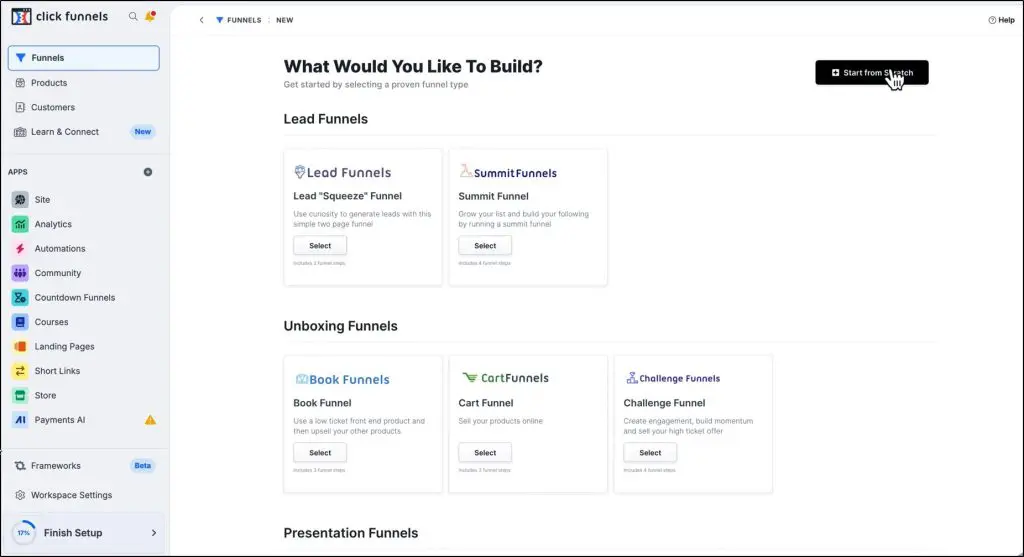
Choose a funnel type based on your goal, choose a template, and customize it with your content.

The platform provides pre-built funnels for different business goals, such as webinar sign-ups, lead generation, product sales, coaching offers, course enrollments, and memberships.
Each funnel is structured to capture leads, nurture them through emails, and close the sale—without requiring you to figure out the technical setup. Plus, every funnel comes with its own set of design templates.

This is why ClickFunnels is so powerful. Instead of spending weeks piecing together separate tools, you get a ready-to-use, conversion-optimized system that lets you focus on growing your business.
Whether you are launching a course, selling digital products, or offering coaching, ClickFunnels hands you a proven sales engine that marketers like Tony Robbins, Grant Cardone, and Dean Graziosi have used for years.
ClickFunnels Feature #2: Online Course & Membership Hosting
ClickFunnels now lets you create, sell, and deliver online courses and memberships without third-party integrations.
The process is quick and straightforward.

You can build courses using the drag-and-drop course builder, organize lessons into modules, and choose whether to release content all at once or drip it over time.
The biggest advantage of creating courses in ClickFunnels is how seamlessly they integrate with its sales funnels. For example, you can:
- Build a high-converting funnel to capture leads and sell your course.
- Automatically enroll students after they purchase through your funnel.
- Trigger email sequences to onboard students and keep them engaged.
- Offer upsells and order bumps for memberships or additional content.
- Give VIP access to a private community within ClickFunnels.
Unlike traditional course platforms, ClickFunnels prioritizes sales first and course delivery second. This means your courses are not just sitting inside a dashboard waiting for buyers. You are actively driving traffic to them using proven funnels.
What ClickFunnels 2.0 offers for courses & memberships:
- Drag-and-Drop Course Builder – Easily structure modules and lessons.
- Drip Content and Lesson Scheduling – Release content gradually.
- Basic Student Progress Tracking – Tracks lesson completions.
- Membership Areas – Restrict content access for paid members.
- Seamless Funnel Integration – Automate course enrollments and upsells.

ClickFunnels is not trying to replace Kajabi, Thinkific, or Teachable as a full-fledged learning management system.
Instead, it is best for entrepreneurs who care more about selling their courses than managing a structured educational experience.
Here’s what it specifically lacks in terms of course creation
- No Quizzes, Assignments – Unlike Kajabi and Thinkific, ClickFunnels does not have built-in tools to test student knowledge.
- No Advanced Student Engagement Tracking – You can see if a student completed a lesson, but ClickFunnels does not track video engagement, quiz scores, or time spent per lesson.
- No Mobile App for Course Access – Platforms like Kajabi and Teachable allow students to access courses via a mobile app, but ClickFunnels does not.
It’s clear your courses won’t be as engaging with ClickFunnels as they’d be with a dedicated online course platform.
But with ClickFunnels’ sales engine, email automation, and membership features, this course hosting feature makes it possible to not only create a course but also turn it into a sales-generating machine.
ClickFunnels Feature #3: Community and Private Groups
ClickFunnels includes a Community App that lets course creators build private groups for students, members, or paying subscribers.
It’s one of the best ways to build a loyal group around your brand especially in the age of AI when people are looking to connect with authentic experts for real-world insights.

This feature allows you to create structured discussions, share exclusive content, and encourage engagement without relying on public platforms like Facebook Groups.
- Organized Discussions and Groups – Create structured conversations around topics.
- Engagement Features – Members can post, comment, and interact.
- Content Sharing – Share updates, videos, and exclusive content.
You can create dedicated groups within communities, and each group can have multiple topics to organize discussions.
Plus, you can control who accesses groups or add a pay shall to a specific section of the community for exclusive access.
While this adds value, ClickFunnels’ community features are fairly basic.
- No gamification or engagement tracking like Mighty Networks.
- No built-in live events or coaching rooms like Kajabi.
- No mobile app for easy access.
That said, when paired with ClickFunnels’ funnels and email automation, this feature is great for keeping buyers engaged after a sale. It works well for membership communities, coaching groups, or premium course discussions.
ClickFunnels Feature #4: Email Marketing & Automation
ClickFunnels now includes built-in email marketing and automation, allowing users to send newsletters, create automated sequences, and segment subscribers without needing third-party tools like Mailchimp or ConvertKit.
What makes ClickFunnels’ email system unique is how it directly connects to your sales funnels, courses, and memberships. Instead of manually linking your email service to different sales steps, ClickFunnels automates the process within its ecosystem.
With ClickFunnels, you can:
- Send a welcome sequence automatically when someone buys a course or joins a membership.
- Follow up on abandoned checkouts with reminders or discounts.
- Segment leads automatically based on which funnel step they completed.
- Promote upsells, community access, or additional courses without external integrations.
Here’s what ClickFunnels email marketing allows you to do:
- Broadcast Emails – Send newsletters and promotional campaigns.
- Automated Sequences – Run welcome, nurture, and sales follow-ups.
- Segmentation & Tagging – Target subscribers based on behavior.
- Basic A/B Testing – Test subject lines and email variations.
It gives you an email builder which is quite similar to a page builder where you can drag & drop different elements to design your emails.
Then you can use different filters to choose your audience based on their activity, status, lifetime value, course subscriptions and several other activities.
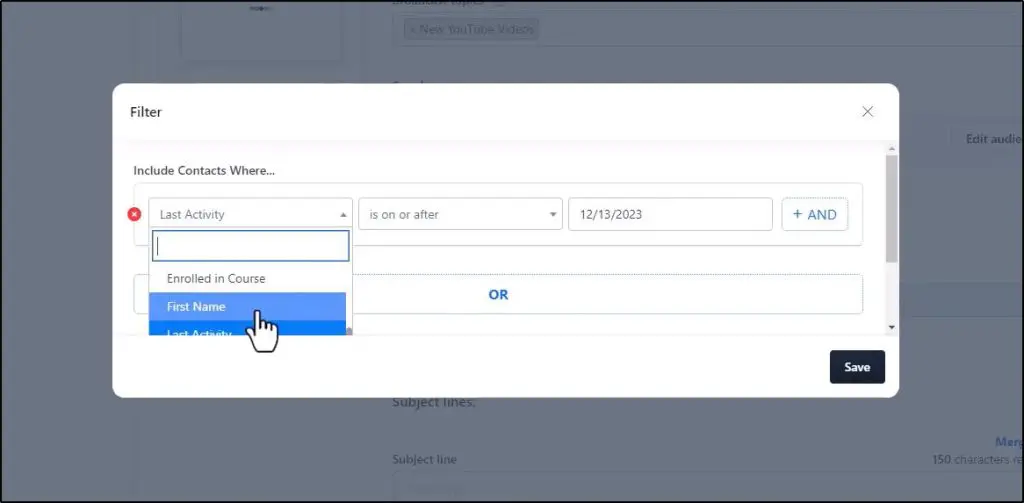
ClickFunnels also has a powerful Workflow Builder where you can create complete email automation using a drag & drop interface.

You can use conditional paths for if-then-else scenarios, add delays, define triggers, and adjust just about everything in your email sequences.
However, ClickFunnels has several limitations in its automation features. For example:
- No behavior-based triggers – You cannot automatically email students who haven’t logged in for a certain period or send reminders to those who started a lesson but didn’t finish.
- No AI-driven send-time optimization – Platforms like ConvertKit optimize email timing based on individual engagement patterns, but ClickFunnels sends emails at the same scheduled time for everyone.
For most course and membership sellers, ClickFunnels’ email automation is good enough. If your focus is selling courses, onboarding students, and promoting upsells, its built-in email system works well, especially since it seamlessly integrates with funnels, checkout pages, and membership access.
However, it’s not a complete replacement for a dedicated email marketing tool.
ClickFunnels Feature #5: Website & Blog Builder
ClickFunnels includes a full website builder, allowing users to create homepages, about pages, course websites, and sales pages—all using drag-and-drop customization with no coding required.
It offers pre-designed templates optimized for conversions, making it easy to launch a site quickly. Users can customize fonts, colors, and layouts using different widgets and design elements.
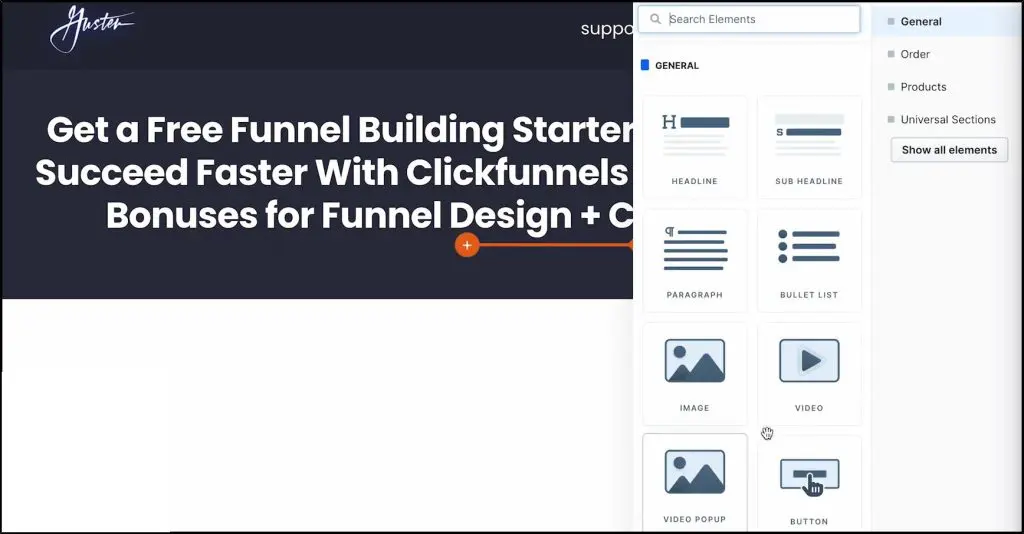
ClickFunnels also supports custom domains, so you can build a branded site without needing a third-party host.
The blog functionality allows for basic SEO settings like metadata and structured content, but it lacks advanced blogging tools like WordPress.
While ClickFunnels can replace a standalone website for many course creators, it is still built for sales-focused sites rather than content-heavy platforms.
If you need a marketing-driven website that integrates directly with funnels, memberships, and email automation, ClickFunnels does the job.
But for a robust blogging platform, you may need an external solution.
ClickFunnels Feature #6: Appointment Booking & Scheduling
For high-ticket course creators and coaches, ClickFunnels’ Appointments App is a valuable tool that lets you book, manage, and automate client calls without needing external scheduling apps like Calendly.
This is especially useful for coaching programs, one-on-one mentorships, or sales calls for premium courses.
You can embed a booking form directly into their sales funnel, allowing potential clients to schedule a consultation immediately after opting in.
Payment integration means you can charge for sessions upfront, making it ideal for paid coaching calls or strategy sessions. Its automated email and SMS reminders help reduce no-shows, keeping your calendar organized.
However, ClickFunnels lacks group scheduling, team booking, or built-in Zoom integration, so meeting links must be manually added.
Other Useful ClickFunnels Features
Beyond sales funnels, courses, and email marketing, ClickFunnels 2.0 includes several additional tools that enhance sales and customer management. The built-in CRM & Contact Management system lets you track leads, manage customer interactions, and organize sales opportunities without needing external software.
Analytics & A/B Testing allow you to monitor funnel performance, track conversions, and test different page variations to optimize sales.
The Affiliate Center enables users to create and manage an affiliate program for their courses or memberships (but you must manage payouts yourself).
ClickFunnels also includes Countdown Timers to drive urgency, Short Links for branded tracking, and Survey Workflows for collecting customer insights.
While these features may not be as advanced as standalone platforms, they provide course creators and coaches with essential marketing, tracking, and engagement tools—all inside one system.
ClickFunnels Pros And Cons | What Are Its Main Strengths & Weaknesses?
ClickFunnels is still a sales-first platform with strong funnels, built-in payments, email, and course delivery. But creators who need deep LMS features or advanced marketing automation may still need additional tools.
| Pros | Cons |
|---|---|
| Powerful plug-and-play funnels built for selling courses, coaching, memberships, and high-ticket offers. | No quizzes, assignments, graded tests, or structured learning paths. Still not a full LMS. |
| Combines funnels, email, automations, CRM, courses, communities, e-commerce, and scheduling in one system. | No native mobile app for students or community members. |
| Courses include progress tracking and completion certificates, plus cleaner video playback and bulk video upload. | Course analytics remain basic. No engagement heatmaps or detailed reporting. |
| Payments AI handles subscriptions, failed payment retries, and multiple gateways without extra tools. | Affiliate system requires manual payouts. No automatic commission payments. |
| Email marketing now includes subject line split testing, revenue tracking, and a smoother workflow builder. | Email automation is still mid-level — not as advanced as dedicated platforms like ActiveCampaign. |
| Communities and membership spaces are built-in, with group discussions, topics, and moderation controls. | Blogging and SEO features are basic; not ideal for long-form content or organic growth. |
| Unlimited funnels and unlimited visitors even on the lowest plan. | No built-in webinar hosting — you still need Zoom or another tool for live sessions. |
| Drag-and-drop page, funnel, and site builder with new mobile/desktop styling controls. | Coaching tools are simple; group sessions and advanced scheduling require external tools. |
| Appointment booking removes the need for separate schedulers for coaching calls. | Best suited for selling — not for academics or structured online education. |
Verdict | Who Should Use ClickFunnels? Is It Worth Your Money?
ClickFunnels is best for course creators, coaches, and membership site owners who prioritize sales and marketing over deep student engagement.
It is a powerful tool for selling high-ticket courses, automating enrollments, and managing memberships without third-party integrations.
However, it is not a true learning management system (LMS) and lacks advanced course tracking, quizzes, and certifications.
In short, ClickFunnels is great for selling courses, but if structured learning is your priority, you may need a dedicated course platform.
Frequently Asked Questions (FAQs)
Does ClickFunnels 2.0 offer a free trial?
Yes, ClickFunnels 2.0 offers a 14-day free trial with full access to its core features so you can test sales funnels, email marketing, and course hosting.
Can you build a website entirely with ClickFunnels 2.0?
Yes, ClickFunnels includes a drag-and-drop website builder with support for custom domains, landing pages, blogs, and branded sites.
Is ClickFunnels 2.0 GDPR compliant?
ClickFunnels 2.0 offers basic GDPR tools like consent checkboxes and data exports, but full compliance depends on how you configure your funnels.
Can I sell physical products using ClickFunnels 2.0?
Yes, you can sell physical products using the sales funnel system, but it lacks advanced inventory and shipping features like Shopify.
Does ClickFunnels support upsells and order bumps?
Yes, ClickFunnels makes it easy to add upsells, downsells, and order bumps directly into your funnel to maximize revenue.
Can you integrate ClickFunnels 2.0 with WordPress?
While there’s no official plugin, you can integrate ClickFunnels with WordPress via subdomains or embed funnel elements using HTML blocks.
Does ClickFunnels 2.0 work with Stripe and PayPal?
Yes, ClickFunnels supports both Stripe and PayPal through Payments AI for processing payments within your sales funnels.
Can you host a webinar on ClickFunnels 2.0?
ClickFunnels does not offer native webinar hosting but integrates easily with tools like Zoom or WebinarJam for webinar funnels.
Is ClickFunnels good for beginners with no tech skills?
Yes, ClickFunnels is designed for non-technical users with pre-built templates and an intuitive editor that requires no coding.
Can you migrate from Kajabi or Teachable to ClickFunnels 2.0?
You can manually recreate courses and funnels in ClickFunnels, but there is no direct migration tool. It’s best for new projects or simplified course structures.
Table of Contents





ClickFunnels used to be great — now it’s a mess.
Constant bugs, poor reactivity, and overpriced compared to newer tools that do the same job 6x cheaper.
They call themselves “premium,” but when something goes wrong and you ask for support or a refund, you just get silence.
Can you suggest a better alternative to ClickFunnels in your experience? And what aspects of the platform do you think are overpriced or underwhelming?