

TL;DR: Kajabi vs ClickFunnels: Which Platform Is Right For Your Business? (2026)
I’ve used Kajabi since 2017. Both platforms can build funnels and sell courses, and they started from opposite ends.
Kajabi is an all-in-one platform for knowledge businesses. It’s built to deliver courses, coaching, communities, and memberships, with strong marketing tools to sell them.
ClickFunnels is a sales funnel and marketing platform. It’s built to turn traffic into buyers for any kind of product, and it also includes courses, a community, and a store.
Pricing & Free trial
Kajabi starts at $143/month on annual billing ($179 monthly), with no platform fee when you use Kajabi Payments. The trial is 14 days, or 30 days with our link.
ClickFunnels starts at $81/month on annual billing ($97 monthly) and takes no share of your sales. It offers a free trial and a 30-day money-back guarantee.
Choose Kajabi if you sell what you know, and the learning experience matters as much as the sale.
Choose ClickFunnels if selling is the hard part of your business, or you sell physical products and services alongside digital ones.
Try Kajabi for Free | Try ClickFunnels for Free
Kajabi and ClickFunnels look similar on a features page. Both build landing pages and funnels, send email, take payments, and host online courses.
But they were designed for different jobs.
Kajabi is a platform for people who sell their expertise. I’ve used it since 2017, and I rank it among the best online course platforms because it delivers the product as well as it sells it.
ClickFunnels is a platform for selling. It was built around the sales funnel, and its course and community tools were added to give marketers something to deliver.
In this comparison I cover what each one costs at real revenue levels, how their features differ across nine areas, and which one fits your expertise-based business.
Kajabi vs ClickFunnels: The Main Differences
Kajabi starts with the product and adds marketing. ClickFunnels starts with marketing and adds products.
| Kajabi | ClickFunnels | |
|---|---|---|
| Built for | Edupreneurs who sell courses, coaching, communities, and memberships | Marketers and businesses that sell any product through funnels |
| Core strength | Learning experience, coaching, community, and AI | Funnels, page building, split testing, workflows, and CRM |
| Starting price | $143/mo on annual billing ($179 monthly) | $81/mo on annual billing ($97 monthly) |
| Share of sales | None with Kajabi Payments. 2% (Basic), 1% (Growth), 0.5% (Pro) with a third-party provider | None |
| Courses and products | 5 products on Basic, 50 on Growth, unlimited on Pro | 3 courses on Launch, 6 on Scale, 10 on Optimize |
| Contacts | 2,500, 25,000, or 100,000 | 10,000, 75,000, or 150,000 |
| Marketing emails | Unlimited on every plan | 50,000, 300,000, or 750,000 a month |
| Funnels and landing pages | Unlimited on every plan | Unlimited funnels on every plan, with A/B testing |
| Coaching | Native scheduler, built-in video, and automatic recordings | Appointments app for bookings |
| Physical products | Built for digital products | Store app and store funnels |
| Money-back guarantee | 30 days | 30 days |
Read: The best online course platforms right now
Kajabi vs ClickFunnels Overview
Both platforms aim to replace a stack of separate tools. Here’s what each one is and what it includes.
What Is Kajabi?
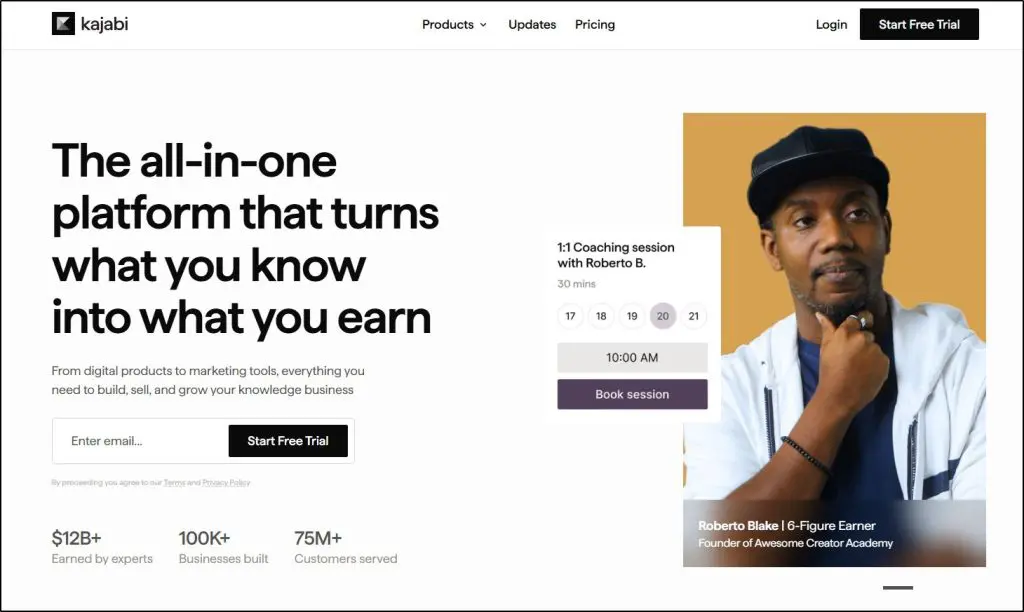
Kajabi is an advanced all-in-one platform for knowledge businesses. It combines course hosting, coaching, community, a website builder, email marketing, sales funnels, and automation in one account.
What sets it apart from ClickFunnels is what happens after the sale.
Kajabi’s course player, community, coaching tools, and mobile app are first-class products. It can carry a customer along the full Value Ramp, from a free lead magnet to a course, a membership, and a high-ticket coaching offer.
In other words, you can call Kajabi a business platform for people in the creator economy who sell what they know.
But its marketing tools, while strong, aren’t as deep as a dedicated funnel builder’s.
Read my full Kajabi review for more detail.
Main Kajabi Features
- Course builder with video, drip, lesson locking, graded quizzes, and certificates
- Coaching with a native scheduler, built-in video, and automatic session recordings
- Community with channels, live rooms, challenges, and leaderboards
- Unlimited funnels, landing pages, and marketing emails on every plan
- Email marketing with sequences, tagging, and behavior-based automations
- Cofounder AI assistant and an MCP connection to Claude or ChatGPT
- A mobile app for customers on every plan
- Affiliate program on Growth and above

What Is ClickFunnels?
ClickFunnels is a sales funnel builder that has grown into a full marketing platform. The company says more than 100,000 people use it.
Everything in ClickFunnels points toward the sale.
You build a funnel from linked pages, test versions against each other, and add upsells at checkout. Around that core, ClickFunnels now includes email, automations, a CRM, appointments, an online store, courses, and a community.
In other words, you can call ClickFunnels a selling machine that also gives you a place to deliver what you sold.
But its course tools are basic, and every plan caps the number of courses you can run.
Read my full ClickFunnels review for a closer look.
Main ClickFunnels Features
- Drag-and-drop funnel and page editor with A/B testing
- Smart Checkout with order bumps and one-click upsells
- Survey funnels, countdown funnels, and store funnels
- Email marketing and an Automations app for workflows
- CRM with opportunities and a Message Hub for conversations
- Appointments app for bookings and follow-ups
- Courses, membership areas, and a Community app
- Online store for physical and digital products
- AI writing tools, plus an Affiliate Center on Optimize and Dominate

Kajabi vs ClickFunnels Pricing: How Much Do They Cost
ClickFunnels is cheaper at the entry level and includes far more contacts. Kajabi includes more products and unlimited email.
Kajabi Pricing
Kajabi has three plans and no free plan. The standard trial is 14 days with a card on file, and our link extends it to 30 days. Every plan also carries a 30-day money-back guarantee.
- Basic: $143/month billed annually ($179 billed monthly)
- Growth: $199/month billed annually ($249 billed monthly)
- Pro: $399/month billed annually ($499 billed monthly)
| Feature | Basic | Growth | Pro |
|---|---|---|---|
| Products (courses, coaching, downloads) | 5 | 50 | Unlimited |
| Contacts | 2,500 | 25,000 | 100,000 |
| Communities | 1 | 1 | 3 |
| Websites | 1 | 1 | 3 |
| Admin users | 2 | 11 | 26 |
| AI credits | 0 | 500 | 1,000 |
| Cohort courses | ✗ | ✓ | ✓ |
| Affiliate program | ✗ | ✓ | ✓ |
| Advanced automations & webhooks | ✗ | ✓ | ✓ |
| Remove Kajabi branding | ✗ | ✓ | ✓ |
| Custom code editor | ✗ | ✗ | ✓ |
| API access | ✗ | ✗ | Yes ($25/mo value) |
| Branded mobile app | ✗ | ✗ | Included ($199/mo value) |
| Kajabi Payments fee | 2.9% + $0.30 | 2.8% + $0.30 | 2.7% + $0.30 |
| Fee with 3rd-party gateway | 2% | 1% | 0.5% |
| Kajabi MCP | ✓ | ✓ | ✓ |
| Marketing emails, landing pages and funnels | Unlimited | Unlimited | Unlimited |
Basic is tighter than its price suggests. It allows 5 products and 2,500 contacts, and it leaves affiliates, cohort courses, advanced automations, and AI credits to Growth.
I cover each plan in my Kajabi pricing guide.
ClickFunnels Pricing
ClickFunnels has four plans. It takes no percentage of your sales, and every plan carries a 30-day money-back guarantee.
- Launch: $81/month billed annually ($97 billed monthly)
- Scale: $164/month billed annually ($197 billed monthly)
- Optimize: $248/month billed annually ($297 billed monthly)
- Dominate: $5,997 a year, billed annually only
| Feature | Launch | Scale | Optimize | Dominate |
|---|---|---|---|---|
| Funnels | Unlimited | Unlimited | Unlimited | Unlimited |
| Contacts | 10,000 | 75,000 | 150,000 | 400,000 |
| Emails per month | 50,000 | 300,000 | 750,000 | 1.2 million |
| Courses | 3 | 6 | 10 | 20 |
| Workspaces | 1 | 5 | 10 | 20 |
| Team members | 2 | 5 | 10 | 20 |
| Custom domains | 5 | Unlimited | Unlimited | Unlimited |
| AI tools (words) | 1 million | 2 million | 5 million | 10 million |
| Email marketing, CRM pipelines, Payments AI, courses, community | ✓ | ✓ | ✓ | ✓ |
| Automations (workflows) | ✗ | ✓ | ✓ | ✓ |
| Advanced workflows | ✗ | ✗ | ✓ | ✓ |
| Appointments | ✗ | ✓ | ✓ | ✓ |
| Calendars | None | 5 | 10 | 20 |
| Countdown funnels and conversion boosters | ✗ | ✓ | ✓ | ✓ |
| Affiliate Center | ✗ | ✗ | ✓ | ✓ |
| Custom code editor, webhooks and API | ✗ | ✓ | ✓ | ✓ |
| Support | Standard | Priority and live chat | Priority and live chat | VIP and live chat |
| Onboarding calls | Group | Group | Group plus private 1 hour | Group plus private 3 hours |
The course limit is the one to watch. Launch allows 3 courses and Scale allows 6, which is low for a course business. ClickFunnels also lists unlimited funnels as a limited-time offer, so check that before you buy.
Contacts and email volume are generous. Launch includes 10,000 contacts, four times what Kajabi Basic allows.
Kajabi vs ClickFunnels Pricing Comparison
Here’s how the comparable plans line up. Prices are per month on annual billing.
| Kajabi | ClickFunnels | |
|---|---|---|
| Entry plan | Basic at $143 | Launch at $81 |
| Mid plan | Growth at $199 | Scale at $164 |
| Upper plan | Pro at $399 | Optimize at $248 |
| Share of sales | None with Kajabi Payments | None |
| Card processing | 2.9% + 30¢ on Basic, 2.8% on Growth, 2.7% on Pro | Your payment gateway’s rates |
| Courses and products | 5, 50, or unlimited | 3, 6, or 10 courses |
| Contacts | 2,500, 25,000, or 100,000 | 10,000, 75,000, or 150,000 |
| Emails | Unlimited | 50,000, 300,000, or 750,000 a month |
| Money-back guarantee | 30 days | 30 days |
Kajabi vs ClickFunnels: Real Cost at $10,000 and $50,000 a Month
Plan prices tell you little once you’re selling. So I worked out what each plan costs in a month where you sell $10,000 and one where you sell $50,000.
I’ve assumed a $200 average sale, annual billing, US cards, Kajabi Payments on the Kajabi side, and standard processing of 2.9% plus 30 cents on the ClickFunnels side. Neither platform takes a share of sales.
| Plan | Cost at $10,000/month | Cost at $50,000/month |
|---|---|---|
| Kajabi Basic | $448 | $1,668 |
| Kajabi Growth | $494 | $1,674 |
| Kajabi Pro | $684 | $1,824 |
| ClickFunnels Launch | $386 | $1,606 |
| ClickFunnels Scale | $469 | $1,689 |
| ClickFunnels Optimize | $553 | $1,773 |
ClickFunnels Launch is the cheapest plan here at both levels. At $10,000 a month it costs $386, against $448 for Kajabi Basic, a difference of $62.
The mid plans are close. ClickFunnels Scale costs $469 at $10,000 and Kajabi Growth costs $494. At $50,000, Kajabi Growth comes out $15 cheaper, because its processing rate drops to 2.8%.
So price won’t settle this. What you sell will.
If you sell courses, ClickFunnels’ limit of 3, 6, or 10 courses will push you up a tier long before its contact limits do. If you sell one or two offers to a large list, ClickFunnels gives you far more contacts for the money.
You can check the processing math on your own prices with my Stripe fee calculator.
Kajabi vs ClickFunnels Features: How They Compare
I’ve compared the two platforms across nine areas. The first four cover what you deliver, and the last five cover how you market and sell it.
| Feature | Winner | Why |
|---|---|---|
| Course creation and learning structure | Kajabi | Lesson locking, graded quizzes, cohorts, and far higher product limits |
| Community | Kajabi | Live rooms, challenges, leaderboards, and an app |
| Coaching | Kajabi | Built-in video, recordings, and a client workspace |
| AI features | Kajabi | An assistant for the whole business, plus an MCP connection |
| Landing pages and websites | ClickFunnels | A more flexible editor with A/B testing |
| Sales funnels | ClickFunnels | Split testing, Smart Checkout, and more funnel types |
| Email marketing | Kajabi | Unlimited sending tied to course and community activity |
| Automation | ClickFunnels | Visual workflows on every plan |
| CRM, checkout, and other sales tools | ClickFunnels | A sales pipeline, a message hub, and an online store |
Kajabi wins five and ClickFunnels wins four.
But the split is clean. Kajabi wins everything about delivering a knowledge product. ClickFunnels wins almost everything about selling one.
Feature #1: Course Creation and Learning Structure
The course builder shapes how students experience your product and whether they finish it. I’ve included memberships here because both platforms use them to package content.
Kajabi
Kajabi’s course builder was made for teaching. You organize lessons into modules, add video, audio, and text, and drip content on a schedule. Product templates give you a starting structure.
It gives you real control over progress. You can lock a lesson until the student completes the previous one, grade quizzes against a pass mark, and issue completion certificates. Cohort courses come with Growth, and students can learn in the Kajabi mobile app on every plan.
The limits are 5 products on Basic and 50 on Growth, and Kajabi has no formal exam or native assignment tool. Memberships are products you build from courses, community access, and coaching.
ClickFunnels
ClickFunnels includes a Courses app and membership areas. You can organize lessons into modules, add video and text, drip content, and place the course behind a login in its Customer Center.
It works for a simple course that follows a funnel. Because the course sits inside the same system, a purchase can enroll the buyer automatically and a workflow can follow up.
It covers more than I expected, with course templates, progress tracking, automated certificates, and scheduled content releases. But it’s still thin as a learning tool. I haven’t found graded quizzes with a pass mark, lesson locking, or cohort features in ClickFunnels, or a student mobile app. The plan limits are strict, with 3 courses on Launch, 6 on Scale, and 10 on Optimize.
Winner: Kajabi. It’s a full course platform with progress controls and a mobile app. ClickFunnels hosts a basic course and caps how many you can run.
Feature #2: Community
A community keeps customers engaged after the sale and gives you a recurring product. Both platforms now include one.
Kajabi
Kajabi’s community is a full product on every plan. You create channels for topics or member groups and control access through unlimited access groups. Members get direct messaging, live rooms, meetups, challenges, and leaderboards.
You can sell the community by itself or bundle it with courses and coaching. A comment-to-DM feature turns public replies into private conversations. Members use it on the web and in the Kajabi app.
The limit is the number of communities. Basic and Growth include one, and Pro includes three, so you organize programs through channels and access groups until you reach the top plan.
ClickFunnels
ClickFunnels has a Community app that lets you create groups and topics, post updates, and moderate discussion. It sits beside your courses in the member area.
For a marketer, its value is retention. Buyers who join a community after a purchase stay closer to your next offer, and you manage them in the same contact record as your funnels and emails.
It’s a basic discussion space. I haven’t found live rooms, challenges, leaderboards, or a member mobile app in ClickFunnels. If community is a product you plan to charge for, compare a dedicated community platform as well.
Winner: Kajabi. Its community has live rooms, challenges, and an app, and you can sell it as a product. ClickFunnels offers a simple discussion area.
Feature #3: Coaching
Coaching usually carries your highest price, so how a platform books, delivers, and records sessions affects your best offer.
Kajabi
Kajabi handles the whole coaching workflow in-house. Kajabi Scheduler manages your availability, buffers, and reminders, and calls run on Kajabi Live, its built-in video tool.
After each call, the recording uploads to the client’s session automatically. You can ask onboarding questions at checkout, set cancellation policies, and sell coaching as single sessions or packages. Each client gets a workspace that holds sessions, notes, and resources.
Coaching also connects to the rest of Kajabi. A funnel can offer coaching to course buyers, and a purchase can start an email sequence. Each coaching offer counts toward your product limit.
ClickFunnels
ClickFunnels has an Appointments app. Prospects and clients book a time from your calendar, and ClickFunnels sends confirmations and follow-ups.
That suits sales calls well. A funnel can end in a booking page, the appointment appears against the contact, and a workflow can chase people who don’t show. For a consultant who sells through discovery calls, that’s a strong setup.
It isn’t a coaching product. ClickFunnels has no built-in video room, no session recordings, and no client workspace, so you’d run the call on Zoom and keep notes elsewhere.
Winner: Kajabi. It runs and records the session and gives each client a workspace. ClickFunnels is good at booking sales calls.
Feature #4: AI Features
AI can now draft pages, emails, and course outlines in minutes. Both platforms include it, with different reach.
Kajabi
Kajabi’s Cofounder is an AI assistant inside the dashboard that drafts sales pages, emails, and course outlines. Growth includes 500 AI credits a month and Pro includes 1,000, and Basic includes none.
Every plan also has an MCP connection, which lets you run parts of your account from Claude or ChatGPT. Kajabi lists Expert Agents, which answer buyer and student questions, as coming soon. I cover the full set in my Kajabi AI review.
None of this picks your offer or your audience for you. AI makes the execution cheap once you’ve made those calls.
ClickFunnels
ClickFunnels includes AI tools on every plan, measured in words. Launch includes 1 million words, Scale includes 2 million, and Optimize includes 5 million.
The tools focus on marketing copy for pages, funnels, and emails. For a business that writes a lot of sales copy, that allowance is large, and it’s available on the cheapest plan, where Kajabi Basic gives you no AI credits.
What I haven’t found is AI for building course content, or a connection that lets an outside tool such as Claude or ChatGPT work with your account. So ClickFunnels’ AI helps you write, and it stops short of helping you run the business.
Winner: Kajabi. Cofounder and the MCP connection reach courses, marketing, and account data. ClickFunnels offers a generous AI writing allowance on every plan.
Feature #5: Landing Pages and Websites
Landing pages are where a visitor decides to opt in or buy. Here I compare the page builders and what you can do with them.
Kajabi
Kajabi includes unlimited landing pages on every plan, along with a full website builder and a blog. You start from a template, edit sections in a visual builder, and publish on your own domain.
The templates cover common needs, such as opt-in pages, sales pages, and webinar registration. Pages connect directly to your offers, forms, and email sequences, so a new subscriber goes straight into your system.
The builder favors ease over control. You work within a section layout, and I haven’t found built-in A/B testing for pages. For most knowledge businesses that’s enough. If page design is central to how you sell, see my guide to landing page software.
ClickFunnels
Page building is ClickFunnels’ home ground. Its drag-and-drop editor gives you finer control over layout and elements, and you can build standalone landing pages, a full website, a blog, or a store.
A/B testing is built in. You can run two versions of a page against each other and send traffic to the winner. Countdown timers and survey steps can be added to any offer.
Launch includes 5 custom domains, and Scale and above include unlimited domains with a custom code editor. The trade-off is time. ClickFunnels gives you more to adjust, and it takes longer to learn than Kajabi’s builder.
Winner: ClickFunnels. Its editor is more flexible and includes A/B testing. Kajabi’s pages are quicker to build and are enough for most course sellers.
Feature #6: Sales Funnels
A funnel links pages, emails, and a checkout into one path from visitor to buyer. This is the feature ClickFunnels was built around.
Kajabi
Kajabi includes unlimited funnels on every plan. A funnel links an opt-in page, an email sequence, and a checkout into one flow, and Kajabi supplies templates for common goals such as a lead magnet, a product launch, or a webinar.
Its strength is the handoff. A funnel can deliver a lead magnet, sell a low-priced course, and then offer a membership or coaching, all inside one account. Checkout supports upsells, order bumps, coupons, and payment plans.
Kajabi’s funnels are simpler than ClickFunnels’. You get fewer funnel types and no split testing, so you improve a funnel by editing it and watching the numbers.
ClickFunnels
ClickFunnels offers unlimited funnels on every plan, though it labels that as a limited-time offer. You build a funnel step by step or start from a template.
It gives you more ways to sell. Smart Checkout handles order bumps and one-click upsells. Survey funnels qualify leads, countdown funnels add a deadline, and store funnels sell physical products. You can A/B test funnel steps to find what converts.
That depth pays off when you run paid traffic and small gains in conversion matter. If you’re still learning the basics, my guide on how to create a sales funnel explains the stages. For a simple course launch, most of this is more than you need.
Winner: ClickFunnels. It offers more funnel types, split testing, and a stronger checkout. Kajabi’s funnels are easier and connect better to courses and coaching.
Feature #7: Email Marketing
Email turns leads into buyers and buyers into repeat customers. Both platforms include it, and they limit it in different ways.
Kajabi
Kajabi includes unlimited marketing emails on every plan. You can send broadcasts, build multi-step sequences, tag contacts, and segment by behavior and purchase history.
Its advantage is context. Because your courses, community, and coaching live in the same account, you can email people based on what they bought, what they finished, or which offer they haven’t seen yet. You can also publish a newsletter from Kajabi.
The limit is list size. Basic allows 2,500 contacts, Growth allows 25,000, and Pro allows 100,000. For deeper options, see my list of email marketing platforms.
ClickFunnels
ClickFunnels includes an Email app on every plan. You can send broadcasts and build follow-up sequences, and you can A/B test email campaigns.
Its limits are generous on contacts and capped on volume. Launch includes 10,000 contacts and 50,000 emails a month, Scale includes 75,000 contacts and 300,000 emails, and Optimize includes 150,000 contacts and 750,000 emails.
So ClickFunnels suits a large list that gets a few emails a week. What it knows about each contact is mostly sales activity, such as pages visited, forms submitted, and orders placed. It has less to work with on learning behavior, because its course tools are basic.
Winner: Kajabi. Sending is unlimited, and emails can respond to course, community, and coaching activity. ClickFunnels includes far more contacts and email split testing.
Feature #8: Automation
Automation connects your pages, emails, and products so the right thing happens without you. It’s what lets a small business act like a larger one.
Kajabi
Kajabi’s automations use simple rules. When something happens, such as a form submission, a purchase, or a completed lesson, Kajabi can send an email, add a tag, grant an offer, or start a sequence.
Those rules cover the common cases well. A purchase can trigger onboarding, add the buyer to your community, and tag them for a later offer. The rules sit inside the feature you’re editing, so they’re easy to find and set up.
Advanced automations, which add conditions to those rules, need Growth, along with webhooks. Kajabi has no visual canvas for building a multi-branch workflow, so complex journeys take several separate rules.
ClickFunnels
ClickFunnels includes its Automations app on every plan. It responds to customer actions, from opt-ins to purchases, by sending messages, enrolling people in courses, or starting sequences based on their behavior.
You can use quick actions for simple jobs or build advanced workflows for full customer journeys. A workflow can follow up with leads, make targeted offers, and move a contact through your sales pipeline.
Because funnels, email, appointments, and the CRM share one system, a single workflow can touch all of them. Webhooks and full API access start on Scale. The cost is complexity. A workflow with many branches takes care to build and test.
Winner: ClickFunnels. Workflows are included on every plan and can span funnels, email, and the CRM. Kajabi’s automations are simpler, and its advanced ones need Growth.
Feature #9: CRM, Checkout, and Other Sales Tools
Beyond pages and email, a selling platform needs to track leads, handle conversations, and take payment for whatever you sell.
Kajabi
Kajabi keeps a record for each contact with their purchases, tags, and activity. It’s a customer list more than a sales CRM, and it has no deal pipeline.
Checkout is solid. You can sell one-time offers, subscriptions, and payment plans, and add upsells, order bumps, and coupons. Kajabi Payments charges no platform fee, and its processing rate drops on higher plans. The affiliate program starts on Growth.
Kajabi is built for digital products. It has no online store for physical goods and no shared inbox for sales conversations. For a business that sells only what it knows, those gaps rarely matter.
ClickFunnels
ClickFunnels has more sales tools. Its Opportunities app gives you a pipeline for tracking deals, and Message Hub puts conversations with leads and customers in one place.
It also sells more kinds of products. The Store app and store funnels handle physical goods, and discounts and short links come built in. An Affiliate Center is included on the Optimize and Dominate plans. Payments AI lets you use its built-in payment system or connect Stripe and PayPal.
Team features scale with the plan. Launch includes 1 workspace and 2 team members, and Scale includes 5 of each, which suits an agency or a business with several brands. Check its analytics too, which report on funnels, pages, and sales in detail. For bringing visitors in, my traffic generation tips apply to either platform.
Winner: ClickFunnels. It adds a sales pipeline, a message hub, and an online store. Kajabi has a strong checkout for digital products and little beyond it.
Kajabi vs ClickFunnels: Pros and Cons
These are the practical strengths and weaknesses you’ll notice once you’re running a business on each platform.
Kajabi Pros and Cons
| Pros | Cons |
|---|---|
| Built for courses, coaching, communities, and memberships | Higher entry price than ClickFunnels |
| Strong learning experience with a mobile app | Basic is tight, with 5 products and 2,500 contacts |
| Unlimited funnels, landing pages, and marketing emails | No A/B testing for pages or funnels |
| Built-in coaching video with automatic recordings | No sales pipeline or shared inbox |
| Cofounder AI assistant and an MCP connection | Advanced automations and affiliates need Growth |
| Easier to learn than ClickFunnels | Not built for physical products |
ClickFunnels Pros and Cons
| Pros | Cons |
|---|---|
| The deepest funnel tools, with A/B testing and Smart Checkout | Courses are capped at 3, 6, or 10 by plan |
| Flexible page editor for landing pages, sites, and stores | Basic course and community tools |
| Workflows, CRM, and Message Hub on every plan | No built-in coaching video or client workspace |
| 10,000 contacts on the entry plan | Emails are capped each month |
| Sells physical products as well as digital ones | Steeper learning curve |
| Takes no share of your sales | No mobile app for students |
Kajabi vs ClickFunnels Verdict: Which One Should You Choose
Both are strong platforms, and they’re strong at different things. Match the choice to what you sell and where your business struggles.
- You sell courses, memberships, or cohorts: choose Kajabi. ClickFunnels’ course tools and limits will hold you back.
- You sell coaching or a paid community: choose Kajabi. It delivers both properly.
- You want one platform that’s quick to learn: choose Kajabi.
- You run paid traffic and need to test and improve conversion: choose ClickFunnels. Split testing and Smart Checkout are built for that.
- You sell physical products, services, or software alongside digital products: choose ClickFunnels.
- You have a large list and a small number of offers: choose ClickFunnels for its contact limits.
- You sell through sales calls and need a pipeline: choose ClickFunnels for its CRM and appointments.
- You run an agency or several brands: choose ClickFunnels Scale for its workspaces.
For most edupreneurs, I’d choose Kajabi.
A knowledge business succeeds when customers get results and come back for the next offer. Kajabi is built for that, and its funnels and email are strong enough to run a full Value Ramp.
I’d choose ClickFunnels if selling were the hard part of my business. That means paid traffic, tested funnels, and offers where a small lift in conversion pays for the tool many times over.
Some businesses use both. They build funnels in ClickFunnels and deliver courses in a dedicated platform. That works, and it means two subscriptions and two systems to connect. Try one platform first.
If neither fits, my Podia vs Kajabi and Kajabi vs Teachable comparisons cover simpler and cheaper options.
Start with Kajabi if the product comes first, or start with ClickFunnels if the sale does.
Kajabi vs ClickFunnels: Frequently Asked Questions
What is the main difference between Kajabi and ClickFunnels?
Kajabi is an all-in-one platform for knowledge businesses, built to deliver courses, coaching, communities, and memberships with marketing tools to sell them. ClickFunnels is a sales funnel and marketing platform for any kind of product, with basic course and community tools added. Kajabi leads on delivery, and ClickFunnels leads on selling.
Is ClickFunnels better than Kajabi?
ClickFunnels is better for building and testing sales funnels, with A/B testing, Smart Checkout, visual workflows, and a CRM. Kajabi is better for creating and delivering courses, coaching, and communities. If your product is knowledge, Kajabi is the stronger choice. If conversion is your main problem, ClickFunnels is.
Is ClickFunnels cheaper than Kajabi?
Yes, at the entry level. ClickFunnels Launch costs $81 a month on annual billing, against $143 for Kajabi Basic. Their mid plans are close, at $164 for ClickFunnels Scale and $199 for Kajabi Growth. Neither platform takes a percentage of your sales.
Can you create online courses in ClickFunnels?
Yes. ClickFunnels includes a Courses app and membership areas. Its plans allow 3 courses on Launch, 6 on Scale, and 10 on Optimize. The Courses app includes templates, progress tracking, and certificates. It’s basic compared with Kajabi, which offers lesson locking, graded quizzes, certificates, cohort courses, and a mobile app.
Can you build landing pages on Kajabi?
Yes. Kajabi includes unlimited landing pages on every plan, with templates for opt-in pages, sales pages, and webinar registration. Pages connect directly to your offers and email sequences. ClickFunnels offers a more flexible page editor and built-in A/B testing.
Can you build sales funnels in Kajabi?
Yes. Kajabi includes unlimited funnels on every plan, with templates for lead magnets, product launches, and webinars. A funnel links an opt-in page, emails, and a checkout. ClickFunnels offers more funnel types, split testing, and one-click upsells through Smart Checkout.
Can you sell physical products on Kajabi?
Kajabi is built for digital products such as courses, coaching, memberships, and downloads, and it has no online store for physical goods. ClickFunnels includes a Store app and store funnels for physical products, so it’s the better fit if you ship items.
What is ClickFunnels used for?
ClickFunnels is used to build sales funnels, which are sets of linked pages that guide a visitor from a first click to a purchase. It also includes landing pages, checkout, email, automations, a CRM, appointments, an online store, courses, and a community.
Which has better automation, Kajabi or ClickFunnels?
ClickFunnels does. Its Automations app is included on every plan and builds workflows that span funnels, email, appointments, and the CRM. Kajabi’s automations use simpler rules tied to forms, purchases, and course activity, and its advanced automations need the Growth plan.
Do Kajabi and ClickFunnels offer free trials?
Both do. Kajabi offers a 14-day free trial, extended to 30 days through our link, and a 30-day money-back guarantee. ClickFunnels offers a free trial and a 30-day money-back guarantee. Neither has a free plan.
Can I use Kajabi and ClickFunnels together?
Yes. Some businesses build funnels in ClickFunnels and deliver courses in Kajabi, connecting the two through webhooks or Zapier. It works, and it means paying for two platforms and keeping contacts in sync. Most knowledge businesses are better served by choosing one.

Jeff Cobb, Founder of Learning Revolution
Jeff Cobb is an expert in online education and the business of adult lifelong learning. Over the past 20+ years he has built a thriving career based on that expertise – as an entrepreneur, a consultant, an author, and a speaker. Learning Revolution is a place where Jeff curates tips, insights, and resources to help you build a thriving expertise-based business. Learn more about Jeff Cobb here.
Table of Contents
Related Posts
8 Best Affiliate Marketing Niches For Coaches and Course Creators
IONOS Review | Is It Right for Your Course or Coaching Website?
ScalaHosting Review | It Offers Great Value With A Few Drawbacks