
TL;DR: Kajabi AI Review (2026): What It Does And Whether It’s Worth It
Kajabi AI is a set of AI features inside Kajabi. Some help you plan and write, some let outside AI tools work in your account, and some answer your customers. Two come with every plan, and the rest cost extra or depend on your plan.
• What’s included. Cofounder, an AI business assistant, and Kajabi MCP, which connects your account to Claude and ChatGPT. Both come with Basic, Growth, and Pro.
• What costs extra. Expert Agents, the AI chat agents for sales pages and courses. Kajabi’s help center lists them at $79 a month for each agent.
• AI credits. Credits pay for video transcription, translation, and dubbing. Basic includes none, Growth includes 500 a month, and Pro includes 1,000.
• Biggest strength. The AI works inside your account, so it can see your products and build drafts where you’ll publish them.
• Biggest weakness. Most of the writing help matches what ChatGPT or Claude already gives you, and dubbing burns through credits fast.
• Plan pricing. Basic costs $143/month, Growth costs $199/month, and Pro costs $399/month on annual billing.
• Use it if you already run your business on Kajabi or plan to for other reasons.
• Skip it if AI is your main reason for choosing Kajabi. The AI alone doesn’t justify the subscription.
Try Kajabi For Free
Every course platform now advertises AI. Most of the claims sound the same, and they promise a finished course, a sales page, and a launch plan in a few minutes.
Kajabi’s AI has changed a lot since the company launched its free AI Creator Hub in 2023. The current lineup includes an assistant called Cofounder, a connection to outside AI tools called Kajabi MCP, customer-facing Expert Agents, and a credit system for video.
I’ve been a Kajabi customer for years, and I recommend the platform often. I’m more cautious about its AI. Parts of it will save you time, parts of it duplicate tools you may already pay for, and one part costs more than most creators will expect.
In this review, I’ll go through each AI feature, explain what it does and what it costs, and help you decide how much weight to give AI when you choose a platform.

Kajabi AI Snapshot (2026)
| Kajabi AI feature | What it does | Cost |
|---|---|---|
| Cofounder | AI assistant that suggests offers and drafts outlines, emails, and page copy | Included on every plan |
| Kajabi MCP | Lets Claude, ChatGPT, and similar tools build drafts in your Kajabi account | Included on every plan |
| Expert Agents | A Sales Agent for offer pages and a Teaching Assistant for courses | $79/month for each agent, per Kajabi’s help center |
| Transcription | Turns video into text and captions | 1 AI credit per minute |
| Translation | Translates video captions | 10 AI credits per minute |
| Dubbing | Creates a voice track in another language | 100 AI credits per minute |
| Backstage AI | Summarizes recorded coaching sessions and transcribes voice memos | Included with Backstage |
| Creator Studio | Repurposes a video into clips and written content | Paid add-on, closing on November 9, 2026 |
| Monthly AI credits | Basic 0, Growth 500, Pro 1,000 | 500 more for $15 |
| Free trial | 14-day free trial and a 30-day money-back guarantee | Free |
Quick Verdict | Is Kajabi AI Worth It?
Kajabi AI is a useful extra for people who already run their business on Kajabi. Cofounder and Kajabi MCP cost nothing beyond your plan, and both can shorten the time between an idea and a draft you can edit.
I wouldn’t choose Kajabi because of its AI. A general AI assistant writes outlines and sales copy as well as Cofounder does, and it costs far less than $143/month. The paid parts need a careful look too, because Expert Agents add a monthly fee and video dubbing uses credits quickly.
So pick the platform on its core strengths, which I cover in my Kajabi review. Then treat the AI as a bonus and test it during your trial.
What Is Kajabi AI?
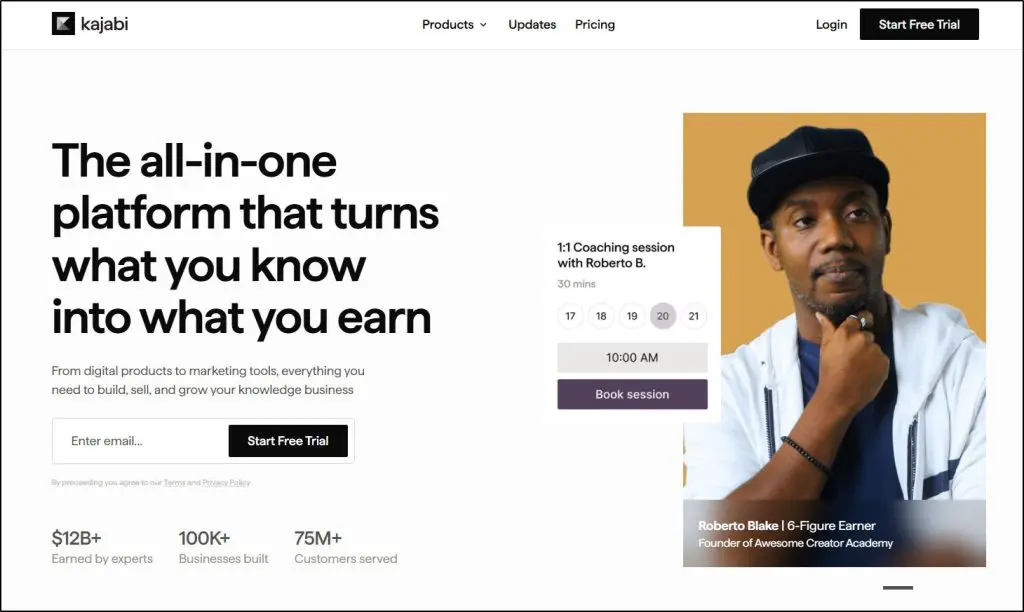
Kajabi AI is the name people use for the AI features spread across the Kajabi platform. Kajabi doesn’t sell it as a separate product. You get some features with your plan and pay for others as you use them.
The features fall into three groups.
- AI that helps you build. Cofounder and Kajabi MCP help you plan products and draft content, pages, and emails.
- AI that talks to your customers. Expert Agents answer questions from buyers and students on your Kajabi pages.
- AI that processes your media. Transcription, translation, dubbing, and Backstage session summaries work on your video and audio.
What happened to the AI Creator Hub. Kajabi launched the AI Creator Hub in 2023 as a set of free generators for course outlines, lesson content, sales emails, landing page copy, video scripts, and social posts. Anyone could use them without a Kajabi account. Kajabi’s current product pages and help center now point that kind of work to Cofounder, and non-customers can try Cofounder before they sign up. If you used the old generators, expect Cofounder to replace them.
Kajabi AI Pricing | What Will It Cost You?
Kajabi has no free plan, and it doesn’t sell its AI separately. You need a Kajabi subscription first. Kajabi offers a 14-day free trial and a 30-day money-back guarantee.
| Plan | Price on annual billing | Price paid monthly | AI you get |
|---|---|---|---|
| Basic | $143/month | $179/month | Cofounder and Kajabi MCP. No AI credits |
| Growth | $199/month | $249/month | Cofounder, Kajabi MCP, and 500 AI credits a month |
| Pro | $399/month | $499/month | Cofounder, Kajabi MCP, and 1,000 AI credits a month |
On top of your plan, budget for these extras if you need them.
- Extra AI credits: $15 for 500 credits
- Expert Agents: $79 a month for each agent, according to Kajabi’s help center
- Your own AI tool for MCP: Whatever you pay for Claude or ChatGPT
Here’s how that adds up for a creator on Growth who runs one Teaching Assistant and one Sales Agent. The plan costs $249/month paid monthly, and the two agents add $158 a month at the listed rate. The AI then makes up a large share of the bill, so make sure the agents earn it.
For the full breakdown of plans, limits, and fees, read my Kajabi pricing guide.
Kajabi AI Features | What Each One Does And Where It Falls Short
Beyond the usual AI tools that almost every online course platform is offering these days, here are some of the unique AI features in Kajabi.
Feature #1: Cofounder
Cofounder is an AI assistant that sits in your Kajabi dashboard. It starts by interviewing you about your expertise, audience, and goals. Then it suggests products you could sell and gives you a short action plan.
From there, you can ask it to do the following.
- Draft a course outline with modules and lessons
- Draft individual pages for a Kajabi funnel or an opt-in page to build your email list
- Write emails, landing page copy, and sales page copy
- Suggest prices, bundles, and promotions for your offers
- Create draft pages and other draft resources in your account
- Walk you through Kajabi features step by step
Cofounder remembers earlier conversations and can see your products and offers, so its suggestions refer to your business. Kajabi says it trained Cofounder on more than ten years of data from Kajabi businesses and that it doesn’t use your content to train the underlying models. Cofounder also has its own mobile app.
It’s most useful at the start of a project. If you’re planning to create an online course and you’re staring at an empty page, an interview followed by a draft outline gets you moving.
Where it falls short. Kajabi’s help center says Cofounder can’t build complete funnels, automations, or images. It also can’t change account settings, connect integrations, import contacts, or delete anything. It creates drafts, and you still review, edit, and publish them.
The bigger limit is quality. An outline from any AI tool reflects the average course on your topic. It doesn’t know your learners, their starting point, or the mistakes they make, and those details are what make a course worth paying for. My guide to humanizing AI content covers how to close that gap.
Kajabi also says future limits may apply to Cofounder. It’s included today, and I wouldn’t build a business plan around unlimited use.
Feature #2: Kajabi MCP
Kajabi MCP connects your Kajabi account to outside AI tools, including Claude and ChatGPT. MCP stands for Model Context Protocol, a standard that lets an AI assistant work inside other software.
Once you connect it, you type a request into your AI tool and it works in Kajabi for you. Kajabi’s example is a request to create a 30% discount offer, draft the announcement email, and update the landing page copy. The AI tool builds all three as drafts.
Kajabi says MCP can work with pages, emails, offers, courses, contacts, orders, tags, segments, and blog posts. You approve each permission when you connect it, and sensitive actions start switched off.
For people who already use Claude or ChatGPT every day, this is the most practical AI feature Kajabi has. Your AI tool already knows how you write, and now it can put the work where it belongs.
Where it falls short. Everything arrives as a draft, so MCP doesn’t remove the review step. Kajabi says it can’t process payments, send a live email broadcast without your review, edit theme code, review analytics, or add users to your account.
You also need to bring your own AI tool, and that can mean a second subscription. Beginners who have never used Claude or ChatGPT will find Cofounder easier.
Feature #3: Expert Agents
Expert Agents are AI chat agents that speak to your customers. Kajabi offers two.
- Sales Agent: Sits on your landing and sales pages and answers questions from buyers, using your offer details, pricing, and product descriptions.
- Teaching Assistant: Sits inside a course and answers questions from students, using your lessons, transcripts, and community posts.
Each agent answers only from the content you’ve published in Kajabi. The Teaching Assistant respects access levels, so students only get answers from products they’ve bought. Kajabi says conversations land in one inbox where you can step in.
I like the idea for courses with a large library. A student who gets stuck at 11 pm can get pointed to the right lesson without waiting for you. Other platforms are testing similar ideas, and my Circle AI review covers one of them. The same logic applies if you run a Kajabi community and answer the same questions every week.
Where it falls short. Expert Agents cost extra. Kajabi’s help center lists each agent at $79 a month, with 1,000 messages and 250 AI credits included, and the message limit applies across your whole account. Kajabi’s pricing page still labels Expert Agents as coming soon, so confirm the price in your own account before you plan around it.
The agents also have firm limits. They’re text only, they work only on Kajabi-hosted pages, and they need Kajabi’s newer page builder and recent themes. The Teaching Assistant can’t read a video without captions, and creating captions uses AI credits. It doesn’t remember a student from one conversation to the next.
I’d also think about what a chat agent replaces. In a premium program, your answers are part of what students pay for. An AI agent suits a low-priced course with many students far better than a small cohort.
Feature #4: AI Credits For Transcription, Translation, And Dubbing
AI credits are the part of Kajabi AI that most people misread. Credits don’t pay for Cofounder or for writing. Kajabi’s help center says they pay for three video services.
| Service | Credits per video minute | What 500 credits covers |
|---|---|---|
| Transcription | 1 | 500 minutes |
| Translation | 10 | 50 minutes |
| Dubbing | 100 | 5 minutes |
Growth includes 500 credits a month, and Pro includes 1,000. Basic includes none. Any plan can buy 500 more for $15, either as a monthly bundle or a one-time top-up. Unused monthly credits don’t roll over.
Transcription is good value at these rates. Captions help learners, and they also give the Teaching Assistant something to read.
Where it falls short. Dubbing gets expensive quickly. A course with 60 minutes of video needs 6,000 credits for one dubbed language. That’s 12 bundles of 500 credits, or $180, on top of your plan. If you want to sell in other languages, compare that with dedicated tools in my guide to AI voice generators.
On Basic, you start at zero credits. Even captions cost extra there.
Feature #5: AI In Backstage
Backstage is Kajabi’s private client portal for one-on-one work. Its AI does two jobs. It summarizes recorded sessions into key points and action items, and it transcribes the voice memos you and your client exchange.
This is quiet, practical AI. It saves a coach the note-taking after each call, and clients get a written record they can search. I go deeper on this in my Kajabi Coaching review.
Where it falls short. The AI doesn’t respond to clients for you, and it serves one-on-one work only. Kajabi’s pricing page also says the company hasn’t settled Backstage limits and pricing yet.
Feature #6: Creator Studio
Creator Studio turns one video into short clips, a transcript, and drafts of blog posts, emails, and social posts. Kajabi has sold it as a paid add-on.
Where it falls short. Kajabi’s help center says Creator Studio will close on November 9, 2026. Don’t build a workflow around it. For repurposing video, look at a dedicated editor such as the ones in my Descript review and my list of the best AI video generators and editors.
Kajabi AI Use Cases | How Can You Use Kajabi’s AI Tools For Your Business
Feature lists only tell you so much. Here are seven situations where a coach, course creator, or consultant would Kajabi’s AI features useful.
| Use case | Tool | Extra cost |
|---|---|---|
| Turn existing material into a course | Kajabi MCP with Claude or ChatGPT | Your AI tool subscription |
| Prepare a launch from one request | Kajabi MCP | Your AI tool subscription |
| Find your first offer | Cofounder | None |
| Keep up with weekly emails and pages | Cofounder | None |
| Follow up after coaching sessions | Backstage AI | None |
| Answer repeat questions from students and buyers | Expert Agents | $79/month for each agent |
| Add captions and reach other languages | AI credits | Credits beyond your plan’s allowance |
Use Case #1: Turn Existing Material Into A Course With Claude
Who it’s for. Consultants, trainers, and course creators who already hold their expertise in workshop notes, slide decks, transcripts, or a book.
What happens. You work with Claude the way you normally would. You share your material, shape it into modules and lessons, and argue with the draft until the structure fits your learners. Then you ask Claude to create the course in Kajabi. Through Kajabi MCP, Claude builds the course in your account as a draft, and you open Kajabi to review it.
What changes. The old process had a tedious middle step. You’d write in a document, then copy every module title and lesson into Kajabi by hand. MCP removes that step. It also lets you do the thinking in a tool that can read long documents and hold a detailed conversation about them, which is where a general assistant beats a built-in one.
Where you hit a wall. MCP moves text and structure. It doesn’t record your videos, design your worksheets, or decide what your learners need to practice. You still open every lesson and check it, because the draft carries whatever errors the AI made. You also need to be comfortable setting up a connection inside Claude or ChatGPT.
Use Case #2: Prepare A Launch From One Request
Who it’s for. Any Kajabi user who runs promotions, and especially solo operators who build every launch alone.
What happens. A promotion in Kajabi touches several places. You create an offer, write the announcement email, and update the landing page. With MCP, you describe the promotion once in your AI tool. Kajabi’s own example is a 30% discount for a course that launches on Tuesday, with the offer, the email, and the page copy all created as drafts.
What changes. You stop clicking between three sections of Kajabi and retyping the same details. The price, the dates, and the wording stay consistent because one request produced all of them. For someone who runs a promotion every month, that’s a real saving in setup time.
Where you hit a wall. Kajabi says MCP can’t send a live broadcast without your review, process payments, or review your analytics. So it can prepare a launch, and it can’t tell you how the last one performed or press send for you. I think that’s the right design, because nobody wants an AI tool emailing their whole list unsupervised.
Use Case #3: Find Your First Offer With Cofounder
Who it’s for. Experts who know their subject and haven’t decided what to sell. That often describes consultants and coaches moving from client work to products.
What happens. Cofounder interviews you about your goals, audience, niche, and the product formats you prefer. It then produces a business profile and an action plan with three to six next steps. You can ask it to suggest a price, a bundle, or a first product, and it will draft the outline.
What changes. You get a structured starting point in one sitting. Many experts stall for months on the choice between a course, a membership, and a coaching program. A guided interview forces a decision, and it works a lot like a first call with a business coach.
Where you hit a wall. Cofounder can’t tell you whether anyone will buy. Its pricing suggestions come from patterns across Kajabi businesses, and your market may behave differently. Test the offer with real people before you build it. Cofounder also won’t solve the hardest problem for a beginner, which is finding an audience.
Use Case #4: Keep Up With Weekly Emails And Pages
Who it’s for. Established Kajabi users who know what they sell and struggle to keep their marketing consistent.
What happens. You ask Cofounder for a newsletter about a lesson from your course, a follow-up email for people who joined a webinar, or copy for a new opt-in page. It already sees your products and offers, and it remembers your earlier conversations, so you skip the background briefing you’d give a general AI tool. The draft appears inside Kajabi.
What changes. The first draft gets faster, and that’s often what keeps a weekly email going out. If you follow sound email marketing practices, a draft you can edit in ten minutes is worth a lot.
Where you hit a wall. Cofounder writes single pieces. Kajabi says it can’t build automations or complete funnels, so you still assemble the sequence and the triggers yourself. It can’t create images either. And the draft will sound like competent marketing copy until you rewrite it in your own voice.
Use Case #5: Follow Up After Coaching Sessions
Who it’s for. Coaches and consultants who run one-on-one engagements through Backstage.
What happens. You record a session, and Backstage produces a summary with key points and action items. Between sessions, you and your client can trade voice memos, and Backstage transcribes them so both of you can read and search them.
What changes. The half hour of notes after each call shrinks to a quick review. Clients also get a written record of what they agreed to do, which helps with follow-through between sessions.
Where you hit a wall. The AI records and summarizes, and it doesn’t coach. It won’t track goals or habits over time, and it won’t reply to a client for you. It also covers one-on-one work only, so group programs get none of it.
Use Case #6: Answer Repeat Questions From Students And Buyers
Who it’s for. Course creators with a large student base, and anyone whose inbox fills with the same pre-sale questions.
What happens. A Teaching Assistant sits inside your course and answers student questions from your lessons and transcripts. Kajabi says it can point students to the relevant part of a lesson. A Sales Agent does the same job on your sales page, using your offer details and pricing to answer buyers.
What changes. Students get an answer at the moment they’re stuck, and you stop writing the same reply every week. On a sales page, a buyer with one remaining doubt can resolve it without emailing you and waiting a day.
Where you hit a wall. Each agent only knows what you’ve published. If your lessons are thin, or your videos have no captions, the answers will be thin too. Kajabi’s help center says the Teaching Assistant refuses off-topic questions, can’t take account actions such as refunds, and doesn’t remember a student between conversations. At $79 a month for each agent with a 1,000-message cap, the numbers only work when you have enough students to keep it busy.
Use Case #7: Add Captions And Reach Other Languages
Who it’s for. Course creators with a video library, and experts with an international audience.
What happens. You run your lesson videos through Kajabi’s transcription to get captions. From there, you can translate the captions or dub the audio into another language.
What changes. Captions make a course easier to follow, and they cost little. A course with 60 minutes of video uses 60 credits. Translated captions for that course use 600 credits for each language, which costs a little more than one month’s allowance on Growth.
Where you hit a wall. Dubbing the same course takes 6,000 credits for each language, or $180 in extra bundles. That’s affordable for one flagship course and expensive for a whole library. I’d caption everything, translate captions for your best seller, and only dub once you’ve seen demand from that market.
The pattern across all seven. Kajabi’s AI is strongest when it moves work you’ve already thought through into the right place in your account. It’s weakest when you ask it to do the thinking, the teaching, or the selling for you.
Kajabi AI vs ChatGPT And Claude | Do You Need It?
This is the comparison that matters most, because a general AI assistant costs a small fraction of a Kajabi plan and many readers already have one.
| Task | Kajabi AI | ChatGPT or Claude alone |
|---|---|---|
| Brainstorm course ideas and outlines | Cofounder does this well | Does this equally well |
| Write emails and sales copy | Cofounder drafts inside Kajabi | Writes the copy, and you paste it in |
| Use your existing products as context | Yes, it reads your account | Only what you paste or upload |
| Build draft pages and offers in Kajabi | Yes, through Cofounder or MCP | No, unless you connect Kajabi MCP |
| Answer students inside your course | Yes, with a paid Teaching Assistant | No |
| Research, long documents, and work outside Kajabi | Limited | Stronger |
For pure writing, Kajabi AI offers little that a general assistant lacks. I’ve written about using ChatGPT for course creation, and the same prompts work in either place.
Kajabi AI earns its place on the last step. It knows your products, and it puts drafts where you’ll publish them. That saves copying and pasting, and it reduces the errors that creep in when you move content between tools.
If you already pay for Claude or ChatGPT, connect it through Kajabi MCP and you get the best of both. If you don’t, Cofounder covers the basics at no extra cost.
5 Tips For Using Kajabi AI Features Effectively
Kajabi’s AI tools perform only as well as the material and instructions you give them. These are the five habits I rely on to get output worth editing.
1. Brief It Like A New Team Member
Never assume the AI knows your client or your offer. Before I ask for anything, I tell it who the learner is, where they’re starting, what they should be able to do at the end, what the offer costs, and which objections come up most. I’d give a new assistant that same briefing on day one.
Take Cofounder’s opening interview seriously for the same reason. It remembers your answers and reuses them in later drafts, so a rushed interview weakens everything that follows. Compare “write a sales email for my course” with “write a sales email for my six-week course for first-time managers who dread giving feedback.” The second request gives the AI something to work with.
2. Fix Your Account Before You Ask For Anything
Kajabi’s AI reads what’s in your account. If your offers have one-line descriptions, your old products are still live, and your sales page skips the common questions, the AI builds on that weak material.
So I’d spend an hour on housekeeping first. Archive products you no longer sell, write complete offer descriptions, and add the questions buyers ask to your sales pages.
If you plan to use a Teaching Assistant, caption your videos before you switch it on. An agent can’t answer from a video it can’t read, and transcription only costs 1 credit per minute.
3. Give It Samples Of Your Own Writing
AI copy sounds generic because the AI has nothing of yours to imitate. Paste in two or three emails you wrote yourself, or a transcript of you teaching a lesson, and ask it to match the tone, sentence length, and vocabulary.
This works best through Kajabi MCP, because Claude and ChatGPT handle long documents well. Give your AI tool a full transcript or a chapter of your book, shape the lesson there, and send the result to Kajabi once it sounds like you.
4. Ask For One Thing At A Time
Large requests produce vague results. I’d ask for one email, one page, or one module, and name the exact product, price, and dates in the request. When the AI has to guess which offer you mean, it guesses wrong often enough to cost you time.
With MCP, add two safeguards. Grant only the permissions the task needs, and ask your AI tool to list what it plans to create before it creates anything. Then review every draft inside Kajabi before you publish.
That matters most during a launch, when a wrong date or price reaches your whole list. My guide to a successful product launch covers the rest of that checklist.
5. Test Your Agents Before Your Students Do
An Expert Agent speaks to your customers in your name, so it deserves more care than any other AI feature. Use the custom instructions to set its tone and focus, and select only the modules and lessons you want it to draw from.
Then ask it the ten questions your students ask most, and read the answers as a student would. A poor answer usually points to a gap in your lessons, so fix the lesson first. After launch, keep the answer ratings switched on, read the conversations each week, and watch your message count against the 1,000-message cap.
One principle sits behind all five tips. The AI handles structure, first drafts, and repetitive work well. Your stories, your judgment, and your feedback are what people pay for, so keep those in your own hands.
Kajabi AI Pros And Cons
| Pros | Cons |
|---|---|
| Cofounder and Kajabi MCP come with every plan | Kajabi says future limits may apply to Cofounder |
| The AI sees your products, offers, and audience | Writing quality matches general AI tools you may already have |
| Drafts land inside Kajabi, ready to edit | Cofounder can’t build full funnels, automations, or images |
| MCP works with Claude and ChatGPT | MCP needs your own AI tool and some comfort with it |
| Teaching Assistant answers from your own course content | Expert Agents cost extra for each agent, with a message cap |
| Transcription is cheap at 1 credit per minute | Dubbing costs 100 credits per minute |
| Kajabi says it doesn’t train models on your content | No AI credits on Basic |
| Session summaries save coaches time | Creator Studio closes in November 2026 |
Who Should Use Kajabi AI?
My advice depends on where you are today.
- You’re already on Kajabi. Use Cofounder and MCP. They cost nothing extra, and they’ll speed up outlines, emails, and page drafts.
- You’re choosing a platform and AI is high on your list. Compare platforms on courses, marketing, and price first. My guide to the best online course platforms will help, and so will my roundup of AI tools for creators.
- You’re a beginner with no audience yet. Start with a free or low-cost AI assistant and a cheaper platform. Kajabi’s AI won’t fix the lack of an audience, and the subscription is a large fixed cost.
- You run a large course with many support questions. Test a Teaching Assistant for a month and count how many questions it resolves.
- You want to sell in several languages. Price the dubbing credits before you commit, and compare a dedicated dubbing tool.
- You’re a coach. The Backstage summaries are the AI you’ll use most.
Overall, Kajabi AI makes a good platform a little faster to work with. It doesn’t change who Kajabi is right for. If the platform fits your business, the AI is a welcome extra, and you can plan the rest with our free creator tools. If the platform is more than you need, the AI shouldn’t change your mind.
Kajabi AI FAQs
What is Kajabi AI?
Kajabi AI is the set of AI features inside the Kajabi platform. It includes the Cofounder assistant, Kajabi MCP for connecting Claude and ChatGPT, Expert Agents that answer customers, and AI credits for video transcription, translation, and dubbing.
Is Kajabi AI free?
Cofounder and Kajabi MCP come with every paid Kajabi plan at no extra charge. Kajabi has no free plan. Expert Agents and extra AI credits cost more, and you can try Cofounder before you sign up.
What is Kajabi Cofounder?
Cofounder is Kajabi’s AI business assistant. It interviews you about your expertise, suggests offers, and drafts course outlines, emails, and page copy inside your account. It creates drafts, and you review and publish them.
What are Kajabi AI credits used for?
AI credits pay for video services. Transcription costs 1 credit per minute, translation costs 10, and dubbing costs 100. Growth includes 500 credits a month, Pro includes 1,000, and Basic includes none.
How much do Kajabi Expert Agents cost?
Kajabi’s help center lists Expert Agents at $79 a month for each agent, with 1,000 messages and 250 AI credits included. Kajabi’s pricing page still shows them as coming soon, so confirm the current price in your account.
Can Kajabi AI build my whole course?
It can draft an outline and lesson text. It can’t supply your expertise, your examples, or your knowledge of your learners. Treat the output as a first draft and expect to rewrite much of it.
Does Kajabi work with ChatGPT and Claude?
Yes. Kajabi MCP connects your account to Claude, ChatGPT, and other tools that support the MCP standard. The AI tool builds pages, emails, and offers as drafts, and you publish them from Kajabi.
Does Kajabi use my content to train AI?
Kajabi says it doesn’t use your content to train models or share it with other customers. It says it may use anonymized usage patterns to improve Cofounder.
What happened to the Kajabi AI Creator Hub?
Kajabi launched the AI Creator Hub in 2023 as a set of free content generators. Kajabi’s current pages direct that work to Cofounder, which drafts outlines, emails, and page copy inside the platform.
Is Kajabi AI better than ChatGPT?
For writing alone, the two perform at a similar level. Kajabi AI has the advantage inside Kajabi, because it knows your products and creates drafts in your account. ChatGPT is stronger for research and work outside Kajabi.

Jeff Cobb, Founder of Learning Revolution
Jeff Cobb is an expert in online education and the business of adult lifelong learning. Over the past 20+ years he has built a thriving career based on that expertise – as an entrepreneur, a consultant, an author, and a speaker. Learning Revolution is a place where Jeff curates tips, insights, and resources to help you build a thriving expertise-based business. Learn more about Jeff Cobb here.
Table of Contents
Related Posts
How To Create And Sell B2B Online Courses
9 Best LMS Platforms For Selling Courses To Professionals
8 Best Small Business LMS Platforms For Employee Training [2026]