
TL;DR: How To Drive Leads and Clients From LinkedIn To Your E-Learning Business
LinkedIn is where the professionals who can actually afford your coaching, courses, or consulting already spend their time. You don’t need a million connections to make it work, just a few hundred relevant followers, content worth reading, and LinkedIn’s own algorithm putting it in front of the right people.
Here’s how I built my LinkedIn engine, the same system a good number of people in my community have replicated:
Step 1: Niche down to one specific audience before you post anything
Step 2: Build a profile that sells before anyone reads a single post
Step 3: Run four content types on a fixed rotation, personal brand, advice, proof of work, and the offer
Step 4: Convert engagement into real leads through comments, profile views, and a dedicated landing page
LinkedIn won’t get you results in one week. But 1-2 hours a week for a quarter or two can transform your business completely.
53% of people earning over $100,000 a year are active on LinkedIn, more than on any other social network. These are professionals who already believe in paying for expertise, because that’s how they got there in the first place.
LinkedIn’s algorithm also keeps them motivated to grow by showing them achievements from their network. Someone got a promotion, a new certification, a testimonial, or closed a deal. That timeline runs on quiet, constant comparison, and it pushes people to act on their own growth instead of just thinking about it.
So, when you show up as the person who answers their real questions and makes sense of what’s actually changing in the field, while everyone else is posting vague AI-generated takes, you become their go-to expert.
Once that happens, you can sell them a course, a coaching offer, a consulting call, whatever helps them grow next.
LinkedIn is where that trust gets built first. As a coach or edupreneur, it’s the one platform you can’t afford to skip.
I’ve been active on LinkedIn for years, and it’s fed directly into my consulting work at Tagoras and Leading Learning. In this guide, I’ll give you the exact content framework I used to build that authority, and the same one you can use to turn it into leads and course sales.
Read: The best online course selling platforms for professionals
Why Use LinkedIn For Your Coaching or Course Business?
For an edupreneur, LinkedIn’s main job is getting one specific type of person to read your post and think, this person actually knows what they’re doing. Building that trust and positioning yourself as the authority is the whole function of using LinkedIn.
As a result, people start following you, connecting with you. Your network grows, your voice grows, your content and messaging get amplified.
This leads to partnerthsips, speaking gigs, course sales, and coaching clients in the long run.
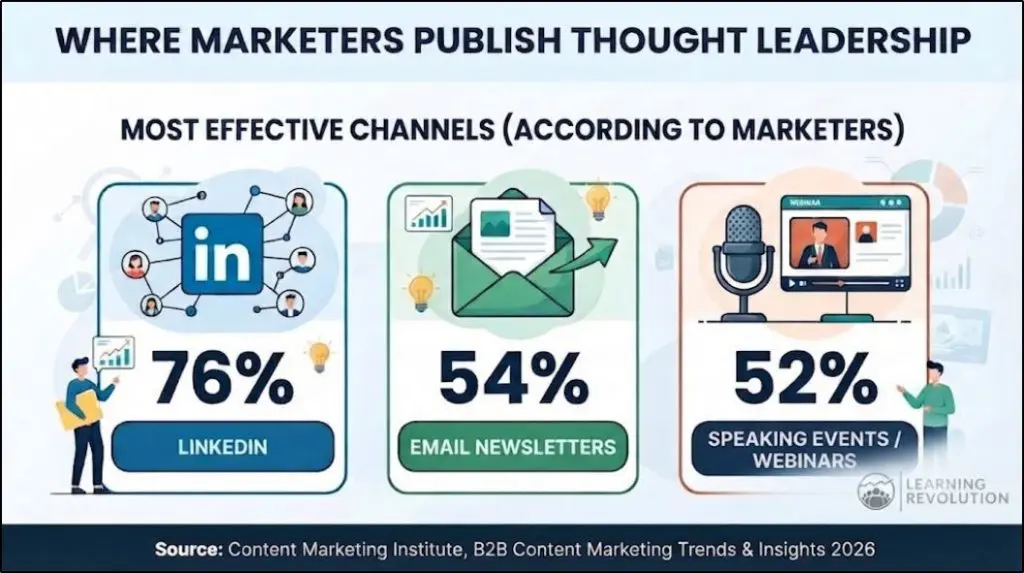
According to a 2026 research study by Content Marketing Institute, 76% of B2B marketers consider LinkedIn the most effective channel for publishing content that results in leads and clients.
But the actual sale usually doesn’t happen on LinkedIn itself. That work happens later, in a DM, on a call, or on a checkout page, a separate job for a separate part of your business.
When people see a genuine, raw, not AI, post, whether it’s your words, a picture, or a video that answers their question or says something they’ve been looking for, they visit your profile, see you’re the real deal, and start following you.
LinkedIn enables that connection. And that connection ultimately leads to opportunities.
My LinkedIn Strategy And Content Framework To Drive Course Sales and Clients
I’ve been on LinkedIn since its early days, but I only started taking it seriously a few years ago, once I realized almost everyone I wanted to work with was already active on the platform. That’s when I started posting regularly.
At first, nothing moved. The only likes and comments on my posts came from my own team and friends. Over time, I built a real framework and learned that LinkedIn doesn’t work if you just publish content without a clear strategy.
Once I got the approach right, things changed. More coaching inquiries came in. I started getting speaking invitations to events I actually respected. And the bigger, more established voices in my industry started engaging with my work, and eventually working with me.
In the rest of this article, I’ll share the exact LinkedIn strategy and content framework I built, the same one that’s worked for me and for a good number of my consulting clients over the years.
Step #1: Niche Down Before You Post Anything
Before you build a profile or post a single word on LinkedIn, understand this: you’re not there to speak to everyone on the platform. Not even to your entire audience. You’re there to build a network, sell courses, or land coaching clients around one specific topic or specialization.
That means you care about your specific niche and the topics closely associated with it. Your profile, your content style, your messaging, your offers, all of it gets built around the ideal client profile (ICP) you define, not around whoever happens to scroll past.
This makes it easier to shine on LinkedIn for two reasons:
- LinkedIn’s algorithm now rewards deep expertise in a vertical. When you post around a specific topic area, LinkedIn promotes your content organically to people who are interested in that topic.
- The other reason is that standing out in a small sub-niche is much easier than dominating the whole platform. You might now become the biggest LinkedIn influencer of all time but you can easily become a leading voice in your specific domain.
So, it’s best to define your target niche and stick to it.
For example, if you coach startup founders who’ve hit $100,000 in revenue but are stuck building the systems to get to a million, everything in your LinkedIn strategy should speak to that exact person. Not total beginners. Not someone still validating their first product. Just the founder who’s past the starting line and needs the next one. That’s the niche, and everything you post either serves it or gets cut.
My own niche has been membership organizations, trade and professional associations, the CEOs, boards, and senior leaders responsible for education, credentialing, membership growth, and non-dues revenue.
Everything on my profile, my tagline, my pitch, my experience, my testimonials, is built around that audience specifically. Someone from that world reads it and thinks, this is the person who understands our exact problem.
So the first step is deciding who you’re actually talking to, and staying focused.
Step #2: Build a LinkedIn Profile That Sells Before You Post
Your LinkedIn profile is often the first thing someone sees after your content shows up in their feed and makes an impression on them. They check your profile to see if your credentials back up the quality of your content, or if you’re someone who’s just faking it.
Most prospects take only a few seconds to decide if you’re worth following or not.
To make them stay, your profile needs to have a few characteristics.
First the basics.
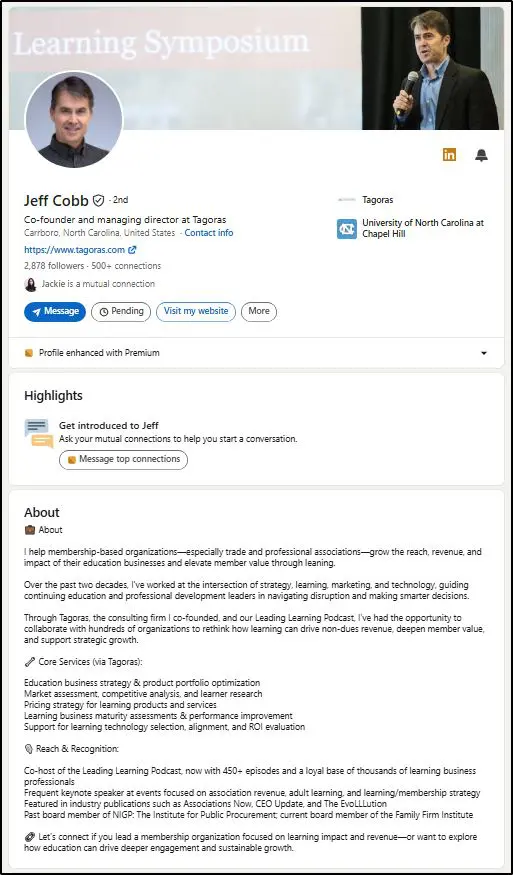
A professional, clearly visible, friendly headshot to make your profile relatable. Plus, a cover image that does the selling for you, showing your social proof, you on stage at a conference, presenting to a group, whatever proves you’re doing the work.
On top of that, a strong profile has these qualities.
- It clearly defines what you do, who you serve, and how you help
- It speaks directly to your ICP
- It has credentials that show you’re the real deal, not an imposter
When your profile has these, it adds weight to your content and builds trust that quietly does the selling for you.
To build one, start with your headline. Either use a clear and definitive title or describe what you offer and to whom. Don’t use vague titles or industry jargon that doesn’t tell the prospect anything about your role.
For example, I use “Co-founder and managing director at Tagoras” which clearly tells them who I am. Alternatively, I could use “Helping associations turn learning into real revenue and member value.” Both work.
Then the core part of your profile, the About section.
This is where you actually make the pitch. This is the space to get specific about who you are, what you do, who you help, and why they should trust you.
I’ve improved an polished my LinkedIn profile’s About section over they years to a point where my prospects can now instantly understand what I do, the value I offer, and the experiences that make me a credible voice.
I still make tweaks every now and then but overall I’m pretty happy it communicates what I want my prospects to see.

A vague About section undermines a strong headline fast. Write it the way you’d explain your work to the exact person you want reading it, not the way you’d write a bio for an awards dinner.
Then comes your Featured section. It’s the closest thing to a landing page you get on LinkedIn. Whoever clicks through from a comment lands there next, so it needs your best proof, not a random assortment. Pin the post that got the most relevant replies, a client result, a speaking clip, whatever shows you actually do the thing you claim to do.
Credentials and testimonials matter too but put them after your main pitch. Your prospects first need to care about what you do before a credential means anything to them.
I personally recommend edupreneurs to get a LinkedIn Premium Business plan. A free LinkedIn account caps how many people outside your network you can message and hides most of your profile analytics, so you can’t tell if your niched content is actually reaching the right people or just anyone. The Business plan gives you enough insight and added features to turn views into leads.
Step #3: My Four-Part LinkedIn Content Framework
Now that we’re done with the groundwork, it’s time to build a voice on LinkedIn and position yourself as an expert to generate leads for your courses and coaching offers.
But posting randomly didn’t work for me.
After publishing countless “value filled” posts that got likes only from my team, I realized I had to be more intentional about my LinkedIn content strategy.
With time, I built a framework where every post has a specific job to do, not just “add to the feed.” I run four content types on a fixed rotation.
Three of them, three to four times a month each (so around twelve to fifteen posts). The fourth runs once or twice, only when I actually have an offer.
Every post should prove you’re a real person doing real work, not a prompt someone typed into an AI tool five minutes ago.
That means a real photo from the room you were actually in, a video of you actually speaking, or a raw, unpolished take that wasn’t smoothed over before it got published. Skip that, and even a technically good post reads like everyone else’s AI-generated content, because at this point, it probably is.
Let me explain each content type and its goal
LinkedIn Content Type #1: Personal Brand Content
I use this content type to build a personal connection with my audience and show them the person behind the profile. It helps people connect with you on a personal level, relate to your struggles, and think, deep down, this guy understands our problems because he’s been through it and came out the other side.
Your origin story lives here. Why you started doing this work, what you were doing before, the moment something didn’t add up and you decided to build something different.
Try a few different topics here and see what resonates most with your audience, then double down on whatever works.
I also use this content type for the light, human moments.
Like a photo from a conference I spoke at or attended. A quick clip from a real conversation with a client. A behind-the-scenes look at a talk I’m prepping for. A short live stream to speak directly to my audience. Or even time I spend away on vacation with my family.
For example,l I sat with Artesha Moore, CEO of Association Forum, on a panel at LearnUpon’s Connect 26 conference moderated by Mark L. Jones.

This instantly differentiates my content in the sea of AI slop we see these days on LinkedIn.
None of it needs to be polished. In fact, raw stuff seems more believable..
The goal here isn’t to teach anything.
We’re just looking to build familiarity so when you’re scrolling past my posts, I want you to start feeling like you know me a little, the same way you’d get to know someone at a conference over a few real conversations instead of one pitch.
That familiarity is what makes my advice content land harder later, and what makes the offer, when it finally shows up, feel like it’s coming from someone you already trust instead of a stranger asking for your money.
Read: How to use LinkedIn Live Streaming to grow your audience.
LinkedIn Content Type #2: Advice and Informational Content
This is where you answer your audience’s most burning questions. The things they regularly ask, their biggest confusions, the stuff holding them back.
This is pure value, based on your experience.
Say everything from experience. Mention real examples of how you handled a situation or helped a client through it. Don’t say anything theoretically.
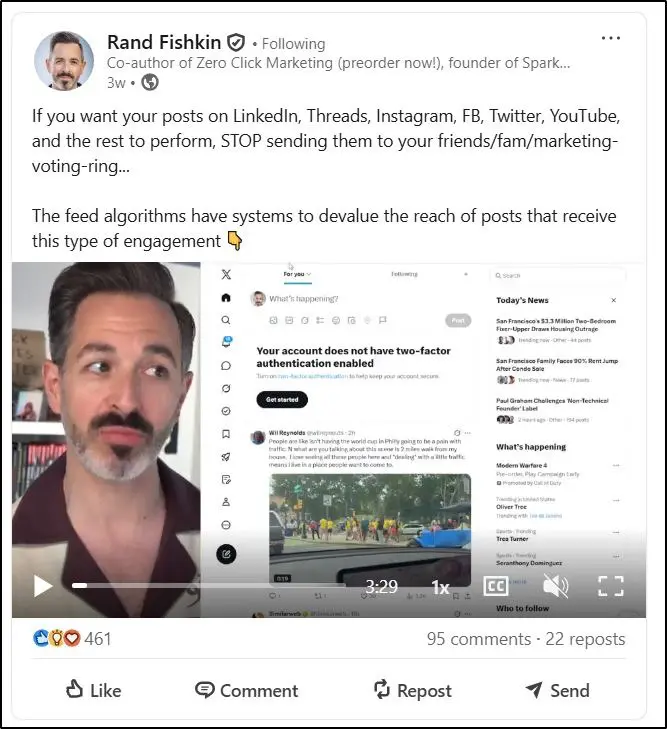
Rand Fishkin does this regularly and to great effect.
Think about the questions that show up over and over, in DMs, in comments, in the first call with a new client, before they’ve even signed on. Those repeat questions are your best content, because if one person is stuck on it, dozens of people scrolling past your post are stuck on the exact same thing and just haven’t asked anyone yet.
Answer it the way you’d answer a friend who called you about it, not the way you’d write a guide. Name the specific situation. Say what you actually did, or what you told a client to do, and why. If there’s a number attached, a timeframe, a result, include it. That specificity is what separates a real answer from a generic one, and it’s also what makes the post impossible for someone to have generated with a prompt in ten seconds.
Justin Welsh does this better than most people I’ve seen. He turns questions into compelling short essays that get tons of engagement.
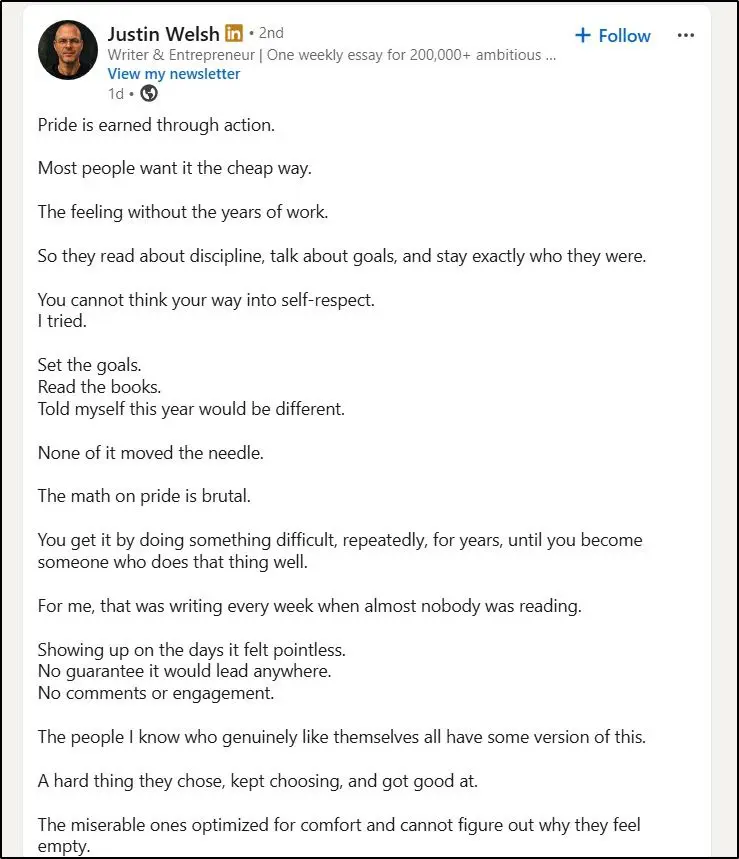
Ideally, combine text with a short video to make it stand out. No need to polish it, just pick up your phone and share what you know. A slightly rough video of you actually explaining something is more convincing than a perfectly edited one, it looks like you, talking, not a script being performed.
That’s what makes you an approachable expert. It also gives your audience a taste of what it’s actually like to consult with you, this is the closest thing to a free sample of your thinking that they’ll get before they pay for it.
LinkedIn Content Type #3: Proof-of-Work Content
This is where you show yourself doing the actual work. Real client meetings, problems you solved, the complaints people DM you about most often. This content type earns trust that a bio or a testimonial page never will, because it’s happening in real time, not curated after the fact.
It can be as simple as narrating a client interaction like this post.
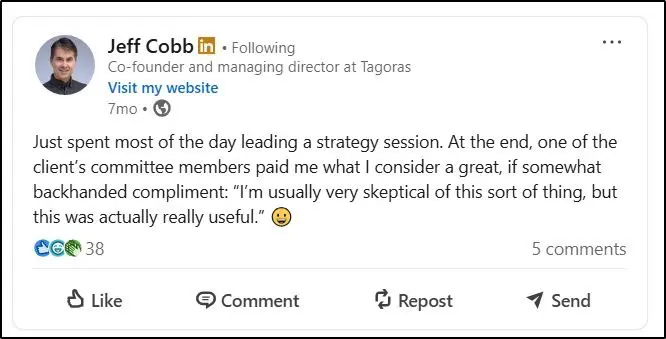
Be careful not to get too specific about your client’s business or problems because some clients might have an issue with it.
Use anonymous names, strip out anything identifiable about the deal or the organization if it’s sensitive, and when in doubt, ask before you post.
Here’s a great example of demonstrating actual expertise without exposing your clients.
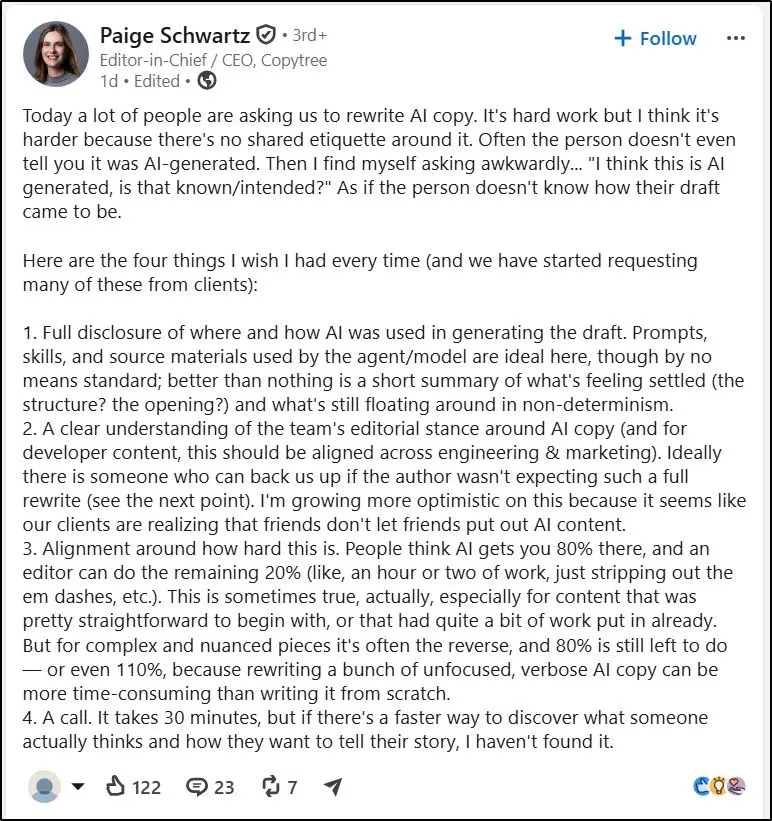
The whole point of this content type is proof you can be trusted with real problems. Breaking a client’s confidence to prove that would be counterintuitive.
LinkedIn Content Type #4: The Offer
This is the only content type that actually asks for something. Use this when you open doors to a program, launch a course offer, or want to drive action that adds leads to your funnel (even when it’s a free offer).
The other three content types build up to this point and if you follow this framework, your offer content drives much higher conversions because you’ve already done the hard part by building trust.
It works because it’s rare.
If every post asked for something, your audience would tune it out the same way they tune out an inbox full of sales emails. Because you’ve spent three posts building trust and one post making an ask, the ask reads as an invitation, not a pitch.
For example, here’s a post where I invited my followers to our annual learning summit.

Keep the ask itself simple. A link, a deadline if there is one, a clear statement of what happens next.
This isn’t the place for a long pitch, the trust was already built in the other three content types. Here, you just need to tell people the door is open.
Step #4: Convert Your Audience Into Leads
Once your content framework is running, publish each type on the rhythm we covered. The first three post regularly. Publish offer-posts only when you actually have one open, or if you take coaching clients year-round, fold a client story into the post itself and close it with a link to your DMs or your call scheduling page.
As you keep this up, your content starts gaining traction. Your profile gets more exposure. People start liking, sharing, and commenting.
This is where conversion actually happens, in two ways.
Comments first: Especially early on, respond to every thoughtful comment on your posts. If someone relevant to your offer, someone who looks like an actual prospect, leaves a comment, send them a connection request with a short, specific note. Mention what you liked about their comment and that you’d like to connect. That one small step turns a passing interaction into an actual relationship.
Profile views second: Your profile will start getting more views too. With LinkedIn Premium, you can see who’s viewing it. If someone looks like a fit for your ICP, send them a connection request the same way, a short note, not a form message.
Beyond those two moments, conversion also depends on what your profile and your links are set up to do.
Your profile needs a clear call-to-action button that leads straight to your offer page, the same profile optimization we already covered.
And you need a landing page built specifically for your LinkedIn audience, one that pitches your offer in language they’ll recognize from your posts. Use that link anywhere you make a direct ask, in an offer post, or any time you write something like “if you want to work with me” or “I’m accepting coaching clients right now.”
LinkedIn Is Worth the Investment for Edupreneurs
LinkedIn won’t drive leads and opportunities for your business from day one. The coaches, course sellers, and edupreneurs actually getting business through LinkedIn have invested months, sometimes years, building their audience and their brand.
It doesn’t take a lot of effort. But it does take patience and consistency.
You don’t need to dedicate ten hours a week to it. Just an hour or two a week, done consistently throughout the year, positions you as the go-to voice in your niche and opens doors you didn’t know existed.
That’s what happened for me, and it’s what’s happened for countless professionals in my community. So, if you haven’t started yet, now’s the time.
Frequently Asked Questions (FAQs)
How long does it take to get a client or course sale from LinkedIn?
Most coaches and consultants see real traction after two to three months of consistent posting, not days. LinkedIn builds trust slowly through repeated exposure to the same audience. The exception is proof-of-work content, a strong client story can shorten that timeline if it reaches the right person at the right moment.
Do you need to post every day on LinkedIn to see results?
No. Daily posting isn’t necessary and can dilute quality if you’re rushing content out. Three to four posts a week, spread across personal brand, advice, and proof-of-work content, works better than daily posts with nothing behind them. Consistency over months matters more than frequency in any single week.
Can you get coaching clients from LinkedIn without spending money on ads?
Yes. Coaches, consultants, and course creators can build a full client pipeline through organic posting alone. LinkedIn ads target cold audiences at volume, which suits outbound sales teams, not a solo practitioner building trust with a small, specific niche. Organic content plus a clear profile does the same job at zero media cost.
What if you’re starting on LinkedIn with zero followers?
A small following isn’t a barrier. What matters is reaching the right few hundred people in your specific niche, not a large general audience. Start by niching your content immediately, engaging genuinely on posts from people in your target audience, and posting consistently. Relevant followers accumulate through the content itself, not the other way around.
Should you use text, video, or images on LinkedIn?
All three work, and mixing formats performs better than sticking to one. Text posts work well for direct advice. Video adds credibility because it’s harder to fake. Photos from real events or client work build the human, behind-the-scenes proof that text alone can’t provide. Match the format to what the specific post needs to prove.

Jeff Cobb, Founder of Learning Revolution
Jeff Cobb is an expert in online education and the business of adult lifelong learning. Over the past 20+ years he has built a thriving career based on that expertise – as an entrepreneur, a consultant, an author, and a speaker. Learning Revolution is a place where Jeff curates tips, insights, and resources to help you build a thriving expertise-based business. Learn more about Jeff Cobb here.
Table of Contents