

TL;DR: Is OneStream Live Worth Using for Your Live Streams?
OneStream Live is the best value multistreaming tool for course creators who want to schedule pre-recorded lessons as live streams and reuse them across platforms. For live interviews with guests and polished on-screen graphics, StreamYard or Restream is the better pick.
– Pricing: Free plan, then Basic $15/mo, Standard $39/mo, Professional $49/mo, Enterprise $139/mo, with lower yearly rates
– Free plan: 2 destinations at 720p, no credit card
– Schedule recorded videos to play as live streams, in playlists, or around the clock
– Stream from a browser studio, or from OBS, Zoom, or any encoder
– Send one stream to 45+ platforms, your website, and a branded page
– Use OneStream if you repurpose recorded lessons, run weekly shows, or stream to many channels
– Skip OneStream if you need registration, paid access, or a webinar-style classroom
Try OneStream Live for Free
People watched more than 31.4 billion hours of live streams in the second quarter of 2026, the highest quarterly total on record, according to Streams Charts. Alex Hormozi says he gets more traction from live streams than any other content format.
For course creators and coaches, live video is one of the most direct ways to reach their audience, answer questions in real time, and send viewers to a course or free masterclass.
Reaching viewers on several platforms at once is where a multistreaming tool like OneStream Live comes in. OneStream sends one stream, live or pre-recorded, to YouTube, Facebook, LinkedIn, and 40+ other destinations at the same time. OneStream can also turn recorded videos into scheduled live broadcasts, which most rivals handle less well.
The real question is whether OneStream is the right choice over StreamYard, Restream, or a webinar platform. In this OneStream Live review, I’ll cover its features, pricing, and pros and cons so you can decide whether it fits your live streaming plans.
OneStream Live at a Glance | Product Snapshot
| OneStream Live | |
|---|---|
| Category | Cloud-based multistreaming and live scheduling platform |
| Best for | Scheduled pre-recorded streams, weekly shows, and multistreaming on a budget |
| Ways to go live | Browser Live Studio, external encoders (RTMP, SRT, WHIP), and pre-recorded videos |
| Destinations | 45+ social platforms, custom RTMP, embedded players, and branded web pages |
| Starting price | Free plan, paid from $15/mo or $12/mo billed yearly |
| Free plan | 2 destinations, 720p, 1 GB storage, 3 scheduled events |
| Main competitors | StreamYard, Restream, Be.Live, Ecamm Live |
| Who should not use it | Creators who need registration, payments, or a classroom with attendee interaction |
Quick Verdict: Is OneStream Live Worth It?
OneStream Live is worth it if much of your live content is recorded first. Scheduling a recording, queuing a playlist, or running a YouTube stream around the clock is where OneStream pulls ahead of StreamYard and Restream. The Standard plan does it at 1080p across 10 destinations for $32 a month billed yearly.
The best fit is a course creator, coach, church, or podcaster who records content in advance and wants it to appear live on several channels without being at the desk. I’d start most of them on Standard, because Basic caps you at 720p, which looks soft on YouTube.
OneStream is a weaker fit for live interviews where the studio itself is the show. StreamYard’s studio feels more polished for guests, and Restream offers stronger branding and analytics. And OneStream doesn’t handle registration or paid access, so live classes for students belong on a platform like Crowdcast.

What Is OneStream Live?
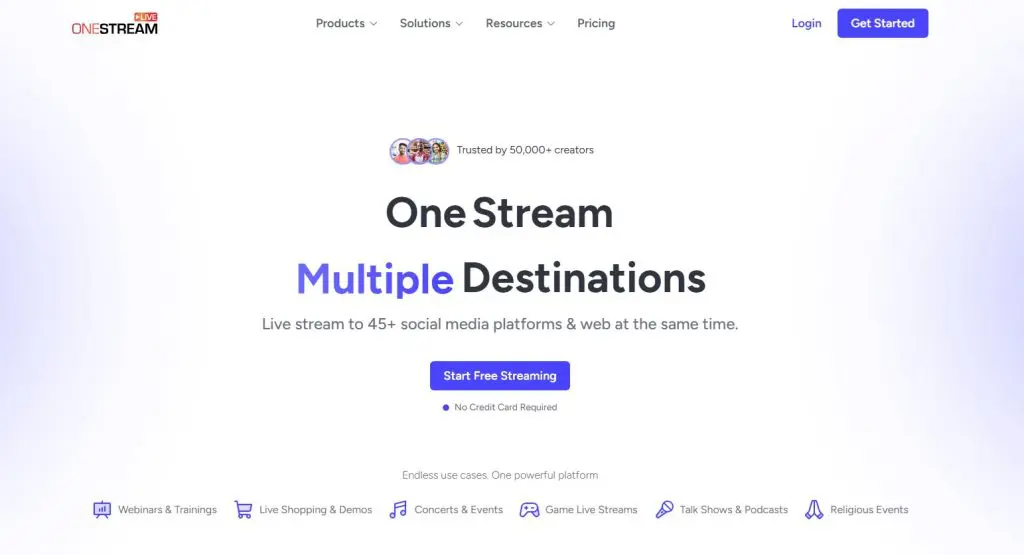
OneStream Live is a cloud-based live streaming platform that sends real-time and pre-recorded video to 45+ social platforms, websites, and custom RTMP destinations at once. Creators can go live from its browser studio, connect an encoder such as OBS or Zoom, or schedule an uploaded video to play as a live stream. More than 50,000 creators and businesses use it.
A typical setup looks like this.
Connect your YouTube, Facebook, LinkedIn, and other accounts, then pick a source. For a live session, open the Studio or paste OneStream’s stream key into your encoder.
For a recorded lesson, upload the file, choose the destinations, and set a date and time. OneStream handles the broadcast and gathers comments from each platform into one chat.
OneStream Live is not a webinar platform, a course platform, or a video editor. Compared with WebinarJam, OneStream has no registration pages or sales tools. Compared with StreamYard, it puts more weight on scheduling and automation than on the live studio experience.
The Main Features in OneStream Live
- Premiere recorded videos as live broadcasts at the time your audience is online
- Run playlists and 24-hour YouTube streams that keep broadcasting without you
- Go live from a browser studio with guests, screen sharing, overlays, and a teleprompter
- Stream from OBS, Zoom, Streamlabs, or any encoder over RTMP, SRT, or WHIP
- Send one stream to YouTube, Facebook, LinkedIn, Twitch, and 40+ other platforms at once
- Reply to comments from several platforms in one unified chat
- Embed live streams on your website or launch a branded stream page with no hosting
- Give team members their own seats and roles to manage streams together
| OneStream Live is | OneStream Live is not |
|---|---|
| A multistreaming and scheduling platform | A webinar platform with registration and reminders |
| A way to broadcast recorded lessons as live streams | A course platform with lessons and student access |
| A browser studio for simple live shows | A full production suite for multi-camera broadcasts |
| A low-cost way to reach many platforms at 1080p | A video editor for cutting clips after the stream |
OneStream Live Pricing & Free Plan | How Much Does It Cost?
OneStream Live has a free plan and four paid plans, with monthly or yearly billing. All plans include the Live Studio, pre-recorded streaming, encoder streaming, embeddable players, and custom websites, so the plans differ mainly in destinations, resolution, seats, storage, and bandwidth. Standard is the plan most course creators should pick.
| Plan | Billed monthly | Billed annually (per month) | Key limits |
|---|---|---|---|
| Free | $0 | $0 | 2 destinations, 720p, 1 GB storage, 3 scheduled events |
| Basic | $15 | $12 | 5 destinations, 720p, 5 GB storage |
| Standard | $39 | $32 | 10 destinations, 1080p, 4 seats, 20 GB storage |
| Professional | $49 | $39 | 30 destinations, 1080p, 6 seats, 50 GB storage |
| Enterprise | $139 | $83 | 50 destinations, 1080p, 10 seats, 150 GB storage |
| Feature | Free | Basic | Standard | Professional | Enterprise |
|---|---|---|---|---|---|
| Capacity | |||||
| Multistream destinations | 2 | 5 | 10 | 30 | 50 |
| Stream resolution | 720p | 720p | 1080p | 1080p | 1080p |
| Team seats | 1 | 1 | 4 | 6 | 10 |
| Cloud storage | 1 GB | 5 GB | 20 GB | 50 GB | 150 GB |
| Monthly player bandwidth | Not listed | 0.5 TB | 1.5 TB | 2.5 TB | 5 TB |
| Ways to stream | |||||
| Browser Live Studio | ✓ | ✓ | ✓ | ✓ | ✓ |
| Encoder streaming (RTMP, SRT, WHIP) | ✓ | ✓ | ✓ | ✓ | ✓ |
| Pre-recorded streaming | ✓ | ✓ | ✓ | ✓ | ✓ |
| Scheduled events | 3 | ✓ | ✓ | ✓ | ✓ |
| 24-hour streams | ✗ | ✓ | ✓ | ✓ | ✓ |
| Publishing | |||||
| Embeddable stream players | ✓ | ✓ | ✓ | ✓ | ✓ |
| Custom websites for streams | ✓ | ✓ | ✓ | ✓ | ✓ |
| Stream keys | ✓ | ✓ | ✓ | ✓ | ✓ |
Resolution decides the first upgrade. Free and Basic stream at 720p, which looks soft next to other creators’ 1080p streams on YouTube. Standard adds 1080p, 10 destinations, and four team seats, which covers a creator streaming to YouTube, Facebook, LinkedIn, and a website.
Destinations matter less than the pricing suggests. According to Streams Charts, YouTube accounted for 49.5% of all livestream hours watched in the second quarter of 2026. For most course creators, YouTube plus two or three channels where their audience already gathers is plenty, so Professional‘s 30 destinations only pay off for agencies and media brands.
Add-ons cover gaps without a full upgrade. Five extra destinations cost $10 a month, a 24-hour YouTube stream $30 a month, two extra team seats $10, 1 TB of extra bandwidth $10 a month, and 10 GB of extra storage $10 a month. Subscriptions can also be paused between busy seasons rather than cancelled.
OneStream Live Features: What Works and What Doesn’t
OneStream competes with StreamYard, Restream, and Be.Live, and its strength is broadcasting recorded content on a schedule. The table shows what each feature does and where it stops, followed by a detailed section on each.
| Feature | What it does | Limitations |
|---|---|---|
| Pre-recorded streaming | Plays uploaded videos as live streams on a schedule | Uploads count against storage, so long libraries need a bigger plan |
| Playlists and 24-hour streams | Queues several videos or runs a nonstop YouTube channel | 24-hour streams beyond the plan need a $30 add-on |
| Live Studio | Hosts browser streams with guests, overlays, and screen sharing | Less polished for interviews than StreamYard |
| Encoder streaming | Accepts RTMP, RTMPS, SRT, and WHIP from OBS, Zoom, and more | Encoders take setup that beginners may find technical |
| Multistreaming | Sends one stream to 45+ platforms and custom RTMP | 720p on Free and Basic, and destination limits by plan |
| Unified chat | Gathers comments from several platforms in one window | Coverage varies by platform, so test your channels |
| Stream players and custom websites | Embeds streams on your site or a branded page with no hosting | No registration, email capture, or paid access |
| Team management | Gives seats and roles to producers and clients | Seats beyond the plan cost $10 for two |
| Mobile app | Streams and manages broadcasts from a phone | Full scheduling is easier on desktop |
| AI and editing | Relies on your own editor for clips and recaps | No built-in AI tools for captions, clips, or summaries |
Feature #1: Pre-Recorded Streaming
Pre-recorded streaming plays an uploaded video as a live stream at the date and time you choose. OneStream accepts MP4, MOV, M4V, and WebM files, including 180-degree and 360-degree video, and processes them for smooth playback on each destination.

Recorded streams are the most useful tool here for course creators. A coach can record a 30-minute training on Monday, schedule it for Thursday at noon on YouTube and LinkedIn, and spend Thursday answering comments instead of presenting. A course creator can premiere a free sample lesson every week as a lead magnet, with a link to the full course in the description.
Be upfront with your audience that the video is recorded, and stay in the chat while it plays. A recorded stream without a live host misses the point of going live, which is the conversation. For a fully automated sales webinar with registration and offers, an evergreen webinar tool fits better.
Feature #2: Playlists and 24-Hour Streams
Playlist streaming plays several videos back to back in one broadcast, and 24-hour streams keep a YouTube channel live around the clock. Playlists and 24-hour streams run on OneStream’s servers, so your computer doesn’t need to stay on.
A playlist turns a course module into a live event. Queue five short lessons as a two-hour “study session” stream, or replay last month’s Q&A sessions on Sunday mornings. A 24-hour stream suits a library of meditation, music, or study content, and churches use it to keep services available all week.
Round-the-clock streams on more channels need the $30-a-month add-on, and long video libraries eat into storage. Check that each platform allows continuous streams, since some limit or flag them.
Feature #3: Live Studio
The Live Studio is OneStream’s browser-based studio for going live without extra software. Hosts can bring guests on screen, share a screen, add overlays and branding, switch camera views, and read from a built-in teleprompter while you stream to every connected destination.

For a course creator, the Studio covers a weekly live Q&A or a short teaching session with a guest. The teleprompter helps when you want to hit specific points in a short promotional stream, and recording the session gives you a file to reuse as a pre-recorded stream later.
The Studio works, but StreamYard’s studio feels smoother for interview shows, with more layout options and easier guest management. Reviewers also note that multi-camera support sits on the top plan. If the live studio is the heart of your show, compare both in my Restream vs. StreamYard guide before you commit.
Feature #4: Encoder Streaming With OBS, Zoom, and More
Encoder streaming lets you produce your stream in another tool and send it through OneStream to all your destinations. OneStream accepts RTMP and RTMPS, the standard for most streaming software, plus SRT for more reliable delivery over unstable connections and WHIP for low-latency browser streams.

Encoder streaming suits creators who already produce in OBS, Ecamm Live, or vMix, or who run classes in Zoom. Paste OneStream’s server URL and stream key into Zoom’s custom streaming settings, and a live Zoom session reaches YouTube and Facebook at the same time. Dropping a single destination mid-stream leaves the others running.
Encoders take some setup, and beginners may find stream keys and bitrate settings confusing. If you’re new, the Studio is the easier starting point.
Feature #5: Multistreaming to 45+ Platforms
Multistreaming sends one stream to several platforms at once, including YouTube, Facebook, LinkedIn, Twitch, Instagram, TikTok, X, and custom RTMP destinations. Connect each account once, then pick destinations for each stream.

Reaching people where they already watch is the point. A coach whose clients live on LinkedIn and Facebook can teach once and appear in both feeds, while YouTube builds a searchable archive. My guides to LinkedIn Live, YouTube Live, and TikTok Live cover each platform’s rules.
More destinations don’t always mean more viewers. Each platform needs its own promotion, and a stream with no audience on five channels still has no audience. Start with the two or three channels where your students already spend time, and add more only when you have a reason.
Feature #6: Unified Chat
Unified chat gathers comments from your connected platforms into one window, so you can read and reply without switching tabs. Each comment shows which platform it came from, with replies sent directly from OneStream.

A combined chat makes multistreaming manageable. When a question comes in on LinkedIn while you’re answering one from YouTube, you see both in one place and can answer each viewer by name. Answering viewers by name keeps them watching and turns a broadcast into a conversation.
Chat support varies by platform, so test which of your destinations feed into unified chat before a big stream. Reviewers on Capterra also mention occasional delays in fixing chat issues.
Feature #7: Stream Players and Custom Websites
Stream players let you embed a live or recorded stream on any website, blog, or online store. Custom websites go further and give you a branded live page with your logo, colors, and domain, with no hosting needed.
Embedding keeps viewers on your own site. A course creator can stream a free workshop on a page next to an email signup form, so viewers join the list while they watch. A coach without a website can use a custom website as a simple home for weekly streams. My guide to landing pages that convert explains what to put beside the player.
OneStream doesn’t gate access, collect registrations, or take payments, so private classes and paid workshops need a platform like Crowdcast or WebinarJam. Players also draw on your plan’s monthly bandwidth, which a popular embedded stream can use up.
Feature #8: Team Management
Team management gives producers, assistants, and clients their own logins with assigned roles. Seats range from one on Free and Basic to ten on Enterprise, and two extra seats cost $10.
Separate seats help once someone else runs your streams. An assistant can schedule next week’s recorded lessons while you teach, and an agency can manage several clients’ channels from one account without sharing passwords.
Solo creators don’t need extra seats, and Basic gives only one, so plan on Standard when a team helps you.
Feature #9: Mobile App
OneStream’s mobile app lets you go live from your phone and manage scheduled streams on the go. Streaming from a phone helps for quick behind-the-scenes updates, event coverage, or a short tip when you’re away from your desk.
Scheduling a full week of recorded streams is easier on a computer, so treat the app as a companion to the desktop dashboard. Pair your phone with a clip-on mic from my live streaming equipment guide, since phone audio is the weak point of mobile streams.
Feature #10: AI and Editing
OneStream Live doesn’t have built-in AI features. The platform covers broadcasting and scheduling, not editing, captions, or clip creation.
AI could do a lot for a scheduling tool like this, such as suggesting the best time to schedule a recorded stream, adding translated captions for viewers in other countries, or cutting short clips from a long stream to promote the next one. None of that is available yet.
OneStream lets you deliver and schedule streams, but it has no AI features to enhance them. So if you want to edit a recording before you schedule it, use video editing software. Most editing tools now include AI features that clean up audio, add captions, and cut highlight clips, which help more people watch your stream.
OneStream Live vs. the Best Alternatives for Live Streaming
OneStream competes with browser streaming studios and multistreaming services. My guide to the best live streaming software compares more options in depth.
| Platform | Best for | Starting price | How it compares with OneStream |
|---|---|---|---|
| OneStream Live | Scheduled and recorded streams | Free plan, paid from $12/mo billed yearly | Strongest scheduling, playlists, and 24-hour streams for the price |
| StreamYard | Live interviews and talk shows | Free plan, paid from $35.99/mo billed yearly | More polished studio for guests, weaker scheduling. See my StreamYard review |
| Restream | Branded multistreaming with analytics | Free plan, paid from $16/mo billed yearly | Stronger graphics and chat tools. See my Restream review |
| Be.Live | Simple talk shows on Facebook and YouTube | Free plan, paid from $14.16/mo billed yearly | Easy studio with fewer destinations. See my Be.Live review |
| Ecamm Live | Mac users who want full production control | Free plan with watermark, paid from $16/mo | Better live production on Mac, no scheduled playback of recordings |
| OBS Studio | Free desktop production | Free | Full control but no multistreaming on its own, so many pair it with OneStream |
Choose OneStream over these when your streams are often recorded first or you want to stream to many channels at a low price. If your show is a live conversation with guests, StreamYard or Restream fits better.
OneStream Live Pros and Cons
These points cover day-to-day issues with OneStream’s billing, support, and setup that the feature sections don’t.
| Pros | Cons |
|---|---|
| A free plan with no credit card lets you test streaming to two destinations | The free plan streams at 720p, so it can’t show what your stream will look like at 1080p |
| Plans can be paused between busy seasons | Cancelling drops you to the Free plan, so check storage limits before you do |
| Small add-ons fill gaps without a full plan upgrade | Add-ons can add up if you need several at once |
| Reviewers on Capterra praise fast, patient support | Some reviewers report occasional glitches and slow fixes |
| All plans include the Studio, encoders, players, and custom websites | Reviewers note multi-camera support is reserved for the top plan |
Is OneStream Live the Best Live Streaming Software for Edupreneurs?
For edupreneurs who reuse recorded content, yes. OneStream turns lessons, interviews, and Q&A recordings you already have into scheduled live streams across several platforms, and few tools do that as well at this price. For edupreneurs whose live sessions are mainly interviews or paid classes, it’s a supporting tool rather than the main one.
The question I’d ask is how much of your live content needs you in real time. If most of it can be recorded and scheduled, OneStream saves hours a week. If most of it is conversation, choose a studio built for guests or a platform built for teaching.
Use Case #1: Weekly Lesson Premieres That Build Your List
A course creator records one free lesson a week and schedules it to premiere on YouTube, Facebook, and LinkedIn every Tuesday at noon, with a link to a free guide in the description. OneStream handles the broadcast while the creator answers questions in unified chat. Standard covers this at 1080p.
Use Case #2: A Live Coaching Q&A Streamed From Zoom
A coach runs a monthly group Q&A in Zoom and uses OneStream to stream it to a Facebook group and YouTube at the same time. The coaching clients interact in Zoom, while the public sees the session as a promotion for the program.
Use Case #3: A Podcast Streamed as Video
Celisa Steele and I have published more than 450 episodes of the Leading Learning Podcast. I’d treat video premieres as one of the simplest ways to put an existing show in front of new people. A podcaster records video episodes and schedules each one to premiere on YouTube and LinkedIn on release day. Viewers who prefer watching to listening find the show, while the stream creates a live chat around each episode. My guides on repurposing podcasts and podcast hosting cover the audio side.
Use Case #4: A Paid Live Class
A teacher charging students for a live class needs registration, payments, and private access, which OneStream doesn’t provide. Use Crowdcast or WebinarJam for the class itself, and OneStream to stream free promotional sessions that fill it.
Should You Choose OneStream Live?
If you’ve decided to try OneStream, start on the free plan and schedule one recorded video to two destinations, then go live once from the Studio to test guests and chat. If both work for your audience, move to Standard for 1080p and more destinations. My guides to multistreaming and live streaming an online class will help you plan the first month of streams.
If OneStream isn’t the right fit, decide what your streams need most. Polished live interviews point to StreamYard, branded graphics and analytics to Restream, and paid classes to Crowdcast. A library of recordings you want to keep broadcasting on a schedule brings you back to OneStream.
Frequently Asked Questions (FAQs)
Is OneStream Live free?
Yes, OneStream Live has a free plan that needs no credit card. The plan includes two multistreaming destinations at 720p, 1 GB of storage, one team seat, and three scheduled events. Paid plans start with Basic and add more destinations, storage, and 1080p streaming on Standard and above.
Can OneStream Live stream pre-recorded videos as live?
Yes. OneStream plays uploaded MP4, MOV, M4V, or WebM videos as live streams at the time you schedule, across all your connected platforms. Several videos can also run as a playlist, or run a 24-hour stream on YouTube without keeping your computer on.
Does OneStream Live have its own studio?
Yes. OneStream’s browser-based Live Studio lets you go live from your browser without extra software, invite guests, share your screen, add overlays and branding, and use a teleprompter. Creators who prefer their own software can stream from OBS, Zoom, or Streamlabs through OneStream’s encoder connection instead.
How many platforms can OneStream Live stream to at once?
OneStream supports 45+ destinations, including YouTube, Facebook, LinkedIn, Twitch, Instagram, TikTok, and custom RTMP. The number you can use at once depends on your plan, from 2 on Free and 5 on Basic to 10, 30, or 50 on the higher plans, plus add-ons.
Is OneStream Live better than Restream?
OneStream is better for scheduling pre-recorded streams, playlists, and 24-hour streams, and often costs less for the same number of destinations. Restream offers stronger on-screen graphics, analytics, and a more established studio, which suits creators whose streams are mostly live.
Can I use OneStream Live with Zoom?
Yes. Paste OneStream’s server URL and stream key into Zoom’s custom live streaming settings. Your Zoom session then streams through OneStream to every connected platform. Participants stay in Zoom while the public watches on YouTube, Facebook, or LinkedIn. Zoom’s own recording settings still apply to the session.
Does OneStream Live have AI features?
OneStream Live doesn’t list built-in AI features for captions, clips, or summaries. Edit recordings in a video editor with AI tools before you schedule them, and turn on each platform’s own automatic captions, such as YouTube’s, so live viewers can follow along.
Can I pause my OneStream Live subscription?
Yes. OneStream lets you pause a paid subscription and reactivate it later, which suits creators who stream in seasons. If you cancel, your plan features stay active until the end of the billing cycle, then your account moves to the free plan.

Jeff Cobb, Founder of Learning Revolution
Jeff Cobb is an expert in online education and the business of adult lifelong learning. Over the past 20+ years he has built a thriving career based on that expertise – as an entrepreneur, a consultant, an author, and a speaker. Learning Revolution is a place where Jeff curates tips, insights, and resources to help you build a thriving expertise-based business. Learn more about Jeff Cobb here.
Table of Contents
Related Posts
What Is StreamYard? | Pricing And Live Streaming Features Reviewed (2026)
WebinarJam Review | Is It the Best Webinar Software for Creators?
19+ Traffic Generation Tips For Online Course Websites