
TL;DR: How To Validate E-learning Product Ideas with the 3M Framework
Most online courses and digital products fail because they’re built on gut feeling rather than honest evaluation. I’ve made that mistake myself. Through years of building and watching others build, I developed the 3M Model as a filter I run every course idea through before committing to it. If all three are there, I build. If one is missing or weak, I pivot.
The three factors are:
Market — Is there real, verifiable demand for this, or are you assuming people want it?
Means — Do you have the genuine expertise to deliver on the promise, and the tools to produce it?
Motivation — Do you care enough about this topic and this audience to push through when it gets hard?
With AI tools like Claude and Perplexity now available, running this validation process is faster than it’s ever been. What used to take days of research can now be done in minutes, which means there’s less excuse than ever to skip it.
Most failed online courses and digital products I’ve seen come down to one of three things: chasing a market that isn’t really there, lacking the real expertise to deliver on the promise, or simply not caring enough to push through when it gets hard.
I’ve watched this play out with solo consultants, coaches, and large organizations running continuing education programs. The failure mode is almost always one of those three, and it usually gets diagnosed too late, after months of work and real money spent.
That’s why I built what I call the 3M Model around the three factors that actually determine whether a course or product idea is worth pursuing: market, means, and motivation.
I use it as a filter before I commit to anything, and I’ve seen it save people from expensive mistakes when they apply it honestly.
In this post I walk through each factor, explain what a weak version of it looks like in practice, and give you three questions at the end to run your own idea through.
Want a faster way to validate your course idea? Use my Free Course Validation Tool
What is the 3M Model for Validating Course Ideas?
The 3M Model is a three-part filter I developed over years of building my own courses and watching other experts do the same.
It asks three questions (the three M’s) before you commit to building anything:
- Market: Is there real demand for this?
- Means: Do I have the genuine ability to deliver on it?
- Motivation: And do I care about this enough to push through the hard parts?
For a winning product idea, you need all three M’s working in your favor, not just two out of three.
For example, a strong market with weak motivation produces a mediocre product that nobody is proud of. Real motivation with no actual market produces something meaningful that nobody buys.
The three factors reinforce each other when they align, and they undermine each other when even one is missing.
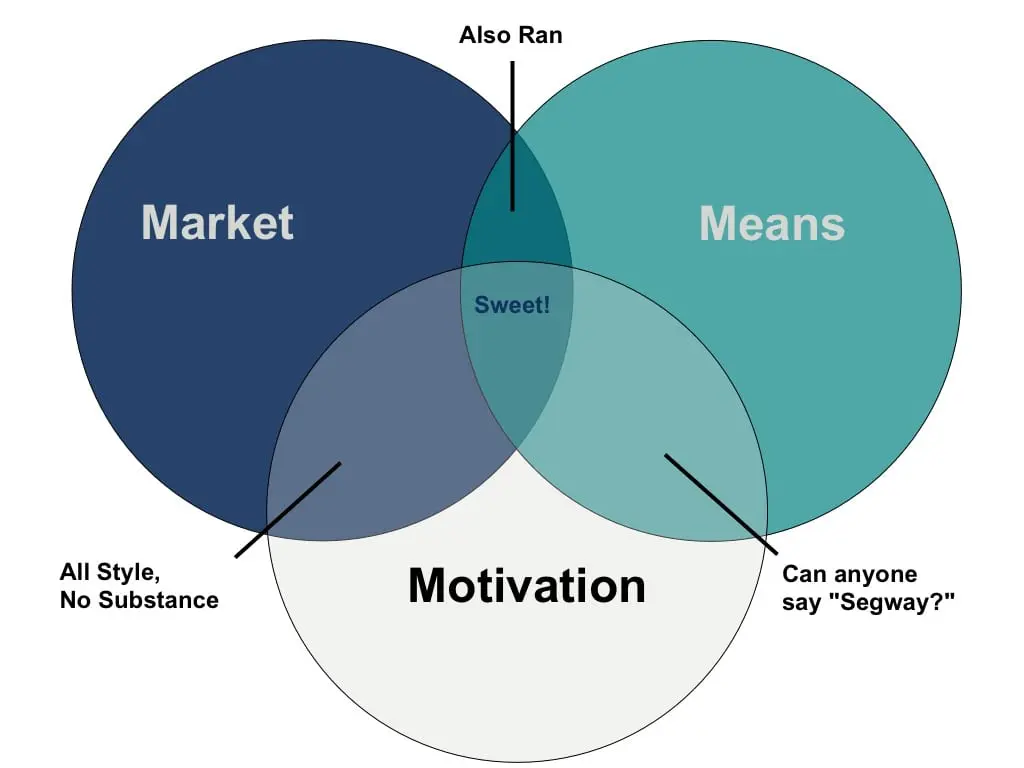
I visualize it as a Venn diagram with three overlapping circles. The place where all three overlap is what I call the strategic sweet spot. That’s where your best product ideas live.
Get all three pointing in the same direction, and you have an online course or e-learning product worth building.
I cover each of these areas in more detail in what follows and also include links to a range of tools I hope you will find helpful.
1. Market: Check Demand
A large percentage of the emails I get come from readers worried about whether demand exists for their product idea, how to price it, and how to promote it. Those questions are all premature. If you’ve done the market work properly, the answers become obvious. If you haven’t, no amount of tactical advice will save the launch.
My consistent response, because I’ve watched this work again and again for myself and many others, is to start by putting content into the market you’re targeting before you build the product. Blog posts, short videos, white papers — pick the format that fits your audience and start there.
For example, a leadership consultant thinking about building a course on executive communication should be writing about it, talking about it on LinkedIn, and watching which angles get traction.
Similarly, a financial planner eyeing a course on retirement planning for business owners should test that specific framing before building a single module.
This is how you build an audience and generate real signal at the same time.
Do people respond? How strong is that response, and what does it tell you about what your product should actually contain? You have to put something out there to find out.
AI has made this testing phase faster too.
ChatGPT or Claude can help you generate content ideas, draft posts, and explore different angles on your topic quickly. But there’s a more direct use that most people miss.
Ask Claude or Perplexity to pull Reddit threads and Quora discussions on your specific topic, and you get raw, unfiltered conversations from the exact people you’re trying to reach.
For example, if you’re thinking about building a course on pricing strategy for agencies you can ask Claude to find what agency owners are actually complaining about on Reddit, and within minutes have a clear picture of the specific frustrations, objections, and language that real buyers use.
That kind of signal used to take days of manual research. Now it takes minutes, which means you can validate faster and with more confidence before committing to a full build.
Search engine demand is the other essential check.
Look at what’s already ranking on Google and what’s selling on Amazon in your topic area. You want evidence that people are actively searching for solutions like yours. Courses launched without that evidence are expensive guesses, and most of them miss.
For a full breakdown of specific tools and approaches, see 15 Ways to Validate Your Online Course Idea.
You cannot know how to position, price, or promote your course until you’ve done this work. Market understanding comes first, and everything downstream follows from it.
Read: The best online course platforms to monetize your knowlegde
2. Means: Can you actually deliver on the promise?
The real question here is whether you have what it takes to build something people will pay for and genuinely benefit from. I split this into two parts: subject matter expertise and production capability. Most people reading this have the first one covered. It’s the second one that trips people up.
On expertise, the consultants, coaches, and trainers I work with are almost always the real thing. A financial planner with 20 years of client work, a leadership coach who has run hundreds of workshops, a project manager who has delivered complex programs across multiple industries. These people have deep, earned knowledge. What they need is a commitment to keep building it. What are you reading, attending, and practicing to sharpen the saw on an ongoing basis? That discipline matters as much as what you already know.
On production, the landscape has changed dramatically since I first wrote this. Creating and selling an online course used to require a significant technical lift. Today the platforms handle most of it. I cover the full range of options in Best Online Course Platforms, and the free Learning Revolutionary’s Toolbox has the specific tools I use and recommend.
AI tools have also changed what’s possible here. A consultant building a course on negotiation skills can now use AI to draft module outlines, generate practice scenarios, and create first-draft workbook content in a fraction of the time it used to take. The expertise still has to come from you. But AI compresses the production work significantly, which means the means barrier is lower than it’s ever been for people who know their subject well.
For gaps you can’t fill yourself, skilled help is still affordable and accessible. Upwork, 99 Designs (I used them for the Learning Revolution logo), and Fiverr give you access to designers, video editors, and course developers without a full-time hire. The Toolbox covers more options there as well.
There’s no serious excuse for means being the thing that stops you in 2026. The real obstacle, when people dig into it honestly, is almost always what comes next.
Read: How to build your e-learning product’s learning objectives
3. Motivation: Do You Care Enough to See It Through?
Motivation is both the hardest of the three factors to assess honestly and the most important.
You can fix a market problem with better research. You can close a production gap with the right tools or help. But you cannot manufacture genuine drive, and without it, the other two factors will only take you so far.
I see this most clearly with organizational clients.
The people responsible for building and delivering educational products often have no real interest in the topics they cover and no sense of how those products could change someone’s life. The content gets built, the courses get launched, and they underperform. The missing ingredient is almost always vision — a clear picture of the difference the product makes for the person who buys it.
Solo edupreneurs and independent consultants tend to have an advantage here. They build courses because they care about the subject and want to help people with it.
That intrinsic motivation is what pushes you through the hard stretches like rewriting modules, handling slow launches, or defending your product pricing with confidence.
Where I see even motivated people struggle is with priorities. I get a steady stream of emails from readers who say they can’t find the time to build their course. Time is always a priorities problem, and priorities flow directly from motivation. If the course keeps getting pushed down the list, that’s worth examining honestly. It may mean the motivation isn’t as strong as you thought, or it may mean you haven’t connected the project clearly enough to the outcome you actually care about.
Spend time getting clear on what drives you before you build. James Clear’s piece on the only productivity tip you’ll ever need is worth reading. So is Cal Newport’s concept of deep work, which Jeff Bullas wrote about and credited with transforming how he works.
AI can help here in a way the traditional assessments can’t. Before you invest months in building, have a direct conversation with Claude or ChatGPT about your course idea. Ask it to challenge your reasoning, push back on your assumptions, and question why you actually want to build this for this audience. The quality of your answers, and how you feel giving them, tells you a lot about whether the motivation is real or whether you’re in love with the idea of a course more than the work of building and delivering one.
If you want structured tools for understanding your own motivations and working style, StrengthsFinder, the Kolbe A Index, and the Fascination Advantage Assessment are all worth the time. Take the results as useful input rather than definitive answers. No questionnaire captures everything that makes you tick, but the process of going through one often clarifies your thinking in ways that direct reflection doesn’t.
Read: Learn how to teach adult learners effectively
Run Your Course Idea Through the 3M Filter Today
Market, means, motivation, all three working together. That’s the filter to find out if a course is worth building.
Before you commit to any new course or product idea, run it through each factor honestly. Is there evidence people are actively searching for this and spending money on it? Do you have the genuine expertise to deliver something worth paying for? And do you care about this enough to push through the hard parts, the slow launch, the rewrite, the moment six months in when it would be easier to stop?
If all three point in the same direction, you’re in the sweet spot. Build it.
If one of them is weak, decide whether you can fix it before you start. A market problem can often be solved with better research and a tighter positioning. A production gap can be closed with tools, AI, or outside help. A motivation problem is harder. If the honest answer is that you don’t really care about this topic or this audience, find a different idea. The work is too hard and too long to do it for the wrong reasons.
The best course ideas I’ve seen, and the ones that have worked best for me, all had the same thing in common. The person building them knew the market, had the ability to deliver, and genuinely wanted to make a difference for the people they were building for. That combination is rarer than it looks. When you find it, don’t waste it.
See also:
- The Power of Naming
- The Key to Long-Term Success as an Edupreneur
- 5 Long-Term Challenges of the Edupreneur

Jeff Cobb, Founder of Learning Revolution
Jeff Cobb is an expert in online education and the business of adult lifelong learning. Over the past 20+ years he has built a thriving career based on that expertise – as an entrepreneur, a consultant, an author, and a speaker. Learning Revolution is a place where Jeff curates tips, insights, and resources to help you build a thriving expertise-based business. Learn more about Jeff Cobb here.
Table of Contents
Related Posts
10 Best Thinkific Examples For Edupreneurs (2026)
How I Get Coaching Clients & Leads From LinkedIn
Buzzsprout Review (2026) | New Pricing for Audio & Video Podcasts