

Viral Video Definition A viral video is online content that spreads rapidly across social media through user sharing and algorithmic distribution, typically reaching hundreds of thousands or millions of views within a short period of time. Virality is defined by two factors: • Scale — the total number of views or interactions • Speed — how quickly those views accumulate A video hitting 1 million views over six months is a strong performer. The same million views in 36 hours is viral because it proves the algorithm is pushing content to cold audiences at scale. |
Quick Answer: How Many Views Is Considered Viral?
Virality has no universal threshold. The definition depends on platform size, audience behavior, and how quickly views accumulate. That said, here are the accepted benchmarks for each major platform in 2026:
| Platform | Viral Threshold | Timeframe |
|---|---|---|
| TikTok | 1M+ views | Within 24–72 hours |
| YouTube (long-form) | 2–5M views | Within 1–2 days |
| YouTube Shorts | 1–3M views | Within 5–7 days |
| Instagram Reels | 500K–3M views | Within a week |
| Facebook Video | 1–5M views | Within a week |
| X (Twitter) | 500K–1M views | Within 2–3 days |
| LinkedIn Video | 100K–300K views | Within 2–5 days |
| LinkedIn Post | 500+ reactions or 50K+ views | Within 2–4 days |
These numbers are not official thresholds set by any platform. They are based on observed performance patterns from creators, marketers, and industry analysts including Shortimize’s 2025 TikTok analysis and platform behavior data tracked by social media researchers.
Platforms do not publish viral definitions because virality is not a feature, it is an outcome of how people respond to content.
What Actually Makes Content Go Viral: The Algorithm Logic
Before going platform by platform, here is the distribution mechanism that applies across all of them.
Every major platform uses a variation of the same model to make content viral:
- Your content is shown to a small test audience — typically your existing followers plus a small cold pool.
- The algorithm measures engagement velocity: how quickly people like, comment, share, and keep watching.
- Strong signals trigger wider distribution. Weak signals stop it.
- Strong performance at each stage triggers the next wave of distribution.
This is why speed matters more than total volume. A video that gets 500K views in 4 hours signals something completely different from one that gets 500K views over 30 days.
Here are the key signals that trigger wider viral content distribution on most platforms:
| Signal | Why It Matters |
|---|---|
| Completion rate / Watch time | Did viewers watch to the end? High completion triggers wider distribution. |
| Shares and saves | The primary mechanism of true viral spread — indicates intent to forward. |
| Comments (with replies) | Conversation signals strong interest to the algorithm. |
| Engagement velocity | Interactions in the first hour carry disproportionate algorithmic weight. |
| Share-to-view ratio | 1 share per 50 views is considered exceptionally strong on TikTok. |
How Many Views Is Viral on TikTok?
Benchmark: 1 million views within 24–72 hours
TikTok is the most aggressive viral distribution machine of any platform. With over a billion monthly users, TikTok’s For You Page (FYP) algorithm does not care about follower count. It cares about how strangers respond to your content. A creator with 200 followers can hit 10 million views if the FYP distributes it to the right audiences at the right time.
According to Shortimize’s 2025 TikTok analysis, approximately 1 million views gained within 24–48 hours is the most widely accepted benchmark for TikTok virality. Videos hitting 3–5 million views in a week are unambiguously viral.
What TikTok’s algorithm specifically rewards:
- Completion rate above 70–80% — TikTok’s algorithm heavily weights loop plays and full completions. A 15-second video watched 3 times is more valuable than a 60-second video abandoned halfway.
- First-hour engagement — Comments, shares, and profile visits in the first 60 minutes signal the algorithm to keep distributing.
- Sound and hashtag associations — Videos using trending sounds get amplified through TikTok’s sound-based discovery system.
- Share-to-view ratio — If 1 in 50 viewers shares a video, that is exceptional and treated as a strong distribution signal.
Niche virality matters here. A video with 80K views in the #woodworking or #dermatology niche can be effectively viral for that audience segment, even if it never trends globally. TikTok’s category-specific distribution means creators in small niches can build highly engaged followings without hitting million-view milestones.
Famous TikTok viral examples:
- Khaby Lame — TikTok’s most-followed creator, known for wordless reaction videos that regularly surpass tens of millions of views. His content spread globally without a single word of dialogue.
- Zach King — Creator famous for short illusion “magic” videos that routinely go viral on both TikTok and Instagram due to their shareability and novelty.
How Many Views Is Viral on YouTube?
Benchmark: 2–5 million views within 1–2 days (long-form); 10M+ in a week for global viral
YouTube operates differently from TikTok. It is primarily an evergreen content platform where most videos build views slowly over months. True virality on YouTube is rarer and more dramatic when it happens.
For a long-form YouTube video to be considered viral, it generally needs 2–3 million views within 1–2 days of posting. Videos hitting 10–20 million views in their first week are trending globally and will appear in the YouTube Trending tab.
Here’s the list of the most-watched YouTube videos gives you an idea of the platform’s potential reach.

Most parents won’t be surprised to see Baby Shark top the list with 12 billion views.
Want to create better YouTube content? Check out our comprehensive list of YouTube tools.
YouTube’s algorithm rewards:
- Click-through rate (CTR) — Thumbnail and title determine whether people click. A 10%+ CTR is exceptional; most videos operate between 2–6%.
- Average view duration (AVD) — How many minutes people actually watched. YouTube wants viewers to stay on the platform.
- Sessions started — YouTube specifically values content that gets people to begin a YouTube session from external sources.
MrBeast is the clearest example of engineered YouTube virality. His videos routinely reach 50–100 million views within days through high-concept formats, extreme production value, and a mastery of thumbnail and title optimization.
Note: YouTube is one of the few platforms where a video can go viral months or years after posting, if picked up by another platform or a high-traffic creator.
How Many Views Is Viral on YouTube Shorts?
Benchmark: 1–3 million views within 5–7 days
YouTube Shorts benefits from YouTube’s massive existing audience, but does not have TikTok’s FYP-level virality engine. A Short is more likely to build views steadily over a few days than to explode overnight.
In March 2025, YouTube updated how Shorts views are counted. They now count each view individually rather than grouping loops. A Short showing 5 million views post-March 2025 is not directly comparable to one from before that date.
For Shorts, completion rate matters even more than on regular YouTube. Shorts are typically 15–60 seconds, and viewers dropping off in the first 3 seconds tanks distribution completely.
Here’s an excellent example of a viral YouTube Shorts video.
Use our YouTube Earnings Calculator to estimate your income
How Many Views Is Viral on Instagram Reels?
Benchmark: 500K–3M views within a week
Instagram has over 2 billion monthly active users, but its distribution model sits between TikTok and YouTube. The Explore page and Reels feed push content to non-followers, but the algorithm is less aggressive than TikTok’s FYP.
Instagram specifically weights:
- Saves — When someone saves a Reel, Instagram treats it as a signal the content is worth watching more than once. Saves are arguably the most powerful distribution signal on Instagram.
- Shares to Stories and DMs — Instagram measures how often Reels are sent between users in Direct Messages or shared to Stories.
- Watch time and replays — Same completion rate logic as TikTok.
For smaller accounts (under 100K followers), 500K views in a few days is a clear viral event. For major creators, the bar is 1–3 million. For something to trend platform-wide in the Explore page, it typically needs 3–4 million views in a week.
Is 1 million views on Instagram viral? Yes, for the vast majority of accounts. A Reel hitting 1 million views in 2–3 days is genuinely viral, especially for accounts with under 500K followers.
How Many Views Is Viral on Facebook?
Benchmark: 1–5 million views within a week
Facebook is no longer where trends start, but with nearly 3 billion monthly active users, it’s where content spreads to broader demographics — particularly audiences aged 35 and older who are not on TikTok.
Facebook’s native video algorithm strongly favors video uploaded directly to Facebook over YouTube links. Facebook Reels follow the same short-form mechanics as Instagram Reels (Meta owns both, and content can crosspost between platforms).
For a video to be considered viral on Facebook, it typically needs 1 million views with strong engagement or 3–5 million views with average engagement. Facebook weights shares especially heavily — a post shared 100,000 times spreads far more broadly than one with 100,000 likes but few shares.
How Many Views Is Viral on X (Twitter)?
Benchmark: 500K–1M views within 2–3 days; 50K+ reposts
X (formerly Twitter) is not primarily a video platform, which changes the virality calculation. Text posts, images, and short clips can all go viral, and engagement metrics are public — anyone can see exactly how many views, likes, and reposts any post has.
For X, virality is often better measured by reposts and quote posts than raw views. A post with 300K reposts reaches far more people than one with 1 million views that nobody reposts, because reposts are the primary mechanism of spread.
Views alone are a weak virality signal on X because the platform counts impressions (how many feeds the post appeared in) differently from actual engaged views. A post can show 5 million impressions while generating almost no reposts or replies.
How Many Views Is Viral on LinkedIn?
Benchmark: 100K–300K views (video) or 500+ reactions (post) within 2–5 days
LinkedIn operates on a fundamentally different virality model. Its audience is professional, its content is career-adjacent, and its algorithm heavily weights first-degree connections. Content goes viral on LinkedIn within professional networks, not globally.
The content types that perform best on LinkedIn: personal career stories, provocative professional opinions, practical lessons from professional experience, and data that surprises people in a specific industry.
LinkedIn virality rarely translates outside LinkedIn. A post with 2 million views on LinkedIn may go entirely unnoticed on other platforms, because the content is tailored to a professional context that does not cross over.
What Does It Mean To Go Viral Online in 2026?
In 2014, Ellen DeGeneres posted a group selfie on her Twitter (now X) account that instantly went viral.
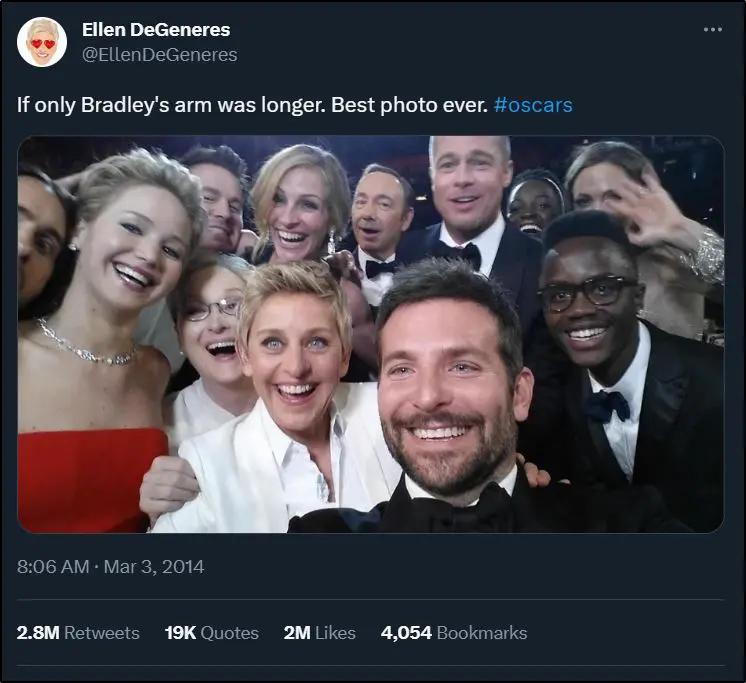
Over 2.8 million people retweeted it, and hundreds of millions saw it across social networks, digital media platforms, and conventional television channels in just a few days.
This simple Tweet had a massive cultural impact worldwide and led to the mainstreaming of group selfies.
Ellen posted that selfie in March 2014. According to Google Trends, that’s precisely when “group selfies” became a thing.
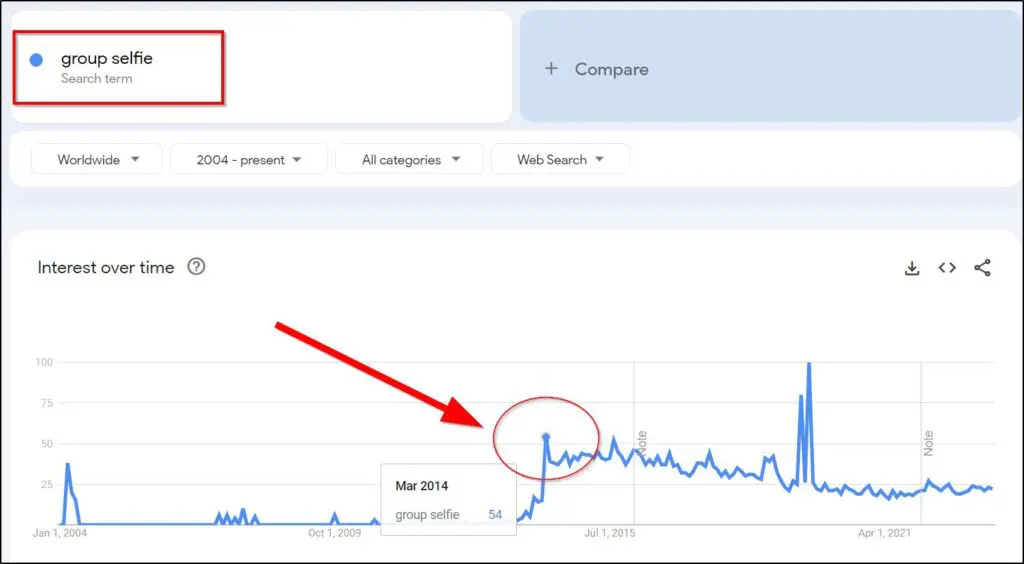
That’s a classic example of what it means to go viral online.
You usually don’t associate anything positive with the word viral (you know, infections, diseases, etc.).
But in the internet world, everyone wants to go viral.
Because going viral online means your content becomes the talk of the town, gets massive exposure, and spreads like wildfire without you spending a dime on advertising.
People start sharing it with friends, family, and online connections on social media platforms like TikTok, YouTube, Facebook, Instagram, and others.
And it doesn’t stop there.
Viral content makes its way to communication tools like WhatsApp and Slack and forums like Reddit, Quora, and online groups.
And ultimately, in people’s real-world discussions.
Viral Content Definition
In simpler words, you’d consider a piece of content viral when many people voluntarily share it on different online platforms in a very short span of time.
For example, you’ll call a video viral if it gets a million views in a single day. But you won’t consider a video viral if it gets a million visitors in two or three years.
One of the first viral videos ever on the internet was made in 1996, well before YouTube or Facebook existed. It’s called the Dancing Baby, and you’ve probably seen it.
Back then, it floated around people’s email inboxes as an attachment. Everyone loved forwarding it to their peers via email and friends on MSN and Yahoo Groups (old days). Later, it was one of the first videos uploaded to YouTube, and it’s still there.
So, when lots of people see and share a piece of content quickly, you call it viral.
How many people and how quickly? It depends on the platform and audience size.
What’s Viral Content In Online Marketing Terms?
From a marketing perspective, you don’t need the kind of global exposure Ellen’s Tweet got to go viral.
Instead, you’ll consider your content viral even if only your target audience enjoys and shares it online. You can also consider content viral if it trends only on a specific platform your audience uses.
Why? Because the internet has become so vast and has so many closed communities, you don’t need the whole world to know about your content to enjoy the benefits of virality.
For example, content going viral on Twitter might perform poorly on Facebook or TikTok. Yet, you’ll consider it viral because hundreds of thousands of people in your target audience are Tweeting it voluntarily.
Similarly, TikTok is an entirely different world in itself. Many Facebook and Twitter users can’t imagine the exposure content gets on TikTok. Yet even the top trending content on TikTok often doesn’t feature on other platforms.
There are completely different worlds closed inside these platforms, with millions of users having unique content consumption habits.
So, when you’re looking to create viral content as a marketer, you must define your target audience and platforms because that’s where your growth comes from.
What Makes Content Go Viral: 6 Core Mechanisms
For most creators, viral content happens by accident.
But most studies show there’s some science behind videos going viral on the internet. So, if you want to go viral on TikTok, YouTube, Instagram, or any other platform, understand what actually makes content go viral.
1. Identity Expression
People share content that says something about who they are or what they believe. Political statements, niche hobby content, and tribal humor go viral because sharing them is a form of self-expression. When someone shares a video, they are telling their network: this is me.
2. High-Activation Emotions
Research on viral content consistently shows that high-arousal emotions — awe, anger, amusement, anxiety — drive sharing far more than low-arousal ones. Sadness and contentment are passive emotions. Outrage and surprise create emotional states that demand action (sharing) as release.
3. Practical Value
“Useful enough to forward” is a legitimate viral mechanism. Tutorial videos, life hacks, and professional tips spread because people want to give their network something useful. “You have to see this” and “you might need this” are both valid sharing motivations.
4. Social Currency
People share content that makes them look good — knowledgeable, funny, ahead of the curve. A creator who covers a trend before it goes mainstream gets shared by people who want to be seen as early adopters.
5. Novelty and Surprise
Content that shows something the viewer genuinely has not seen before triggers a strong sharing impulse. This is why extreme stunts, record-breaking achievements, and genuinely unusual moments go viral even without context or production value.
6. Timing and Trend Proximity
Being first to cover a breaking event, or attaching your content to a trending sound or hashtag, dramatically increases distribution probability. Platforms surface trending content preferentially, so timing your content with a trend can multiply organic reach by 10x or more.
How Long Does It Take for a Video to Go Viral?
Most viral videos hit their peak within 24–72 hours of posting. The window varies by platform:
- TikTok — Fastest. Viral videos typically spike within 12–24 hours. After 72 hours without traction, most videos stop growing.
- YouTube — 24–48 hours for the initial spike, though YouTube is uniquely capable of delayed virality via search or external links months or years later.
- Instagram Reels — 24–48 hours. The Reels feed prioritizes recency; older Reels rarely go viral unless reshared.
- X (Twitter) — Often hours. X moves faster than any other platform for breaking content.
- LinkedIn — 2–5 days. LinkedIn’s slower news cycle gives viral content a longer active window.
Is Virality the Same for Small and Large Creators?
No. Virality is relative to your baseline.
For a creator averaging 500 views per video, hitting 80,000 views is a 160x spike — a genuine viral event for their audience and growth trajectory. The absolute number (1 million, 5 million) matters when asking whether content trended on the platform. But for your own content strategy, the more useful question is: did this content reach people outside my normal audience, and did they respond?
Look at the delta between your typical view count and the spike. A 30x to 40x spike from your baseline is more meaningful for your business than chasing an arbitrary global threshold.
Does Going Viral Actually Help Grow a Course Business?
For online course creators, coaches, consultants, and digital product sellers, viral content is only valuable if it reaches the right audience. A video with 10 million views from a demographic that will never buy your product is worth less than a video with 50,000 views from people actively looking for what you sell.
Read: How to create a successful online course in the AI-age
Top-of-funnel awareness
Short-form viral content on TikTok or YouTube Shorts can introduce your ideas to people who did not know you existed. If the content establishes your expertise — not just entertains — some fraction of viewers will look you up.
Lead generation
Viral content converts into leads only if you have a clear path: a lead magnet, a newsletter, a free resource, or a community. Without that infrastructure, viral views produce a temporary traffic spike and then nothing.
Credibility signals
A video with 500K views gives you a social proof asset. Embedding it in sales pages, email sequences, or pitch decks adds credibility — regardless of whether those 500K viewers were your target customers.
Audience intelligence
Viral content at scale gives you data. Comments on a video with 2 million views tell you what questions, objections, and emotional responses your content triggers. That is market research at no cost.
Read: The best online course platforms for creators
Frequently Asked Questions
How many views is considered viral on TikTok?
A TikTok video is generally considered viral when it reaches 1 million views within 24–72 hours, with high completion rates and strong share activity. Videos hitting 3–5 million views in a week are clearly viral by any standard. For smaller creators, even 50,000–100,000 views can represent a viral event if it marks a major spike beyond their normal reach.
How many views is viral on YouTube?
For long-form YouTube videos, 2–5 million views within 1–2 days indicates viral performance. Global viral status typically requires 10–20 million views in the first week. YouTube Shorts have a lower threshold: 1–3 million views in 5–7 days is considered viral.
Is 1 million views on Instagram viral?
Yes. For most Instagram accounts, 1 million views on a Reel within a few days is clearly viral. For major creator accounts with 5–10 million followers, the bar is higher — they typically need 3–5 million views to consider it a true viral moment.
What is considered viral on Facebook?
A Facebook video is viral when it crosses 1 million views with strong engagement, or 3–5 million views regardless of engagement level. Facebook posts (non-video) are considered viral when they reach 100,000+ shares.
What is engagement velocity and why does it matter?
Engagement velocity is the rate at which content accumulates interactions per unit of time after posting. It matters because every major platform’s algorithm interprets rapid early engagement as a signal to push content to wider audiences. A video that gets 10,000 likes in the first hour is algorithmically treated very differently from one that gets 10,000 likes over a week — even though the total is identical.
What is completion rate and why does it matter for virality?
Completion rate (or watch-through rate) is the percentage of viewers who watch a video from start to finish. On TikTok, a completion rate above 70–80% is considered strong and triggers wider distribution. On YouTube, average view duration as a percentage of total video length is the equivalent metric. High completion rate is arguably the single most important signal for video virality on short-form platforms.
Can a video go viral days or weeks after posting?
Yes, but it is uncommon. On TikTok, videos occasionally resurface through the FYP weeks after posting if the algorithm re-tests them with a new audience. On YouTube, evergreen videos can receive sudden traffic spikes from search or external links months or years after upload. On most other platforms, content that does not gain traction in the first 72 hours rarely recovers.
What is the difference between going viral and trending?
Going viral refers to content spreading rapidly through user sharing behavior — the spread is organic and user-driven. Trending refers to content appearing in a platform’s curated trending section, based on a combination of velocity, recency, and geographic relevance. Viral content often trends, but trending content is not always viral — platforms sometimes surface niche or older content in trending sections.
What makes a video go viral on TikTok specifically?
The combination of: a strong hook in the first 1–3 seconds, high completion rate (people watching to the end), use of trending sounds, and a share-to-view ratio above approximately 2%. The FYP algorithm tests content in progressively larger audience pools, and only content that performs well at each stage gets pushed further.
How many views is viral for a LinkedIn video?
LinkedIn videos with 100,000–300,000 views within 2–5 days are performing at viral levels for the platform. Because LinkedIn’s algorithm distributes through professional networks rather than cold discovery, reaching those numbers indicates the content spread well beyond the poster’s immediate connections.

Jeff Cobb, Founder of Learning Revolution
Jeff Cobb is an expert in online education and the business of adult lifelong learning. Over the past 20+ years he has built a thriving career based on that expertise – as an entrepreneur, a consultant, an author, and a speaker. Learning Revolution is a place where Jeff curates tips, insights, and resources to help you build a thriving expertise-based business. Learn more about Jeff Cobb here.
Table of Contents
Related Posts
How To Go Viral On TikTok Overnight | Proven Examples (2026)
TikTok Income Calculator (2026): Estimate Your Earnings Across Every Revenue Stream
How to Live Stream On YouTube Using StreamYard (2026)