
TL;DR: LearnWorlds AI Features | Are They Actually Useful For Course Creators and Edupreneurs?
LearnWorlds AI is the set of AI tools built into every part of LearnWorlds, from the course builder and exams to the website, emails, mobile app, and reports. It’s more advanced than the AI in Thinkific or Teachable because it also works inside your lessons, where learners answer in their own words, practice with AI-built activities, and get feedback.
What it does well:
– Turns your own files and existing courses into outlines, lessons, and quizzes
– Builds practice activities like branching scenarios and simulations without a separate authoring tool
– Gives learners feedback on open answers inside the lesson
– Follows one set of brand and tone rules across every builder
– Answers plain-language questions about your learners and sales
Where it falls short: Generic output when you start from a topic name alone, monthly credit limits, and several announced features that aren’t available yet.
AI credits: 300 a month on Starter, 500 on Pro Trainer, and 1,000 on Learning Center, with extra credits available to buy.
My take: LearnWorlds AI is worth paying for when you teach skills that need practice and feedback. For a simple video course, Thinkific or Teachable AI covers what you need.
Try LearnWorlds AI free for 30 days
Every course platform now has AI. Thinkific has it, Teachable has it, and most of them do the same few things. They write a course outline, draft some lesson text, and suggest a few quiz questions, and then the AI steps aside while you build the rest by hand.
LearnWorlds took a different route. I’ve run courses on LearnWorlds for years under Leading Learning and Tagoras, including Presenting for Impact, and over the past year AI has spread into almost every part of the platform. It’s there when you build a page, write an exam, design a practice activity, set up your mobile app, and read your reports.
In this guide, I break down every LearnWorlds AI feature, how each one works in practice, and the creator use cases where it makes a real difference. I also explain why LearnWorlds AI goes further than the AI in Thinkific or Teachable, and when it’s worth choosing LearnWorlds because of it.

What Is LearnWorlds AI?
LearnWorlds AI is the AI layer built into the LearnWorlds course platform. It helps you create course content, build interactive practice, run your school site, and understand your learner data, all from inside the tools you already use.
Most platforms give you one AI assistant that lives in a single corner of the product. LearnWorlds put AI into each builder instead. The Site Builder, Ebook Builder, Exam Builder, Form Builder, course outline tool, image creator, email editor, mobile app builder, and Reports Center all have their own AI tools, and they share the same context about your school.
LearnWorlds calls this approach the Living Learning System, which it presented at a launch event on October 13, 2026. The idea is that AI handles more of the production work, while you decide what learners need and how they should practice. Some features from that launch are live now, and others are rolling out in stages, so I’ve marked which is which throughout this guide.
| Where AI shows up | What it does | Available now? |
|---|---|---|
| Course outline tool | Builds sections and activities from an idea, your files, or an existing course | Yes |
| Ebook Builder | Writes lesson pages and adds AI Question, AI Activity, and AI Canvas experiences | Yes |
| Exam and Form Builder | Writes quiz questions, answer feedback, and survey questions | Yes |
| Interactive video | Creates transcripts, subtitles, translations, summaries, and a table of contents | Yes |
| Site Builder and funnels | Writes and edits page copy, builds pages and funnels | Yes, with Create Site with AI coming soon |
| Emails | Writes and rewrites course and marketing emails | Yes |
| Images | Generates lesson visuals and illustrations | Yes |
| Mobile app builder | Builds and updates app screens from a prompt | Yes, with the mobile app add-on |
| Reports Center | Answers plain-language questions about learners and revenue with AI Insights | Yes |
| Learning Agent | Tutors learners inside your course using approved content | Coming soon |
| AI video and avatars | Generates video lessons with avatars and custom voices | Coming soon |

Why LearnWorlds AI Is More Advanced Than Thinkific or Teachable AI
LearnWorlds AI goes further because it works across the whole platform and inside the learning itself. Thinkific and Teachable mostly use AI to help you create course content faster. LearnWorlds also uses it to change what learners do during a lesson and how you run your school afterward.
Thinkific’s AI helps you outline courses, draft lessons and quiz questions, and write sales copy. Its Thinker AI tutor answers student questions from your course content, but it’s limited to Thinkific Plus, the enterprise plan. Teachable’s AI Hub covers outlines, lesson drafts, summaries, quizzes from your material, sales page copy, and subtitles and translations in more than 70 languages.
Those are good creator tools, and for a simple video course they cover most of what you need. The difference shows up in four places.
- AI inside every builder: LearnWorlds puts AI into the site, ebook, exam, form, email, image, app, and reporting tools, so you don’t switch to a separate assistant to get help.
- AI that learners use: AI Question, AI Activity, and AI Canvas sit inside lessons. Learners write answers, get feedback, and practice in scenarios, so the AI improves the learning experience itself.
- One brief for every tool: AI Context stores your audience, tone, terms, and image style once, and every supported builder follows it. Consent controls and a choice of AI providers give organizations control over how AI reaches learners.
- AI after the course launches: AI Insights reads your reports, and recertification, retraining, and the mobile app builder carry AI into running the school over time.
| AI capability | LearnWorlds | Thinkific | Teachable |
|---|---|---|---|
| AI course outlines | Yes, from ideas, files, or existing courses | Yes | Yes |
| AI lesson content | Yes, as editable ebooks with images | Yes | Yes |
| AI quiz and exam questions | Yes, with feedback and difficulty settings | Yes | Yes, from your material |
| Learner answers with AI feedback | Yes, AI Question | No | No |
| AI-built practice activities and simulations | Yes, AI Activity and AI Canvas | No | No |
| AI tutor for learners | Coming soon, plus learner memory now | Yes, Thinker AI on Plus only | No |
| School-wide AI brand and tone rules | Yes, AI Context | No | No |
| AI subtitles and translations | Yes, on higher plans | Not a core feature | Yes, 70+ languages |
| AI help with reports and data | Yes, AI Insights | Through MCP on Plus | Through MCP beta on Growth and up |
| AI disclosure and learner consent | Yes | No | No |
| Starting price (annual billing) | $44/mo | $82/mo | $29/mo |
Thinkific and Teachable still lead in a couple of spots. Thinkific’s Thinker AI tutor is live today, while the LearnWorlds Learning Agent hasn’t launched yet. Both rivals also let you connect Claude or ChatGPT to your school data through MCP, which LearnWorlds has announced but not released. My Teachable vs LearnWorlds comparison covers the wider platform differences.
LearnWorlds AI Features: A Full Breakdown
Here’s how each LearnWorlds AI feature works when you use it, the creator jobs it fits, and where it falls short. I’ve ordered them the way you’d meet them while building and running a course.
1. AI Context: Set Your Brief Once
AI Context works like a creative brief for your whole school. You fill in your audience, language, brand personality, tone of voice, image style, preferred terms, and any custom instructions. From then on, the AI in the Site Builder, Ebook Builder, Exam Builder, Form Builder, course outline tool, and image creator follows those rules.
You can apply a rule to every tool or keep it to one builder. For example, a compliance training company can tell the AI to always say team members instead of employees, use a formal tone in exams, and keep a friendlier voice on sales pages.
Solo creators can skip this at first, but it pays off fast once more than one person builds courses. Without it, each course ends up sounding like whoever wrote the prompt that day.
2. AI Course Outlines and Sections
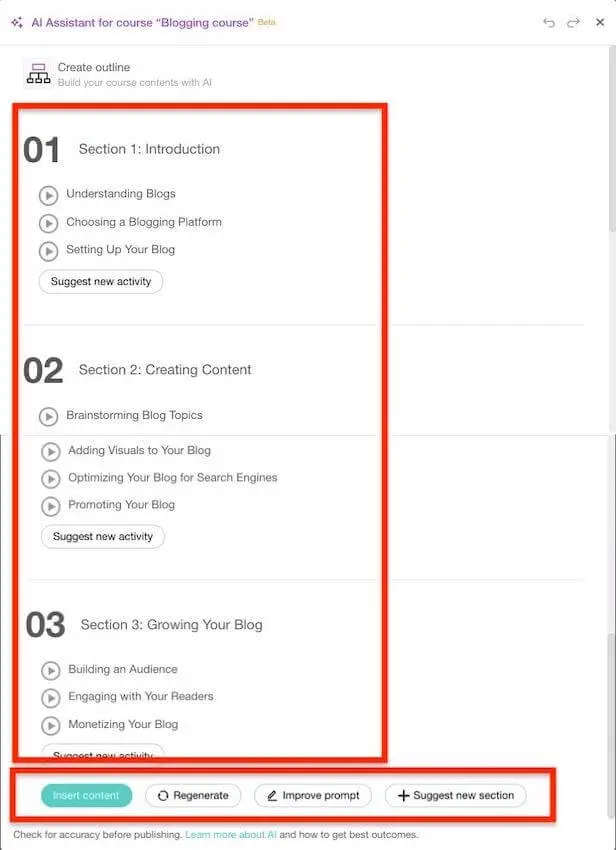
The outline tool builds a course structure from an idea, a file, pasted text, or an existing LearnWorlds course or learning program. You choose the number of sections, the activity types, the level, the audience, and the tone, and you get sections with learning activities already in place. From there, you can regenerate, rearrange, add, or delete anything.
The quality depends on what you give it. A bare topic like “email marketing for coaches” produces an outline that looks like every other course on that topic. A transcript of a workshop you’ve taught ten times produces an outline built on your examples and your teaching order, and that’s the version worth selling.
My favorite use case is repurposing. A coach with a year of podcast episodes or a consultant with a slide library can turn that material into a structured course draft in an afternoon, instead of starting from a blank page.
3. AI Ebooks and Lesson Content
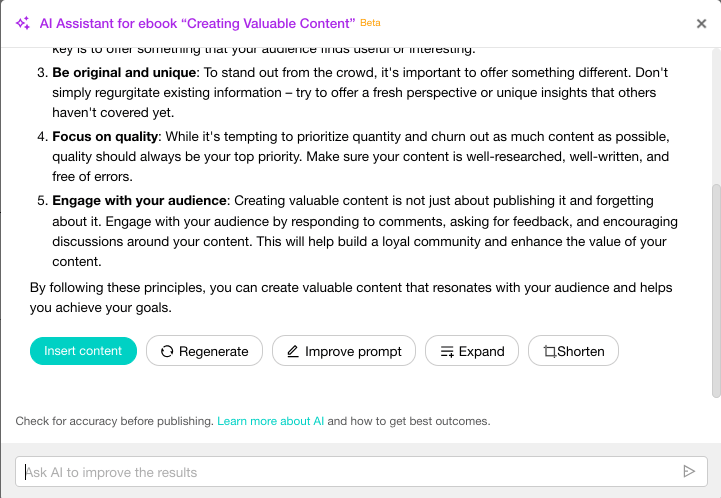
Ebooks are LearnWorlds’ interactive lesson pages, and the AI can write them for you. You pick a format, such as explaining a process in steps, writing a case study, building a glossary, listing pros and cons, or creating journal prompts. Then you set the audience and tone, attach source material if you have it, and the AI drafts the page with text and images.
You can then polish, shorten, expand, summarize, change the tone, or translate any part of it. I use these tools mostly to turn dense source documents into readable lessons. A 30-page policy manual becomes five short lessons with examples, which saves hours of rewriting.
The limitation is accuracy. AI can state things confidently that aren’t true for your field, so a subject expert needs to read every lesson before it goes live.
4. AI Assessments and Feedback

The Exam Builder uses AI to write questions from your lesson content or attached files. You pick the question type, difficulty, learning goal, and feedback style, and the AI writes the questions along with feedback for right and wrong answers. In the review area, AI can also draft feedback on learner assignments, with settings for length, strictness, and tone.
This is the biggest time saver in LearnWorlds AI. Writing a 40-question exam with believable wrong answers can take a subject expert most of a day, and the AI drafts one in minutes. Certification programs, compliance training, and exam prep courses get the most from it, because they need large question banks.
Review every question before learners see it. The AI sometimes writes questions with two defensible answers, or questions that test trivia instead of the skill you’re teaching.
5. AI Question: Open Answers With Feedback
AI Question lets learners answer in their own words inside a lesson and get feedback on what they wrote. They can type or dictate an open answer, or respond to a multiple-choice question or poll, and the AI responds to their actual answer. With learner memory turned on, it can also remember what it has learned about each person over time.
Open questions used to be impractical at scale, because someone had to read every answer. Now a sales trainer can ask learners how they’d handle a price objection, and each learner gets feedback on their own response. A leadership coach can ask for a reflection after each module and get a reply that pushes the learner to think further.
Neither Thinkific nor Teachable offers anything like this inside a lesson today. Keep an eye on credits, though, because LearnWorlds says AI Question draws from your monthly allowance.
6. AI Activity: Practice Without an Authoring Tool
AI Activity builds interactive practice from ready-made patterns. The options include flashcards, matching, sorting, sequencing, branching scenarios, and simulations. You describe what learners should practice, the AI builds the activity, and you test it in AI Studio and ask for changes through chat.
Branching scenarios used to need a tool like Articulate Storyline and a few days of work. With AI Activity, a customer service trainer can build a scenario where learners pick responses to an upset customer and see how each choice plays out, without leaving LearnWorlds. The activities follow your ebook theme and also work in the LearnWorlds mobile app.
For complex simulations with detailed scoring, a dedicated authoring tool still gives you more control. For the everyday practice most courses lack, AI Activity is the strongest AI feature LearnWorlds has shipped.
7. AI Canvas: Custom Interactive Pieces
AI Canvas starts from your idea instead of a pattern. Describe what you want, and it builds things like calculators, maps, games, infographics, and experiments, with code you can edit where LearnWorlds supports it.
The best use cases put learners to work. A personal finance course can include a loan calculator where learners plug in their own numbers. A nutrition course can include a meal planner, and a pricing course can let learners test different price points and see the revenue change.
AI Canvas is also where the gimmick risk lives. A random game inside a leadership course looks clever in a demo and teaches nothing, so ask what the learner practices before you build one.
8. AI Interactive Video, Subtitles, and Translation
Upload a video to LearnWorlds, and the player creates a transcript automatically. AI then adds subtitles, translated subtitles, summaries, a clickable table of contents, and interactive questions inside the video. The basic version comes with Pro Trainer, and the advanced AI video tools need Learning Center.
For creators with a global audience, translated subtitles open a course to new markets without re-recording anything. Transcripts and summaries also help learners who prefer reading or want to review a lesson in two minutes before a quiz.
9. AI for Your Site, Pages, and Emails

Inside the Site Builder, you can select any text and ask the AI to polish it, make it catchier, change the tone, shorten or expand it, or translate it. You can also write your own prompts. The AI uses your course context to draft sales pages, funnels, offers, and pop-ups, and the email editor has AI for writing and rewriting course and marketing emails.
These tools speed up the first draft of a sales page, but they won’t replace knowing your buyer. Write the core promise and the main objections yourself, then use the AI to tighten and test variations. LearnWorlds has also announced Create Site with AI, which proposes a logo, colors, fonts, and messaging from a reference website, and it’s coming soon.
10. AI Mobile App Builder
Since September 2026, the mobile app add-on includes an AI builder. You describe a screen or section, such as a course recommendation or an upgrade offer, and the AI drafts the layout, copy, and visuals. One instruction can also update a whole section, and every result stays as an editable draft until you publish it.
The branded app is a paid add-on on every plan, so this feature only matters if you already plan to offer an app. For schools that do, it cuts app updates from a design task to a short prompt.
11. AI Insights for Reporting
AI Insights adds a conversation layer to the Reports Center. Owners and admins can ask questions in plain English, such as which courses lose the most learners in the second week or which learning program brings in the most revenue. You can choose a Basic or Advanced AI model, depending on how deep the question goes.
Training companies and customer education teams with thousands of learners get the most from it, because the patterns hide in the data. LearnWorlds itself advises checking totals and date ranges in the underlying report before you act on an answer, and I’d follow that advice.
12. AI Disclosure, Consent, and Provider Choice
LearnWorlds lets you decide how learners meet AI. You can show an AI label and ask for consent, show the label without asking, or handle disclosure through your own process. Learners can allow AI once, allow it from then on, or decline, and they can change their choice later.
You can also connect your own OpenAI account for supported uses, and choose between LearnWorlds, Gemini, and OpenAI for image creation. Associations, universities, and companies with privacy rules need these controls before they let AI talk to learners, and few course platforms offer them.
What’s Coming Next in LearnWorlds AI
Several features LearnWorlds showed at its October 2026 launch aren’t available yet. I’d judge the platform on what ships today and treat these as a bonus if they arrive and work well.
| Coming feature | What it will do | Who it will help most |
|---|---|---|
| Learning Agent | A tutor with a defined role, approved knowledge, and a handoff to a person | Large self-paced programs and customer education |
| Authoring Agent and planning canvas | Plans structure, content, activities, and assessments together on one canvas | Instructional designers and training teams |
| Asset Library | Stores approved source material that AI can follow closely or loosely | Teams with policies, product docs, or standards |
| AI video, avatars, and custom voices | Generates video and audio lessons from an approved script | Compliance refreshers and product update videos |
| MCP connections | Lets outside AI assistants prepare reports, tags, and automations for your approval | Schools with complex operations |
| Create Site with AI | Proposes a brand and site from a reference website | New schools launching fast |
On avatars, I’d stay careful. They suit lessons where nobody needs to see the instructor, like a policy update. If you sell your own expertise, keep recording yourself, because learners buy from a person they trust.
Real Creator Use Cases for LearnWorlds AI
The value of LearnWorlds AI depends on what you sell. Here’s how I’d use it in five common situations, and what each one gains compared with building by hand.
| Your situation | How to use LearnWorlds AI | What changes |
|---|---|---|
| Coach turning a podcast or workshop into a course | Upload transcripts to the outline tool, turn sections into ebooks, add AI Question reflections after each module | A first draft in days instead of weeks, with reflection built in |
| Expert selling a skills course | Build AI Activity scenarios for each core skill, add AI assessments with feedback | Learners practice the skill instead of only watching it |
| Training company selling to client organizations | Set AI Context for each client brand, generate exams from client policies, track results with AI Insights | Faster client rollouts with consistent quality |
| Customer education team | Turn product docs into ebooks, build simulations of key workflows, translate subtitles for global users | Fewer support tickets and faster onboarding |
| Association or certification body | Draft large question banks for expert review, use consent controls, pair with recertification | Credential programs that scale without more staff |
For training companies, the AI pairs well with LearnWorlds’ client groups and B2B features. My guide to selling online courses to businesses covers that side, and my guide to the best LMS platforms to sell courses compares the options.
How LearnWorlds AI Credits Work and Which Plan You Need
Every LearnWorlds plan includes AI, and usage runs on monthly credits. Starter includes 300 credits a month, Pro Trainer includes 500, and Learning Center includes 1,000. A standard request usually uses one credit, while bigger workflows use several, and AI Question, AI Activity, AI Canvas, and AI Insights all draw from the same allowance.
Credits reset each billing period, and you can buy extra credits from your dashboard. If you plan to put AI Question in front of hundreds of learners, test usage with a small group first, so a popular course doesn’t drain your credits mid-month.
LearnWorlds pricing plans:
| Plan | Billed monthly | Billed annually (per month) | Transaction fee | Key limits |
|---|---|---|---|---|
| Starter | $49 | $44 | $5 per paid enrollment | 1,000 active learners/mo, 1 admin, 300 AI credits/mo |
| Pro Trainer | $99 | $79 | None | 2,000 active learners/mo, 5 admins, 500 AI credits/mo |
| Learning Center | $299 | $249 | None | 2,000 active learners/mo, 25 admins, 1,000 AI credits/mo, 10 client groups |
| Corporate | Custom | Custom | None | Custom learners, admins, client groups and AI credits |
Most creators should start on Pro Trainer, because Starter adds a fee to every paid enrollment and leaves out certificates and SCORM. Learning Center makes sense when you need the advanced AI video tools, white-labeling, client groups, or automation. My LearnWorlds pricing breakdown explains each plan in detail.
Use the code “LEARNREV2046” when you check out at LearnWorlds to get 20% off the first 6 months of a Pro Trainer plan or higher.
When LearnWorlds AI Is Worth It and When It Isn’t
LearnWorlds AI is worth it when your course depends on practice, feedback, and assessment. Skills training, certification, compliance, coaching programs, and customer education all fit that description. In those courses, AI Question, AI Activity, and AI assessments change what learners do, and that’s a difference Thinkific and Teachable can’t match today.
It’s also worth it for teams. AI Context, consent controls, and AI Insights solve problems that only show up once several people build courses or thousands of learners move through them.
It’s less of a reason to switch if you sell a simple video course to individuals. In that case, the AI in Thinkific or Teachable handles outlines, lesson drafts, and quizzes well enough, and those platforms are easier to learn. If your business runs on email funnels and launches, Kajabi fits better than any of them.
Whichever platform you pick, remember what AI can’t do for you. AI makes producing lessons cheap, so your stories, your examples, and your judgment about what learners need become the part people pay for. LearnWorlds gives you the best tools I’ve seen for building on that judgment, as long as you bring it.
Frequently Asked Questions (FAQs)
Here are answers to the questions creators ask me most often about LearnWorlds AI.
Is LearnWorlds AI included in every plan?
Yes. Every LearnWorlds plan includes the AI tools, with a monthly credit allowance of 300 on Starter, 500 on Pro Trainer, and 1,000 on Learning Center. The 30-day free trial includes AI too. The advanced AI video tools need Learning Center, and the AI app builder needs the mobile app add-on.
Which AI model does LearnWorlds use?
LearnWorlds uses its own default AI provider and lets you connect an OpenAI account for supported uses. For image creation, you can choose between LearnWorlds, Gemini, and OpenAI, and AI Insights offers Basic and Advanced model options. LearnWorlds doesn’t tie the whole platform to one model, so the options can change as models improve.
Can LearnWorlds AI create a full course for me?
LearnWorlds AI can draft a full course structure, lesson pages, quizzes, and practice activities, but it can’t supply your expertise. Treat everything it produces as a first draft. Courses built from your own workshops, transcripts, or documents come out far better than courses built from a topic name.
Do learners see that content is AI-generated?
Only if you choose to show it. LearnWorlds lets you display an AI label on AI-powered interactions, ask learners for consent before they start, or handle disclosure your own way. Learners who decline can still take the rest of the course, and they can change their choice later.
Does LearnWorlds AI work in other languages?
Yes. You can set the AI’s working language in AI Context, translate text inside the builders, and add translated subtitles to videos on higher plans. LearnWorlds also supports a translated learner interface and the Weglot integration for school pages, which helps with multilingual schools.
What happens if I run out of AI credits?
The AI tools pause until your credits reset with the next billing period, or until you buy extra credits from your dashboard. Learner-facing tools like AI Question draw from the same allowance, so check usage regularly if those tools run inside a popular course.
Final Thoughts: How to Test LearnWorlds AI
The best way to judge LearnWorlds AI is to rebuild one course you already sell during the free trial. Set up AI Context first, then upload your source material to the outline tool. Add one AI Activity and one AI Question to a lesson, and generate a quiz you can review against your own expertise.
Within a week, you’ll know whether the AI saves you real time and whether your learners respond to the practice. If they do, LearnWorlds is the platform to build on. My full LearnWorlds review covers the rest of the platform.
Use the code “LEARNREV2046” when you check out at LearnWorlds to get 20% off the first 6 months of a Pro Trainer plan or higher.

Jeff Cobb, Founder of Learning Revolution
Jeff Cobb is an expert in online education and the business of adult lifelong learning. Over the past 20+ years he has built a thriving career based on that expertise – as an entrepreneur, a consultant, an author, and a speaker. Learning Revolution is a place where Jeff curates tips, insights, and resources to help you build a thriving expertise-based business. Learn more about Jeff Cobb here.
Table of Contents
Related Posts
LearnWorlds Review | Overhyped or A Top All-In-One Online Course Platform?
LearnWorlds Pricing | What It Actually Costs and If It’s Worth It
Thinkific vs LearnWorlds (2026) | Comparing The Best Online Learning Platforms