

TL;DR — Podcast Content Marketing Strategies That Work (2026)
Podcast content marketing means using SEO, YouTube, email, social media, and repurposed content to grow your show intentionally instead of relying on luck or algorithmic discovery. It helps you attract the right listeners, build a loyal audience around your expertise, and turn your podcast into a long-term asset for your business.
Without a clear content marketing system, even great episodes get buried. With one, every episode becomes easier to promote, rank, and keep in front of your audience.
Here are the core strategies from this article based on my experience of hosting and promoting over 450 episodes of the Leading Learning Podcast over the last decade.
1. Create a dedicated podcast website: Build a home base for SEO, email growth, and long-term audience control. (Find the best website hosting)
2. Find high-demand podcast ideas: Use Ahrefs, Perplexity, Reddit, and polls to choose topics people already search for.
3. Kick off with at least 3 episodes: Launch with bingeable content so new listeners stick around.
4. Submit to podcast directories: List your show on YouTube Podcasts, Spotify, Apple, Audible, Overcast, and Substack for maximum reach.
5. Promote in relevant online groups: Join conversations in Facebook Groups, Reddit, and LinkedIn and share episodes naturally.
6. Convert your podcast into a YouTube video: Upload full video versions or simple audio-visual formats to tap into YouTube search.
7. Optimize your YouTube Podcast playlist: Use SEO titles, strong descriptions, and podcast settings to boost recommendations.
8. Repurpose for short-form video: Create clips for TikTok, Reels, and Shorts to funnel viewers into full episodes.
9. Use AI-generated clips to scale: Use Wondercraft and ElevenLabs to produce quick commentary, voice-cloned shorts, and multilingual versions.
10. Transcribe your episodes: Turn audio into text so Google can index your content for search.
11. Repurpose into a blog post series: Break episodes into multiple articles that drive traffic back to your show.
12. Reference older episodes: Link past episodes inside new ones to revive your archive.
13. Email your subscribers: Send every new episode directly to your list for instant downloads.
14. Pull quotes for social media: Turn standout insights into shareable quote graphics to grow authority.
15. Leverage guest podcasting: Appear on related shows to borrow their audiences.
16. Get featured in blogs and publications: Use HARO and quotes from your episodes to earn PR and backlinks.
17. Ask guests to promote their episode: Give guests assets and links to share with their audiences.
18. Encourage reviews and shares: Ask for ratings and shares to rise in platform rankings.
19. Create podcast teasers: Share 30–60 sec previews to build anticipation before release.
20. Cover trending topics: Use Google Trends, hashtags, and competitor research to publish timely episodes.
21. Invest in paid ads: Use Facebook and YouTube ads to drive listeners to your site and email list.
22. Use Substack for newsletter-first growth: Send episodes directly to inboxes for higher engagement and listener retention.
The best online course platforms give you tools to create a website, design landing pages, and grow your email list.
Did you know that 34% of Americans listen to an average of 8.3 podcast episodes per week? And 93% of them finish most or all of each episode?
With over 130 million podcast listeners in the US and nearly 600 million globally, podcasts are among the most popular digital content formats.
So, starting a podcast is an excellent way to increase brand awareness, establish authority in your niche, and drive leads and customers for your online courses.
But to attract listeners to your podcast and stand out among thousands of competitors, you must follow a well-defined podcast marketing strategy.
That’s precisely what this article is about.
In the following sections, we’ve highlighted several proven podcast marketing techniques to attract relevant traffic to your podcasts and grow your audience.
Let’s dive in.
Learn how to launch an AI podcast with Wondercraft (all automated)
The Pre-Requisites Of Effective Podcast Content Marketing
Before diving into specific ways to promote a podcast and marketing strategies, it’s crucial to understand what makes a podcast marketable.
Understanding Audience Needs
Even the best podcast content marketing strategies won’t help you build an audience if your content doesn’t address the right topics. So, you must research your audience’s burning questions, understand their most critical goals, and create content that takes them closer to success.
Creating Well-Researched High-Quality Content
Treat every podcast episode as a standalone resource for your audience packed with value and actionable content. To achieve this, you must thoroughly research your topic and discuss things your competitors haven’t covered. This is critical because going into an episode unprepared can backfire by damaging your reputation and turning your listeners away.
Choosing The Right Podcast Hosting Platform
Your podcast hosting platform greatly impacts your show’s reach and shareability. The right podcast hosting platforms offer sufficient space, advanced audience engagement, and content-sharing features, allowing your listeners to create a stronger bond with your show. To help you make the right choice, we’ve reviewed the best podcast hosting platforms here.
How To Promote A Podcast: 21 Podcast Marketing Strategies That Work
Let’s now dive into some of the best podcast marketing strategies to attract relevant listeners and grow your audience. We’ll also include relevant podcast content marketing examples with each strategy to show you how successful podcasters operate.
Podcast Marketing Tip #1: Create A Dedicated Podcast Website
If you want to turn your podcast into a brand and grow a loyal audience around it, you must start a dedicated podcast website that hosts your content and acts as a hub for all your marketing activities.
You’ll use your website to describe your podcast, create awareness about your content, and build an email list so that you don’t have to rely on the platform you don’t own to drive traffic.
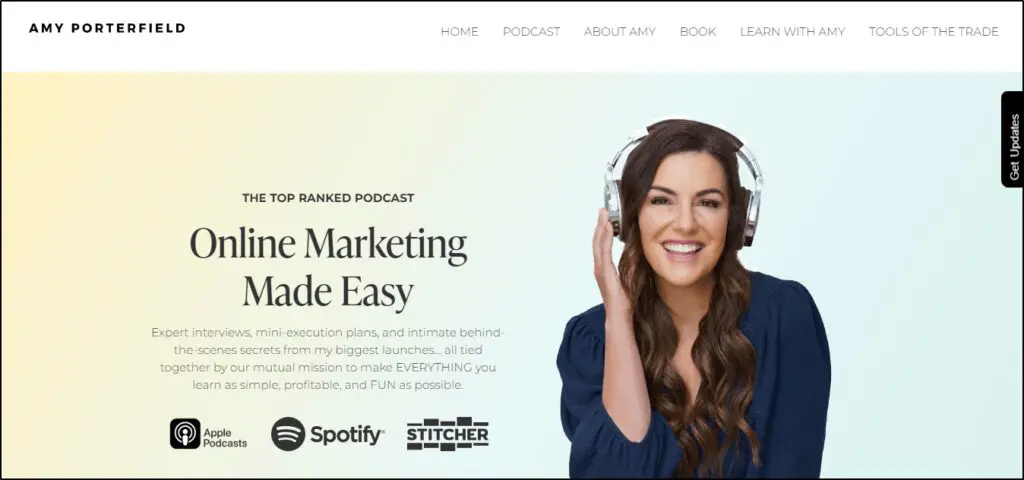
Amy Porterfield, a well-known consultant and online course seller, has a dedicated podcast section on her website with her latest content and details of her podcast’s central theme.
Pat Flynn, another familiar name in the eLearning and internet marketing industry, also has a podcast page on his website listing his latest episodes and guest profiles.

Here are some of the main marketing benefits of starting a podcast website.
- Your website is your own space where you have total control over how you position and describe your podcast.
- It is the home base where you will drive traffic using social media, email marketing, SEO, referrals, and other marketing techniques.
- You won’t have to rely entirely on Apple Podcasts, Spotify, or any other platform for listeners.
Consider this the first step of your podcast marketing strategy because most of the other techniques we’ll share in this article depend on your podcast website.
Podcast Marketing Tip #2: Find High-Demand Podcast Post Ideas
One of the easiest ways to grow your podcast is to create episodes around topics your audience is already searching for. When you align your podcast content with real demand, every episode becomes easier to promote, rank, and repurpose.
Here’s how to find those high-demand podcast ideas:
- SEO Keyword Research: Use tools like Ahrefs to discover topics with high search demand. Look for keywords your audience is actively searching for and create podcast episodes that answer those questions in depth.
- Use Perplexity AI: Perplexity’s “Answers” and “Discover” modes surface trending questions, emerging topics, and discussions from across the web. These insights often point to rising interest before traditional SEO tools catch on.
- Explore Reddit and Quora: Check trending threads, pain points, and recurring questions in your niche. Subreddit discussions and Quora questions are goldmines for podcast ideas because they reflect real, unfiltered curiosity.
- Ask Your Audience Directly: If you have an email list or social media following, run simple polls asking what they want to learn next. Your listeners will tell you exactly what episodes they want you to create.
Once you have validated topics, publish high-quality episodes around them and then optimize your episode pages across your website and podcast directories.
Use keyword-focused titles, meta descriptions, and clear summaries so your episodes have the best chance of ranking in Google, YouTube, Apple Podcasts, and Spotify.
This approach turns your podcast into a direct answer hub for high-demand questions—driving long-term organic traffic while making every episode easier to promote.
Podcast Marketing Tip #3: Kick Off With At Least 3 Episodes
When you start a new show, kick off by publishing at least three episodes together.
Why? Research shows that 46% of people binge-listen to podcasts. So, if they like your show’s first episode, they’d immediately want more content.
In addition, publishing three to five episodes together would also give you time to create new content ensuring you’re always ahead of your publishing schedule.
Podcast Marketing Tip #4: Submit To Podcast Aggregators And Directories
Podcast aggregators and directories are platforms that enlist thousands of podcasts in different categories and attract millions of listeners from across the globe.
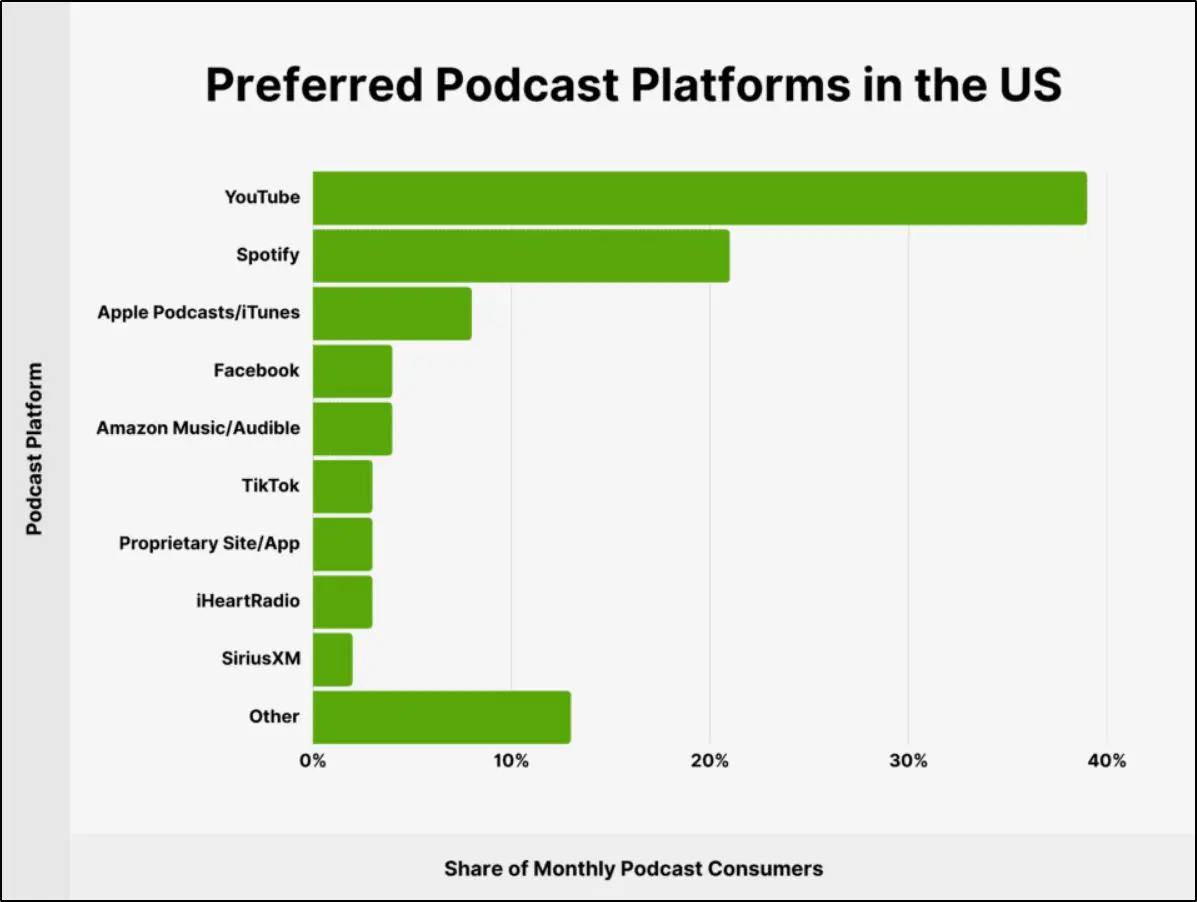
YouTube Podcasts, in particular, has become one of the most popular destinations for podcast listeners
But dozens of other podcast platforms like Spotify, Apple Podcasts, Overcast, Audible, and even Substack Podcasts collectively get millions of monthly users.
Here’s a list of the top podcast platforms where you can list your show.
But since every one of these platforms has thousands of podcasts, you must also optimize your podcast listing to show up in platform searches and attract listeners.
Here are a few ways to do that.
- Create a catchy and brandable podcast name that reflects your main topic and sounds exciting. For example, instead of “SEO Tips For Beginners,” something like “Rankable,” “Authority Hacker,” or “SEO Chronicles” is much more memorable and brandable.
- Use a descriptive podcast title for every episode, including the main topic using relevant search keywords.
- Write a detailed podcast description highlighting its key discussion points and helping the users decide if it’s the right show for them.
- Use a custom podcast thumbnail (if supported by the platform).
Optimizing your podcast for SEO not only helps it rank on podcast platforms but also gets it indexed and listed by Google Search, resulting in thousands of organic search visitors.
Read: The best free & paid podcast hosting platforms
Podcast Marketing Tip #5: Promote In Relevant Online Groups
Relevant online communities, groups, and discussion forums are great places to promote your podcast.
You can search Facebook Groups, LinkedIn Groups, Quora, Reddit, and other industry-specific discussion forums for relevant discussion threads to share your podcast.
However, if you start spamming these platforms with your podcast links, you’ll get banned pretty quickly. So, the right way to do this is to become a part of the discussion, add value with your advice, and only share your podcast link as a reference or an additional resource people can check out to learn more about the topic.
Also, use your profile on these platforms to promote your podcast by briefly describing it and adding its link in your bio.
Podcast Marketing Tip #6: Convert Your Podcast Into A YouTube Video
YouTube is now one of the biggest podcast discovery platforms. Millions of listeners actively search for educational content on YouTube, which is why so many podcasters publish video versions of their episodes.
It’s an easy way to grow your YouTube audience and send traffic back to your podcast website, Apple Podcasts, or Spotify.
If you already record your episodes on camera, upload them as full video podcasts. If you don’t, you can still turn your audio into a YouTube-friendly video using a title slide, waveform graphics, or simple branded visuals.
YouTube now gives podcasters two ways to publish content:
- Upload a video podcast as a regular YouTube video.
- Import your podcast via RSS inside YouTube Studio and automatically publish new episodes to your channel. This feature now includes podcast-specific analytics, allowing you to track performance by episode, topic, and viewing format, even if you didn’t use RSS.
With the continued rollout of YouTube Podcasts, your show can also appear in YouTube’s dedicated podcast recommendations, giving you an additional discovery channel your competitors may not be using.
Podcast Marketing Tip #7: Optimize Your YouTube Podcast Playlist for SEO & Discovery
Once your podcast is on YouTube, your playlist becomes one of the most important discovery tools you have.
YouTube uses playlists to understand the structure of your show, what belongs together, which episodes are connected, and how viewers should move from one episode to the next.
A well-optimized playlist helps your episodes appear in YouTube search, related videos, and YouTube Podcasts recommendations.
Here’s how to optimize your playlist for maximum reach:
- Create one dedicated playlist for your show. Use your podcast name and core topic so YouTube clearly understands your niche.
- Use SEO-focused titles for every episode. Include specific topics and phrases your audience searches for on YouTube.
- Write strong descriptions inside each episode. Add timestamps, guest names, links, and a short summary to give YouTube more context.
- Use consistent thumbnails across your series. This makes your playlist look like a cohesive show and increases click-through rates.
- Pin your most popular or evergreen episodes at the top. New viewers should start with the content most likely to hook them.
- Enable podcast settings in YouTube Studio. This helps YouTube categorize your playlist as an official podcast and makes it eligible for YouTube Podcasts tabs and recommendations.
- Monitor analytics for watch time and retention. Move high-performing episodes higher in the playlist and reposition any that lose viewers early.
Think of your YouTube playlist as the homepage of your podcast. When someone lands there, they should immediately understand your show, where to start, and why your episodes are worth watching.
A structured playlist keeps viewers watching longer. And longer watch times lead to more recommendations from YouTube.
Podcast Marketing Tip #8: Repurpose For Short Video Platforms
Once you convert an audio podcast into a video file, there are many ways to repurpose it and drive hundreds of thousands of visitors to your podcast site.
For example, you can create short video clips (1-2 minutes long) of the best moments of your podcast and share them on YouTube Shorts, Facebook Reels, TikTok, Twitter, and other social media platforms.
These short video platforms (TikTok and YouTube Shorts in particular) drive insane engagement and can help you skyrocket your podcast’s growth.
Here’s an example of a popular YouTube podcast that repurposes content for TikTok and gets millions of additional views because of TikTok’s incredible demand.

YouTube also automatically links your Shorts to your related long-form videos.
This means any short clip you post such as highlight moments, quotes, teasers, or behind-the-scenes comments, can instantly funnel viewers into your full podcast episode without extra setup.
It’s one of the fastest ways to convert short-form viewers into long-form listeners.
However, all of these platforms demand consistency.
If you regularly publish content for a few months, these platforms will start recommending your content to relevant viewers, resulting in exponential traffic growth to your podcast website.
Podcast Marketing Tip #9: Use AI-Generated Podcasts to Scale Faster
AI has become a powerful support tool for podcasters, not a replacement for your real voice or your main show.
Tools like Wondercraft AI let you script, clone your voice, edit, and publish short, high-quality audio pieces in minutes. When used strategically, AI helps you stay consistent, create more discovery channels, and respond faster to trending topics without recording full episodes every time.
Most podcasters don’t want an AI voice running their entire show. That’s not the point. The real value comes from using AI to extend your presence across platforms:
- Create AI-voiced short clips for TikTok, YouTube Shorts, Facebook Reels, or Instagram while keeping your main YouTube or long-form episodes fully human.
- Publish quick commentary episodes when news breaks. For example, you can send an article to ChatGPT, generate a short analysis script, and use Wondercraft or ElevenLabs to instantly produce a polished audio segment for your feed.
- Turn written content into mini-episodes—blog posts, newsletter sections, or Substack commentary can become bite-sized AI-narrated episodes your audience can consume on the go.
- Create multilingual versions of your existing episodes using your AI voice clone, opening up new regions you couldn’t reach before.
- Fill gaps in your publishing schedule with short, helpful AI-generated insights that keep your feed active between your main weekly or biweekly episodes.
Most creators have embraced this hybrid model.
You keep your primary show human and personal but let AI handle the quick, platform-specific, high-frequency content that grows your reach and pulls new listeners toward your main podcast.
If your goal is to scale without burning out, AI-generated content (especially with Wondercraft) helps you stay visible everywhere your audience spends time, while keeping your main show authentic and personality-driven.
Podcast Marketing Tip #10: Transcribe Your Podcasts
Transcribing your podcast is another easy way to drive traffic to your website and gain thousands of listeners through organic SEO.
Why? Because despite all its advancements, Google still can’t index audio content or the keywords used in it. So, even if your podcast has the most groundbreaking information on a topic, Google Search has no way to understand it.
But transcribing your podcast and turning it into a well-structured text format instantly makes it indexable for Google and enables it to show your podcast to relevant searchers.
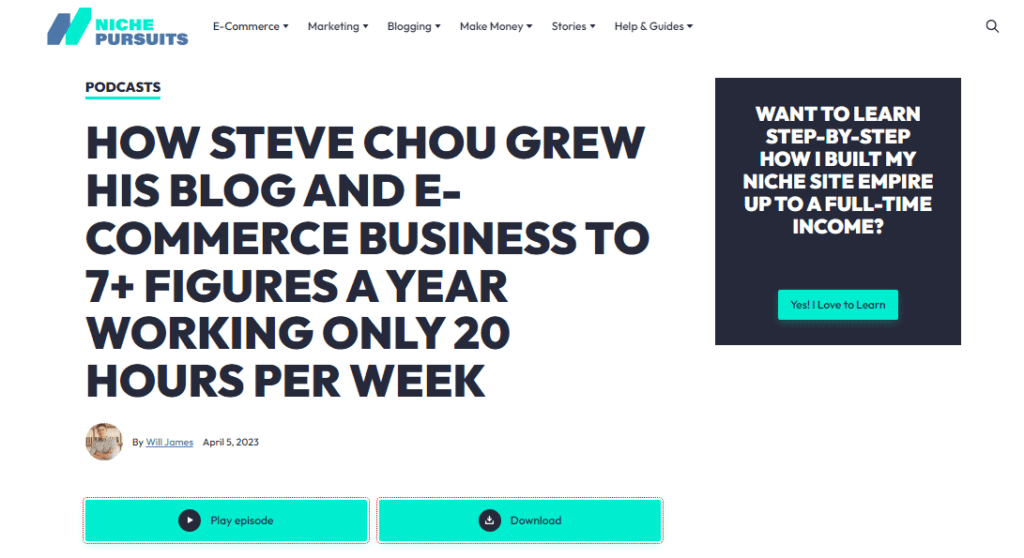
Niche Pursuits, a popular podcast in the online business industry, uses this approach to attract search traffic.
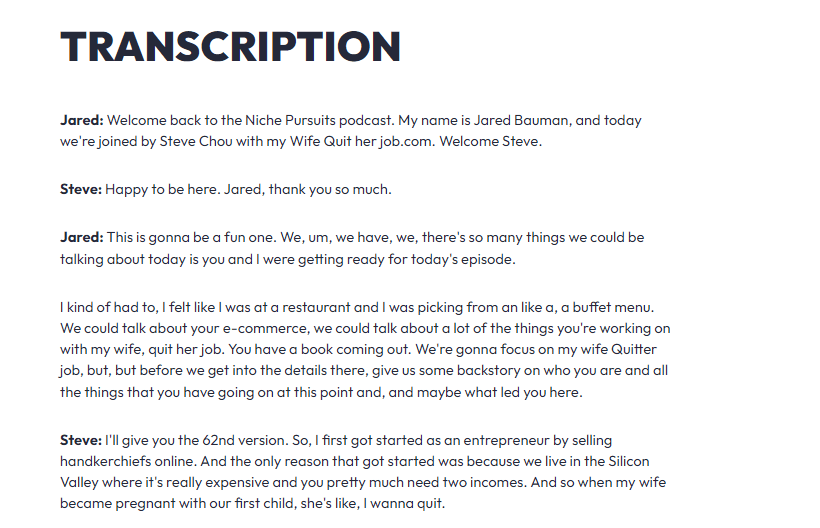
Apart from SEO, transcribing your podcasts helps your audience skim through your podcast content and find the information they want faster.
In addition, it also allows them to copy/paste sections of your podcast and reference them on other platforms.
Podcast Marketing Tip #11: Repurpose Into A Blog Post Series
Once you transcribe your podcast, it opens up more ways to promote and repurpose your content. One of them is turning your transcription into a series of blog posts.
Since podcasts often cover multiple topics in detail, you can easily break down the ideas discussed in a podcast into five, six, or even more articles.
This would help you in two ways.
- It’ll drive organic search traffic to your podcast website.
- It’ll help people discover your podcast through your blog content.
These articles would be much more valuable than a generic piece of content because they’ll contain quotes from your podcast that none of your competing content would have.
Podcast Marketing Tip #12: Reference Older Episodes
As you publish new podcast episodes, your older content can get buried in the archives and might not get the attention it deserves.
So, make sure you regularly reference your older content in your new episodes, mention your past guests, and encourage your listeners to check out your previous podcast episodes.
To make it easier, you can share the links to the episodes you mention in your podcast’s description.
Here’s an example of a detailed podcast description containing relevant links for the audience.

If you look closely, this description links to older episodes and outside sources mentioned during the episode. You can also use it for promoting any specific affiliate or useful resources on your website.
Podcast Marketing Tip #13: Tell Your Email Subscribers
An email list is your greatest asset as an online content creator. So, if you don’t have one yet, you must start building an email list today and move your listeners from third-party platforms to a list you own.
When you have an active email list, generating the early momentum for your podcast episodes is just an email announcement away. You don’t need to wait for users on Apple Podcasts, Spotify or any other platform to discover you organically.
Because you can use your email list to drive traffic to your podcasts whenever you want.
Just like Ray Edwards.
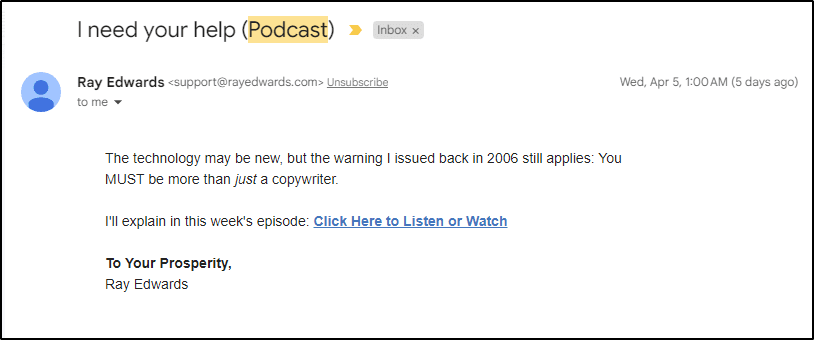
He, and many other podcasters, email their subscribers whenever they publish a new podcast. Plus, they regularly email their archive content as well, whenever it makes sense.
Podcast Marketing Tip #14: Pull Quotes For Social Media
Podcasts are lengthy, in-depth discussions with valuable insights. But to attract listeners, you must give them a glimpse of what’s inside an episode.
Pulling quotes from your podcasts and sharing them as social media images is an excellent way to do that. In fact, as the current co-host of the long-running Leading Learning Podcast, Learning Revolution founder Jeff Cobb, uses this exact strategy to promote its (over 350) episodes.

These images are great for driving traffic and building your brand authority.
You can share them on Facebook, Instagram, Twitter, LinkedIn, and almost any social network your audience uses.
Podcast Marketing Tip #15: Leverage Guest Podcasting
You’ve probably heard of guest blogging, a marketing technique where you offer free blog content to established websites to get exposure and backlinks.
Apply the same strategy to podcasting for immediate results.
How? Let me explain.
- Identify other emerging podcasters in your industry who’re slightly ahead of you in audience size and influence.
- Analyze their content and see if they’ve missed any topic you can cover.
- Pitch yourself as a podcast guest by highlighting the value you can offer their audience.
To succeed with this strategy, you must have something valuable to share, such as a case study, a success story, the results of an experiment, a unique experience, or a research finding.
Not everyone would welcome you to their show, but even one or two good appearances can get the ball rolling for you. Then gradually move towards more popular podcasts with bigger audiences to gain more exposure.
Podcast Marketing Tip #16: Get Mentioned In Leading Blogs
Blogs and online publications always seek expert quotes to make their content more credible and share worthy.
You can make their job easier and get backlinks to your podcast website by sending them quotes from your podcast interviews.
For example, here’s a writer looking for first-hand insights to include in an article for Shopify.
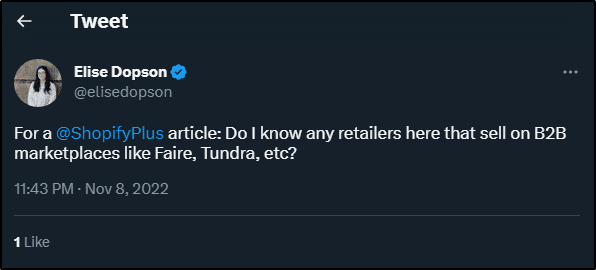
You’ll find such requests from writers in almost every niche.
And even if you don’t, you can use platforms like HARO and Help A B2B Writer, where hundreds of brands, journalists, and publications look for credible first-hand experiences to include in their content.
You can pull out quotes from your podcasts and share them in response to any relevant requests to get your show featured in a top publication.
Podcast Marketing Tip #17: Ask Your Guests To Spread The Word
Podcast guests are influencers with a large following on social media and other online platforms.
When they agree to appear on your show, request them to spread the word about it in their circles. This would create anticipation for your podcast and help you gain new listeners.
For example, they could tag you on Twitter, saying something like, “Watch out for my podcast with @yourname early next week.”
Once your show goes live, send them a quick email requesting them to share the show’s link with their email subscribers and social media followers.
Tim Ferris regularly links to his podcast interviews in his emails.
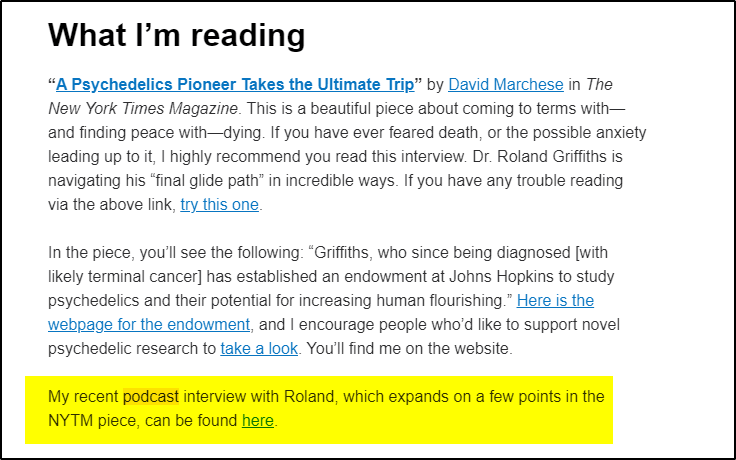
You can do that with your archive content as well.
For example, you could ask an old guest to Tweet their episode link again. This keeps your content alive longer and helps you drive a higher ROI on every episode.
Podcast Marketing Tip #18: Encourage Listeners To Share And Review
Podcast platforms have thousands of active shows in every category.
How do they decide which podcasts appear at the top of the search results for specific topics? Apart from the podcast’s title and description, most platforms use the number of positive reviews and the frequency of shares on a podcast as critical ranking factors.
So, you must regularly ask your listeners to leave positive comments and reviews on your podcast so it rises in the platform’s listings.
You can do that at the show’s start and before concluding an episode. In addition, you can also drop reminders during the episode or in your podcast description.
Podcast Marketing Tip #19: Create Podcast Teasers
Release short teasers at least a week before a new episode to create anticipation in your listeners and spread the word about your show.
Ideally, you should do it on all the platforms where you publish or repurpose your podcasts. For example, you could create a 30-60 clip containing the best moments from your upcoming podcast and share it on Twitter, YouTube, Facebook, LinkedIn, and any other relevant platforms with a link to the main show.
Make it more engaging by adding captions, background sound effects, and clearly mentioning the date & time it goes on-air.
In addition, send a quick email to your subscribers announcing the upcoming show with a Google Calendar link so that they get timely reminders.
Podcast Marketing Tip #20: Cover Trending Topics
Your channel needs to target a niche and a specific audience with a well-defined set of problems or needs. So, you can’t cover every trending topic on the internet.
However, you can research the hottest trends in your industry or the current problems/needs of your audience to create more engaging content.
Here are a few quick ways to find trending topics.
Competitor Analysis: Keep an eye on what your most popular competitors are talking about.
Google Trends: Go to Google Trends, check the trending topics in your target region, and shortlist the ones relevant to your audience. For example, I checked the last 30-day search trend in the finance niche and selected the US as my target region.
Here are the trending topics and search terms according to Google Trends for my criteria.
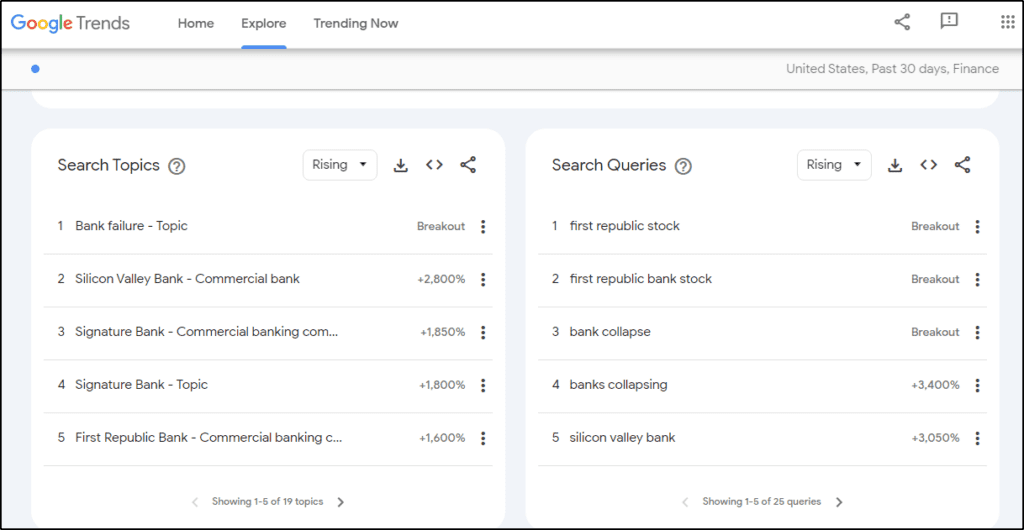
Social Media Hashtags: Check the trending hashtags and topics on Twitter, Facebook, TikTok, and other social networks to quickly grasp the hottest topics in your target region.
Podcast Marketing Tip #21: Invest In Advertising
Finally, if you’re serious about growing your podcast audience, use paid advertising campaigns to create early momentum for your show.
Most podcast platforms allow you to advertise your products, services, or content to your target audiences for a fixed advertising fee.
But outside these platforms, you can use Facebook and YouTube ads to drive listeners to a landing page on your podcast website and turn them into email subscribers. This way, your paid traffic would become your permanent business asset and reduce your reliance on advertising with time.
Podcast Marketing Tip #22: Use Newsletter-First Podcast Growth With Substack
The newsletter-first approach, especially with Substack, is among the fastest growing trends in podcast marketing.
Substack’s built-in podcasting features let you publish audio episodes directly to your subscribers’ inboxes while also posting them on your Substack page.
This creates instant distribution, higher open rates, and deeper engagement compared to relying only on Apple Podcasts or Spotify.
Why does this work so well?
Because your podcast becomes part of a regular email relationship, not just another episode sitting in a feed. When someone subscribes to your Substack, every new episode automatically lands in their inbox with a full description, timestamps, and even a web player.
That means more listens, more replies, and more loyal fans.
Many creators now use Substack as their primary podcast home because:
- You own your audience and don’t depend on algorithmic discovery.
- Episodes become long-form posts, which helps with search and shareability.
- You can add written insights, links, and context around each episode.
- You can monetize through paid newsletters or exclusive bonus episodes.
This approach works especially well for educational and business podcasts where listeners want both commentary and content they can reference later.
You can also add a “Listen on Spotify/YouTube” CTA inside every Substack episode so your newsletter becomes a funnel into your public podcast feed.
If you want a deeper connection with your audience and a reliable distribution channel from day one, make Substack a core part of your podcast marketing strategy.
How Do You Promote Your Podcast?
Podcast demand is growing at an exponential rate. So, you’re still not late to the party. However, with the rising competition, you must devise a marketing strategy before launching your podcast so that you can start promoting it from day 1.
The most critical part of any podcast marketing strategy is your podcast website because everything else revolves around it, as you’ve seen in this article.
But what other podcast marketing strategies have you tried or seen work for your competitors? We’d love to hear about them in the comments.
Frequently Asked Questions (FAQs)
1. How long does it take to see results from podcast content marketing?
Most podcasts start seeing consistent growth within 3–6 months of applying SEO, YouTube, and email-driven promotion. Faster results come if you have an existing audience.
2. How often should I publish new podcast episodes?
Weekly is the ideal frequency for growth, but biweekly also works if you stay consistent. Consistency matters more than volume.
3. What episode length performs best for content marketing?
Episodes between 20–45 minutes perform best for education-focused podcasts since they offer depth without being overwhelming.
4. Should I focus on video or audio first?
If you can only choose one, audio is easier to produce. But YouTube video versions drastically improve discovery, so aim to do both when possible.
5. Do I need expensive equipment to promote a podcast effectively?
No. A good USB mic, a quiet room, and clean editing with tools like Camtasia, Descript, or Audacity are enough for high-quality content.
6. How important is podcast SEO for growth?
Critical. Optimized episode titles, descriptions, and transcriptions allow your episodes to rank in Google, YouTube, and Apple Podcasts search.
7. Should I create social media accounts just for my podcast?
Only if you plan to publish platform-specific content consistently. Otherwise, promote your podcast through your main social presence.
8. How do I choose the right podcast keywords?
Use Ahrefs, Google Trends, Perplexity AI, or YouTube search suggestions to find topics your audience is actively searching for.
9. Is it worth creating a podcast newsletter?
Yes—your email list becomes a reliable distribution channel. You can use Substack, ConvertKit, or your website’s ESP to send new episodes directly.
10. Should I promote every episode individually?
Yes. Every episode should have its own webpage, social snippets, SEO-optimized title, email mention, and at least one short-form video clip.
11. Does having guests help podcast marketing?
Absolutely. Guests bring new audiences, increase credibility, and create natural opportunities for shares and backlinks.
12. Can older podcast episodes still drive traffic?
Yes. With updated titles, descriptions, and fresh repurposed content, old episodes can rank and generate new listeners for years.
13. What’s the biggest mistake podcasters make with marketing?
Publishing episodes without creating supporting content—no SEO, no blog post, no clips, no email, and no platform distribution.
14. Do transcripts help with YouTube podcast visibility?
Yes. YouTube reads your video subtitles and metadata, helping your episodes rank for relevant keywords.
15. Should I create separate playlists for different types of episodes?
No. Educational podcasts perform best with one main playlist and occasional sub-playlists for themes or seasons.

Jeff Cobb, Founder of Learning Revolution
Jeff Cobb is an expert in online education and the business of adult lifelong learning. Over the past 20+ years he has built a thriving career based on that expertise – as an entrepreneur, a consultant, an author, and a speaker. Learning Revolution is a place where Jeff curates tips, insights, and resources to help you build a thriving expertise-based business. Learn more about Jeff Cobb here.
Table of Contents
Related Posts
Skool vs Kajabi (2026): I’ve Used Both, Here’s My Comparison & Verdict
Skool vs Circle (2026): I’ve Used Both, Here’s My Choice
Thinkific Review (2026) | Pros, Cons & Pricing for Online Course Creators [With Examples]