
TL;DR: Is The New Teachery Platform Worth Using? (2026)
Teachery is an all-in-one platform for selling courses, digital downloads, memberships, and paid communities. All plans include every feature with no limits, and a one-time payment option replaces the monthly bill. Solo creators who care about design and want to escape rising monthly bills get the most from it. Skip it if you need built-in email marketing, native video hosting, or a branded mobile app.
Pricing: Monthly $70/mo, Annual $700/yr, Lifetime Deal $950 one time
Free trial: 14-day free trial with no credit card
Transaction fees: 0% on every plan, plus Stripe processing
Standout features:
– Unlimited courses, products, communities, memberships, and customers on every plan
– Design presets you apply to any course, community, or checkout page in one click
– Checkout pages with multiple upsells, 1-click post-purchase offers, timers, and purchase limits
– An optional AI assistant plus an MCP connector for Claude and ChatGPT
Use Teachery when: You sell a mix of courses and digital products and want a pay-once platform that looks like your brand.
Skip Teachery when: You want email, video hosting, and a mobile app in one bill (pick Kajabi or Thinkific).
Try Teachery free for 14 days
Teachery has been around for a long time. In its early days, I used to recommend it because of its simplicity and affordability.
But I stopped doing so when I noticed that the platform had stopped evolving.
That changed in 2026 when Teachery launched a new and revamped version of its platform with features like online courses, community management, memberships, and AI tools.
To see how it holds up, I built a sample course, set up a paid community, and tested the checkout pages, memberships, and AI tools.
In this Teachery review, I cover what the platform does well, where it falls short, what it costs, and who should use it.
Compare your options with my list of the best online course platforms
Teachery Product Snapshot (2026)
Here’s a quick look at Teachery as of October 2026.
| Teachery | |
|---|---|
| What it is | An all-in-one platform for selling courses, digital products, memberships, and communities |
| Made by | Teachery Inc., run by Jason and Caroline Zook since 2013 |
| Best for | Solo creators, artists, coaches, and small businesses selling several kinds of products |
| Pricing | Monthly $70/mo, Annual $700/yr, or Lifetime Deal $950 one time |
| Free trial | 14-day free trial with no credit card |
| Transaction fees | 0% platform fee on every plan, plus Stripe processing |
| What you can sell | Courses, digital downloads, memberships, communities, and bundles |
| Limits | Unlimited products, customers, checkout pages, and landing pages |
| Video | Embedded from hosts such as Vimeo, Wistia, Loom, and Tella |
| AI features | Optional AI assistant, AI quiz questions, and an MCP connector for Claude and ChatGPT |
| Payments | Stripe with cards, Apple Pay, Google Pay, and Klarna, with PayPal planned by the end of 2026 |
| Mobile | A mobile-friendly web editor, with no native app |
| Support | Human support on weekdays from 9 am to 5 pm, with the AI assistant as the first stop |
| Key limitations | No email newsletters or sequences, quizzes limited to three question types with no assignments, community events that link out to Zoom or Google Meet, no mobile app, and Stripe only until PayPal arrives |

My Quick Verdict On Teachery: It’s An Attractive Platform For Beginenrs
If you’re a beginner, Teachery gives you everything you need to sell, without the price tag of a big all-in-one platform.
Its course and community tools cover the essentials well, with quizzes, drip schedules, certificates, events, and purchase-based access.
If you’re looking for an advanced learning experience, Thinkific goes much deeper than Teachery on learning features. For community, Circle offers far more depth.
But Teachery gives you a balanced toolset at an affordable price, without going too deep on anything.
I do like its selling and presentation features. Its checkout pages hold their own against Kajabi’s, and its design tools make a solo creator look like an established brand. Plus, all plans include the full feature set.
Even after you add a video host and an email tool, the monthly cost stays below Kajabi’s entry plan, and the Lifetime Deal makes Teachery one of the cheapest platforms to run over two or three years.
For a new creator, my advice is simple. Start with Teachery if you want a polished, affordable place to sell your first courses and products. Move to Thinkific when your learning programs grow, or to Kajabi when you need email marketing and funnels in one place.
What Is Teachery?

Teachery is an online platform for creating and selling courses, digital downloads, memberships, and paid communities from one account.
The platform hosts your lessons and files, builds your checkout pages, takes payments through Stripe, and gives your customers a branded place to learn and connect.
Design gets more attention here than on most course platforms. One-click themes, curated font pairings, and saved design presets make every course, community, and checkout page look like part of the same brand.
A husband-and-wife team, Jason and Caroline Zook, has run Teachery since 2013 without outside investors, and they sell their own courses on it.
It stands out for its simplicity and ease of use. Artists, coaches, writers, and solo creators who want to sell several kinds of products without paying a premium price should find Teachery quite attractive.
But if you need more in-depth learning tools, built-in email marketing, native video hosting, or a branded mobile app, Kajabi or Thinkific will suit you better.
The Main Features in Teachery
- Courses: Build lessons with embedded video, audio, downloads, quizzes, comments, and completion certificates.
- Digital products: Sell ebooks, templates, presets, and other files with instant delivery after checkout.
- Communities: Run free or paid communities with spaces, events, and access tied to what people bought.
- Memberships: Bundle courses, products, and community access into one recurring offer.
- Checkout pages: Add multiple upsells, 1-click post-purchase offers, countdown timers, and purchase limits.
- Showcases: Share all your offers from one mobile-friendly storefront or link-in-bio page.
- Design presets: Save your fonts and colors once and apply them to anything in your account in one click.
- Customer tags: Tag buyers automatically and use those tags to give access to lessons and member areas.
- Affiliates: Let customers join your affiliate program and set your own commission rates.
- AI assistant and MCP: Build and edit your products by chatting, inside Teachery or from Claude and ChatGPT.
Teachery Pricing and Free Trial
Teachery has one feature set and three ways to pay for it.
All three plans include unlimited courses, products, communities, memberships, checkout pages, and customers, so you never upgrade to get a feature. The 14-day free trial needs no credit card.
Teachery pricing plans:
| Plan | Billed monthly | Billed annually (per month) | Notes |
|---|---|---|---|
| Monthly | $70 | – | Cancel any time |
| Annual | – | $58.33 | $700 billed yearly, two months free vs monthly |
| Lifetime Deal | – | – | $950 one-time payment, no renewals, all future features |
Teachery features by plan:
| Feature | Monthly | Annual | Lifetime Deal |
|---|---|---|---|
| Included on every plan | |||
| Courses, digital products, communities, memberships | Unlimited | Unlimited | Unlimited |
| Customers and students | Unlimited | Unlimited | Unlimited |
| Platform transaction fee | 0% | 0% | 0% |
| Checkout pages with upsells and 1-click post-purchase offers | ✓ | ✓ | ✓ |
| Payment plans, subscriptions, pay what you want, free trials | ✓ | ✓ | ✓ |
| Quizzes and completion certificates | ✓ | ✓ | ✓ |
| Drip schedules and lesson locking | ✓ | ✓ | ✓ |
| Communities with spaces and events | ✓ | ✓ | ✓ |
| Showcase storefront pages | ✓ | ✓ | ✓ |
| Landing pages with custom HTML and CSS | ✓ | ✓ | ✓ |
| Design presets, Google and custom fonts | ✓ | ✓ | ✓ |
| Customer tags and access rules | ✓ | ✓ | ✓ |
| Affiliate program | ✓ | ✓ | ✓ |
| Optional AI assistant | ✓ | ✓ | ✓ |
| MCP connector for Claude and ChatGPT | ✓ | ✓ | ✓ |
| Custom domains | ✓ | ✓ | ✓ |
| Video hosting | Embed only (Vimeo, Wistia, Loom, Tella) | Embed only (Vimeo, Wistia, Loom, Tella) | Embed only (Vimeo, Wistia, Loom, Tella) |
| File uploads | Up to 1 GB per file | Up to 1 GB per file | Up to 1 GB per file |
| Payment methods | Stripe with cards, Apple Pay, Google Pay, Klarna (PayPal planned) | Stripe with cards, Apple Pay, Google Pay, Klarna (PayPal planned) | Stripe with cards, Apple Pay, Google Pay, Klarna (PayPal planned) |
| Mobile app | Mobile web only | Mobile web only | Mobile web only |
| Support | Human support, weekdays 9am-5pm | Human support, weekdays 9am-5pm | Human support, weekdays 9am-5pm |
| All future features at no extra cost | Included while subscribed | Included while subscribed | ✓ |
- Monthly ($70/mo): Suits creators who want to test the platform with real customers before committing. Cancel any time.
- Annual ($700/yr): Gives you two months free compared with paying monthly.
- Lifetime Deal ($950 one time): One payment for permanent access, including every feature Teachery adds later. Teachery says it will likely stop offering this deal after 2026.
The math favors the Lifetime Deal if you plan to stay. The one-time price equals about 14 months on the monthly plan, or about 16 months on the annual plan, and the platform costs nothing after that.
In my experience, the smart move is to use the free trial to build one real course first. If the editor fits the way you work, the Lifetime Deal pays for itself in a little over a year.
Teachery charges no transaction fees on any plan. The only cost per sale is Stripe’s processing fee, which Teachery puts at around 3%.
Budget for two outside tools, though.
Teachery doesn’t host video, so you’ll need a host such as Vimeo or Wistia, and it has no built-in email marketing, so you’ll want an email platform like Kit.
Prices also stay locked. Teachery promises never to raise prices on existing customers, whichever plan you choose.
How Teachery’s Price Compares
Here’s how Teachery’s monthly price and fees stack up against the entry plans of popular course platforms.
| Platform | Entry plan | Monthly price | Transaction fee | Lifetime option |
|---|---|---|---|---|
| Teachery | Monthly | $70/mo | 0% | Yes, $950 one time |
| Thinkific | Start | $109/mo | 0% | No |
| Kajabi | Basic | $179/mo | 0% with Kajabi Payments | No |
| Teachable | Starter | $39/mo | 7.5% | No |
| Podia | Mover | $49/mo | 5% | No |
Entry plans on other platforms often cap products, add a transaction fee, or hold back features like upsells and affiliates. With Teachery, the Monthly plan already includes everything, so the fair comparison is often a competitor’s mid-tier plan. Run your own numbers with my online course pricing calculator.
Start your 14-day Teachery free trial
Teachery Features: What Can You Do With It?
Teachery let you create, sell, and manage multiple types of e-learning products and digital offers.
I’ll start with a summary table and then walk through each feature as I used it.
| Feature | What you can do | Limitations |
|---|---|---|
| Online courses | Lessons, sections, sublessons, drip schedules, quizzes, comments, and certificates | Three quiz question types (multiple choice, true or false, select all), no assignments or written answers, and lesson locks set one lesson at a time |
| Digital products | Sell downloads, templates, and files with instant delivery | Files capped at 1 GB each, so large video bundles need an outside host |
| Memberships | Bundle courses, products, and communities with recurring or lifetime pricing | Pages built from sections and content blocks only, with no raw HTML blocks inside the member area |
| Online community | Spaces, posts, events with reminders, and access tied to purchases | Events link out to Zoom or Google Meet, past events drop off the page, no direct messages between members, and no app for push notifications |
| Checkout pages | Upsells, post-purchase offers, timers, purchase limits, and pay what you want | Stripe only until PayPal arrives, and price tiers change by number of sales, not by date |
| Showcase pages | A mobile storefront or link-in-bio page with a shopping cart | Fewer design controls than the course editor |
| Landing pages and design | Block editor, themes, font pairings, presets, custom HTML and CSS | Standalone pages only, with no blog or multi-page website |
| Customers and tags | Profiles, tags, access rules, and messages to tagged groups | One-off messages only, with no newsletters, email sequences, or automated follow-ups |
| Affiliates | Self-join affiliates, custom commissions, and payout schedules | In-app affiliate payouts still rolling out, so you pay affiliates yourself for now |
| AI assistant and MCP | Build courses from PDFs, add images, write quiz questions, and work from Claude or ChatGPT | Assembles your existing material but won’t research or write a course, and works best when you name the exact course or page |
| Analytics | Revenue, buyers, signups, and growth on one dashboard, plus per-product stats | No video watch-time data, since videos play from outside hosts |
| Integrations | Stripe, plus email tools, Zapier, Make, Pabbly, and an API | Native email connections only for Kit, MailerLite, Mailchimp, and Flodesk, with other tools through Zapier, Make, or Pabbly |
Feature #1: Online Courses
Course creation starts with a short setup wizard. In four steps, you pick what you want to make, name it, choose a style, and sketch your first lessons, while a phone preview on the right updates as you type.
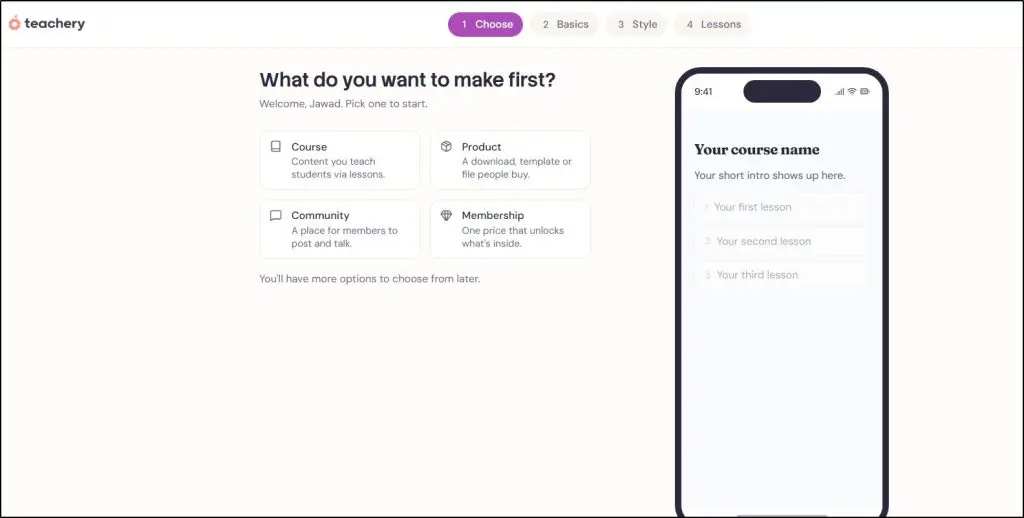
For my AI Video Creation for Beginners course, I entered a name and a short intro, picked a color theme, and added three lessons. A Suggest lessons button can also draft lesson titles for you.
Inside the editor, you can organize lessons into sections and sublessons, and drag them into any order. A slash menu, like the one in Notion, lets you add video embeds, audio, files, buttons, and other blocks without hunting through menus.
Each lesson can also have its own resources tab for links and downloads, plus a comments tab where students ask questions. Comments keep the discussion next to the lesson, which I prefer to sending people off to a separate forum.
For the course home page, you can show lessons as image cards in a grid or as a simple list. Inside a lesson, students get a sidebar with the full course outline on larger screens and a floating lesson list on phones.
Lesson locking covers the usual options. Lessons can open after students complete the previous one, a set number of days after enrollment, or on a fixed date, and Teachery can email students when new lessons open.
Quizzes support multiple choice, true or false, and select-all-that-apply questions, and they can show one question at a time. Add a final quiz, and students who pass receive a completion certificate.
For example, I asked the AI assistant to write quiz questions from one of my lessons and then edited them by hand, which saved me most of the writing time. My guide on how to create quizzes covers what makes a good question.
The real gaps are in assessment. Beyond those three question types, students can’t submit assignments or written answers for you to review. For a skills course on writing, design, or coaching, where you need to see the student’s work, you’d have to collect it by email or in the community instead.
Lesson locks also need setting one lesson at a time, with no option to apply one rule to the whole course. On a five-lesson course, it takes a minute. On a 40-lesson program that drips weekly, expect some tedious clicking.
Videos sit on an outside host such as Vimeo, Wistia, Loom, or Tella, and you embed them in your lessons. In my experience, that keeps your videos portable if you ever switch platforms, but it adds a monthly bill that Thinkific and Kajabi include, and Teachery can’t show you how much of each video students watched. If you rely on watch-time data to spot where students drop off, you’ll need to check it in your video host instead.
Read my step-by-step guide to creating an online course
Feature #2: Digital Products
Teachery lets you sell ebooks, templates, guides, presets, swipe files, and any other download alongside your courses.
Setting one up takes a couple of minutes. After uploading the file, you set a price, and choose whether buyers get a download page or a redirect to a link, such as a Notion or Canva template.
For example, a watercolor teacher could sell a $28 palette pack as a standalone product and also add it as an upsell on her main course checkout.
Files can be up to 1 GB each, and everything lives in a file library with folders, search, alt text, and a crop tool. The cap covers PDFs, templates, and preset packs easily, but a large video bundle or software file needs splitting or a link to outside storage. Products also work with every pricing option, including pay what you want and payment plans.
If downloads make up a big part of your business, compare Teachery with the tools in my guide to selling digital downloads.
Feature #3: Memberships
A Teachery membership bundles your courses, products, and community access behind one purchase.
The membership page uses sections. I added a section for courses, another for downloads, and a callout that gives every member access to the community.
Pricing gives you plenty of room. Recurring plans can bill weekly, every two weeks, monthly, quarterly, or yearly, and you can add a one-time lifetime option on the same page.
Members see a different view from visitors. Visitors see the sales content and buy buttons, while members see their courses, their progress on each one, and any announcements you’ve scheduled.
Scheduled announcements are a nice touch. For example, you can post a banner for a new workshop that appears on launch day and disappears when enrollment closes.
Products stay independent, so a course can sit inside your membership and still sell on its own checkout page. When you add a new course to a membership, you also decide whether existing members get it and whether Teachery emails them.
Memberships felt less polished than courses and communities in my testing. The building blocks work, but the member area only takes sections and content blocks, and it doesn’t accept raw HTML blocks, so custom layouts depend on embeds and custom CSS. For a standard library of courses and downloads, the sections work fine. The limit only bites if you want a custom-coded member dashboard. For ideas on what to put inside, see my list of membership site ideas.
Feature #4: Online Community
Teachery’s communities work like a private forum with channels, which Teachery calls spaces.
When I set up a community for my AI video course, I created spaces for introductions, prompt help, and finished projects. Members can post, reply in threads, react, and share images, files, links, and polls.
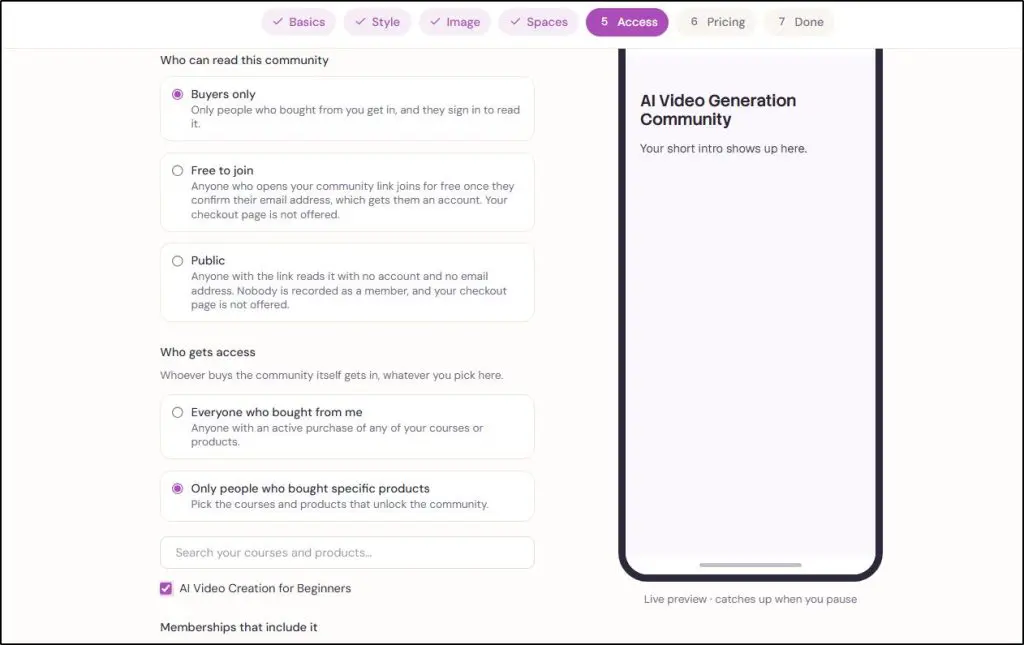
A community can be public, free to join with an email address, or open only to buyers. You can also tie access to specific courses or digital products you’re selling through Teachery. So, every course can have its own dedicated community.
Individual spaces can have their own access rules too.
For example, everyone who bought anything from you could join the main community, while only your premium course students see a private Q&A space.
Events cover live sessions. After you add a Zoom or Google Meet link, Teachery queues reminder emails one week, one day, and one hour before the event.
A community can also be its own paid product, sold with a recurring price, a one-time price, or pay what you want. Moderation tools include reported posts, member removal, and collaborators who help you manage the space.
The community has a few gaps to know about. Events link out to Zoom or Google Meet instead of running live inside Teachery, and past events drop off the page once they end. Members also can’t message each other directly, and without a mobile app, nobody gets push notifications.
For a community attached to a course, none of these gaps get in the way. For a community you sell as the main product, where members expect private chats and phone alerts that pull them back in, Circle or Skool will keep members more engaged.
If community is the center of your business, compare it with the platforms in my guide on building a learning community.
Feature #5: Checkout Pages, Upsells, and Payments
Teachery’s checkout pages are its strongest selling tool. Each one is its own item, so you can reuse a page that converts well across several products.
On each page, you choose a side-by-side or stacked layout, add images and sales copy, and apply your design preset so the checkout matches the course.
Pricing options go deeper than on most course platforms. Teachery supports one-time payments, subscriptions, payment plans, free trials on recurring plans, and pay what you want with a minimum and a suggested price.
Purchase limits are the feature I liked most. For example, I set the first 15 spots at one price and the next 15 at a higher one, and the page moved to the next price on its own once the first tier sold out.
Price tiers change by the number of sales, not by date, though. To end an early-bird price at midnight on Friday, set a countdown timer on the early-bird checkout page and redirect buyers to a second checkout page with the full price.
Countdown timers can close the page on a set date, show a closed message, or redirect buyers somewhere else. Promo codes, custom fields, and a terms checkbox are available as well.
For extra revenue, you can stack several upsells on the checkout itself, then show a sequence of 1-click offers after the purchase. Buyers accept a post-purchase offer without typing their card details again.
Payments run through Stripe and support cards, Apple Pay, Google Pay, and Klarna, with automatic tax handling. Teachery plans to add PayPal by the end of 2026, but it isn’t available yet. If many of your buyers prefer PayPal, keep that gap in mind.
Read my guide to creating landing pages that convert
Feature #6: Showcase Pages
A showcase is a mobile-friendly page that lists your courses, products, freebies, memberships, and favorite links in one place.
Creators can use it as a link-in-bio page for Instagram or TikTok, or turn it into a small shop where buyers add several products to a cart and pay once.
For example, a creator who sells ten Notion templates can send followers to one showcase instead of ten separate checkout pages. The cart checkout supports the same promo codes, upsells, and post-purchase offers as any other checkout page.
The design options here are simpler than in the course editor, but the page does its job well on a phone.
Feature #7: Landing Pages and Design Customization
Teachery puts more effort into design than any course platform I’ve tested. To begin, you pick one of ten color themes, such as Candy, Glass, Oatmeal, or Neo-Brutal, and a Remix button shuffles the design if you want a fresh starting point.
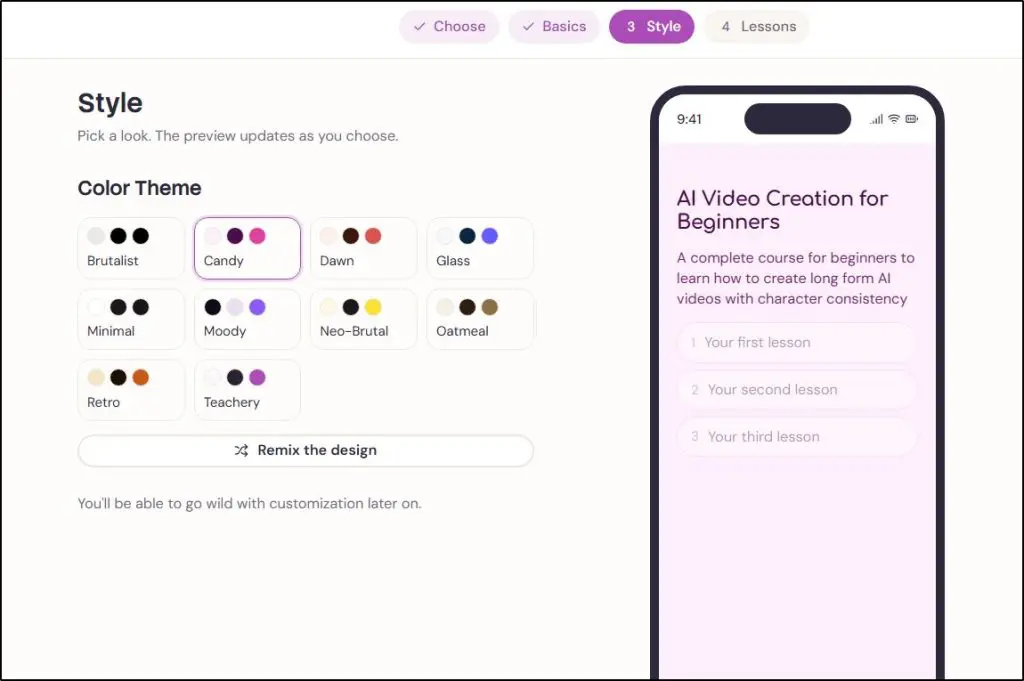
From there, you can pick a curated font pairing, add a Google font, or upload a font you’ve bought. Advanced controls let you adjust headings, colors, corners, borders, and buttons.
Design presets tie it all together. Once you save a preset, you can apply it to a course, community, membership, showcase, landing page, or checkout page in one click.
For example, I saved the look of my course as a preset and applied it to the community and the checkout page, and all three matched in seconds. Editing a preset later updates everything that uses it, which makes a rebrand quick.
The landing page builder uses blocks for heroes, features, pricing tables, testimonials, FAQs, email capture, and buttons that link to your checkout. If you already design pages elsewhere, you can paste in custom HTML and CSS, and Teachery renders and hosts the page.
Custom CSS works on every item for anyone who wants full control. Custom domains connect to your courses, pages, and products as well.
Teachery builds standalone pages, not a full website with a blog. If you publish articles for SEO or want a multi-page site with navigation, keep your main website on WordPress or a site builder and link to your Teachery pages from it.
Feature #8: Customer Management and Tagging
Teachery’s dashboard shows revenue, buyers, signups, and growth at a glance, along with a getting-started checklist and your recent customers.

Each customer has a profile with their purchase and access history. From the customer list, you can search, filter, import, and export customers, grant access in bulk, and set start and end dates for access.
Tags add some automation. Teachery can tag buyers after a purchase, and rules can use those tags to open lessons, membership areas, or communities.
For example, you could tag everyone who bought your workshop and send that group a one-off message about a new advanced course.
Failed-payment recovery and billing self-service also reduce support emails from members whose cards expire.
Tags and one-off messages aren’t a replacement for an email platform, though. Teachery can’t send a weekly newsletter or an automated welcome sequence over several days. For newsletters and sequences, you’ll still connect a tool like Kit.
Feature #9: Affiliate Program
Teachery includes an affiliate program on every plan, which many platforms keep for their pricier tiers.
Teachery lets you invite affiliates in bulk or let customers join on their own, set commission rates per product, and choose how often and above what amount you pay them. Affiliates get a welcome email and their own dashboard with links and earnings.
For example, students who love your course can sign up from a link on your thank-you page and start sharing it the same day.
Chargebacks and refunds adjust commissions automatically. In-app payouts are still rolling out, so for now you track commissions in Teachery and pay affiliates yourself. With five affiliates, the manual step takes minutes. With fifty, wait for the payout tool or budget time each month. If you plan to grow through partners, my guide to e-learning affiliate programs shows how other creators set theirs up.
Feature #10: AI Assistant and MCP Connector
Teachery’s AI assistant builds and edits things for you from a chat box. You can also turn it off completely in your account settings if you’d rather not use AI.
The assistant works best with material you’ve already created.
For example, when I gave it a PDF of my course outline, it created the lessons and filled them with the text from the document while I was still setting up the course details.
The assistant also handles busy work well. I asked it to add images from a folder in my file library to my lesson cards and to publish every lesson, and it did both faster than I could click through them.
The assistant needs clear instructions, though. When I referred to a folder that didn’t exist yet, it told me so instead of guessing, and naming the exact course in my request gave better results. Navigation is another gap. When I asked where to limit purchases on a checkout page, the assistant couldn’t take me to the setting, so I still had to find it myself.
Teachery deliberately keeps the assistant focused on assembling your material rather than researching or writing a course for you. For deeper thinking, it points you to Claude or ChatGPT, and the AI assistant currently costs nothing extra.
The MCP connector links your Teachery account to Claude or ChatGPT, so you can create courses, write quizzes, change designs, and edit checkout pages without opening Teachery at all.
For example, you could plan a course with Claude, then ask it to build every lesson in Teachery, add a quiz to each one, and pick a matching design. Larger requests take a few minutes, and I still reviewed the layout and fonts afterward.
For AI-heavy creators, this is one of the most useful features on any course platform right now. If you want prompts to plan the course itself, start with my list of ChatGPT prompts for course creators.
Feature #11: Integrations and Support
Teachery connects to Stripe for payments and to email platforms such as Kit, MailerLite, Mailchimp, and Flodesk. For tools without a direct connection, Teachery supports Zapier, Make, Pabbly, and an API.
Native email connections cover those four tools only, so ActiveCampaign or HubSpot users need Zapier, Make, or Pabbly, and some connections are still rolling out. Check that your email tool and automations work during the free trial.
Support comes from people who use the product. The AI assistant answers first, and you can reach a human on weekdays between 9 am and 5 pm. There’s no 24/7 support, which matters if you launch on weekends.
Teachery Pros and Cons
Here are the strengths and weaknesses that showed up once I built real products in Teachery.
| Pros | Cons |
|---|---|
| A one-time lifetime price, plus monthly and annual options | No email marketing, since messages to tagged groups are one-off with no newsletters or sequences |
| Every feature and unlimited products on every plan | Quizzes offer three question types, with no assignments or written answers to grade |
| 0% transaction fees on all plans | No mobile app, so students and members get no push notifications |
| Design presets that keep every product on brand in one click | Stripe only until PayPal arrives by the end of 2026 |
| Checkout pages with upsells, post-purchase offers, timers, and tiered limits | Native email connections only for Kit, MailerLite, Mailchimp, and Flodesk |
| Courses, downloads, memberships, and communities under one login | Community events link out to Zoom or Google Meet, and members can’t message each other directly |
| An optional AI assistant and an MCP connector for Claude and ChatGPT | Human support only on weekdays, 9 am to 5 pm, with no weekend help during launches |
| A small, independent team that promises not to raise your price | Videos live on Vimeo or Wistia, so you pay for a host and get no watch-time data in Teachery |
Teachery Alternatives
Teachery is the only platform here with a one-time price, but the alternatives include things it leaves out, such as video hosting and email marketing.
| Platform | Starting price | Native video hosting | Built-in email | Lifetime plan | Best for |
|---|---|---|---|---|---|
| Teachery | $70/mo | No | No | Yes | Creators selling a mix of courses and digital products |
| Thinkific | $109/mo | Yes | Basic | No | Structured courses and cohorts |
| Kajabi | $179/mo | Yes | Yes | No | Courses, email, and funnels in one place |
| Podia | $49/mo | Yes | Yes | No | Digital products with email built in |
| Teachable | $39/mo | Yes | Basic | No | Getting a first course online quickly |
- Thinkific: Choose it if you want video hosting, strong course tools, and room to grow into cohorts or a branded app. I run six courses on Thinkific, and my Thinkific review covers it in depth.
- Kajabi: Pick it if you want email marketing, sales funnels, and a mobile app in one bill and don’t mind the higher price. See my Kajabi review.
- Podia: Go with it if you sell mostly downloads and want email marketing built in. My Podia review explains the plans.
- Teachable: Consider it for a simple first course with video hosting included, and read my Teachable review for the fee details.
- Skool: Choose it if your business is mainly a community and you want people to discover you inside the platform. My Skool review covers it.
- Circle: Pick it for an advanced community with live streams and built-in email. See my Circle review.
See my full list of the best online course platforms
Should You Use Teachery?
Overall I recommend Teachery for solo creators and small businesses who sell a mix of courses, downloads, memberships, and community access, and want an easy to use platform at an affordable price.
The Lifetime Deal is the best long-term value I’ve seen from a course platform, and the checkout tools hold their own against platforms that cost twice as much.
Teachery is the wrong choice if you want email marketing, video hosting, and a mobile app included in one bill, or if most of your buyers pay with PayPal today.
A larger platform such as Kajabi or Thinkific will save you from stitching tools together.
My Recommendation by Use Case
| Your situation | My recommendation |
|---|---|
| You sell courses plus templates, presets, or ebooks | Teachery, with everything on one plan |
| You want to stop paying a monthly platform bill | Teachery’s Lifetime Deal |
| You’re an artist or maker who wants a design-led course experience | Teachery |
| You run launches with upsells, timers, and limited spots | Teachery |
| You build your business on email sequences and funnels | Kajabi |
| You need assignments, video hosting, or a branded mobile app | Thinkific or Kajabi |
| Your business is mainly a community that needs discovery | Skool |
| You sell training to companies or want an LMS for your team | LearnWorlds or TalentLMS |
Who Should and Shouldn’t Use Teachery
| Teachery is for | Teachery is not for |
|---|---|
| Solo creators who sell several kinds of digital products | Creators who want email newsletters and sequences built into their course platform |
| Artists, makers, and coaches who care about brand and design | Course creators who grade assignments or written answers |
| Creators tired of price hikes and tiered feature limits | Communities that rely on member messaging and a mobile app with push notifications |
| AI users who want to build products from Claude or ChatGPT | Sellers whose buyers mostly pay with PayPal today |
| Small businesses running launches with upsells and limited spots | Teams that need weekend support, SCORM, or corporate LMS features |
My advice is to start the 14-day free trial, build one real course or product, and run a test purchase through a checkout page. If the editor fits the way you work, the Lifetime Deal will pay for itself within about a year and a half.
Frequently Asked Questions (FAQs)
Here are answers to the questions people ask me most often about Teachery.
Is Teachery worth it?
Teachery is worth it for creators who sell a mix of courses, downloads, memberships, and communities and want every feature without tiered plans. The one-time Lifetime Deal is strong value. Look elsewhere if you need built-in email marketing, native video hosting, a mobile app, or PayPal today.
How much does Teachery cost?
Teachery costs $70 a month, $700 a year, or $950 one time for the Lifetime Deal. All three plans include the same features and unlimited products and customers. A 14-day free trial needs no credit card, and Teachery says it will likely stop offering the Lifetime Deal after 2026.
Does Teachery charge transaction fees?
No. Teachery charges a 0% platform fee on every plan, so you keep 100% of your sales minus payment processing. Payments run through Stripe, which charges its standard processing fees of around 3% per sale. Money goes straight to your Stripe account, not through Teachery.
Can you host videos on Teachery?
No. Teachery doesn’t host video files. Instead, you upload videos to a host such as Vimeo, Wistia, Loom, or Tella and embed them in your lessons. Your videos stay portable if you switch platforms, but you’ll need to budget for a video host.
Does Teachery have a mobile app?
No. Teachery has no native mobile app for creators or students. Teachery designed the platform to work well in a phone browser instead, so you can edit courses and pages on mobile, and students get a mobile-friendly lesson view with a floating lesson list and search.
Can I sell memberships and communities on Teachery?
Yes. Teachery lets you sell a community on its own, bundle it into a membership, or give access to buyers of specific courses and products. Memberships support weekly, monthly, quarterly, yearly, and lifetime pricing, and all communities and memberships are unlimited on every plan.
What is the Teachery Lifetime Deal?
The Teachery Lifetime Deal is a one-time $950 payment for permanent access to the platform, including every feature Teachery adds later. The deal has no renewals or upgrade fees. The price equals about 14 months on the monthly plan, and Teachery says the offer may end after 2026.
Does Teachery work with ChatGPT or Claude?
Yes. Teachery offers an MCP connector that lets Claude or ChatGPT create and edit courses, quizzes, designs, and checkout pages in your account. Teachery also has an optional built-in AI assistant that builds lessons from your PDFs and documents, and you can switch it off entirely.
Table of Contents
Related Posts
10 Best SCORM-Compliant LMS Platforms for Selling Courses
What Is SCORM And Is It Necessary For Selling Online Courses
Social Media SEO: How To Optimize Your Content for Discovery