

TL;DR: Kajabi vs Teachable (2026)
I’ve used both platforms for years, and they now serve different edupreneurs at different stages.
Kajabi is an advanced all-in-one platform. It puts courses, coaching, community, email, funnels, a website, and AI tools in one account, and it suits established edupreneurs who run a full funnel.
Teachable is a focused online learning platform. It does courses, coaching, and memberships well and is easier to run, but it leaves email marketing, funnels, and automation to other tools.
Pricing
Kajabi starts at $143/month on annual billing ($179 monthly), with no platform fee when you use Kajabi Payments.
Teachable starts at $29/month on annual billing ($39 monthly) with a 7.5% transaction fee. Builder at $69/month removes the fee.
Choose Kajabi if you want one platform for your whole business and have the budget and audience to use it.
Choose Teachable if you’re starting out, or you want a dedicated learning platform and already handle marketing in tools like Kit, ActiveCampaign, or ClickFunnels.
Try Kajabi for Free | Try Teachable for Free
Kajabi vs Teachable used to be a close call between two online course platforms. It isn’t close anymore, because the two have grown in opposite directions.
I’ve been a paying Kajabi customer since 2017, and I’ve also recommended Teachable to the right clients for years.
Kajabi kept adding marketing, automation, and AI until it became a full business platform. Teachable stayed focused on the learning experience and on selling courses, coaching, and memberships.
So the choice depends on your stage and on how much of your business you want one platform to run. In this comparison I cover what each costs at real revenue levels, how their core features differ, and which one fits your situation.
Kajabi vs Teachable: The Main Differences
Kajabi runs your whole business, from the first opt-in to the high-ticket offer. Teachable runs your learning products and expects you to bring your own marketing stack.
| Kajabi | Teachable | |
|---|---|---|
| Built for | Established edupreneurs who want courses, marketing, and sales in one account | Beginners and specialists who want a dedicated platform for learning products |
| Core strength | Marketing, automation, AI, and audience building | Course delivery, coaching, memberships, payments & tax management and ease of use |
| Starting price | $143/mo on annual billing ($179 monthly) | $29/mo on annual billing ($39 monthly) |
| Transaction fees | 0% with Kajabi Payments. 2% (Basic), 1% (Growth), 0.5% (Pro) with a third-party gateway | 7.5% on Starter, 0% on Builder and above. 2% extra for US schools that use their own Stripe |
| Product limits | 5 products on Basic, 50 on Growth, unlimited on Pro | 5 published products on Starter, 10 on Builder, 50 on Growth |
| Email and funnels | Full email marketing, automations, funnels, and landing pages built in | Basic student emails from Builder. No funnels, so you add a tool like Kit |
| AI tools | Cofounder assistant, AI credits on Growth and Pro, and an MCP connection on every plan | AI course outlines, quizzes, and transcripts |
| Coaching | Native scheduler, built-in video, and automatic recordings | Built-in scheduling, intake forms, and client tracking |
| Community | Channels, live rooms, challenges, and leaderboards on every plan | Forum-style community from Builder, tied to a course or membership |
| Free trial | 14 days as standard, 30 days with our link | 7 days, plus a 30-day money-back guarantee |
Read: The best online course platforms right now
Kajabi vs Teachable Overview
Both platforms let you create and sell courses online, but they define the job differently. Here’s what each one is and what it includes.
What Is Kajabi?
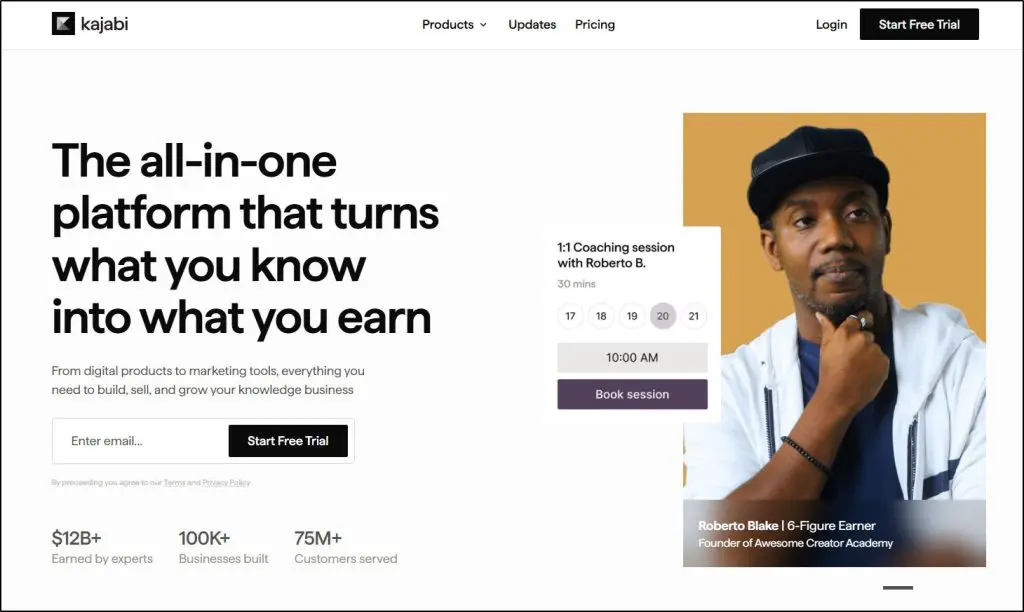
Kajabi is an all-in-one audience growth platform for edupreneurs, creators, and knowledge businesses. It combines course hosting, coaching, community, a website builder, email marketing, sales funnels, and automation in one account, so you can run your whole operation without stitching tools together.
What sets it apart is how far it reaches beyond the course. Kajabi can carry a customer along the full Value Ramp, from a free lead magnet to a course, a membership, and a high-ticket coaching offer, with email and automation connecting each step.
Naturally, Kajabi is the most expensive option in this comparison, and its features pay off only when you have an audience and offers to market.
Read my full Kajabi review for a deeper look.
Main Kajabi Features
- Course builder with video, drip, lesson locking, graded quizzes, and certificates
- Email marketing with broadcasts, sequences, tagging, and behavior-based automations
- Unlimited funnels and landing pages, plus a full website builder and blog
- Coaching with a native scheduler, built-in video, and automatic session recordings
- Community with channels, live rooms, challenges, and leaderboards
- AI tools, including the Cofounder assistant and an MCP connection to Claude or ChatGPT
- Affiliate program on Growth and above

What Is Teachable?
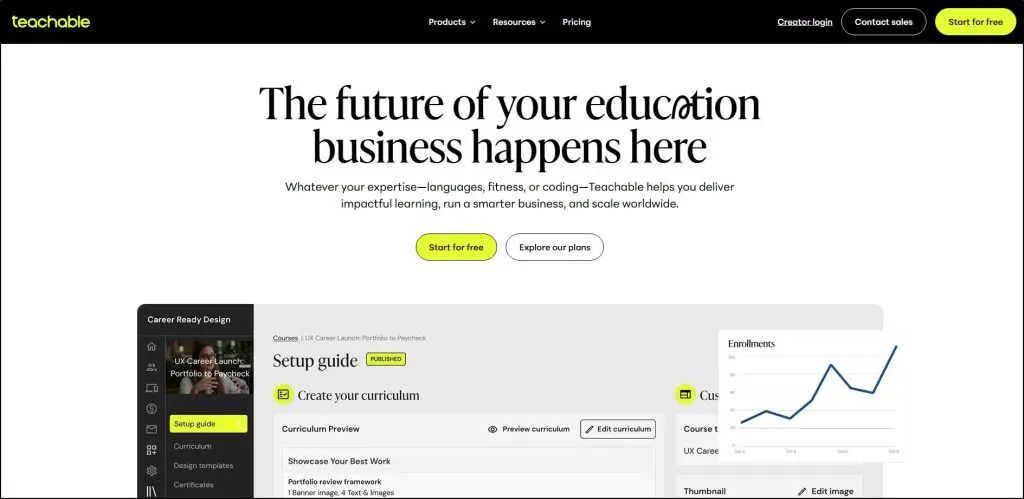
Teachable is a beginner-friendly online platform for creating and selling courses, coaching, memberships, and digital downloads. It launched in 2013 and is now part of the Hotmart group.
Teachable intentionally focuses on letting users build excellent online learning experiences. Its course builder is easy to learn, student management is detailed, and its teachable:pay system handles payments, subscriptions, and sales tax for you. If you’re a first-time creator, Teachable helps you get your course live quickly.
Unlike Kajabi, Teachable doesn’t try to be the ultimate all-in-one platform and does not offer that same depth of marketing, automation, and audience engagement features.
It has no funnels or lead nurturing, and its email covers students only, so it works best as the learning specialist inside a larger stack.
Read my full Teachable review for more detail.
Main Teachable Features
- Course builder with quizzes, drip scheduling, and course compliance rules
- Coaching products with built-in scheduling, intake forms, and client tracking
- Membership tiers and subscriptions on every plan
- Automatic sales tax and VAT handling through teachable:pay
- Upsells, order bumps, coupons, and bundles at checkout
- Affiliate program with automated payouts from the Builder plan
- iOS and Android apps for students

Kajabi vs Teachable Pricing: How Much Do They Cost
Kajabi charges a high flat fee and takes no cut of your sales. Teachable starts far cheaper, charges a fee on its entry plan, and caps how many products you can publish.
Kajabi Pricing and Free Trial
Kajabi has three paid plans and no free plan. The standard trial is 14 days with a card on file, and our link extends it to 30 days. Kajabi has also been running a promotion of 50% off every plan for the first six months, so check its pricing page before you sign up.
- Basic: $143/month billed annually ($179 billed monthly)
- Growth: $199/month billed annually ($249 billed monthly)
- Pro: $399/month billed annually ($499 billed monthly)
| Feature | Basic | Growth | Pro |
|---|---|---|---|
| Products (courses, coaching, downloads) | 5 | 50 | Unlimited |
| Contacts | 2,500 | 25,000 | 100,000 |
| Communities | 1 | 1 | 3 |
| Websites | 1 | 1 | 3 |
| Admin users | 2 | 11 | 26 |
| AI credits | 0 | 500 | 1,000 |
| Cohort courses | ✗ | ✓ | ✓ |
| Affiliate program | ✗ | ✓ | ✓ |
| Advanced automations & webhooks | ✗ | ✓ | ✓ |
| Remove Kajabi branding | ✗ | ✓ | ✓ |
| Custom code editor | ✗ | ✗ | ✓ |
| API access | ✗ | ✗ | Yes ($25/mo value) |
| Branded mobile app | ✗ | ✗ | Included ($199/mo value) |
| Kajabi Payments fee | 2.9% + $0.30 | 2.8% + $0.30 | 2.7% + $0.30 |
| Fee with 3rd-party gateway | 2% | 1% | 0.5% |
The limits on Basic are tighter than most people expect. Five products and 2,500 contacts go quickly once you start marketing, and affiliates, cohort courses, and advanced automations all need Growth. I cover each plan in my Kajabi pricing guide.
Teachable Pricing
Teachable has three self-serve plans and a custom tier. It retired its free plan in June 2025. You now get a 7-day free trial and a 30-day money-back guarantee.
- Starter: $29/month billed annually ($39 billed monthly), 7.5% transaction fee
- Builder: $69/month billed annually ($89 billed monthly), no transaction fee
- Growth: $139/month billed annually ($189 billed monthly), no transaction fee
- Custom: quote-based pricing for larger schools
| Feature | Starter | Builder | Growth | Custom |
|---|---|---|---|---|
| Transaction fee | 7.5% | 0% | 0% | 0% |
| Published products | 5 | 10 | 50 | Custom |
| Admin users | 1 | 1 | 5 | Custom |
| Students | Unlimited | Unlimited | Unlimited | Unlimited |
| Community | ✗ | ✓ | ✓ | ✓ |
| Certificates | ✗ | ✗ | ✓ | ✓ |
| Bulk student imports | ✗ | ✗ | ✓ | ✓ |
| Built-in email marketing | ✗ | ✓ | ✓ | ✓ |
| Affiliate program | ✗ | ✓ | ✓ | ✓ |
| Custom domain | ✗ | ✓ | ✓ | ✓ |
| CSS snippets | ✗ | ✓ | ✓ | ✓ |
| Remove Teachable branding | ✗ | ✗ | ✓ | ✓ |
| Custom user roles | ✗ | ✗ | ✓ | ✓ |
| Zapier & webhooks | ✗ | ✗ | ✓ | ✓ |
| Public API | ✗ | ✗ | ✓ | ✓ |
| Real-time support | ✗ | ✓ | ✓ | ✓ |
| Card processing (Teachable Payments) | 2.9% + 30¢ US, 3.9% + 30¢ intl | 2.9% + 30¢ US, 3.9% + 30¢ intl | 2.9% + 30¢ US, 3.9% + 30¢ intl | 2.9% + 30¢ US, 3.9% + 30¢ intl |
Starter is a testing plan. It has no community, no email, no custom domain, and no affiliates, and its fee adds up fast. Builder is the realistic starting point, and certificates, Zapier, and white labeling wait on Growth.
Kajabi vs Teachable Pricing Comparison
Here’s how the comparable plans line up. Prices are per month on annual billing.
| Kajabi | Teachable | |
|---|---|---|
| Entry plan | Basic at $143 | Starter at $29 |
| Mid plan | Growth at $199 | Builder at $69 |
| Top self-serve plan | Pro at $399 | Growth at $139 |
| Platform fee | None with Kajabi Payments | 7.5% on Starter, none above |
| Card processing | 2.9% + 30¢ on Basic, 2.8% on Growth, 2.7% on Pro | 2.9% + 30¢ in the US, 3.9% + 30¢ internationally |
| Third-party gateway surcharge | 2% on Basic, 1% on Growth, 0.5% on Pro | 2% for US schools using their own Stripe |
| Email marketing | Included on every plan | Basic student emails from Builder. Full email needs a separate tool |
| Free trial | 14 days, or 30 with our link | 7 days |
Kajabi vs Teachable: Real Cost at $10,000 and $50,000 a Month
Headline prices hide most of the cost once you’re selling. So I worked out what each plan costs in a month where you sell $10,000 and one where you sell $50,000.
I’ve assumed a $200 average sale, annual billing, US cards, and each platform’s own payment processor. The totals include the plan price, card processing, and any transaction fee.
| Plan | Cost at $10,000/month | Cost at $50,000/month |
|---|---|---|
| Kajabi Basic | $448 | $1,668 |
| Kajabi Growth | $494 | $1,674 |
| Kajabi Pro | $684 | $1,824 |
| Teachable Starter | $1,084 | $5,304 |
| Teachable Builder | $374 | $1,594 |
| Teachable Growth | $444 | $1,664 |
| Teachable Builder + Kit (10,000 subscribers) | $491 | Not applicable |
| Teachable Growth + Kit (25,000 subscribers) | Not applicable | $1,832 |
Teachable Builder is the cheapest plan at both levels, at $374 and $1,594. Teachable Starter is the most expensive by a wide margin, because its 7.5% fee takes $750 of every $10,000 you sell.
The comparison changes when you add email. Teachable needs a separate tool to market to leads, and Kajabi includes one. I’ve used Kit’s pricing and assumed a 10,000-subscriber list at $10,000 a month and 25,000 subscribers at $50,000. On those assumptions, Teachable Builder plus Kit costs $491 against $494 for Kajabi Growth, and Teachable Growth plus Kit costs $1,832 against $1,674.
So Kajabi’s premium mostly disappears once your list is large, and it still includes funnels, a website, and coaching video that Teachable would need more tools to match. With a small list, Teachable stays cheaper.
To check the processing math on your own prices, use my Stripe fee calculator. Avoid third-party gateways on either platform if you can. At $50,000 a month, Kajabi’s surcharge adds $1,000 on Basic and $500 on Growth, and Teachable’s adds $1,000 for US schools.
Kajabi vs Teachable Features: How They Compare
I’ve compared the two platforms on the six features that matter most to an expertise business. Each section ends with my pick.
| Feature | Winner | Why |
|---|---|---|
| Course creation and learning structure | Teachable | Easier builder, compliance rules, and detailed student management |
| Community | Kajabi | Live rooms, challenges, and leaderboards, and it sells on its own |
| Coaching | Kajabi | Built-in video and automatic recordings |
| AI features | Kajabi | An assistant for the whole business, plus an MCP connection |
| Email marketing and automation | Kajabi | Full email, tagging, and behavior-based automations built in |
| Other marketing and sales features | Kajabi | Website, funnels, and landing pages, though Teachable handles tax better |
Kajabi takes five of the six. Teachable takes the one that matters most if the course itself is your product.
Feature #1: Course Creation and Learning Structure
The course builder is where you’ll spend most of your time, and where students form their opinion of your product. I’ve included memberships here because both platforms treat them as a way to package courses.
Kajabi
Kajabi’s course builder is clean and capable. You organize lessons into modules, add video, audio, and text, and drip content on a schedule. It has closed some old gaps. You can now lock lessons until a student completes the previous one, grade quizzes against a pass mark, and issue completion certificates.
Cohort courses, which run a group through the material together, need the Growth plan. Memberships are products you build from courses, community access, and coaching, with subscription pricing attached.
The limits are what hold it back. Basic allows only 5 products, and Kajabi has no native assignment tool or formal exam. It’s a good course builder inside a marketing platform, and a dedicated learning platform still does more.
Teachable
Teachable’s builder is the easiest I’ve used with clients, which matters when you’re creating your first online course. You add sections and lessons, upload content, and publish, and its AI drafts outlines and quiz questions to speed things up. Drip scheduling and multiple-choice quizzes are included.
Course compliance is the feature Kajabi can’t fully match. You can require students to finish lessons in order, pass a quiz, and watch a set share of a video before they move on. Student management is detailed, with progress reports per student.
Membership tiers and subscriptions come on every plan, and students get iOS and Android apps. The weak points are the caps of 5, 10, and 50 published products, quizzes that stop at multiple choice, and certificates that wait until the Growth plan.
Winner: Teachable. It’s easier to build on and gives you more control over how students move through a course. Kajabi wins if you need certificates on an entry plan.
Feature #2: Online Community & Engagement
More edupreneurs now sell community access alongside their courses, because peer connection keeps members subscribed. The two platforms take this at different depths.
Kajabi
Kajabi’s community is a full product. You create channels for topics or member groups and control access by plan or product. Members get direct messaging, live rooms, meetups, challenges, and leaderboards.
You can sell the community by itself or bundle it with courses and coaching. A comment-to-DM automation turns public replies into private conversations, which helps with sales and support. Basic and Growth include one community, and Pro includes three.
Members reach it on the web and in the Kajabi mobile app. The main limit is the single community on the two lower plans, which forces you to organize everything through channels and access groups until you move to Pro.
Teachable
Teachable added a community feature in 2024, and it starts on the Builder plan. It’s a forum-style space with categories, topics, and moderation tools, and students can reach it from inside a course.
It’s a supporting feature. You can’t sell the community as its own product, because access comes through a course or membership. It has no live events, no gamification, and no push notifications, so keeping it active depends on your own prompting.
It does its job for course Q&A and cohort discussion. If you want to sell a paid community, you’d pair Teachable with a dedicated community platform, which means another subscription and another login for your members.
Winner: Kajabi. It has engagement tools Teachable lacks and can sell community as a product. Teachable’s version works only as a discussion space for enrolled students.
Feature #3: Coaching & Session Management
Coaching sits at the top of the Value Ramp for most experts, so how a platform sells and delivers sessions affects your highest-priced offer.
Kajabi
Kajabi handles the whole coaching workflow in-house. Kajabi Scheduler manages availability, buffers, and reminders, and calls run on Kajabi Live, its built-in video tool. You don’t need Calendly or Zoom.
After each call, the recording uploads to the client’s session automatically. You can ask onboarding questions at checkout, set cancellation policies, and sell coaching as single sessions or packages. Clients get a workspace that holds their sessions, notes, and resources in one place.
Coaching also connects to the rest of Kajabi. A purchase can start an email sequence and add the client to your community, and a funnel can offer coaching to course buyers. Each coaching offer counts toward your product limit, which matters on Basic.
Teachable
Teachable treats coaching as its own product type, which is rare among course platforms. It includes built-in scheduling, intake forms, and milestones for tracking each client, and you can sell coaching alone or bundle it with a course.
The session itself runs on Zoom or another video tool, so recordings and replays are yours to manage. For a coach who wants a simple way to sell and organize sessions at a lower price, that’s enough. It falls short when coaching is the center of the business.
Payments and subscriptions for coaching run through teachable:pay, with tax handled for you. Each coaching product counts toward your published product cap, so a coach with several offers will need Growth sooner than expected.
Winner: Kajabi. Built-in video and automatic recordings remove two outside tools. Teachable is the better value if coaching is a small part of what you sell.
Feature #4: AI Features
AI now touches every part of a course business, from drafting lessons to writing emails. What matters is whether the AI helps with the whole business or only with course content.
Kajabi
Kajabi has gone furthest here. Cofounder is an AI assistant inside the dashboard that drafts sales pages, emails, and course outlines. Growth and Pro include monthly AI credits, and Basic includes none.
Kajabi also offers paid Expert Agents that answer buyer or student questions, and an MCP connection on every plan. That connection lets you run parts of your account from Claude or ChatGPT. I cover the full set in my Kajabi AI review.
None of this picks your offer or your audience for you. AI makes the execution cheap once you’ve made those calls, and Kajabi gives you more places to apply it than any other course platform I’ve used.
Teachable
Teachable’s AI stays inside the course builder. It generates course outlines, quiz questions, and lesson transcripts, and the Growth plan adds free subtitles and translations.
Those tools save real time when you build a course. They don’t help you write a sales page, plan a launch, or answer a prospect, and I haven’t found an AI assistant for marketing on Teachable.
That fits Teachable’s focus on learning. If you already write your marketing copy in Claude or ChatGPT, you won’t miss much. You will be working across more tools, and nothing connects your AI to your school’s data.
Winner: Kajabi. Its AI works across marketing, sales, and content. Teachable’s AI helps you build a course and stops there.
Feature #5: Email Marketing and Automation
Email is how you turn an audience into buyers and buyers into repeat customers. This is the widest gap between the two platforms.
Kajabi
Kajabi includes a full email marketing system on every plan. You can send broadcasts, build multi-step sequences, tag contacts, and segment your list by behavior and purchase history.
Automations connect everything. A purchase can trigger an onboarding sequence, grant access to a community, and tag the buyer for a later offer. Advanced automations and webhooks need Growth. Contact limits are 2,500 on Basic, 25,000 on Growth, and 100,000 on Pro, so the plan you need depends on your list size.
A typical setup looks like this. A visitor downloads a lead magnet, receives a five-email sequence, and gets an offer for your course. Buyers move into an onboarding sequence and non-buyers get a follow-up. You build all of it inside Kajabi, and this is where the platform earns its price.
Teachable
Teachable’s email is a student notification system. From the Builder plan you can email enrolled students and send abandoned cart reminders. You can’t nurture leads who haven’t bought yet.
For real email marketing, you connect a tool like Kit or ActiveCampaign. Zapier and webhooks arrive on the Growth plan, so deeper automation between tools costs more. That setup works well if you already run your marketing elsewhere, and Kit starts at $33/month on annual billing.
The trade-off is two systems to keep in sync. Your student data lives in Teachable and your leads live in the email tool. In return, a dedicated email platform gives you deeper automation than Kajabi’s own, so specialists often prefer this setup.
Winner: Kajabi. Its email and automation replace a separate tool. Teachable expects you to bring your own.
Feature #6: Other Marketing and Sales Features
Beyond email, a platform has to help you attract visitors and convert them. Here I compare websites, funnels, checkout tools, and affiliates.
Kajabi
Kajabi gives you a full website builder with a blog, unlimited landing pages, and funnels that link opt-in pages, emails, and checkout into one flow. You can also host a podcast and publish a newsletter from the same account.
Checkout supports upsells, order bumps, coupons, and payment plans. The affiliate program starts on Growth. A branded mobile app comes with Pro and costs $199 a month as an add-on on lower plans.
The value is in how these connect. One funnel can take a visitor from a blog post to an opt-in, a low-priced course, and a membership offer, without any integration work. Removing Kajabi’s branding from your site needs the Growth plan.
Teachable
Teachable covers the sale itself well. You get sales pages, upsells, order bumps, coupons, and bundles, and an affiliate program from Builder that pays your affiliates automatically.
Its real advantage is tax. teachable:pay collects and remits sales tax and VAT for you, which Kajabi leaves to you. My sales tax and VAT calculator shows what that means per sale.
What Teachable lacks is everything before the checkout.
It has no funnel builder, no blog, and limited page design, so creators often pair it with ClickFunnels or HighLevel for lead generation.
A custom domain comes with Builder, and removing Teachable’s branding needs Growth. So on Starter your school sits on a Teachable address, which is fine for testing and weak for a brand.
Winner: Kajabi. It covers the full funnel from first visit to repeat sale. Teachable wins on tax handling and affiliate payouts.
Kajabi vs Teachable: Pros and Cons
These are the practical strengths and weaknesses you’ll run into day to day, beyond the feature comparison.
Kajabi Pros and Cons
| Pros | Cons |
|---|---|
| One login and one bill for courses, email, funnels, website, and community | Highest price in this comparison, from $143/mo on annual billing |
| No platform fee on sales through Kajabi Payments | Basic is tight, with 5 products and 2,500 contacts |
| Card processing rate drops on Growth and Pro | Affiliates, cohort courses, and advanced automations need Growth |
| Regular 50% off promotions for the first six months | Steep learning curve, with features a beginner won’t use |
| 30-day trial through our link | You handle your own sales tax |
Teachable Pros and Cons
| Pros | Cons |
|---|---|
| Fast to learn, with a course live in days | 7.5% transaction fee on Starter |
| Lowest cost per sale on Builder and above | Published product caps of 5, 10, and 50 |
| Automatic sales tax and VAT handling | Prices have risen sharply for long-term users |
| Unlimited students on every plan | Only a 7-day trial and no free plan |
| iOS and Android apps for students | Certificates, Zapier, and white labeling need Growth |
Kajabi vs Teachable Verdict: Which One Should You Choose
Kajabi and Teachable are both good at what they do. They do different jobs for edupreneurs at different stages, so match the platform to your situation.
- You’re launching your first course: choose Teachable Builder. You’ll be live quickly, and you won’t pay for marketing tools you can’t use yet.
- You already run email in Kit or ActiveCampaign and funnels in ClickFunnels or HighLevel: choose Teachable. It’s the learning specialist in your stack, and the cheapest plan per sale.
- Your course is the product and students need structure: choose Teachable for course compliance and student tracking. If you need exams and assignments, look at Thinkific too.
- You have an audience and several offers to sell: choose Kajabi Growth. Email, funnels, and automation in one place will earn back the price.
- Coaching or community is central to your business: choose Kajabi. Its coaching video and community tools are a full step ahead.
- You want one platform for everything and have the budget: choose Kajabi. Nothing else in this category matches its range, as my Kajabi vs Thinkific comparison also shows.
If I were starting today with a first course and no list, I’d begin on Teachable Builder and keep my costs low while I proved the offer.
My students count calculator shows how many sales that takes at your price.
Once I had an audience and a second or third product to sell, I’d move to Kajabi Growth and run the whole Value Ramp from one account.
Both offer free trials, so test the one that fits your stage. Start with Kajabi if you’re ready to run a full funnel, or start with Teachable if you want to get a course live first.
Kajabi vs Teachable | Frequently Asked Questions (FAQs)
Is Kajabi better than Teachable?
Kajabi is better for established edupreneurs who want courses, email, funnels, coaching, and community in one platform. Teachable is better for beginners and for creators who only need a learning platform and run marketing in other tools. Kajabi does more, and Teachable costs less and is easier to learn.
Is Kajabi worth the higher price?
Kajabi is worth it when you would otherwise pay for a course platform, an email tool, a funnel builder, and a website separately. With a list of about 10,000 subscribers, Kajabi Growth costs about the same as Teachable Builder plus Kit. Below that list size, Teachable is cheaper.
Do Kajabi and Teachable have free plans?
Neither platform has a free plan. Kajabi offers a 14-day free trial, which our link extends to 30 days. Teachable retired its free plan in June 2025 and now offers a 7-day free trial with a 30-day money-back guarantee.
Do Kajabi and Teachable charge transaction fees?
Kajabi charges no transaction fee when you use Kajabi Payments, and adds 2%, 1%, or 0.5% by plan if you use a third-party gateway. Teachable charges 7.5% on its Starter plan and nothing on Builder and above. Both charge card processing of about 2.9% plus 30 cents per sale.
Which is better for beginners, Kajabi or Teachable?
Teachable is better for beginners. Its course builder is easier to learn, its Builder plan costs less than half of Kajabi Basic, and you can launch a course without setting up funnels or automations. Move to Kajabi once you have an audience and more than one offer to sell.
Which platform is better for membership sites?
Teachable includes membership tiers on every plan and suits a simple content membership. Kajabi suits a membership built around community and coaching, because it adds live rooms, challenges, and built-in coaching video. Choose Kajabi if engagement drives your retention, and Teachable if the content library does.
Which platform handles sales tax and VAT?
Teachable handles it for you. Its teachable:pay system calculates, collects, and remits sales tax and VAT on your sales. Kajabi can calculate and collect tax at checkout, but filing and remitting stay your responsibility. Teachable is the easier choice if you sell to buyers in many countries.
Can I use Teachable with Kit or ActiveCampaign?
Yes. Teachable connects to email tools through its integrations, and its Growth plan adds Zapier and webhooks for deeper automation. Most Teachable users run their list and sales emails in a tool like Kit or ActiveCampaign, because Teachable’s own email only reaches enrolled students.
Do Kajabi and Teachable have mobile apps?
Both do. Teachable has iOS and Android apps where students take courses. Kajabi has a shared mobile app for courses and community, and it includes a branded app under your own name on the Pro plan. On lower Kajabi plans the branded app costs $199 a month.
Can I switch from Teachable to Kajabi later?
Yes. You export your student list from Teachable, rebuild or re-upload your courses in Kajabi, and import your contacts. Active subscriptions are the hard part, because recurring payments don’t transfer automatically. Plan the move between launches, and keep both accounts running until your students have access.
What are the best alternatives to Kajabi and Teachable?
Thinkific is the strongest alternative for structured courses with exams and assignments. Podia is a simpler, cheaper all-in-one for early-stage creators. Skool and Circle suit businesses where community is the main product. The right one depends on whether you prioritize learning depth, price, or community.
See also:
- Kajabi Review – Powerful All-In-One Solution
- Is Kajabi Pricing Worth It for You?
- Teachable Review – One of the Best Platforms for New Course Creators
- Teachable vs Thinkific

Jeff Cobb, Founder of Learning Revolution
Jeff Cobb is an expert in online education and the business of adult lifelong learning. Over the past 20+ years he has built a thriving career based on that expertise – as an entrepreneur, a consultant, an author, and a speaker. Learning Revolution is a place where Jeff curates tips, insights, and resources to help you build a thriving expertise-based business. Learn more about Jeff Cobb here.
Table of Contents
Related Posts
Zenler vs Kajabi (2026) | My Honest Review After Using Both
Teachable vs Udemy (2026) | Which Online Course Platform Is Right For You
Teachable vs. LearnWorlds (2026) | My Honest Review After Using Both