

I consider Thinkific the best online course platform for most beginners and mid-tier course sellers, membership site owners, and anyone building a structured learning program.
Every time I search for thinkific examples, though, the same six or seven sites show up in article after article.
So I pulled Ahrefs data, worked through the SERPs by hand, and ran a batch of sites through third-party detection tools to confirm what platform they actually run on.
That process turned up businesses that use Thinkific, including a few that use it on a custom domain with zero obvious course-platform branding, sites nobody’s roundup ever catches.
This list covers ten such examples, proof of how far you can stretch Thinkific whether you’re selling a course, a membership, a community, or some mix of all three.
Read my detailed Thinkific Review to decide if its the right choice for you
The Best Live Thinkific Examples To Inspire You
Every site below is live right now and I encourage you to visit these sites to experience how they use Thinkific.
Let’s break them down one by one.
| Thinkific Example | Description |
|---|---|
| Miss Excel | A popular Excel and Microsoft Office course academy built on Thinkific |
| Alana Collins Fitness School | A single flagship strength-training course for women over 40 |
| Sew It Academy | A sewing membership with a large, active Facebook community layered on top |
| BrickFlicks Academy | A stop-motion LEGO animation academy for kids |
| Oh So Lovely London | A hybrid, accredited beauty training academy with online theory and in-person practicals |
| Learn Prompting | A subscription-based prompt engineering course library |
| No-Hype Marketing Academy | An audio-first copywriting course |
| Adsterra Courses | A B2B partner and publisher training academy for an ad network |
| Motivity | A continuing education platform for behavioral health clinicians |
| Calypso Education (Nasdaq) | Nasdaq’s enterprise certification academy for its Calypso trading software |

Thinkific Example #1: Miss Excel

Miss Excel is among the most popular and widely cited Thinkific examples out there. I’m including it anyway because it’s genuinely good and shows real platform strength, not because it’s an easy pick.
Kat Norton, who runs the site, has a multi-million following across TikTok, Instagram, and other platforms. She funnels that audience to her Miss Excel course site, built on Thinkific but running on her own custom domain.
She sells standalone courses on Excel, Power BI, PowerPoint, Word, and using AI inside Excel. The site’s course pages use a simple design focused on converting cold visitors who’ve never heard of the brand before.
Thinkific handles checkout and course delivery in the background, letting Norton focus on content and traffic instead of site infrastructure.
Thinkific Example #2: Alana Collins Fitness School
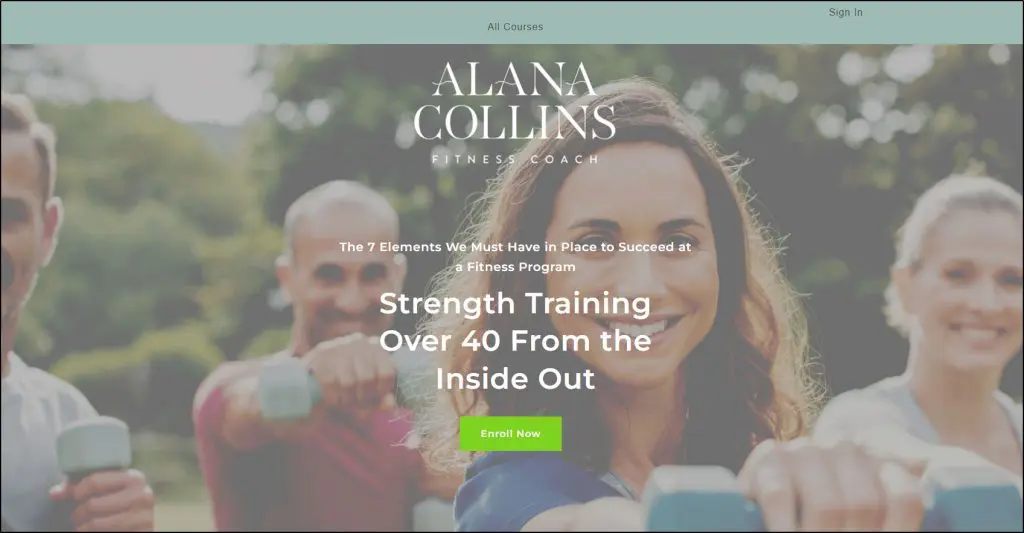
Alana Collins Fitness School is one of the simplest live examples on this list, a single flagship course with nothing else layered on top.
Alana Collins sells Building Fitness Over 40 (From the Inside Out) for $97which pairs with her published book of the same name, giving buyers a second format to reinforce what they learn.
It’s about as lean as a Thinkific site gets, one expert, one course, one clear offer. For a focused audience like women over 40 who want real strength training, that simplicity works.
But this is also an example of Thinkific’s design limitations.
Thinkific Example #3: Sew It Academy
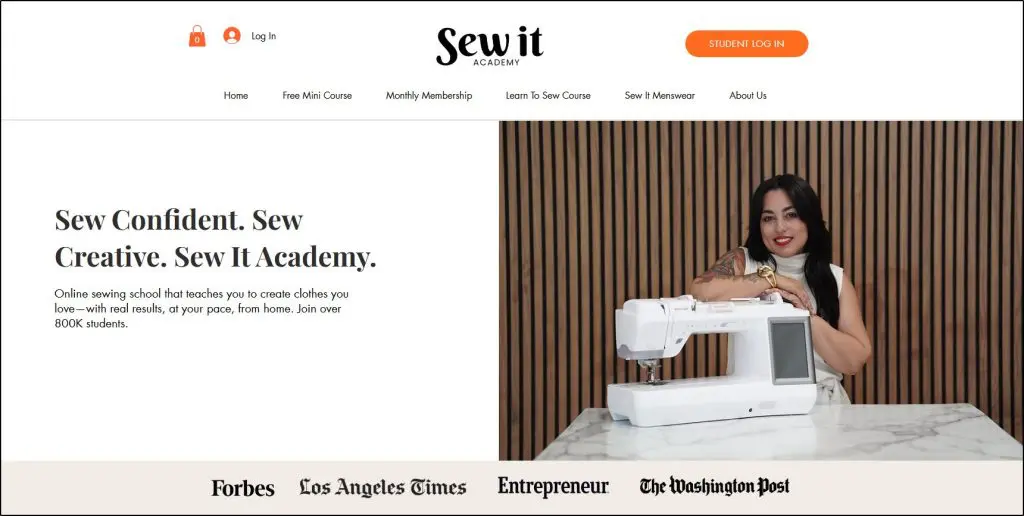
Sew It Academy is an excellent example of a membership built around genuine community. Mimi G, a working fashion designer with a Project Runway credit to her name, runs it as an $11.97 a month subscription covering roughly 60 sewing courses.
Mimi invites new members into a private Facebook group, where she answers questions, posts live videos, and connects students by location to sew and shop together.
That group is where the real community activity happens, layered on top of the Thinkific membership rather than built into it.
The brand has taught, by its own count, over 800,000 people to sew, with a new lesson added every month to keep subscribers engaged.
Thinkific Example #4: BrickFlicks Academy

BrickFlicks Academy is one of the more unusual entries here, a Thinkific site built entirely for a young, creative audience. It teaches kids eight and up to make stop-motion films using LEGO.
The core library is self-paced video lessons, hosted directly on Thinkific. Around that, the team runs monthly competitions and live webinars, giving members a reason to keep coming back between lessons.
Thinkific doesn’t host live video natively, so the webinars run through a separate tool, a common pairing for any course brand that wants a live element.
Thinkific Example #5: Oh So Lovely London
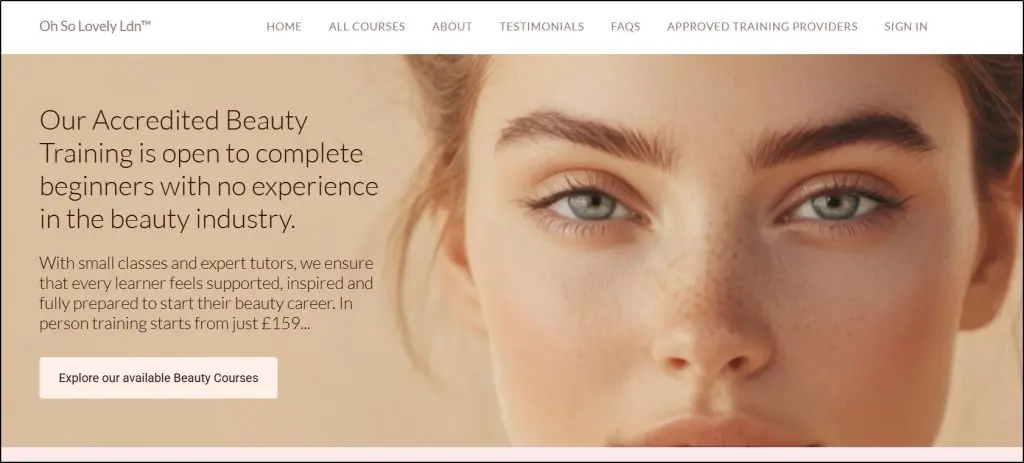
Oh So Lovely London is a strong example of Thinkific supporting a hybrid, accredited training model rather than a fully online one.
Students complete accredited theory online through the platform, then attend a required practical day in person at the company’s London studio.
The brand has trained staff for Chanel, Dior, Estée Lauder, and Harrods over its 20 years in business. Their courses cover treatments like Russian lash extensions, brow lamination, and face sculpt massage, each accredited through recognized bodies like ABT.
Thinkific handles the online theory portion well. But it doesn’t include scheduling or booking tools for the practical day, so that part of the process runs outside the platform.
Thinkific Example #6: Learn Prompting

Learn Prompting is a good example of Thinkific applied to a subject that barely existed a few years ago. Sander Schulhoff, an ML researcher at the University of Maryland, built one of the first widely shared open-source guides to prompt engineering, then turned it into a 15-course library.
Students get access through a Learn Prompting Plus subscription rather than buying individual courses. The flagship course, Introduction to Prompt Engineering, runs self-paced over three days in short lessons, with quizzes and exercises built in.
Subscriptions and bundles are native Thinkific features, so the recurring-access model didn’t require any extra tooling to set up.
Thinkific Example #7: No-Hype Marketing Academy

No-Hype Marketing Academy is worth including because it teaches copywriting almost entirely through audio instead of video. Its flagship program, 6 Weeks to Masterful Copywriting, builds around six 80-minute audio lessons.
Each week pairs a lesson with a writing challenge, applied to a real business offer, and students then see how the instructor handled the same brief.
Most copywriting courses on Thinkific default to video, so the format stands out immediately.
Thinkific built its course player primarily around video and text. An audio course works within that framework rather than getting a dedicated audio experience.
Thinkific Example #8: Adsterra Courses

Adsterra Courses is a good example of training your own customers rather than selling education as the product. The ad network runs its partner onboarding through a dedicated Thinkific course library.
The courses walk publishers and advertisers through platform setup, ad formats, and campaign optimization step by step. That structure gives new partners a guided path instead of a static help center to search through.
It also lets Adsterra track who actually completed onboarding, not just who visited a page once.
Thinkific Example #9: Motivity
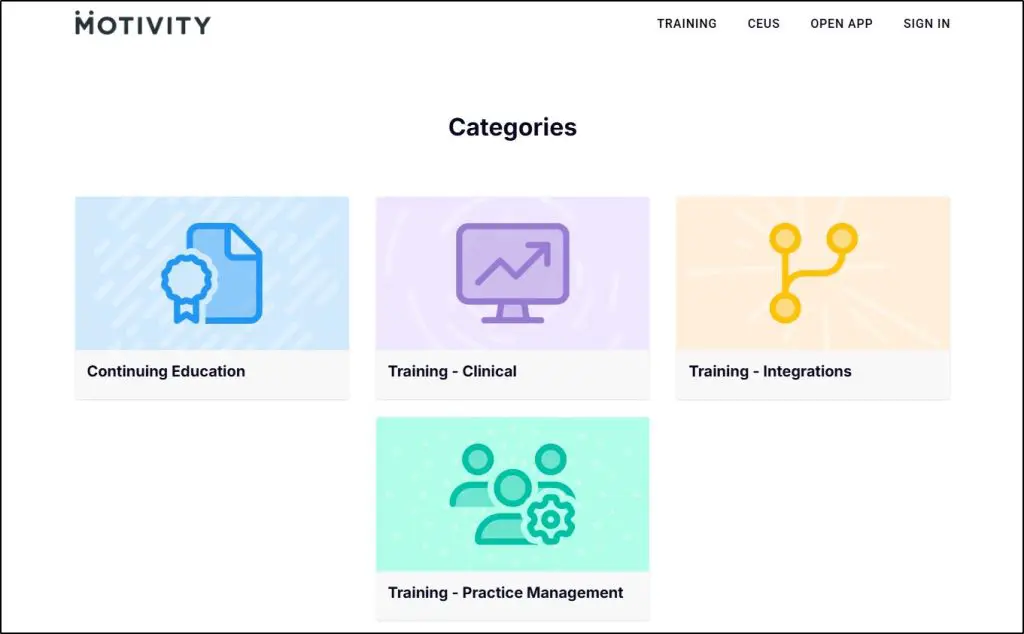
Motivity is a clear example of Thinkific used for regulated, credit-bearing professional education rather than general skill-building. The company sells behavioral health software to ABA clinics, and it uses Thinkific to deliver continuing education credits to the clinicians who run that software.
Courses are split into separate tracks, one for Registered Behavior Technicians, one for Board Certified Behavior Analysts, one for general support staff.
Clinicians need these CEUs to maintain their licensure, a higher bar than a typical how-to course carries. Thinkific handles the segmentation and access control cleanly, keeping each role’s training separate from the others.
Thinkific Example #10: Calypso Education (Nasdaq)

Nasdaq’s Calypso Education site is a great example of how corporations use Thinkific for client and in-house learning. The academy offers certification training for Nasdaq’s Calypso treasury and trading software.
Nasdaq strips out the platform’s default branding entirely, so the site reads as a Nasdaq product from top to bottom. It organizes courses into bundles by function, front office, post-trade processing, decision support and risk, letting a bank’s operations team find role-specific training instead of browsing one flat list.
This level of scale and white-labeling reflects Thinkific’s higher-tier Plus plan, not the base plan most solo creators start on.
How Much Does Thinkific Cost? Pricing Plans and Features
| Feature | Basic$40/mo billed yearly | Start$82/mo billed yearly | Grow$164/mo billed yearly | PlusCustom |
|---|---|---|---|---|
| Courses & students | ||||
| Published courses | Unlimited | Unlimited | Unlimited | Unlimited |
| Current students | 10,000 | 10,000 | 10,000 | Custom |
| Video bandwidth | 100 GB/mo | 200 GB/mo | 400 GB/mo | From 7,500 GB/mo |
| Digital downloads | 5 | Unlimited | Unlimited | Unlimited |
| Coaching & webinars | 5 | Unlimited | Unlimited | Unlimited |
| Certificates, assignments, private courses | ✗ | ✓ | ✓ | ✓ |
| Zoom lessons in courses | ✗ | ✓ | ✓ | ✓ |
| SCORM | ✗ | ✗ | ✗ | ✓ |
| Learning paths | ✗ | ✗ | ✗ | ✓ |
| Community | ||||
| Communities | 1 | 1 | 3 | Unlimited |
| Spaces per community | 5 | 10 | 20 | Unlimited |
| Selling | ||||
| Paid memberships / subscriptions | ✗ | ✓ | ✓ | ✓ |
| Bundles & payment plans | ✗ | ✓ | ✓ | ✓ |
| PayPal payments | ✗ | ✗ | ✓ | ✓ |
| Site & admin | ||||
| Remove Thinkific branding | ✗ | ✗ | ✓ | ✓ |
| Support | Email & chat | Email & chat | Phone & priority chat | Dedicated success team |
| Branded mobile app | $199/mo add-on | $199/mo add-on | $199/mo add-on | Included on select contracts |
| AI & integrations | ||||
| Thinker AI teaching assistant | ✗ | ✗ | ✗ | ✓ |
| Thinkific MCP (Claude, ChatGPT) | ✗ | ✗ | ✗ | ✓ |
| Marketing | ||||
| Email Automation | ✓ | ✓ | ✓ | ✓ |
| Landing Pages | ✓ | ✓ | ✓ | ✓ |
| Site Builder | ✓ | ✓ | ✓ | ✓ |
| Transaction Fee (without Thinkific Payments) | 5% | 2% | 1% | 0 |
| Transaction fee | – | – | – | – |
Should You Build Your E-learning Program on Thinkific?
Thinkific is not primarily a site builder. It’s an e-learning platform that handles the backend of your online education business. But its site builder is good enough for a basic website or landing to market your program.
If you’re still deciding whether it’s the right platform for what you’re building, the fastest way to find out isn’t reading another comparison post.
Thinkific offers a 30-day free trial, long enough to build a real course or membership page, connect a custom domain, and see how it actually feels to run your content through it before you commit to a plan.
Start the trial, build the thing you’ve been putting off, and judge the platform on your own project instead of someone else’s.
Frequently Asked Questions (FAQs)
What types of websites can you actually build with Thinkific?
Thinkific supports four main site types, standalone courses, recurring memberships, community-driven platforms, and white-labeled enterprise training academies. The examples above show all four in production, from a single $97 fitness course to Nasdaq’s internal certification portal. The platform doesn’t limit you to one format, you choose the structure based on how you want to monetize your content.
Can you use a custom domain on Thinkific, or is every site stuck on a thinkific.com subdomain?
Every paid Thinkific plan supports a custom domain through a CNAME record, so your site never has to show thinkific.com in the URL. Several sites in this list, including Miss Excel and Nasdaq’s Calypso Education academy, run entirely on their own branded domains. That’s also why so many real Thinkific sites don’t get recognized as Thinkific sites.
How can you tell if a website is actually built on Thinkific?
Look at the URL structure first, paths like /courses/, /collections/, or /bundles/ are Thinkific defaults that carry over even to custom domains. You can also check the page source for assets loading from cdn.thinkific.com, or look for a Powered by Thinkific link in the footer, though higher-tier plans can remove that badge.
Does Thinkific support memberships and recurring subscriptions, or only one-time course sales?
Yes, membership and bundle pricing are native Thinkific features, not an add-on. Sew It Academy and Learn Prompting both run as monthly subscriptions rather than single purchases, using Thinkific’s built-in billing and access controls. That makes Thinkific a legitimate option for creators who want recurring revenue instead of one-off transactions.
Can large companies use Thinkific for enterprise or customer training?
Yes, through Thinkific Plus, the platform’s enterprise tier. Nasdaq uses it to deliver certification training for its Calypso software, and Motivity uses it to issue continuing education credits to licensed clinicians. Both examples run fully white-labeled, with no visible Thinkific branding, which is standard on Plus accounts.
How much does Thinkific cost?
Thinkific runs on tiered monthly plans, with cost rising based on features like custom domains, advanced integrations, and Thinkific Plus white-labeling. Because pricing changes fairly often, see our full Thinkific pricing breakdown for exact current numbers instead of a figure that risks going stale here.
How is Thinkific different from Teachable or Kajabi?
Teachable is generally the simplest of the three to set up, with the least built-in marketing automation. Kajabi is the most expensive and most complete, adding a full funnel and email marketing suite on top of course hosting. Thinkific sits in between, stronger on course and membership infrastructure than Teachable, lighter on built-in marketing than Kajabi.
Does Thinkific have built-in community features, or do you need a separate tool?
Thinkific’s native Community feature has improved significantly in recent versions, with real discussion, engagement, and management tools built into the platform. That said, some creators still choose an external community instead. Sew It Academy runs its member community through a private Facebook group rather than Thinkific’s own tools, and that’s a valid choice, not a platform shortfall.
Table of Contents
Related Posts
Kajabi Communities (2026) | Is It A Reliable Online Community Platform?
Kajabi Funnels (2026) | Is It Worth Using?
Kajabi AI Tools (2026) | Are They Actually Useful? Use Cases & Tips