
TL;DR: Is Castos Worth Using For Your Podcast?
Castos is the best podcast host for private, members-only podcasts and for WordPress publishers. For a simple public show, it’s a fair but unremarkable choice.
– Pricing: Essentials $19/mo, Growth $49/mo, Pro $99/mo, Castos Premium from $499/mo
– Free trial: 14-day free trial on every plan, no free plan
– Private feeds you can revoke listener by listener, with Stripe, Kit, and membership plugin integrations
– Free Seriously Simple Podcasting plugin for publishing from WordPress
– Unlimited shows, episodes, and downloads on every plan
– Use Castos if you sell or share audio with a defined group, such as course students, members, or employees
– Skip Castos if you run one public show and want the easiest setup, where Buzzsprout is simpler and has a free plan
I’ve co-hosted the Leading Learning Podcast for more than 450 episodes, and over that time I’ve tried most of the major podcast hosts. For a public show, the differences between them are smaller than their marketing suggests. They all store your files, build your RSS feed, and send your episodes to Apple Podcasts and Spotify.
Castos stands apart because of what it does beyond that. It’s built for private podcasting, where only paying members, students, or employees can listen, and for publishing from WordPress.
The product has also grown recently, with an AI Assistant for show notes, automatic ads that need no minimum audience, and a built-in recording studio in private beta.
In this Castos review, I’ll explain what Castos is, how each feature works in practice, where it falls short, how it compares with its main alternatives, and which plan to start on as an edupreneur.
Castos at a Glance | Product Snapshot
| Castos | |
|---|---|
| Category | Podcast hosting platform with private and hybrid podcasting |
| Main competitors | Buzzsprout, Transistor, Captivate, Podbean |
| Best for | Course creators, membership sites, coaches, and companies running private or hybrid podcasts |
| Starting price | $19/mo, or $190/yr billed annually |
| Free trial | 14-day free trial, card required, no free plan |
| Recent updates | AI Assistant, automatic ads with no minimum audience, and Castos Studio in private beta |
| Who should not use it | Podcasters who want a free plan, live streaming, or a video-first workflow |
Quick Verdict: Is Castos Worth It?
Castos is worth it if you plan to put audio behind a paywall or a login. Its private feeds give each listener a unique link that you can revoke the moment they cancel, and its integrations connect those feeds to the tools course creators already use to take payments. Few hosts handle private podcasting this well at this price.
Castos fits course creators who want an audio version of their course, membership site owners who want members-only episodes, coaches who share audio with clients, and companies that use podcasts for internal training. Castos also suits anyone who wants to manage a public show from a WordPress site.
If you run a single public show, Castos works, but you’ll pay for features you won’t use. Buzzsprout is easier for beginners and has a free plan. Transistor handles several shows for different clients better. And if your main audience watches on YouTube, publish real video there directly.

What Is Castos?
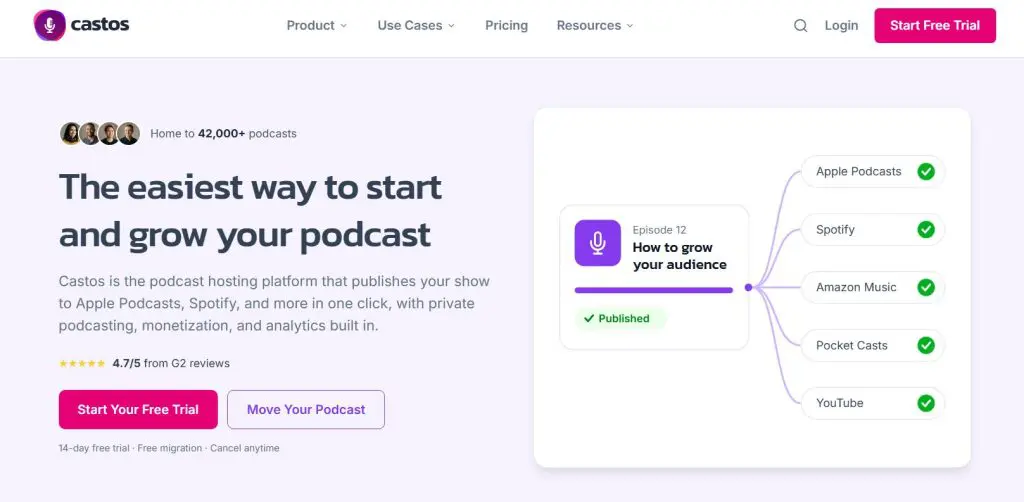
Castos is a podcast hosting platform that stores your audio, creates your RSS feed, and distributes your show to Apple Podcasts, Spotify, Amazon Music, and other apps.
Its specialty is private podcasting, which limits episodes to listeners you approve. Castos is built for course creators, membership sites, coaches, companies, and WordPress publishers.
In practice, you create a show in the Castos dashboard or in WordPress, upload an episode, and publish once. Castos then sends it to every directory, your podcast website, and your YouTube channel if you connect one.
For a private show, each listener gets a personal feed. Castos adds or removes listeners as payments start or stop in Stripe, Kit, or your membership plugin.
Castos is not an editing suite or a course platform. Recording, editing, and course sales happen in other tools, at least until Castos Studio leaves beta. Castos delivers the audio.
The Main Features in Castos
- Sell audio as a product with private feeds you can switch off for any listener in one click
- Mix free and members-only episodes in one show to turn listeners into paying members
- Publish and manage episodes from your own WordPress site with the free Seriously Simple Podcasting plugin
- Run as many shows as you need from one account, each with its own feed, website, and analytics
- Reach YouTube viewers automatically by republishing each new episode as a video
- Make episodes searchable and accessible with transcripts in 19 languages
- Get titles, show notes, and social posts drafted from each transcript with the AI Assistant
- Earn from ads stitched into your whole back catalog with no minimum audience
- Trust your numbers with IAB v2 compliant analytics that filter out bots and repeat downloads
| Castos is | Castos is not |
|---|---|
| A podcast host that stores files and builds your RSS feed | A full recording and editing suite like Riverside or Descript |
| A private podcasting platform with revocable feeds | A course platform like Thinkific or Kajabi |
| A WordPress podcast publishing system | A live streaming or webinar tool |
| A distribution hub for directories and YouTube | A video-first host for YouTube creators |
Castos Pricing & Free Trial | How Much Does It Cost?
Castos has four plans, and annual billing gives two months free. I’d start most edupreneurs on Growth, since it adds the onboarding call, the listener app, YouTube republishing, a custom domain, and five team seats. Prices below come from the Castos pricing page.
| Plan | Billed monthly | Billed annually (per month) |
|---|---|---|
| Essentials | $19 | $16 |
| Growth | $49 | $41 |
| Pro | $99 | $83 |
| Castos Premium | $499 | $416 |
| Feature | Essentials | Growth | Pro | Castos Premium |
|---|---|---|---|---|
| Hosting and publishing | ||||
| Podcasts, episodes, and downloads | Unlimited | Unlimited | Unlimited | Unlimited |
| Directory distribution and podcast website | ✓ | ✓ | ✓ | ✓ |
| Seriously Simple Podcasting WordPress plugin | ✓ | ✓ | ✓ | ✓ |
| Custom website domain | ✗ | ✓ | ✓ | ✓ |
| Free migration and migration help | ✓ | ✓ | ✓ | ✓ |
| Private podcasting | ||||
| Private subscribers | 100 | 250 | 500 | Custom |
| Mobile app for private listeners | ✗ | ✓ | ✓ | ✓ |
| Single sign-on | ✗ | ✗ | ✗ | ✓ |
| Content and growth | ||||
| Transcript credits a month | 10 | 25 | 100 | Unlimited |
| AI Assistant | $10 a month add-on | $10 a month add-on | $10 a month add-on | $10 a month add-on |
| YouTube republishing | ✗ | ✓ | ✓ | ✓ |
| Headliner audiogram integration | ✗ | ✓ | ✓ | ✓ |
| Video file hosting | ✗ | ✗ | ✓ | ✓ |
| Castos Ads and listener donations | ✓ | ✓ | ✓ | ✓ |
| Analytics | ||||
| Listener analytics | ✓ | ✓ | ✓ | ✓ |
| Advanced analytics and custom reports | ✗ | ✓ | ✓ | ✓ |
| Team and support | ||||
| Team members | 1 | Up to 5 | Up to 10 | Unlimited |
| 1:1 onboarding call | ✗ | ✓ | ✓ | ✓ |
| Priority support | ✗ | ✗ | ✓ | ✓ |
| 100% uptime SLA | ✗ | ✗ | ✓ | ✓ |
| Pay by invoice or check | ✗ | ✗ | ✓ | ✓ |
| Dedicated account manager and custom contracts | ✗ | ✗ | ✗ | ✓ |
Two add-ons work on any plan. The AI Assistant costs $10 a month, and Pro users can add 500 more private subscribers for $50 a month per batch.
Castos Features: What Works and What Doesn’t
Castos competes mainly with Buzzsprout, Transistor, and Captivate. The company is best known for private podcasting and WordPress integration. Here is a summary of each feature before the detailed sections.
| Feature | What it does | Limitations |
|---|---|---|
| Private podcasting | Gives each approved listener a personal feed you can revoke | No Spotify support, and shared feeds can’t be revoked per person |
| Hybrid podcasting | Mixes public and members-only episodes in one show | Setup details for locked episodes vary by listening app |
| Seriously Simple Podcasting | Publishes and manages episodes from WordPress | Adds plugin maintenance and theme conflicts to your workload |
| Hosting and distribution | Stores unlimited episodes and submits shows to major directories | No live streaming or live podcasting |
| Podcast websites | Builds a site per show with episode, about, and subscribe pages | Few themes and limited layout control |
| Analytics | Reports filtered listens, unique listeners, apps, and locations | No per-subscriber listening data for private shows |
| YouTube republishing | Turns each public episode into a YouTube video automatically | Videos show a static image, not real footage |
| Transcripts | Transcribes episodes in 19 languages and adds chapters | Monthly credit limits and PDF-only downloads |
| AI Assistant | Drafts titles, show notes, and social posts from the transcript | No tone or style controls |
| Ads and donations | Inserts ads across your catalog and collects listener support | Ad payout rates aren’t published |
| Castos Studio | Records and edits up to four people in the browser | Invite-only private beta |
Feature #1: Private Podcasting
Private podcasting is the reason to choose Castos. After you mark a show as private and add listeners by email, by hand or through an integration, each person receives an invitation with a feed link that works only for them. According to Castos’s private podcasting documentation, you can revoke any single feed without touching anyone else’s.
The integrations decide how much work this takes. Stripe and Kit can add and remove listeners automatically, so a new payment or a tag in Kit grants access and a cancellation removes it. On WordPress, the plugin connects to MemberPress, Paid Memberships Pro, WooCommerce Memberships, and LifterLMS. Zapier covers most other tools, including MemberSpace.
Listeners add their link to Apple Podcasts, Overcast, Pocket Casts, or Castro, or sign in to the Castos mobile app with their email. The app option matters more than it sounds, because many members struggle to paste a feed URL into a podcast app.
Two limits shape how you set this up. Spotify doesn’t support private feeds, so Spotify-only listeners need another app. And Castos also offers a single shared feed for a whole group, which is easier to send but can’t be revoked person by person, so use individual feeds for anything people pay for. My guide to membership site platforms covers the paywall side.
Feature #2: Hybrid Podcasting
Hybrid podcasting puts free and paid episodes in one show. Instead of running a public podcast and a separate private one, you decide episode by episode who has access. Paying listeners can get early access, the full back catalog, or bonus episodes, while everyone else hears the public episodes.
For an edupreneur, this is the most practical way to turn a free podcast into a product. A course creator might publish weekly public episodes that teach one idea each, then offer members the extended version with worksheets and Q&A. Castos also supports Apple Podcasts Subscriptions, so listeners can pay inside the Apple app.
The limitation is clarity for the listener. Castos documents the concept well but says little about how locked episodes appear in each app, so test the experience on an iPhone and an Android phone before you announce it.
Feature #3: Seriously Simple Podcasting for WordPress
Castos makes the free Seriously Simple Podcasting plugin, which Castos says runs on more than 30,000 WordPress sites. The plugin adds a podcast post type, so each episode becomes a page on your site with the player built in. Show notes, audio uploads, and publishing all happen in the WordPress editor. Each episode then syncs to Castos and the directories.
Keeping episodes on your own WordPress website puts your show notes and transcripts on your domain, where they can rank in search and link to your courses. The plugin also connects private feeds to WordPress membership plugins, which no other major host offers as directly.
The catch is maintenance. Plugin updates, caching, and theme quirks can affect how episodes and players display, leaving you to troubleshoot them yourself. If your site isn’t on WordPress, this feature adds nothing.
Feature #4: Hosting, Distribution, and Podcast Websites
Castos stores unlimited shows, episodes, and downloads, so long educational episodes and big back catalogs never hit a cap. One click submits your show to every major directory, including Pocket Casts. After that, each new episode reaches them automatically. Moving from Libsyn, Buzzsprout, Transistor, Podbean, Simplecast, or SoundCloud takes a one-click import.
Distribution now has to include video platforms. According to Nielsen, podcasts took 20% of Americans’ ad-supported audio listening time in the third quarter of 2025, and my roundup of podcast statistics shows how quickly YouTube has grown as a place to watch podcasts.

Each show also gets a website with an episode archive, host profiles, an about page, a subscribe page, and an embeddable player, plus Google Analytics support. The site is functional but plain, with a few themes, fonts, and colors to pick from. Reviewers on Trustpilot mention limited customization, so plan on WordPress or your own site if design matters. Castos also has no live streaming, so use a separate tool if you want to stream live.
Feature #5: Podcast Analytics
Castos analytics show total listens, unique listeners, locations down to the city, and the apps people use, along with Spotify streams next to download numbers. Followers, meaning people who receive each new episode within 48 hours, help you see whether your audience is growing or only sampling.

The numbers are conservative by design. Castos’s analytics documentation says its IAB v2 compliant counting removes bots and data center traffic, counts a play only after about one minute of audio, and counts repeat downloads from the same listener on the same day once. Expect lower totals than a host with looser rules, and compare hosts on the same standard.
Sponsor-ready PDF reports and CSV exports help when you pitch a sponsor or report to a client. The gap is private shows. Castos doesn’t show which subscribers listen, so if you run a paid audio course, you can’t see who has fallen behind.
Feature #6: YouTube Republishing
YouTube republishing turns each new public episode into a video and posts it to your YouTube channel shortly after it goes live. Setup takes one channel connection, then a choice of shows, a playlist, and either your episode artwork or one background image. Chapter timestamps from your transcript go into the video description.

Republishing gets your back catalog in front of YouTube’s search audience with no editing. The result, though, is audio over a still image, and viewers who watch podcasts on YouTube expect to see the hosts. Private and members-only episodes never go to YouTube, which protects paid content.
If video is central to your growth, record real video with Descript or a similar tool and upload it to YouTube directly. My guide to repurposing podcasts covers clips and other formats.
Feature #7: Transcripts
Castos transcribes episodes automatically in 19 languages when you save, schedule, or publish. On-demand transcription covers older episodes too. Transcripts can appear on the episode page, download as PDFs, and generate chapters without extra cost.
Transcripts do two jobs for an edupreneur. They make episodes accessible to people who read rather than listen. They also give search engines and AI tools text to index, which helps your show notes rank.
Castos says nothing about editing transcripts or labeling speakers, and PDF is the only download format it names. If you need clean, speaker-labeled transcripts for a course, run the audio through a dedicated editor as well.
Feature #8: The Castos AI Assistant
The AI Assistant turns each episode’s transcript into publishing copy. According to Castos’s AI Assistant page, it drafts three title options in curiosity-driven, value-driven, and bold styles, a show notes summary with the key points and resources you mentioned, and short, medium, and long social posts.
In practice, this removes the writing that piles up after recording. Once the transcript finishes, you pick a title, apply it and the show notes with one click, and copy the posts into your social channels. The assistant can run automatically on every new episode or only on the ones you choose. For a weekly show, that turns most post-production writing into an editing job.
The value is speed, while the risk is drafts that sound like everyone else’s. Castos describes no tone or style settings, so drafts won’t sound like you until you edit them. Applying the summary also replaces your existing show notes. The assistant also depends on transcripts, so each episode uses a transcript credit and an AI credit. Treat the drafts as a first pass and spend your time on the judgment calls, such as which idea to lead with and which course to mention. My list of ChatGPT prompts for course creators covers how to get similar drafts from a general AI tool.
Feature #9: Ads and Listener Donations
Castos Ads inserts one short pre-roll and one post-roll ad into every episode, including your back catalog, after you switch it on in the dashboard. Castos sets no minimum audience, pays per listen at the end of each month, and lets you pause ads anytime.

Castos Commerce collects one-time or recurring donations through a checkout page on your podcast website. Castos takes no cut, and Stripe charges its standard 2.9% plus 30 cents.
Ads and donations suit hobby and audience-building shows more than education businesses. Castos doesn’t publish its ad rates, and automatic ads add about a minute to each episode, which may clash with a premium brand. For most edupreneurs, private feeds earn more than ads or donations. According to Kajabi’s creator commerce data, cited in my eLearning statistics roundup, podcast revenue among Kajabi creators grew 47%. My guide on how to monetize a podcast covers the other options.
Feature #10: Castos Studio, Migration, and Support
Castos Studio is a browser-based recording and editing tool inside Castos. Up to four people record on separate tracks, guests join from a link with no download, and a green room checks mics and cameras first. Editing happens in the transcript, with noise cleanup and loudness leveling on export. Studio is in invite-only private beta, so don’t choose Castos for it yet. Until it opens, my list of the best podcast recording and editing software covers proven options.
Support is a strength. Castos runs a weekly live “Getting Started With Castos” call for new users, and reviewers on Trustpilot praise how responsive the team is. Castos holds only about two dozen reviews there, though, which is a thin record for a host of its size.
Castos vs. the Best Alternatives for Podcast Hosting
Castos competes most directly with the hosts below. My full guide to the best podcast hosting platforms compares them in more depth.
| Platform | Best for | Starting price | How it compares with Castos |
|---|---|---|---|
| Castos | Private and WordPress podcasts | $19/mo | Strongest private feeds and WordPress plugin |
| Buzzsprout | Beginners with one public show | Free plan, paid from $18/mo | Easier setup, limited by upload hours. See my Buzzsprout review |
| Transistor | Several shows or client podcasts | $19/mo | Similar prices, priced by downloads with private feeds included |
| Captivate | Marketers growing a public show | $19/mo | Every feature on every plan, priced by downloads |
| Podbean | Low-cost hosting with built-in monetization | Free plan, paid from $17/mo | Cheaper, with less WordPress depth. See my Podbean review |
| Spotify for Creators | Hobby shows on a zero budget | Free | No private feeds or WordPress tools |
Choose Castos over these when private feeds or WordPress publishing matter to you. Otherwise, the cheaper or simpler options cover a public show equally well.
Castos Pros and Cons
These points come from Castos’s billing terms and support documentation. They cover day-to-day issues the feature sections don’t.
| Pros | Cons |
|---|---|
| Each show in one account gets its own feed, website, and analytics, so you can test a new show without a new bill | Going over your private subscriber limit moves you to the next plan automatically, so a growing membership can raise your bill without warning |
| Upgrades and downgrades happen in the dashboard, with no sales call needed | Cancelling takes your feed and episodes offline, so redirect your feed to a new host before you leave |
| Castos offers discounts for nonprofits and religious organizations on request | The free trial requires a card, and Castos charges it automatically after 14 days |
| Annual plans can be paid by invoice or purchase order, which helps company buyers | Castos’s pricing page and FAQ list different plans for invoice billing, so confirm before you buy |
| Triple-redundant backups and a global CDN protect your episodes and keep downloads fast | The AI Assistant and transcripts share episode credits, so a daily show can run out mid-month |
Is Castos The Best Podcast Hosting Platform for Edupreneurs?
Yes, if private podcasting is part of your plan. Castos gives you revocable feeds, a listening app, and direct links to Stripe, Kit, and WordPress membership plugins at a price small creators can afford. Together, those tools turn audio into a product you can sell.
The strongest cases are audio companions to online courses, bonus episodes inside a membership, private audio for coaching clients, and training podcasts inside organizations. I covered why podcasting suits learning businesses in episode 30 of the Leading Learning Podcast, and private feeds make that opportunity easier to monetize.
Castos is not the best value for a single public show, where Buzzsprout is simpler, or for agencies running many client shows, where Transistor fits better. If your growth depends on YouTube video, publish video there directly and choose a cheaper audio host.
Should You Choose Castos?
If you’ve decided to try Castos, start the free trial on Growth. Set up one private test feed, connect it to Stripe, Kit, or your membership plugin, and add yourself as a listener to check the experience on your phone before you invite anyone else. If you’re still planning your show, my guides on how to start a podcast, write a podcast script, and market a podcast will help.
If Castos isn’t the right fit, decide first whether you need private feeds at all. If you don’t, compare Buzzsprout, Transistor, and Captivate in my podcast hosting guide and choose on price and ease of use.
Frequently Asked Questions (FAQs)
Does Castos have a free plan?
No. Castos has no free plan, but every paid plan starts with a 14-day free trial. The trial requires a card, which Castos charges when the trial ends unless you cancel. For free hosting, Spotify for Creators and Buzzsprout’s free plan are the main options.
What happens to my podcast if I cancel Castos?
Cancelling Castos makes your RSS feed and episodes unavailable to listeners. Before you cancel, move your show to a new host and set up a feed redirect, so apps keep delivering episodes. Castos says you can reopen an account later by contacting its support team.
How do I move my podcast to Castos?
Castos includes free one-click migration and personalized migration help on every plan. Castos imports episodes from hosts such as Libsyn, Buzzsprout, Transistor, Podbean, Simplecast, and SoundCloud, and a feed redirect keeps your existing subscribers without asking them to resubscribe in their podcast apps.
Can private podcast subscribers listen on Spotify?
No. Spotify doesn’t support private feeds, so subscribers need another app. They can add their private feed link to Apple Podcasts, Overcast, Pocket Casts, or Castro, or use the Castos mobile app on Growth and higher plans, which signs them in by email.
Can I run multiple podcasts on one Castos account?
Yes, all Castos plans allow unlimited podcasts, episodes, and downloads. Each show gets its own RSS feed, podcast website, and analytics, so you can run a public show and a private members-only show from one account without paying extra for the second show.
Does Castos support video podcasts?
Castos hosts video files only on the Pro plan and higher. The Growth plan can republish audio episodes to YouTube as videos with a still image, but it doesn’t host your own video recordings. Video-first creators usually do better publishing directly to YouTube.
What happens if I go over my private subscriber limit?
Castos moves you to the next plan automatically when you pass your private subscriber limit of 100, 250, or 500. Pro users can instead add batches of 500 subscribers for $50 a month each. Larger organizations can ask about Castos Premium for custom limits.
Does Castos work without WordPress?
Yes. Castos works as a standalone host with its own dashboard, podcast websites, and directory distribution. The Seriously Simple Podcasting plugin is optional and only adds value if you want to publish episodes and manage private feeds from a WordPress site.

Jeff Cobb, Founder of Learning Revolution
Jeff Cobb is an expert in online education and the business of adult lifelong learning. Over the past 20+ years he has built a thriving career based on that expertise – as an entrepreneur, a consultant, an author, and a speaker. Learning Revolution is a place where Jeff curates tips, insights, and resources to help you build a thriving expertise-based business. Learn more about Jeff Cobb here.
Table of Contents