

TL;DR: Podia Blogging Review (2026)
Podia Blogging lets you publish a blog on the same site where you sell your courses, so every post can link straight to a sales page, a lead magnet, or your email list.
What it can do
– Grow your school’s search footprint and build topical relevance around your course
– Send any post to your list as a newsletter in one click
– Keep giving course buyers fresh value after they finish
– Capture leads with sign-up forms and free downloads
– Import posts from WordPress, Substack, or Squarespace
What it can’t do
– Replace WordPress for a content-led business
– Give you plugins, schema control, or deep SEO settings
– Rank generic, AI-written keyword posts in today’s search results
My take: Treat Podia Blogging as a useful add-on for course marketing, not a reason to choose Podia. Fill it with your own insights, data, and opinions, or it won’t move the needle.
Included with: Every Podia plan, from Mover at $42/month billed annually.
Try Podia free (14-day free trial)
Most course creators treat their course site as a store. Visitors land on a sales page, buy or leave, and the site does nothing else for the business. The approach works only as long as you keep paying for traffic or keep posting on social media.
A blog on the same site changes that.
Every useful post gives search engines, AI search tools, and readers another reason to find your school, and every post can point to the course that goes deeper. Podia added blogging to give its creators exactly that option.
In this review, I’ll explain why content still matters for a course business, what Podia Blogging can do, and the kind of content that works in search today.
For the full platform picture, read my Podia review.
Why a Course Business Needs SEO and Content Marketing
A course sales page can rank for a handful of searches at best. Search engines and AI assistants look for sites that cover a subject in depth. Content gives your school that depth.
I see three jobs for content in a course business.
- Bring in new buyers: People search for help with the problem your course solves long before they search for a course. A post that answers one of those questions puts your expertise in front of them at the right moment.
- Build topical relevance: A cluster of posts around your course topic tells search engines that your site knows the subject, which helps both the posts and your course pages show up for related searches.
- Keep buyers engaged: Course content ages. Posts on new tools, new research, or new examples keep giving past students value, bring them back to your site, and set up your next offer.
Content also feeds the rest of your marketing. A good post becomes a newsletter, a social post, a community discussion, and a lead magnet.
In my value ramp approach, free content sits at the bottom of the ramp and builds the trust that later turns readers into students. My guide to the content marketing funnel covers that path in more detail.
What Is Podia Blogging?
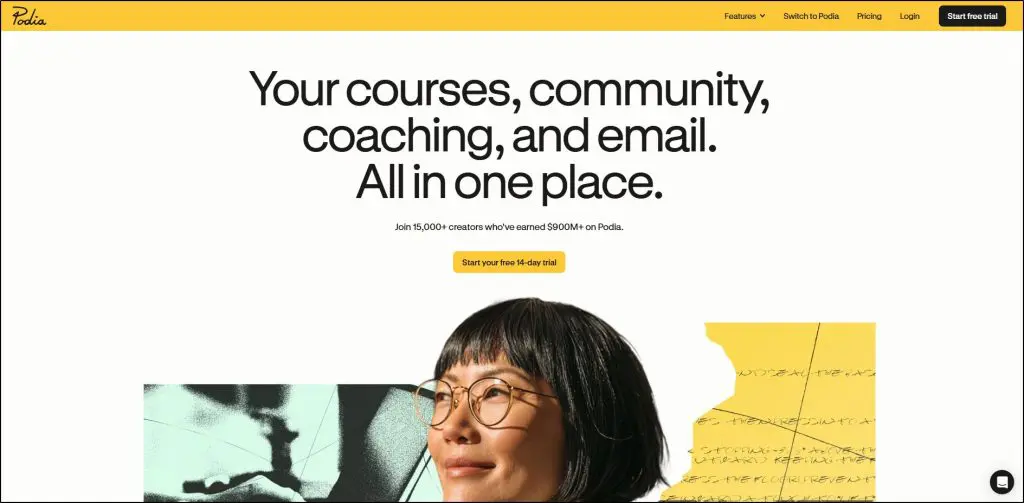
Podia Blogging is the blog built into Podia, the all-in-one platform for selling courses, digital downloads, coaching, events, and community memberships. The blog lives on the same domain as your products, uses the same design settings, and connects to the same email list and checkout.
Before Podia added a blog, creators had to fake one with a free course, custom pages, or public community posts, or run a separate WordPress or Squarespace site. Now every Podia plan includes a proper blog with SEO settings, scheduling, and one-click email publishing.
The feature fits Podia’s broader idea. Podia wants your website, products, email, and community to run as one connected business, and the blog adds the piece that brings strangers in from search.

Podia Blogging Features at a Glance
Here’s what Podia Blogging includes, what each feature does, and where it stops short.
| Feature | What it does | Limitation |
|---|---|---|
| Rich-text editor with slash menu | Type or paste content, then add headings, lists, quotes, code blocks, files, embeds, buttons, and dividers | No table block or advanced layout blocks |
| Images and embeds | Add images and embed video, audio, forms, and posts from over 1,900 supported platforms | Embeds depend on the outside service staying available |
| SEO title and meta description | Set the title and description that appear in search results for each post | No schema, canonical, or redirect settings in the feature list |
| Custom URL slug | Edit the URL of each post | Changing a live slug has no built-in redirect manager |
| Search visibility toggle | Choose whether each post appears in search results | Per-post only, with no bulk controls |
| Scheduled publishing | Set a future date and time for a post to go live | No editorial calendar view |
| Publish-to-email | Send any new post to your list as a newsletter in one click | Email limits from your Podia plan still apply |
| Blog page customization | Set colors, fonts, content width, and text size to match your brand | No custom post templates |
| Blog importer | Bring posts from WordPress, Substack, Squarespace, and other platforms | Check formatting and links on every imported post |
| Google Analytics | Track traffic, sources, and conversions across your Podia site | No blog-specific analytics inside Podia |
What You Can Do With Podia Blogging
Let me show you what Podia’s Blog feature actually offers.
Grow Your School’s Search Footprint
A Podia site without a blog usually has a homepage, a few sales pages, and a checkout. Search engines have little to index and little reason to send visitors. Every useful post adds a new page that can rank for a question your audience asks.
Pick the questions people ask before they’re ready to buy your course. A course on Lightroom editing for wedding photographers could support posts on culling a 2,000-photo wedding, building a consistent editing style, or pricing editing as an add-on. Each post solves one problem and points to the course for the full system.
Build Topical Relevance Around Your Course
One post rarely moves your rankings. A group of posts that covers your course topic from several angles does far more, because it shows search engines and AI tools that your site owns the subject.
Plan your blog around your course outline. Each module can inspire two or three posts that teach one idea in depth, and each post links back to the course page and to related posts. Over time, the cluster supports your sales page as much as it supports itself.
| Post type | Example for a course business | Why it helps |
|---|---|---|
| Problem-solving how-to | How to cull 2,000 wedding photos in an afternoon | Matches a real search and leads naturally to the course |
| Original data post | What 400 of my students say slows down their editing | Gives search engines and AI tools something no other site has |
| Strong opinion post | Why I stopped teaching presets to beginners | Shows your point of view and attracts people who share it |
| Student result story | How one student cut her editing time by half | Proves the course works, with permission from the student |
| Update post | What changed in Lightroom this year and what to do about it | Keeps past buyers engaged and gives you a reason to email |
| Repurposed video or podcast | A written guide built around your latest YouTube video | Gives content you already made another way to reach searchers |
Keep Giving Value to Your Course Buyers
Course buyers want to know their purchase stays current. Regular posts on new tools, new examples, and answers to common student questions show that you’re still in the field and still teaching.
Send those posts to your students with Podia’s publish-to-email feature, and link them from your community. A student who keeps getting useful posts stays engaged, recommends you to others, and is far more likely to buy your next course or coaching offer.
Turn Every Post Into a Newsletter
Publish-to-email sends any new post to your subscribers as a newsletter in one click. Writing once and using it twice keeps a weekly or biweekly publishing schedule realistic for a solo creator.
Segment the send when it makes sense. A post on an advanced technique could go to past buyers only, while a beginner post goes to new subscribers. My guide to Podia Email covers segmentation and sequences in detail.
Capture Leads From Search Traffic
Search visitors rarely buy on their first visit, so every post needs a next step. Add a sign-up form or a free lead magnet, such as a checklist or template, that fits the post’s topic. Podia sells and gives away digital downloads from the same dashboard.
Podia delivers free downloads by email, so a reader can grab the resource and land on your list in one step. My list of lead magnet ideas and my guide on how to build an email list can help you choose the right offer.
Repurpose Video, Podcast, and Community Content
Podia supports embeds from over 1,900 platforms, including YouTube, Loom, Spotify, and Typeform. Embed a video or podcast episode, then write the post around it with your key points, examples, and a clear takeaway.
Podia communities also give you topic ideas. When the same question keeps coming up in your Podia community, answer it in a post, then share the link in the thread. The post helps the member today and every searcher after them.
Move an Existing Blog to Podia
Podia’s blog importer brings posts over from WordPress, Substack, Squarespace, and other platforms. Podia also offers free migrations for products and customers. Before you switch a blog with real search traffic, list every old URL and plan where it will point, since losing those URLs can cost you rankings you spent years building.
The Content That Works in Search Now
Podia gives you the tools to publish but it can’t make the content worth reading.
The old playbook was simple.
Find keywords, write a post for each one, cover every subtopic a competitor covered, and publish as often as possible. AI tools made that playbook cheap, and search engines and readers have caught on.
Google’s own guidance on helpful content asks whether content offers original information, research, or analysis, and whether it shows first-hand experience.
Google also warns against publishing lots of content on many topics in the hope that some of it ranks. In March 2024, Google announced it would treat content produced at scale to boost rankings as spam, whether people or automation produced it.
AI search raises the bar further.
AI Overviews and chat assistants already answer generic questions without a click. A post that repeats what every other site says gives them no reason to cite you and gives readers no reason to visit.
| Old keyword playbook | What works now |
|---|---|
| One post per keyword, written to match competitors | Fewer posts, each with something only you can say |
| AI drafts with light editing | Your experience, examples, and opinions, with AI as a helper at most |
| Summaries of other people’s research | Your own data from students, customers, or surveys |
| Neutral, cover-everything tone | A clear position readers can agree or argue with |
| Publishing volume as the goal | Topical depth around your course as the goal |
As a course creator, you have an advantage here. Most creators already sit on material no other site has.
- Student questions and results: What your students struggle with, where they get stuck, and what changes once they finish.
- Your own data: Quiz results, course completion patterns, or a short survey of your list, shared without naming individuals.
- Your methods: The framework, process, or checklist you teach, explained well enough to help but not so fully that the course becomes unnecessary.
- Your opinions: The common advice in your field you disagree with, and why.
Podia helps you dig this material out. Student progress and quiz scores show where learners struggle, and email analytics show which topics your list cares about. Podia Agent answers questions about what’s selling and who bought, and your community shows the questions people ask in their own words. Build your posts from those signals, not from a keyword tool alone.
Podia Blogging Limitations
Podia Blogging covers the basics well, but it’s a blog inside a sales platform, not a content management system. Know these limits before you plan a content strategy around it.
- Limited SEO control: Podia gives you titles, meta descriptions, slugs, and a search visibility toggle. Its feature list includes no schema markup settings, canonical tags, or redirect manager.
- No plugin ecosystem: WordPress plugins for SEO, internal linking, tables of contents, or calculators have no Podia equivalent. Third-party code snippets and embeds cover only part of that gap.
- No categories or tags listed: Podia’s blog feature list doesn’t include categories, tags, or topic hubs, which makes organizing a large library harder.
- Basic analytics: Blog performance tracking relies on Google Analytics. Podia shows no post-level traffic inside the dashboard.
- Simple layouts: The editor handles text, images, embeds, and buttons, but it has no table block or advanced layouts, so comparison posts and data-heavy posts take workarounds.
- Platform lock-in: The blog lives on Podia. If you ever leave, moving posts and preserving their URLs takes planning, so keep copies of your content.
For a creator who publishes a few strong posts a month to support a course, none of these limits stops the strategy. For a business that grows mainly through search, they add up quickly.
Podia Blogging vs WordPress
Here’s my position. Podia Blogging doesn’t replace WordPress, and you shouldn’t choose Podia because of its blog. Choose Podia for its courses, community, email, and checkout, and treat the blog as a useful add-on for course marketing.
| Your situation | Podia Blogging | WordPress |
|---|---|---|
| Your course is the business and content supports it | Good fit, with everything on one domain and one bill | More setup than you need |
| Search is your main growth channel | Too limited for a large content library | Better fit, with full SEO control and plugins |
| You publish a few posts a month | Easy to keep up with, especially with publish-to-email | Works, but adds hosting and maintenance |
| You need schema, redirects, and internal linking tools | Not available | Available through plugins |
| You want calculators, tools, or interactive content | Embeds only | Full control with custom code and plugins |
| You want no technical maintenance | No updates, hosting, or security to manage | You handle hosting, updates, and backups |
Many established creators run both. A WordPress site handles the blog and search traffic, and Podia handles courses, community, and checkout, with Podia sign-up forms embedded on the WordPress site. My guide on how to create a WordPress website covers the WordPress side.
If you’re still choosing a course platform, my roundup of the best online course platforms and comparisons of Podia vs Thinkific and Podia vs Kajabi show how Podia stacks up beyond the blog.
Podia Pricing Plans
Blogging comes with every Podia plan at no extra cost, with unlimited posts and your own domain. The plans differ in transaction fees, email subscriber limits, products, and community spaces, and Mover shows Podia branding on your site.
| Plan | Billed monthly | Billed annually (per month) | Transaction fee | Key limits |
|---|---|---|---|---|
| Mover | $49 | $42 | 5% | 100 subscribers, 50 products, 25 spaces |
| Shaker | $99 | $84 | 0% | 500 subscribers, 150 products, 100 spaces |
| Earthquaker | $179 | $150 | 0% | 1,000 subscribers, unlimited products and spaces |
| Feature | Mover | Shaker | Earthquaker |
|---|---|---|---|
| Transaction fee | 5% | 0% | 0% |
| Email subscribers at base price | 100 | 500 | 1,000 |
| Customers | Unlimited | Unlimited | Unlimited |
| Products | 50 | 150 | Unlimited |
| Videos | 500 | 1,000 | Unlimited |
| Community spaces | 25 | 100 | Unlimited |
| Assistants (team seats) | 0 | 1 | Unlimited |
| Affiliate marketing | ✗ | ✓ | ✓ |
| Upsells | ✗ | ✓ | ✓ |
| PayPal | ✗ | ✓ | ✓ |
| Zapier | ✗ | ✓ | ✓ |
| Included on every plan | |||
| Courses, downloads, coaching, events | ✓ | ✓ | ✓ |
| Website, blog, custom domain | ✓ | ✓ | ✓ |
| Sales tax handling (230 countries) | ✓ | ✓ | ✓ |
| Email & chat support | ✓ | ✓ | ✓ |
For a course business that plans to send posts by email, the subscriber limit matters most. Mover includes 100 subscribers, Shaker 500, and Earthquaker 1,000, with a paid add-on beyond that. To compare plans at your sales volume, use the calculator in my Podia pricing guide.
Is Podia Blogging Worth Using?
Yes, if you already sell on Podia or plan to. A blog on the same domain as your courses grows your search footprint, builds topical relevance around what you teach, and gives your buyers a steady reason to come back. Publish-to-email turns each post into a newsletter, so the effort pays off twice.
The feature only works if the content does. Posts built from your student questions, your data, and your opinions can earn search traffic and AI citations. Generic posts written to match keywords won’t, no matter which platform publishes them.
Don’t pick Podia for its blog, and don’t move a search-driven content business off WordPress to use it. For a course creator who wants a few strong posts a month to support a course, though, Podia Blogging does the job with almost no setup.
Podia Blogging FAQs
Does Podia have a blog?
Yes. Every Podia plan includes a built-in blog with a rich-text editor, embeds, SEO titles and meta descriptions, custom URLs, scheduled publishing, and one-click publishing to email. The blog lives on the same domain as your courses and products, so every post can link directly to a sales page or sign-up form.
Is Podia Blogging free?
Podia Blogging comes with every paid Podia plan at no extra cost, with unlimited posts and your own custom domain. Podia no longer offers a free plan, so you need a paid plan after the free trial. Sending posts by email counts toward your plan’s email subscriber limit.
Is Podia good for SEO?
Podia covers the SEO basics, including titles, meta descriptions, custom URLs, a search visibility toggle, and Google Analytics. Its feature list includes no schema markup, canonical tags, or redirect manager. Those basics work for a course site that publishes a few strong posts a month, but search-led businesses need WordPress.
Can Podia replace WordPress for blogging?
Not for a business that grows mainly through search. WordPress offers plugins, schema control, redirects, categories, and custom tools that Podia lacks. Podia Blogging works best as an add-on to course marketing. Many creators run a WordPress blog and use Podia for courses, community, and checkout.
Can I import my WordPress blog into Podia?
Yes. Podia’s blog importer brings posts over from WordPress, Substack, Squarespace, and other platforms. Check formatting and links on every imported post, and plan where each old URL will point before you switch domains. Losing old URLs can cost you rankings built over years.
Can I send Podia blog posts as newsletters?
Yes. Podia’s publish-to-email feature sends any new post to your email subscribers as a newsletter in one click. Writing once and using the post twice makes a regular publishing schedule realistic for solo creators. Each send counts toward your plan’s email subscriber limit.
Can I use AI to write Podia blog posts?
AI works as a helper, but AI-written posts built to match keywords rarely rank now. Google’s guidance favors original information and first-hand experience. Use AI to outline or edit, and fill the post with your own student questions, data, examples, and opinions.
What should a course creator blog about?
Blog about the problems your course solves, one question per post. Add original data from your students or surveys, strong opinions on common advice in your field, student result stories shared with permission, and updates that keep past buyers current. Link each post to your course and a related lead magnet.
Does Podia Blogging support categories and comments?
Podia’s blog feature list doesn’t include categories, tags, or blog comments. Readers can join your Podia community for discussion, and you can link related posts manually to organize your library. For a large library that needs categories and topic hubs, WordPress is the better choice.

Jeff Cobb, Founder of Learning Revolution
Jeff Cobb is an expert in online education and the business of adult lifelong learning. Over the past 20+ years he has built a thriving career based on that expertise – as an entrepreneur, a consultant, an author, and a speaker. Learning Revolution is a place where Jeff curates tips, insights, and resources to help you build a thriving expertise-based business. Learn more about Jeff Cobb here.
Table of Contents
Related Posts
8 Best Podia Alternatives For Selling Courses, Memberships & Communities
Podia Email Marketing (2026): What Can It Do And What Are Its Limitations
Podia vs Teachable (2026) | Which Platform Is Right For You?