

TL;DR: Teachable Membership Site Review (2026): Is It Good Enough For Recurring Revenue?
Teachable Memberships let you sell monthly or yearly access to bundles of your courses, coaching, and digital downloads in tiers. Setup takes an afternoon, and members manage their own plans. The tools for keeping members engaged are thin, so retention rests on you.
• What you get. Membership tiers with monthly and yearly pricing, free trials of 7, 14, or 30 days, self-serve upgrades and downgrades, a hosted sales page, and a membership dashboard.
• What sets it apart. Your courses, coaching, and downloads already live on Teachable, so a membership is a new way to package them.
• What’s missing. Teachable has closed its Community feature to new schools, and it offers no churn reports, gamification, or content scheduling across a membership.
• Pricing. Teachable has no free plan. Starter costs $29/month, Builder costs $69/month, and Growth costs $139/month on annual billing. Starter adds a 7.5% transaction fee.
• Use it if you sell courses and want to bundle them into a subscription.
• Skip it if community is the heart of your membership.
Try Teachable Memberships For Free
A membership changes the economics of a course business. Instead of selling a course once and looking for the next buyer, you earn every month from the people who stay. The catch is that a membership is a promise of ongoing value, and members cancel the month that promise feels broken.
Teachable added memberships so creators could bundle their existing courses, coaching, and downloads into tiers and sell them on a subscription. Teachable says members have a 43% higher lifetime value than one-time students, which is its own figure.
I’ve used Teachable for years and written plenty about the membership model. In this review, I’ll walk through how a Teachable membership works from setup to renewal, which membership models it suits, and where it falls short.

Teachable Memberships Snapshot (2026)
| What membership owners ask | Teachable’s answer |
|---|---|
| What a tier can include | Published courses, coaching products, and digital downloads, organized into sections |
| Billing | Monthly, yearly, or both, plus free tiers |
| Free trials | 7, 14, or 30 days per tier |
| Upgrades and downgrades | Members switch tiers themselves, with upgrades prorated |
| Community | Closed to new schools. Existing schools can add it to a tier |
| Member experience | A My Membership page, plus iOS and Android student apps |
| Reporting | Total revenue, active members, and average revenue per member |
| Product limits | Memberships don’t count toward your plan’s product limit |
| Starting price | $29/month on annual billing or $39/month paid monthly |
| Free trial | 7-day free trial and a 30-day money-back guarantee |
Quick Verdict | Is Teachable Good For A Membership Site?
Teachable is a good membership platform for course creators. If you already have several courses or a library of downloads, a membership turns them into recurring revenue with little extra work, and Teachable handles billing, tax, and tier changes cleanly.
It’s a weak choice for community-led memberships. New schools can’t add Teachable’s Community feature, so member discussion needs another tool, and that splits your members across two logins. Teachable also offers few tools for engagement or churn, which is where most memberships succeed or fail.
So the question is what members pay for. If they pay for content and access to you, Teachable works. If they pay to belong to a group, look at a community platform first.
What Is A Teachable Membership?
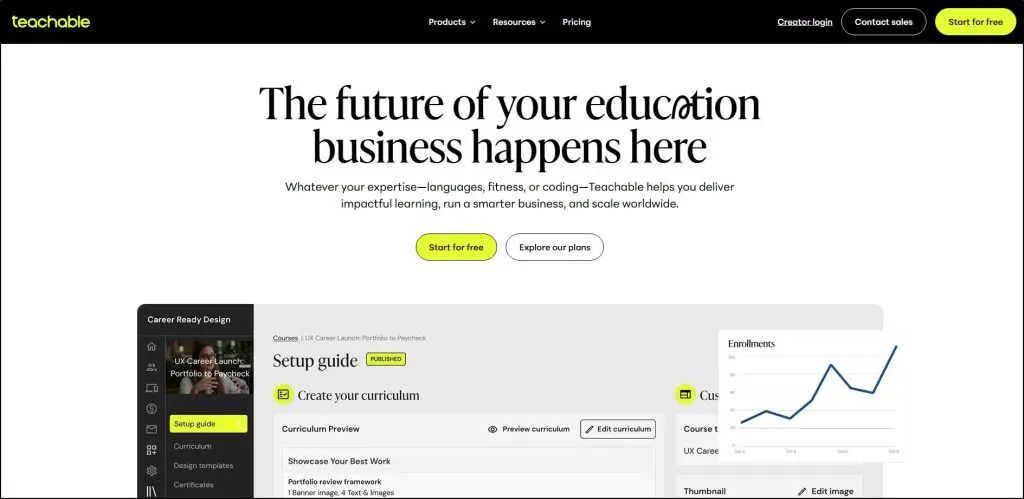
A Teachable membership is a product type that bundles your other products into tiers. Each tier has its own price and its own set of courses, coaching products, and digital downloads. Members pay monthly or yearly and keep access while they pay.
That differs from selling a course in three ways.
- Access instead of ownership: A course buyer keeps the course. A member keeps access only while the subscription runs.
- Recurring revenue: Each member pays every month or year, which makes income more predictable.
- An ongoing promise: Members expect new content, support, or access over time. A membership that never changes loses people.
Memberships and bundles don’t count toward your plan’s product limit. Only the courses, coaching products, and downloads inside them do. For ideas on what to offer, see my list of membership site ideas.
Setting Up A Teachable Membership, Step By Step
Here’s how a two-tier membership comes together, with a basic tier for your course library and a premium tier that adds monthly coaching.
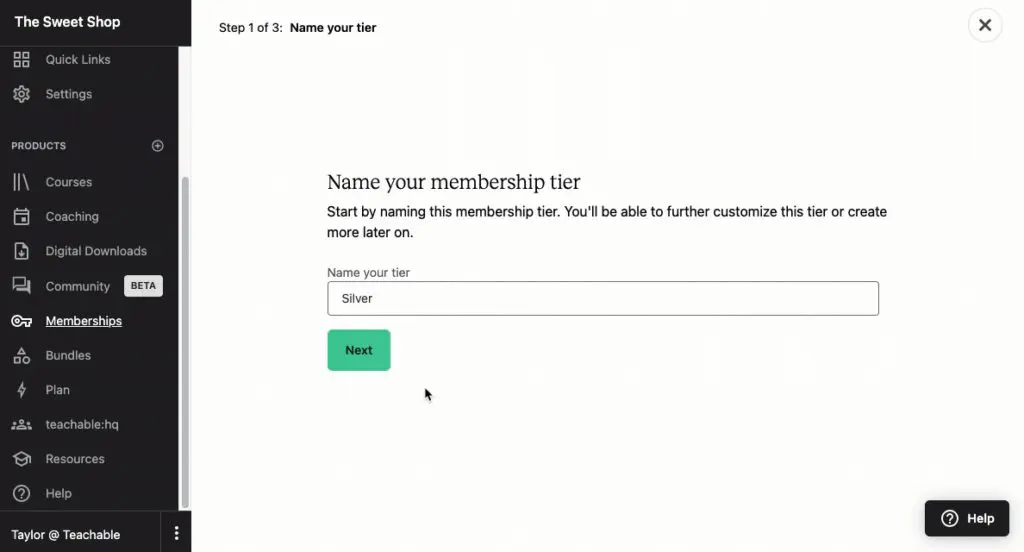
Step 1: Name The First Tier
Open Memberships in your admin panel and create a tier. Give it a clear name that signals what members get, such as “Library” or “Library + Coaching,” rather than “Gold” or “Silver.”
Step 2: Add Products In Sections
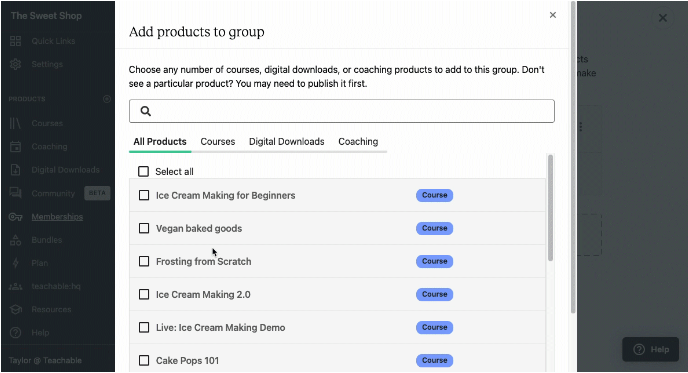
Add published courses, coaching products, and downloads to the tier, grouped into sections such as “Start Here,” “Core Courses,” and “Templates.” Members see these sections on their My Membership page, so the order works as your onboarding path.
Step 3: Set The Price And Trial
Choose a currency and set a monthly price, a yearly price, or both. You can make a tier free or add a free trial of 7, 14, or 30 days. Each pricing option has its own checkout link you can share directly.

Step 4: Publish And Build The Sales Page
Tiers start unpublished and hidden. Publish each tier, then edit the membership sales page with the page editor. A pricing block shows every published tier, and members can switch between monthly and yearly prices on it. Teachable also creates a hosted product page that updates when your membership changes.
Step 5: Add The Premium Tier
Create a second tier with everything in the first plus your coaching product. Teachable’s help center still describes tier limits using its retired plan names, with one tier on the old Basic plan and unlimited tiers on Pro and above. Those plans map to Builder and Growth today, so confirm your tier limit during the trial before you plan several tiers.
What this adds up to. If your courses already exist, you can launch a membership in an afternoon. The harder work is deciding what members get each month after they join.
What Members Experience In Teachable
After buying, a member lands on a My Membership page that shows every product in their tier, grouped by your sections. They can open any course, coaching product, or download from there, on the web or in Teachable’s iOS and Android student apps.
Members also manage their own subscription. In early 2026, Teachable improved this flow. An upgrade takes effect right away, with credit for the unused part of the current billing period. A downgrade takes effect at the end of the period. Members can also switch between monthly and yearly billing on the same tier. Teachable says schools that adopted these changes saw an 11% increase in student lifetime value, again its own figure.
You can check all of this yourself with Preview as Student on any tier.
Teachable Membership Features | What Each One Does And Where It Falls Short
Feature #1: Tiers And Access Control
Each tier controls which products members can open. When you add or remove a product, the change applies to existing members too, so you can grow a library without migrating anyone.
Where it falls short. Access works at the product level. You can’t open individual lessons to one tier and hide them from another, so a premium bonus lesson needs its own course. Teachable also has no way to unlock content gradually across a membership, such as a new course in month two. Drip scheduling works inside a single course, measured from enrollment.
Feature #2: Pricing, Trials, And Tier Changes
You can set monthly and yearly prices on each tier, offer free trials, and share direct checkout links. Price changes apply only to new members, so existing members keep their original rate. That protects loyal members, and it means a price increase takes time to show up in revenue.
Where it falls short. Trials stop at 30 days, and you can’t offer a paid trial such as $1 for the first week. Coupons and order bumps help with promotions, though a membership that leans on discounts tends to attract members who leave when the discount ends.
Feature #3: Sales Page And Product Page
The membership sales page uses Teachable’s block editor, and the pricing block lists your tiers automatically. The hosted product page shows the tier, price, and contents and stays current as you change the membership.
Where it falls short. The editor is simple, and it gives you less design control than a dedicated page builder. If you plan a long sales letter with custom layouts, you may build the page elsewhere and link to Teachable’s checkout.
Feature #4: Membership Dashboard
The Membership dashboard shows total revenue, total active members, and average revenue per member across all tiers. Each tier links to a filtered list of its members.
Where it falls short. Teachable’s help center doesn’t describe churn rates, cancellation reasons, or cohort retention for memberships. Those are the numbers a membership owner watches most. Expect to track churn yourself, for example by exporting members each month or connecting an analytics tool on Growth.
Feature #5: Payments, Tax, And Failed Payments
Teachable Payments handles cards, PayPal, and local payment methods, and it calculates sales tax, VAT, and GST in many countries. Teachable also lists subscription recovery among its payment features, which helps with failed renewals.
Where it falls short. US cards cost 2.9% plus 30 cents, and international cards cost 3.9% plus 30 cents. On a $20 monthly membership, the fixed 30 cents takes a bigger share than it does on a course sale, so check your numbers at low prices.
Feature #6: Community And Engagement
For schools that already have Teachable Community, you can add it to any tier and make it members-only. Members then see a button to join the discussion.
Where it falls short. Teachable has closed Community to new schools, so new membership owners need another tool for discussion. Teachable also has no challenges, leaderboards, or badges. Most memberships keep members through connection and routine, so plan those yourself, using my guide to community engagement and one of the online community platforms I recommend.
Feature #7: Email And Integrations
Built-in email marketing starts on Builder, so you can announce new content to members without another tool. Zapier, webhooks, and the public API start on Growth.
Where it falls short. For onboarding sequences, renewal reminders, and win-back campaigns, most membership owners connect a dedicated email platform. On Starter and Builder, you’ll connect it without Zapier, which limits what you can automate.
Membership Models That Work On Teachable
Teachable’s strengths favor some membership models over others. Here are five that fit, with how to build each one.
1. The Course Library
What it is. Members pay for access to all your courses, with new ones added over time.
How to build it on Teachable. Put every course in one tier and add a section for new releases. Offer a yearly price that saves members two months.
Watch out for. Members join, take the course they wanted, and cancel. Release new material on a schedule members can see, and show the release calendar on the sales page.
2. Library Plus Coaching
What it is. A basic tier for courses and a premium tier that adds group calls or one-on-one sessions.
How to build it on Teachable. Create a coaching product with a monthly call milestone and add it only to the premium tier. My Teachable Coaching review explains how coaching works.
Watch out for. Coaching takes your time every month. Cap the premium tier or price it so the hours make sense.
3. The Resource Vault
What it is. Templates, worksheets, and tools for a profession, refreshed regularly.
How to build it on Teachable. Sell each resource as a digital download and bundle them into sections by topic inside one tier.
Watch out for. A vault feels finished once members have downloaded what they need. Add something useful every month.
4. The Skill-Building Program
What it is. A long program, such as a language, an instrument, or fitness, where progress takes months.
How to build it on Teachable. Build the program as a drip course and include it in the tier, with practice resources alongside.
Watch out for. Drip timing runs from each member’s enrollment, which suits self-paced progress. It doesn’t suit a group moving together through live sessions.

5. The Professional Membership
What it is. Ongoing education for a profession or an association, with certificates.
How to build it on Teachable. Combine courses with quizzes and certificates on Growth, and add a resource library.
Watch out for. Teachable has no group billing for organizations on its self-serve plans. Bulk sales fall under its Custom plan.
For more inspiration, see these membership site examples.
5 Tips For Running A Teachable Membership
1. Offer A Yearly Price
A yearly plan locks in revenue and removes eleven chances to cancel. Price it at ten months of the monthly rate, and give it prominence on your sales page.
2. Build A Start Here Section
New members decide in their first week whether the membership is worth keeping. Put a short orientation course at the top of the tier that shows them where to begin and what to do first.
3. Publish On A Schedule Members Can See
Pick a rhythm you can sustain, such as one new lesson or resource every two weeks, and tell members what’s coming. A visible schedule gives members a reason to stay through the next release.
4. Use Trials Carefully
A free trial lowers the barrier to joining, and it also brings in people who never meant to pay. Start with a 7-day trial and watch how many trial members convert before you lengthen it.
5. Track Churn Yourself
Teachable shows active members and revenue, so record those figures at the start of each month and calculate how many members you lost. My guide to membership site pricing explains how churn and pricing affect each other.
Teachable Membership Pricing | What Will It Cost You?
Memberships come with every Teachable plan, and Teachable no longer has a free plan. It offers a 7-day free trial and a 30-day money-back guarantee.
- Starter: $29/month on annual billing or $39/month paid monthly. 5 products
- Builder: $69/month on annual billing or $89/month paid monthly. 10 products
- Growth: $139/month on annual billing or $189/month paid monthly. 50 products
- Custom: Custom pricing. Unlimited products
| Feature | Starter | Builder | Growth | Custom |
|---|---|---|---|---|
| Transaction fee | 7.5% | 0% | 0% | 0% |
| Published products | 5 | 10 | 50 | Custom |
| Admin users | 1 | 1 | 5 | Custom |
| Students | Unlimited | Unlimited | Unlimited | Unlimited |
| Community | ✗ | ✓ | ✓ | ✓ |
| Certificates | ✗ | ✗ | ✓ | ✓ |
| Bulk student imports | ✗ | ✗ | ✓ | ✓ |
| Built-in email marketing | ✗ | ✓ | ✓ | ✓ |
| Affiliate program | ✗ | ✓ | ✓ | ✓ |
| Custom domain | ✗ | ✓ | ✓ | ✓ |
| CSS snippets | ✗ | ✓ | ✓ | ✓ |
| Remove Teachable branding | ✗ | ✗ | ✓ | ✓ |
| Custom user roles | ✗ | ✗ | ✓ | ✓ |
| Zapier & webhooks | ✗ | ✗ | ✓ | ✓ |
| Public API | ✗ | ✗ | ✓ | ✓ |
| Real-time support | ✗ | ✓ | ✓ | ✓ |
| Card processing (Teachable Payments) | 2.9% + 30¢ US, 3.9% + 30¢ intl | 2.9% + 30¢ US, 3.9% + 30¢ intl | 2.9% + 30¢ US, 3.9% + 30¢ intl | 2.9% + 30¢ US, 3.9% + 30¢ intl |
| AI Course Starter, quizzes, lessons, and summaries | ✓ | ✓ | ✓ | ✓ |
| AI subtitles and translations (70+ languages) | Extra usage cost | Extra usage cost | Free, unlimited | Free, unlimited |
| Teachable MCP for Claude (beta) | ✗ | ✗ | ✓ | ✓ |
Which plan suits a membership. Starter adds a 7.5% fee to every renewal, which compounds month after month. On 200 members paying $30, that’s $450 a month. Builder removes the fee and adds email and affiliates, so most membership owners should start there. Choose Growth for several tiers, Zapier, certificates, and free subtitles. My Teachable pricing guide covers the details.
Teachable Membership Alternatives
| Platform | Starting price | Choose it if |
|---|---|---|
| Teachable | $29/month, annual billing | Your membership is built on courses and downloads |
| Kajabi | $143/month, annual billing | You want courses, a built-in community, email, and funnels in one place |
| Podia | $42/month, annual billing | You want a cheaper all-in-one with a community and email |
| Mighty Networks | $79/month, annual billing | Members join mainly to connect with each other |
| Circle | $89/month, annual billing | You want a flexible community with courses alongside |
I compare these and more in my guide to the best membership site platforms. If community matters most, my Kajabi Communities review covers the closest all-in-one option.
Teachable Membership Pros And Cons
| Pros | Cons |
|---|---|
| Bundles courses, coaching, and downloads into tiers | Community closed to new schools |
| Monthly, yearly, and free tiers with 7, 14, or 30-day trials | No paid trials, and trials stop at 30 days |
| Members upgrade, downgrade, and switch billing themselves | Access works per product, with no lesson-level control |
| Prorated upgrades and existing members keep their price | No churn or retention reports |
| Memberships don’t count toward product limits | No gamification or engagement tools |
| Teachable Payments handles global tax and failed renewals | Starter adds a 7.5% fee to every renewal |
| iOS and Android student apps | Zapier and the API need Growth |
Who Should Build A Membership On Teachable?
- You already sell several courses on Teachable. Add a membership tier. It costs nothing extra, and it gives buyers a reason to stay.
- You want a course library with premium coaching. Teachable fits well, with two tiers and a coaching product.
- Your members join for community. Choose a community platform such as Mighty Networks or Circle.
- You’re starting from zero. Sell one course first. A membership needs enough content and an audience to keep people paying.
- You need detailed retention data. Plan on outside analytics, or choose a platform with stronger membership reporting.
Overall, Teachable Memberships turn existing courses and resources into recurring revenue with little friction. The platform handles packaging and billing well and leaves engagement and retention to you. For the full platform, read my Teachable review, promote your launch with these membership promotion ideas, and plan your numbers with our free creator tools.
Teachable Membership FAQs
Does Teachable support memberships?
Yes. Teachable Memberships let you bundle courses, coaching products, and digital downloads into tiers and sell them on a monthly or yearly subscription. Memberships come with every Teachable plan.
Can I offer a free trial on a Teachable membership?
Yes. You can add a free trial of 7, 14, or 30 days to any tier. The trial starts when the member enrolls.
How many membership tiers can I create on Teachable?
Teachable’s help center still uses its retired plan names, with one tier on the old Basic plan and unlimited tiers on Pro and above. Those plans map to Builder and Growth today, so confirm your tier limit during the trial.
Can members upgrade or downgrade their Teachable membership?
Yes. Members manage their plan from their account. Upgrades take effect immediately with credit for unused time, and downgrades take effect at the end of the billing period. Members can also switch between monthly and yearly billing.
Does Teachable have a community for memberships?
Teachable has closed its Community feature to new schools. Schools that already have it can add it to a tier. New membership owners need a separate community tool.
Does Teachable support drip content for memberships?
Drip scheduling works inside individual courses, timed from enrollment. Teachable has no way to unlock whole courses on a schedule across a membership.
Do memberships count toward Teachable’s product limit?
No, memberships and bundles don’t count toward the limit, though the courses, coaching products, and downloads inside them do count.
What happens to existing members if I change my price?
Existing members keep their original price. Only new members pay the new price.
Can I see churn data for my Teachable membership?
The Membership dashboard shows total revenue, active members, and average revenue per member. Teachable’s help center doesn’t describe churn reports, so most owners track churn themselves.
Is Teachable good for a membership site?
Teachable works well for memberships built on courses, coaching, and downloads. It’s weaker for community-led memberships, because new schools can’t use its Community feature.

Jeff Cobb, Founder of Learning Revolution
Jeff Cobb is an expert in online education and the business of adult lifelong learning. Over the past 20+ years he has built a thriving career based on that expertise – as an entrepreneur, a consultant, an author, and a speaker. Learning Revolution is a place where Jeff curates tips, insights, and resources to help you build a thriving expertise-based business. Learn more about Jeff Cobb here.
Table of Contents
Related Posts
Teachable Coaching Review | Should You Choose It For Its Coaching Features?
Teachable Pricing (2026): Use Fee Calculator To Find Hidden Costs
Teachable Review (2026) | I Was a Fan For Years, Not Anymore