

TL;DR: Is WebinarJam Worth Using For Your Webinars?
WebinarJam is the best value webinar platform for course creators and coaches who sell through live webinars, because it combines registration pages, reminders, live offers, and replays at a low cost per attendee. Teams who need polished on-brand video or deep CRM features should look elsewhere.
– Pricing: Starter $49/mo, Basic $99/mo, Professional $299/mo, Enterprise $499/mo, or up to 22% less billed yearly
– Trial: $1 for a 14-day trial with 500 attendees and 2 hosts
– EverWebinar automated webinars are included free on Basic and above
– Live offers, polls, and timed calls to action are built in
– Email and SMS reminders target registrants by what they did
– Use WebinarJam if you run sales webinars, free masterclasses, or paid workshops
– Skip WebinarJam if you need interactive classes with real-time conversation or enterprise-level branding
Try WebinarJam for Free
Celisa and I have run Leading Learning webinars for years. A webinar lets people see how you think before they spend money with you. For course creators and coaches, that makes it one of the most reliable ways to turn strangers into buyers.
The catch is attendance. ON24’s 2026 Webinar Benchmarks Report puts the average registrant-to-attendee rate at 60%, so four in ten people who sign up never show. A good webinar platform fights that with reminders, replays, and follow-up, and WebinarJam is built around exactly that sales cycle.
In this WebinarJam review, I’ll explain what WebinarJam is, how each feature works in a real sales webinar, what the plans cost now that monthly billing is back, and when a course creator or coach should pick another platform.
WebinarJam at a Glance | Product Snapshot
| WebinarJam | |
|---|---|
| Category | Browser-based live webinar platform for marketing and sales |
| Company | Genesis Digital, which also makes EverWebinar and Kartra |
| Best for | Sales webinars, free masterclasses, paid workshops, and launch events |
| Starting price | $49/mo, or $39/mo billed yearly |
| Free trial | $1 for a 14-day trial, plus a 30-day money-back guarantee |
| Capacity | 100 to 5,000 attendees and 1 to 6 hosts, depending on plan |
| Automated webinars | EverWebinar included on Basic and above |
| Main competitors | Demio, Livestorm, Zoom Webinars, Crowdcast, WebinarNinja |
| Who should not use it | Teachers running small interactive classes, and teams that need enterprise branding or deep CRM tools |
Quick Verdict: Is WebinarJam Worth It?
WebinarJam is worth it if your webinars exist to sell. You get registration pages, reminder emails and texts, polls, timed offers, and replays in one dashboard. The Basic plan covers 500 attendees for less than many rivals charge for 100. Adding EverWebinar at no extra cost on Basic means a live webinar that converts can keep selling on autopilot.
The best fit is a course creator, coach, or small education business that runs a free masterclass every month or a launch webinar a few times a year. I’d start most of them on Basic, because Starter‘s one-hour limit and missing automation hold back a real sales webinar.
WebinarJam is a weaker fit for live classes where students talk back and forth, since it’s built around a presenter and an audience. Video quality and stream delay are a problem as well, so creators who need a polished broadcast may prefer Demio or Livestorm.

What Is WebinarJam?
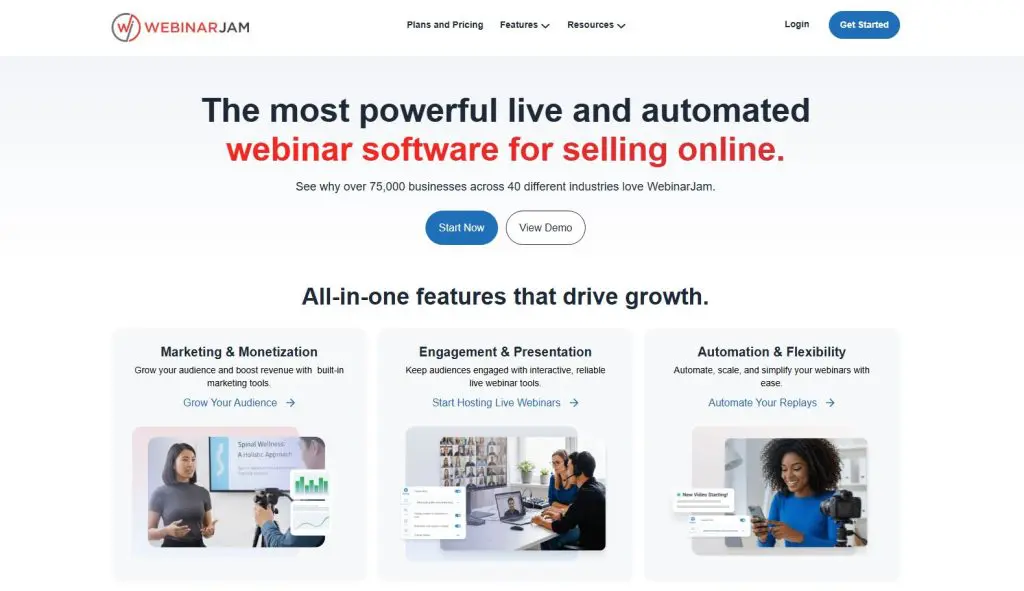
WebinarJam is a browser-based webinar platform for hosting live and hybrid webinars that generate leads and sales. WebinarJam combines registration pages, email and SMS reminders, a live webinar room, polls, on-screen offers, payments, and replays in one tool. Genesis Digital, the company behind Kartra and EverWebinar, owns it, and more than 75,000 businesses use it.
A WebinarJam webinar works like this.
Pick a schedule, build a registration page from a template, and set reminders. On the day, attendees join from a browser or phone with no download while you present with your camera, slides, screen, or a pre-recorded video.
When you reach the pitch, an offer pops up on screen, and afterward WebinarJam sends replays and follow-ups based on who attended.
WebinarJam is not a course platform, a full email marketing system, or a meeting tool for small group discussion. Compared with Zoom, WebinarJam puts selling first. Compared with Crowdcast, it’s built for presenting to an audience rather than running an interactive class.
The Main Features in WebinarJam
- Host unlimited live webinars for up to 5,000 attendees without any software download
- Mix live presenting with pre-recorded video to run hybrid webinars
- Build registration and thank-you pages from templates and split-test them
- Bring more people to the live session with email and SMS reminders sent by attendee behavior
- Sell during the webinar with timed on-screen offers linked to your checkout
- Charge for premium webinars through Stripe or PayPal
- Keep attendees engaged with chat, Q&A, polls, surveys, and a whiteboard
- Turn a winning live webinar into an automated one with EverWebinar on Basic and above
- Stream the session to Facebook and YouTube at the same time
| WebinarJam is | WebinarJam is not |
|---|---|
| A live webinar platform built for marketing and sales | A course platform with lessons and progress tracking |
| A registration page and reminder system for events | A full email marketing or CRM tool |
| A way to sell during a webinar with live offers | A small-group meeting tool like Zoom Meetings |
| Paired with EverWebinar for automated replays | A broadcast studio for polished branded video |
WebinarJam Pricing & Free Trial | How Much Does It Cost?
WebinarJam offers four plans with monthly or annual billing, and annual billing saves up to 22%. There’s no free plan, but a $1 trial gives you 14 days with Basic-level limits, and every paid plan has a 30-day money-back guarantee. For most course creators and coaches, Basic is the plan to pick.
| Plan | Billed monthly | Billed annually (per month) | Key limits |
|---|---|---|---|
| Starter | $49 | $39 | 100 attendees, 1 host, 1-hour webinars |
| Basic | $99 | $79 | 500 attendees, 2 hosts, 2-hour webinars |
| Professional | $299 | $229 | 2,000 attendees, 4 hosts, 3-hour webinars |
| Enterprise | $499 | $379 | 5,000 attendees, 6 hosts, 4-hour webinars |
| Feature | Starter | Basic | Professional | Enterprise |
|---|---|---|---|---|
| Capacity | ||||
| Attendees per webinar | 100 | 500 | 2,000 | 5,000 |
| Max webinar length | 1 hour | 2 hours | 3 hours | 4 hours |
| Hosts | 1 | 2 | 4 | 6 |
| Extra team members | 1 | 5 | 10 | 25 |
| Webinar types | ||||
| Live webinars | Unlimited | Unlimited | Unlimited | Unlimited |
| Hybrid webinars with video injections | ✓ | ✓ | ✓ | ✓ |
| Automated webinars (EverWebinar) | ✗ | ✓ | ✓ | ✓ |
| Always-on live room | ✗ | ✗ | ✓ | ✓ |
| Broadcast to Facebook and YouTube | ✓ | ✓ | ✓ | ✓ |
| Engagement and selling | ||||
| Live chat and Q&A | ✓ | ✓ | ✓ | ✓ |
| Polls and surveys | ✓ | ✓ | ✓ | ✓ |
| On-screen whiteboard | ✓ | ✓ | ✓ | ✓ |
| Live offer displays | ✓ | ✓ | ✓ | ✓ |
| Attendee spotlight (bring attendees on stage) | ✗ | ✓ | ✓ | ✓ |
| Bad words filter | ✓ | ✓ | ✓ | ✓ |
| Marketing and control | ||||
| Customizable registration and thank-you pages | ✓ | ✓ | ✓ | ✓ |
| A/B split testing of pages | ✓ | ✓ | ✓ | ✓ |
| Email and SMS reminders | ✓ | ✓ | ✓ | ✓ |
| Panic button | ✗ | ✗ | ✓ | ✓ |
| Control panel | ✗ | ✗ | ✗ | ✓ |
Session length matters more than attendee count for most course creators. A good sales webinar runs 60 to 90 minutes with Q&A, so Starter‘s one-hour limit forces you to rush the pitch. Basic doubles the time, adds a second host, lets you bring attendees on stage, and includes EverWebinar, which alone can replace a separate automated webinar subscription.
Professional makes sense when you regularly pass 500 live attendees or want the panic button and an always-on room. Enterprise suits large organizations running 5,000-person events, and few independent creators need it.
A few costs sit outside the plans. Paid webinars and live offers run through your own Stripe or PayPal account, so standard processing fees apply. SMS reminders connect through Twilio, which bills for each text. If you run sessions longer than your plan allows, WebinarJam suggests scheduling a second session 30 minutes after the first.
WebinarJam Features: What Works and What Doesn’t
WebinarJam competes with Demio, Livestorm, and Zoom Webinars, and its strength is turning attendees into buyers. The table shows what each feature does and where it stops, followed by a detailed section on each.
| Feature | What it does | Limitations |
|---|---|---|
| Live webinar room | Hosts browser-based webinars with camera, screen, slides, and backgrounds | Users report stream delay and softer video than some rivals |
| Hybrid webinars | Plays pre-recorded video inside a live session | Video files need to be ready and uploaded before the event |
| Scheduling and always-on room | Runs one-off, multiple, recurring, and on-demand sessions | The always-on room starts on the Professional plan |
| Registration pages | Creates sign-up pages with split testing and one-click registration | Design control is narrower than a dedicated page builder |
| Email and SMS reminders | Sends up to ten notifications targeted by attendee behavior | SMS needs a Twilio account billed separately |
| Live offers and paid webinars | Shows timed offers on screen and charges for premium sessions | Checkout runs through Stripe or PayPal links |
| Engagement tools | Adds chat, Q&A, polls, surveys, whiteboard, and handouts | No breakout rooms for small-group work |
| Attendee spotlight | Brings attendees on stage to speak or share their screen | Missing from Starter, with a host limit on each plan |
| Replays and EverWebinar | Records sessions and turns them into automated webinars | Replay controls are basic, and EverWebinar is a separate app |
| Analytics and integrations | Tracks attendance and engagement, and connects to email tools and Zapier | No built-in AI tools for summaries or clips |
Feature #1: The Live Webinar Room
WebinarJam’s live room runs in the browser for both hosts and attendees, with no download. Hosts can present on camera, share a screen, run uploaded PDF or PowerPoint slides from the control panel, and add a custom background. Attendees join from a computer, tablet, or phone with one click from the reminder email.

Running slides from uploaded files rather than screen sharing keeps the presentation sharp for attendees on slow connections. For a coach pitching a group program, that means the offer slide looks clean even for viewers on slow connections.
Stream quality is the most common complaint. Reviewers on Software Advice mention lag between presenter and audience and softer video than they expected, so test your setup and keep a few seconds of delay in mind when you take live questions. Hosts also need a computer for the full control panel, and my guide to live streaming equipment covers the camera and mic that help most.
Feature #2: Hybrid Webinars With Video Injections
Video injections let you play a pre-recorded video inside a live webinar, from an uploaded MP4 or a YouTube link. Each attendee streams the video at their own connection speed, so it plays smoothly instead of stuttering through screen share.
Hybrid webinars suit a creator who wants a polished teaching segment and a live pitch. Record the 40-minute lesson once, play it in the live room, and then come on camera for a live Q&A and offer. The format blends the reliability of a recording with the trust of a live conversation, which suits a masterclass you run every month.
Upload and test the video before the event, since a missing or slow file is hard to fix live. For a fully automated version of the same webinar, EverWebinar is the better tool.
Feature #3: Flexible Scheduling and the Always-On Room
WebinarJam supports five scheduling options. Hosts can go live now, schedule one session, offer several dates for the same webinar, run a recurring series that people register for once, or use an always-on room you can enter any time.

Multiple dates help with time zones, since a creator selling worldwide can offer a morning and an evening session from one registration page. A recurring series suits a weekly office hours call or live show. The always-on room on Professional works like a permanent studio for impromptu sessions.
WebinarJam advises against running two webinars at the same time in one account and suggests spacing them 15 to 30 minutes apart so replays process properly. Plan your calendar around that if several team members host.
Feature #4: Registration Pages and One-Click Sign-Ups
WebinarJam’s page builder creates registration and thank-you pages from templates. Hosts can edit text, images, colors, and video, choose required form fields, and place sign-up as a bar, a pop-up bubble, a button, or an embedded form on your own website. A/B split testing compares two page designs to see which brings more registrants.

One-click registration is the hidden win. Past attendees who click an invite link are registered instantly, because WebinarJam already has their details. A thank-you page poll asking registrants what they most want to learn tells you which part of your topic to emphasize.
The templates look dated next to a dedicated tool, and design control has limits. If your registration page carries the full sales job, build it with landing page software and send sign-ups to WebinarJam through its integrations.
Feature #5: Email and SMS Reminders
WebinarJam sends up to ten email and SMS notifications before and after each webinar, from the sign-up confirmation to last-minute reminders and replay links. Each one can target a group, such as people who registered but didn’t attend, or people who left before the offer.

Behavior-based follow-up is where WebinarJam earns its price. A no-show gets a replay with a deadline, while someone who stayed for the pitch gets a reminder that the bonus expires tonight. A text 15 minutes before start reaches people who never open the reminder email.
SMS reminders connect through a Twilio account, so you’ll set that up and pay Twilio for each text. WebinarJam’s emails also cover the event only, so longer nurture sequences belong in your email marketing platform, connected through one of WebinarJam’s integrations.
Feature #6: Live Offers and Paid Webinars
Live offers display a clickable offer on screen at the moment you choose, with a product image, price, and buy button that links to your checkout. Premium webinars go further and charge a ticket price at registration through Stripe or PayPal.

Timing the offer to your pitch is what makes WebinarJam a sales tool. Show the offer the moment you present your course, keep it visible through Q&A, and use a countdown so attendees act before the session ends. Paid webinars suit a skill-building workshop, which I’ve long argued should be priced separately from informational webinars in my 7 must-dos for maximizing webinar value.
The offer is a link out to your checkout page rather than a checkout inside the room, so the buying experience depends on your course platform or cart. My guide to making money from webinars covers pricing and offer structure.
Feature #7: Chat, Q&A, Polls, and Whiteboard
WebinarJam’s live chat supports public and private messages, moderation, sticky announcements, and a bad-words filter. Attendees can mark messages as questions so they stand out. Hosts can also run polls and surveys, draw on a whiteboard, and share handouts during the session.
Polls do the most work in a sales webinar. A quick poll about the audience’s biggest challenge early on tells you which examples to stress, and a handout keeps people around until the end. Wayne Turmel made the point when I interviewed him on the Learning Revolution Podcast that interaction has to be planned into a webinar rather than hoped for, and these tools make that easy to schedule.
WebinarJam has no breakout rooms, so workshops built around small-group practice need a meeting tool from my list of Zoom alternatives.
Feature #8: Attendee Spotlight and Multiple Hosts
Attendee spotlight brings anyone from the audience on stage to speak, share their screen, or present slides, then returns them to the audience when they’re done. Each plan also includes a set number of hosts, from one on Starter to six on Enterprise.
Bringing a past student on stage for a live testimonial is one of the strongest moves in a course sales webinar. Co-hosts help too, since a partner can run the chat and post the offer while you teach.
Attendee spotlight isn’t available on Starter, and on-screen hosts are capped by plan, so panels with many speakers fit HeySummit or a dedicated event platform better.
Feature #9: Replays and Automated Webinars With EverWebinar
WebinarJam records each session and can send replays automatically. Replica Replay recreates the session as it happened, with polls and offers appearing at the same moments. On Basic and above, EverWebinar is included, so you can turn a recorded webinar into an automated one that runs on a schedule.
Automation is how a webinar keeps selling after the live date. Run a masterclass live, refine it based on questions and sales, then load the best version into EverWebinar as an evergreen webinar that plays every day. Getting that tool for free is a real advantage over rivals that charge extra for automation.
Users find replay controls basic, with limited ways to skip around. EverWebinar is also a separate app with its own setup, so plan an afternoon to configure schedules, emails, and offers there.
Feature #10: Analytics, Integrations, and the Panic Button
WebinarJam’s analytics show registrations, attendance, watch time, drop-off points, and offer clicks for each webinar. Direct integrations cover Kartra, ActiveCampaign, Kit, AWeber, GetResponse, Mailchimp, Keap, Drip, and Twilio, and Zapier connects thousands more. Professional and above add a panic button that moves everyone to a fresh room if the stream fails.
Drop-off data tells you where your pitch loses people. If half the room leaves at minute 35, shorten the teaching before the offer. Sending attendee data to your email tool lets you follow up differently with buyers, attendees, and no-shows.
WebinarJam has no built-in AI tools. AI could do a lot here, such as summarizing questions, drafting follow-up emails from the transcript, or cutting promo clips, but you’ll need separate tools for that. Download the recording and use an AI video editor to create clips and recaps.
WebinarJam vs. the Best Alternatives for Webinars
WebinarJam competes with marketing webinar platforms and live class tools. My guide to the best webinar software platforms compares more options in depth.
| Platform | Best for | Starting price | How it compares with WebinarJam |
|---|---|---|---|
| WebinarJam | Sales webinars on a budget | $49/mo | Lowest cost per attendee, with EverWebinar included on Basic |
| Demio | Polished marketing webinars | From $45/mo billed yearly | Cleaner video and interface, fewer attendees per dollar |
| Livestorm | Webinars for small teams | Free plan, paid from $100/mo | Stronger on-demand features, priced by attendee credits |
| Zoom Webinars | Teams already on Zoom | From $66.67/mo billed yearly | Reliable video, weaker sales and marketing tools |
| Crowdcast | Interactive live classes | From $49/mo | Better for back-and-forth teaching, weaker sales tools. See my Crowdcast review |
| WebinarNinja | Simple all-in-one webinars | Priced per attendee seat | Simpler setup with built-in automation |
Choose WebinarJam over these when selling a course or program is the main goal and you want the most attendees for your money. If video polish or interactive teaching matters more, Demio or Crowdcast fits better.
WebinarJam Pros and Cons
These points cover day-to-day issues with WebinarJam’s billing, support, and setup that the feature sections don’t.
| Pros | Cons |
|---|---|
| Monthly billing is now available, so you can pay only in months you run webinars | Annual billing is needed to get the lowest price |
| A $1 trial includes Basic-level limits, so you can test a real webinar | The trial still costs $1 and needs a card |
| A 30-day money-back guarantee covers paid plans | Support responses can be slow during a live event |
| Basic includes EverWebinar, saving a separate subscription | EverWebinar runs as a separate app with its own setup |
| Past webinars can be cloned to save setup time | Platform updates have changed existing webinar settings for some users |
Is WebinarJam the Best Webinar Platform for Edupreneurs?
For edupreneurs who sell through webinars, yes. WebinarJam gives you the registration pages, reminders, live offers, and automation a course sales funnel needs at a lower price than most rivals. For edupreneurs who teach live classes, it’s the wrong shape.
I’d decide by asking what the webinar is for. On my Value Ramp, a free webinar sits near the bottom as a way to build trust, and its job is to move people toward a course or coaching program. WebinarJam is built for that job, while live teaching inside a paid program usually belongs on a different tool.
Use Case #1: A Monthly Free Masterclass That Sells a Course
A course creator runs a 75-minute masterclass every month to sell a $497 course. WebinarJam handles the registration page, reminders, live offer, and replay sequence, and EverWebinar runs the best version on autopilot between live dates. Choose Basic for the session length and included automation. My guides on planning a masterclass and promoting a masterclass cover the rest.
Use Case #2: A Paid Workshop
A coach charges $49 for a two-hour live workshop on a specific skill. WebinarJam’s premium webinars collect payment at registration through Stripe or PayPal, and replays go to buyers who missed it. Basic covers this up to 500 attendees.
Use Case #3: A Launch Webinar Series
A creator launching a new program runs three webinars over a week, each building toward the offer. A recurring series lets people register once for all three, and behavior-based emails follow up with anyone who missed a session. Professional makes sense if launch attendance passes 500.
Use Case #4: A Live Cohort Class
A teacher running a cohort-based course with discussion and student questions needs a tool built for conversation. Crowdcast or a meeting tool suits that better, with WebinarJam saved for the free webinar that fills the cohort.
Should You Choose WebinarJam?
If you’ve decided to try WebinarJam, use the $1 trial to run a full rehearsal. Build a registration page, set three reminders including one text, upload your slides and a short video, add a live offer, and invite a few friends to watch on phones and laptops. Check the stream delay and the replay before your first real audience. My guides to webinar marketing and running successful webinars will help you fill the room.
If WebinarJam isn’t the right fit, decide what matters most. Video polish points to Demio, interactive teaching to Crowdcast, and simple team webinars to Livestorm or Zoom. A webinar built to sell a course to hundreds of people at the lowest cost brings you back to WebinarJam.
Frequently Asked Questions (FAQs)
Is WebinarJam free?
No, WebinarJam has no free plan. A 14-day trial costs $1 and includes 500 attendees and two hosts, and every paid plan comes with a 30-day money-back guarantee. Plans start with Starter on monthly billing, and annual billing saves up to 22%.
Does WebinarJam offer monthly billing?
Yes. WebinarJam now offers monthly billing on every plan, with Starter at $49, Basic at $99, Professional at $299, and Enterprise at $499 a month. Annual billing lowers those prices to $39, $79, $229, and $379 a month, a saving of up to 22%.
What is the difference between WebinarJam and EverWebinar?
WebinarJam runs live and hybrid webinars with real-time interaction. EverWebinar replays a recorded webinar on a schedule as an automated webinar. Genesis Digital makes both, and EverWebinar is included at no extra cost on WebinarJam’s Basic, Professional, and Enterprise plans.
How many people can attend a WebinarJam webinar?
WebinarJam allows 100, 500, 2,000, or 5,000 attendees per webinar, depending on your plan. Session length also scales by plan, from one hour on Starter to four hours on Enterprise. Longer events can run as back-to-back sessions scheduled 30 minutes apart.
Do attendees need to download anything to join WebinarJam?
No. Attendees join WebinarJam from a browser on a computer, tablet, or phone with one click from their reminder email. Hosts also run webinars in the browser, but they need a computer to use the full control panel for slides, offers, polls, and attendee management.
Can I charge for webinars with WebinarJam?
Yes. WebinarJam’s premium webinars charge a ticket price at registration through Stripe or PayPal. Hosts can also show live offers during free webinars that link to your course checkout, which lets a free masterclass sell a paid program while attendees are still watching.
Is WebinarJam better than Zoom for webinars?
For selling courses and programs, yes. WebinarJam includes registration pages, behavior-based reminders, live offers, and automated replays that Zoom Webinars lacks. Zoom offers more familiar, reliable video and stronger meeting tools, which suits internal training and teams that already use Zoom.
Does WebinarJam have AI features?
WebinarJam doesn’t list built-in AI tools for summaries, transcripts, or clips. Download your webinar recording and use a separate AI video editor or transcription tool to create highlight clips, recap emails, and course content from each session after the event ends.

Jeff Cobb, Founder of Learning Revolution
Jeff Cobb is an expert in online education and the business of adult lifelong learning. Over the past 20+ years he has built a thriving career based on that expertise – as an entrepreneur, a consultant, an author, and a speaker. Learning Revolution is a place where Jeff curates tips, insights, and resources to help you build a thriving expertise-based business. Learn more about Jeff Cobb here.
Table of Contents