

TL;DR: Best Email List Building Tools for Course Creators and Coaches
List building tools turn visitors into email subscribers with forms, popups, landing pages, quizzes, and referral programs. For a course or coaching business, the list is where most sales start, because subscribers who get a useful lead magnet and a good welcome sequence buy far more often than cold visitors.
Best overall for course creators: Kit
Best for popups: OptinMonster
Best for lead magnet landing pages: Leadpages
Best for quizzes: Interact
Best for coaches and consultants: ScoreApp
Best for calculators: Outgrow
Best free form builder: Tally
Best free popup tool: Poptin
Best for newsletter referrals: beehiiv
My take: Start with an email platform that includes forms and landing pages, such as Kit, and add one capture tool for your best traffic source. Most creators need two tools, not five.
Ask any successful course creator what their most valuable business asset is, and most will say their email list.
Social reach rises and falls with each algorithm change. An email list stays yours, and it’s where you launch courses, fill cohorts, and book coaching calls.
In my work with learning businesses at Tagoras and Learning Revolution, the pattern holds. Most course sales start with a free resource, a welcome sequence, and an offer, which is why the tools that capture emails matter so much.
Below, I compare 11 list building tools by the job each one does best, show what they cost, and tell you which two to start with.
Read my guide to the best email marketing platforms for course creators
What Is a List Building Tool?
A list building tool captures a visitor’s email address and sends it to your email platform. The tool shows the signup offer, and the email platform delivers the lead magnet and the follow-up emails.
These tools fall into six types.
| Type | What it does | Example tools |
|---|---|---|
| Forms and landing pages | Collect emails on your site or on a dedicated page | Kit, Leadpages, Carrd, Tally |
| Popups and onsite messages | Show offers based on time, scroll, or exit intent | OptinMonster, Poptin, Getsitecontrol |
| Quizzes | Ask questions, segment people, and collect emails before results | Interact |
| Scorecards and assessments | Score answers and send a personal report | ScoreApp, Outgrow |
| Calculators | Give a personal number in exchange for an email | Outgrow |
| Referral and recommendation programs | Get subscribers to bring in new subscribers | beehiiv, Kit |
No tool works without a reason to sign up. A free mini-course, checklist, template, quiz result, or workshop recording gives visitors that reason, and my guide to lead magnet ideas covers what works best for course creators.
Best List Building Tools Compared
Here’s how the 11 tools compare at a glance.
| Tool | Type | Best for | AI features | Starting price |
|---|---|---|---|---|
| Kit | Email platform with forms and landing pages | Course creators who want one tool for forms, pages, and email | Official MCP server for Claude and ChatGPT, AI subject lines | Free up to 10,000 subscribers, paid from $33/mo billed annually |
| OptinMonster | Popups and onsite forms | Turning blog and site traffic into subscribers | Smart Optimizations AI copy | $9/mo billed annually (first year) |
| Leadpages | Landing pages and popups | Lead magnet landing pages | AI Engine page builder, Leadmeter, MCP server | $79/mo billed annually |
| Interact | Quiz funnels | Personality and recommendation quizzes | InteractAI builds a quiz from your website | /mo |
| ScoreApp | Scorecard quizzes | Coaches and consultants qualifying leads | AI quiz builder and AI marketing assistant | $39/mo |
| Outgrow | Calculators and assessments | Calculators and ROI tools | None listed on its pricing page | Free forms plan, calculators from $14/mo billed annually |
| Tally | Forms | Free forms and lead qualification | Community-built MCP server only | Free, Pro from $29/mo |
| Poptin | Popups | Free popups on a small site | None advertised | Free plan, paid from $25/mo |
| Getsitecontrol | Popups and email | Cheap popups with built-in email | None advertised | $19/mo plus email usage |
| Carrd | One-page sites | A one-page site or waitlist in an hour | None | Free, Pro from about $9 a year |
| beehiiv | Newsletter growth | Growing a newsletter through referrals | Copilot AI operator | Free up to 2,500 subscribers, paid from $49/mo billed annually |
Which List Building Tool Should You Pick?
Choose by your traffic source and your business model, not by the longest feature list.
| Your situation | Pick | Why |
|---|---|---|
| You’re starting from zero | Kit | Free forms, landing pages, and email up to 10,000 subscribers |
| Your blog or site already gets steady traffic | OptinMonster | Exit-intent and targeted popups turn more of that traffic into subscribers |
| You run ads or webinars to a lead magnet | Leadpages | Fast, testable landing pages built for one goal |
| You sell several courses and want to recommend one | Interact | A quiz sends each person to the right course |
| You sell coaching or consulting | ScoreApp | A scored assessment qualifies leads and books calls |
| Your offer saves people money or time | Outgrow | A calculator shows the value in numbers |
| You have no budget | Tally or Poptin | Generous free plans for forms and popups |
| A newsletter is your main lead magnet | beehiiv | Built-in referral rewards and Recommendations |
My position is that most course creators should start with two tools. Use an email platform with built-in forms and landing pages, then add one capture tool that matches your biggest traffic source. Buying a popup tool, a quiz tool, and a landing page builder on day one usually means three subscriptions and no lead magnet worth signing up for.
If you sell on a platform like Kajabi or HighLevel, check its built-in forms and pages first, since you may only need a quiz or popup tool on top.
The 11 Best List Building Tools for Course Creators
Below, I cover each tool in order of how useful it is for a typical course or coaching business. Each entry explains what the tool does best, how it uses AI, who should use it, and where it falls short.
1. Kit
- Best for: Course creators who want one tool for forms, pages, and email
- Not for: Detailed popup targeting
- Works with: Its own email platform
- Starting price: Free up to 10,000 subscribers, paid from $33/mo billed annually
- Key features: Forms, landing pages, email sequences, tagging, Creator Network, digital products, and an official MCP server
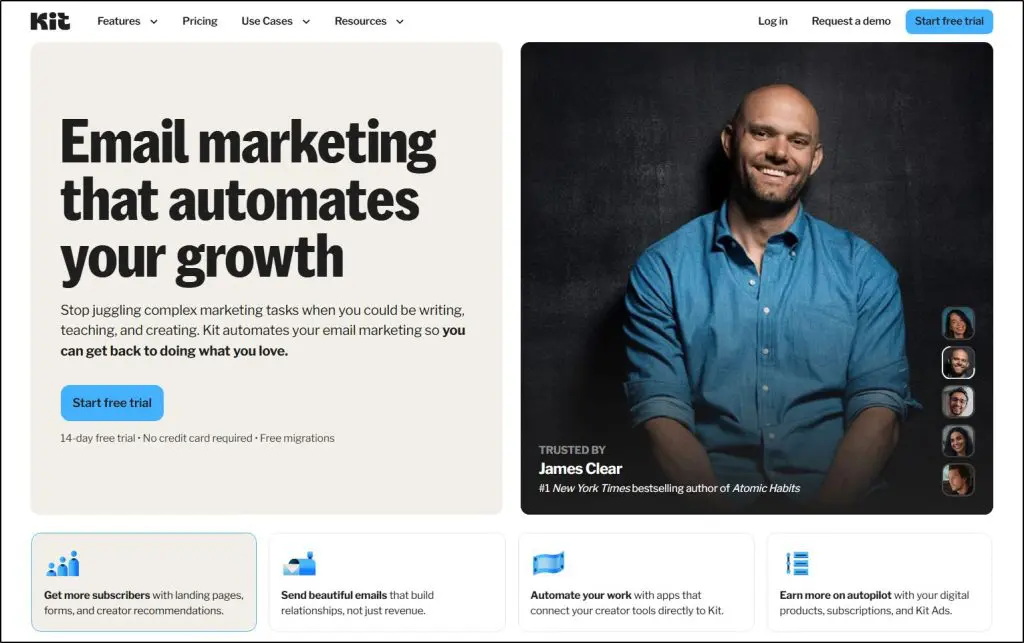
Kit, formerly ConvertKit, is an email platform built for creators, and it’s the simplest place to start building a list. Its forms and landing pages connect straight to your subscribers, so you skip the step of wiring a separate capture tool to your email account.
For example, a language teacher can build a landing page for a free pronunciation guide, tag everyone who signs up, and send a 5-day welcome sequence that ends with an offer for the full course. The free plan covers up to 10,000 subscribers, which is enough for most creators’ first few years.
The list also grows on its own. The Creator Network lets other creators recommend your newsletter to their subscribers, and paid recommendations and sponsorships open on higher plans.
An official MCP server connects your Kit account to Claude, ChatGPT, and other AI assistants. Ask Claude which forms brought in the most subscribers last month, tag a group of buyers, or draft a broadcast without opening the dashboard. AI also suggests and tests subject lines inside the editor.
The weak spot is onsite capture. Its forms appear inline, as slide-ins, or as modals, but targeting rules are basic next to OptinMonster.
My verdict: If you sell courses and have nothing set up yet, start with Kit, because it handles the form, the landing page, and the email that delivers your lead magnet.
| Pros | Cons |
|---|---|
| Free plan up to 10,000 subscribers | Basic popup targeting |
| Forms, landing pages, and email in one place | Templates look simple |
| Creator Network grows your list through recommendations | Automations and sequences require a paid plan |
| Official MCP server for AI assistants | Prices climb as your list grows |
Kit pricing:
| Plan | Billed monthly | Billed annually (per month) | Key limits |
|---|---|---|---|
| Newsletter | $0 | $0 | Up to 10,000 subscribers |
| Creator | $39 | $33 | Priced from 1,000 subscribers |
| Pro | $79 | $66 | Priced from 1,000 subscribers |
The free plan covers up to 10,000 subscribers with forms, landing pages, and broadcasts, so most course creators can start without paying. Upgrade to Creator once you need automations and email sequences.
Kit features by plan:
| Feature | Newsletter | Creator | Pro |
|---|---|---|---|
| Subscribers | Up to 10,000 | Priced by list size | Priced by list size |
| Landing pages, forms & broadcasts | Unlimited | Unlimited | Unlimited |
| Tagging & segmentation | ✓ | ✓ | ✓ |
| Sell digital products & paid newsletters | ✓ | ✓ | ✓ |
| Commerce fee | 3.5% + 30¢ | 3.5% + 30¢ | 3.5% + 30¢ |
| Users | 1 | 2 | Unlimited |
| Visual automations | ✗ | Unlimited | Unlimited |
| Email sequences | ✗ | ✓ | ✓ |
| RSS campaigns & 100+ app integrations | ✗ | ✓ | ✓ |
| Remove Kit branding | ✗ | ✓ | ✓ |
| A/B testing | 2 subject lines | 2 subject lines | 5 subject lines + content |
| Paid Recommendations & sponsorships | ✗ | ✓ | ✓ |
| Engagement scoring & Subscriber Signals | ✗ | ✗ | ✓ |
| Deliverability reporting & insights dashboard | ✗ | ✗ | ✓ |
| Newsletter referral system (SparkLoop) | ✗ | ✗ | ✓ |
| Facebook custom audiences | ✗ | ✗ | ✓ |
| Free migration | ✗ | ✓ | ✓ |
| Support | 24/7 email & chat | 24/7 priority |
2. OptinMonster

- Best for: Turning blog and site traffic into subscribers
- Not for: Creators with little site traffic
- Works with: Kit, Mailchimp, ActiveCampaign, and most email tools
- Starting price: $9/mo billed annually (first year)
- Key features: Popups, slide-ins, floating bars, inline forms, exit-intent, page and geo targeting, onsite retargeting, and AI copy
OptinMonster is the best-known popup and onsite capture tool, and it fits creators whose blog or website already gets steady traffic. OptinMonster shows the right signup offer to the right visitor at the right moment, such as a checklist offer when someone is about to leave a blog post on the same topic.
Campaign types include lightbox popups, full-screen welcome mats, floating bars, slide-ins, inline forms, coupon wheels, and yes/no forms. Targeting rules cover exit intent, scroll depth, time on page, specific pages, location, and returning visitors.
Its AI feature, Smart Optimizations, rewrites any headline, button, or text field in your campaign. Click it and you get five copy variations to test, which helps when you’re stuck on how to word an offer.
OptinMonster only pays off with traffic. A site with 1,000 visitors a month won’t gain many subscribers no matter how clever the popup is.
My verdict: Choose OptinMonster once your site gets steady traffic, since popups only pay off when people visit.
| Pros | Cons |
|---|---|
| Deep targeting, including exit intent | No free plan |
| Many campaign types and templates | First-year discounts hide the renewal price |
| AI copy variations at no extra cost | Needs real traffic to pay off |
| Works with almost every email platform | Advanced features sit on higher plans |
OptinMonster pricing:
| Plan | Billed monthly | Billed annually (per month) |
|---|---|---|
| Basic | $21 | $9 |
| Plus | $57 | $27 |
| Pro | $87 | $37 |
| Growth | $147 | $67 |
The annual prices are first-year promotional rates, so check the renewal price before you buy. OptinMonster offers no free plan.
OptinMonster features by plan:
| Feature | Basic | Plus | Pro | Growth |
|---|---|---|---|---|
| Sites | 1 | 2 | 3 | 5 |
| Impressions a month | 2,500 | 10,000 | 25,000 | 100,000 |
| Renewal price (per year) | $210 | $570 | $870 | $1,470 |
| All campaign types and 700+ templates | ✓ | ✓ | ✓ | ✓ |
| Page targeting and time, scroll, and page triggers | ✓ | ✓ | ✓ | ✓ |
| A/B testing | ✗ | ✓ | ✓ | ✓ |
| Content locking and device targeting | ✗ | ✓ | ✓ | ✓ |
| Yes/No forms with multiple views | ✗ | ✓ | ✓ | ✓ |
| Exit-Intent | ✗ | ✗ | ✓ | ✓ |
| Countdown timers and campaign scheduling | ✗ | ✗ | ✓ | ✓ |
| Smart Tags and revenue attribution | ✗ | ✗ | ✓ | ✓ |
| Zapier, webhooks, and Google Analytics | ✗ | ✗ | ✓ | ✓ |
| Remove OptinMonster badge | ✗ | ✗ | ✓ | ✓ |
| Geolocation and new vs. returning targeting | ✗ | ✗ | ✗ | ✓ |
| OnSite Retargeting and Follow-up Campaigns | ✗ | ✗ | ✗ | ✓ |
| Coupon wheel campaigns | ✗ | ✗ | ✗ | ✓ |
| eCommerce and membership integrations (MemberPress, WooCommerce) | ✗ | ✗ | ✗ | ✓ |
Read my email marketing best practices for course creators
3. Leadpages
- Best for: Lead magnet landing pages
- Not for: Full websites with many pages
- Works with: 50+ integrations, including Kit and Mailchimp
- Starting price: $79/mo billed annually
- Key features: Landing pages, popups, alert bars, AI Engine, Leadmeter, A/B testing, lead magnet delivery, and an MCP server
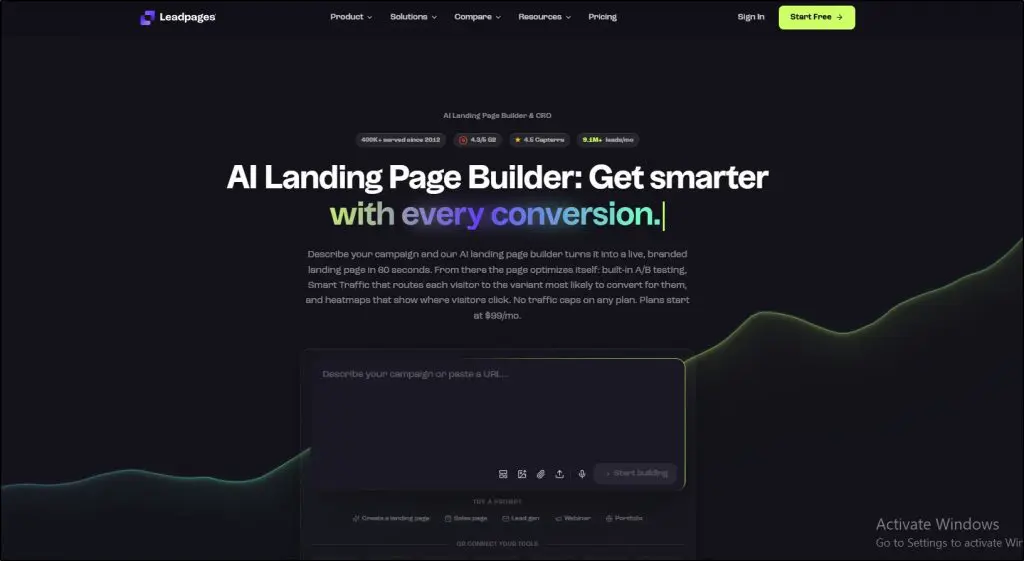
Leadpages is a landing page builder made for lead generation. Course creators use it for lead magnet pages, webinar registration pages, and waitlists, especially when they send paid ads or podcast traffic to a single offer.
Its AI Engine builds a full page from a short description in about a minute. Leadmeter scores your page as you build and tells you what will lift conversions, such as a shorter form or a clearer headline, and A/B testing shows which version wins.
Beyond pages, Leadpages adds exit-intent, timed, and scroll-triggered popups plus sticky alert bars with countdown timers. Leadpages also offers an MCP server, so AI assistants can work with your pages and leads.
For a full site with many pages and a blog, use a website builder or your course platform instead. My landing page software roundup covers the alternatives.
My verdict: Use Leadpages when your lead magnets need their own pages and you run ads or webinars to them.
| Pros | Cons |
|---|---|
| Fast AI page builder | Pricier than simple page builders |
| Leadmeter conversion scoring | Not a full website builder |
| Popups and alert bars included | Cheaper HTML Pub plans lack lead tools |
| Unlimited pages on Grow | Design flexibility below page builders like Webflow |
Leadpages pricing:
| Plan | Billed monthly | Billed annually (per month) | Key limits |
|---|---|---|---|
| HTML Pub Starter | $10 | – | 5 pages, 1 custom domain |
| HTML Pub Pro | $29 | – | 25 pages, 1 custom domain, 1 blog |
| HTML Pub Business | $49 | – | 50 pages, 2 custom domains, 2 blogs |
| Grow | $99 | $79 | Unlimited pages and traffic, 4 domains |
| Optimize | $199 | $159 | Unlimited pages and traffic, 6 domains |
| Scale | $399 | $319 | Unlimited pages and traffic, 10 domains |
| Enterprise | Custom | Custom | SSO, custom contracts, volume publishing |
The HTML Pub plans host simple pages, but the Grow plan is where unlimited lead pages, popups, and the AI tools live.
Leadpages features by plan:
| Feature | HTML Pub Starter | HTML Pub Pro | HTML Pub Business | Grow | Optimize | Scale | Enterprise |
|---|---|---|---|---|---|---|---|
| Pages | 5 | 25 | 50 | Unlimited | Unlimited | Unlimited | – |
| Custom domains | 1 | 1 | 2 | 4 | 6 | 10 | – |
| Blogs | 0 | 1 | 2 | 3 | 5 | 10 | – |
| AI credits per month | 4,000 | 12,000 | 20,000 | 40,000 | 80,000 | 160,000 | – |
| AI page creation | ✓ | ✓ | ✓ | ✓ | ✓ | ✓ | – |
| A/B testing | ✗ | ✗ | ✗ | Yes, up to 6 variants | Yes, up to 6 variants plus multivariate | Yes, 4 variants | – |
| Dynamic text replacement | ✗ | ✗ | ✗ | ✓ | ✓ | ✓ | – |
| Lead enrichment | ✗ | ✗ | ✗ | ✓ | ✓ | ✓ | – |
| Smart Traffic (AI routing) | ✗ | ✗ | ✗ | ✗ | ✓ | ✓ | – |
| Heatmaps | ✗ | ✗ | ✗ | ✗ | ✓ | ✓ | – |
| Auto-personalization | ✗ | ✗ | ✗ | ✗ | ✓ | ✓ | – |
| Full auto-optimization | ✗ | ✗ | ✗ | ✗ | ✗ | ✓ | – |
| Active integrations | – | 5 | 5 | 5 | 10 | 25 | – |
| Team seats | – | 1 | 1 | 1 | 3 | 10 | – |
| Email marketing | ✗ | ✗ | ✗ | ✗ | ✗ | ✗ | – |
Read my guide to creating landing pages that convert
4. Interact

- Best for: Personality and recommendation quizzes
- Not for: Scored assessments with PDF reports
- Works with: Kit, Mailchimp, Kajabi, Klaviyo, and others
- Starting price: /mo
- Key features: Personality, assessment, and scored quizzes, branching logic, result-based segmentation, InteractAI, and email integrations
Interact builds quiz funnels. A visitor answers a few questions, enters an email to see the result, and lands in your email platform tagged by the answer they chose.
Quizzes work well for creators with more than one offer. For example, a fitness coach could run a “What’s your training style?” quiz that sends each result group to a different program and email sequence, so every follow-up email fits the reader.
InteractAI builds a first draft of a quiz from your website. The AI reads your pages, suggests questions and results, and matches them to your products, so you edit a draft instead of starting blank.
Interact suits fun, personality-style quizzes best. For scored assessments with a personal PDF report, ScoreApp is the stronger fit. My guide on how to create quizzes covers the basics.
My verdict: Pick Interact if a fun quiz fits your topic, such as “Which course is right for you?”
| Pros | Cons |
|---|---|
| Quizzes that segment subscribers by result | Monthly lead caps with overage fees |
| InteractAI drafts quizzes from your site | Branding removal starts on Growth |
| Branching logic on every plan | No built-in landing pages beyond the quiz |
| Integrates with Kit, Mailchimp, and Kajabi | Annual savings not shown publicly |
Interact pricing:
| Plan | Billed monthly | Key limits |
|---|---|---|
| Free | $0 | 100 leads/mo, 5 quizzes, 1 user |
| Lite | – | 500 leads/mo, 25 quizzes, 2 users |
| Growth | – | 2,000 leads/mo, 50 quizzes, 5 users |
| Pro | – | 8,000 leads/mo, 100 quizzes, 10 users |
Plans cap the number of email leads each month, and Interact charges overage fees past the cap. Pick a plan with room for your best traffic month.
Interact features by plan:
| Feature | Free | Lite | Growth | Pro |
|---|---|---|---|---|
| Email leads a month | 100 | 500 | 2,000 | 8,000 |
| Quizzes | 5 | 25 | 50 | 100 |
| Users | 1 | 2 | 5 | 10 |
| Branching logic and custom design | Not listed | ✓ | ✓ | ✓ |
| Remove Interact branding | ✗ | ✗ | ✓ | ✓ |
| Conversion tracking | ✗ | ✗ | ✓ | ✓ |
| Advanced integrations | ✗ | ✗ | ✗ | ✓ |
5. ScoreApp
- Best for: Coaches and consultants qualifying leads
- Not for: Fun personality quizzes on a tight budget
- Works with: Major email tools and CRMs
- Starting price: $39/mo
- Key features: Scorecard quizzes, AI quiz builder, AI marketing assistant, dynamic PDF reports, custom domains, and split testing
ScoreApp builds scorecards, which are short assessments that give each person a score and a personal report. Coaches, consultants, and service businesses use them as lead magnets because a score feels useful and leads straight into a sales conversation.
Picture a leadership coach running a “How ready is your team for remote work?” scorecard. Each person who scores low gets a report with three recommendations and a link to book a strategy call, and the coach sees every answer before the call starts.
AI does much of the setup. The AI quiz builder drafts the questions, scoring, and result pages from a description of your business, and the AI marketing assistant writes promotional copy for the scorecard. Business plans add dynamic PDF reports and abandon emails for people who start but don’t finish.
ScoreApp costs more than a simple quiz tool, and the response caps on lower plans fill up fast if a scorecard spreads on social media.
My verdict: For coaches and consultants, ScoreApp is the best tool here for turning a free assessment into booked calls.
| Pros | Cons |
|---|---|
| Scorecards built for coaches and consultants | Higher price than basic quiz tools |
| AI quiz builder and marketing assistant | Response caps on lower plans |
| Personal PDF reports on Business | Custom domains start on Business |
| Strong lead qualification before sales calls | Less suited to fun personality quizzes |
ScoreApp pricing:
| Plan | Billed monthly | Key limits |
|---|---|---|
| Starter | $39 | 3 scorecards, 100 responses/mo, 1 user |
| Business | $99 | 10 scorecards, 1,000 responses/mo, 3 users |
| Pro | $149 | 30 scorecards, 3,000 responses/mo, 5 users |
| Enterprise | Custom | From $799/mo, unlimited seats |
Response caps matter most here. A scorecard that takes off on social media can blow past 100 responses a month on Starter.
ScoreApp features by plan:
| Feature | Starter | Business | Pro | Enterprise |
|---|---|---|---|---|
| Live scorecards | 3 | 10 | 30 | Custom |
| Responses a month | 100 | 1,000 | 3,000 | Custom |
| AI quiz builder and marketing assistant | ✓ | ✓ | ✓ | ✓ |
| Custom domain | ✗ | ✓ | ✓ | ✓ |
| Dynamic PDF reports | ✗ | ✓ | ✓ | ✓ |
| Split testing | ✗ | ✗ | ✓ | ✓ |
Read my guide to starting an online coaching business
6. Outgrow
- Best for: Calculators and ROI tools
- Not for: Beginners who need a cheap first tool
- Works with: Email tools, CRMs, and Zapier
- Starting price: Free forms plan, calculators from $14/mo billed annually
- Key features: Calculators, quizzes, assessments, polls, chatbots, forms, templates, and lead analytics
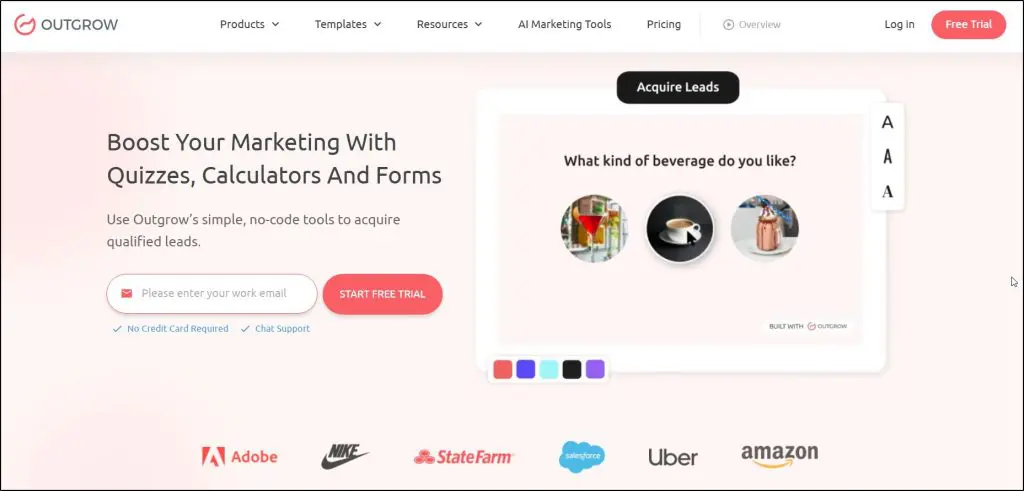
Outgrow builds interactive calculators, quizzes, assessments, and polls. Calculators are its standout, because a personal number, such as how much a course could save someone, makes a strong reason to share an email.
For example, a bookkeeping instructor could offer a “How much is DIY bookkeeping costing you?” calculator, show the result, and invite people to a free workshop. A career coach could offer a salary negotiation calculator that leads into a coaching offer.
Outgrow’s pricing page lists no AI builder, so expect to build calculators from templates yourself. Templates cover many industries, and the paid plans support logic, formulas, and integrations with email tools and CRMs.
The trade-off is cost and complexity. Calculators take longer to build than quizzes, and Outgrow’s higher plans cost far more than other tools on this list.
My verdict: Choose Outgrow only if a calculator is your best lead magnet, since it costs more than simpler tools.
| Pros | Cons |
|---|---|
| Best calculator builder here | No AI builder listed |
| Many templates across industries | Calculators take time to build |
| Quizzes, polls, and assessments included | Low lead caps on cheaper plans |
| 7-day trial without a card | Business plan is expensive |
Outgrow pricing:
| Plan | Billed monthly | Billed annually (per month) | Key limits |
|---|---|---|---|
| Free Forms/Surveys | Free | Free | Forms and surveys only, 100 leads/mo |
| Freelancer | $22 | $14 | 250 leads/mo, 5 content pieces |
| Freelancer Pro | $45 | $25 | 1,000 leads/mo, 7 content pieces |
| Essentials | $115 | $95 | 7,500 leads/mo, 3 users |
| Business | $720 | $600 | 50,000 leads/mo, 10 users |
The free plan covers forms and surveys only. Calculators and quizzes start on Freelancer, and annual billing saves up to 44%.
Outgrow features by plan:
| Feature | Free Forms/Surveys | Freelancer | Freelancer Pro | Essentials | Business |
|---|---|---|---|---|---|
| Leads a month | 100 | 250 | 1,000 | 7,500 | 50,000 |
| Users | 1 | 1 | 1 | 3 | 10 |
| Content pieces | 4 | 5 | 7 | Unlimited | Unlimited |
| Calculators, quizzes, and assessments | ✗ | ✓ | ✓ | ✓ | ✓ |
7. Tally
- Best for: Free forms and lead qualification
- Not for: Popups or exit-intent capture
- Works with: Zapier, Make, webhooks, and native email integrations
- Starting price: Free, Pro from $29/mo
- Key features: Unlimited forms and submissions, conditional logic, file uploads, payments, hidden fields, and integrations
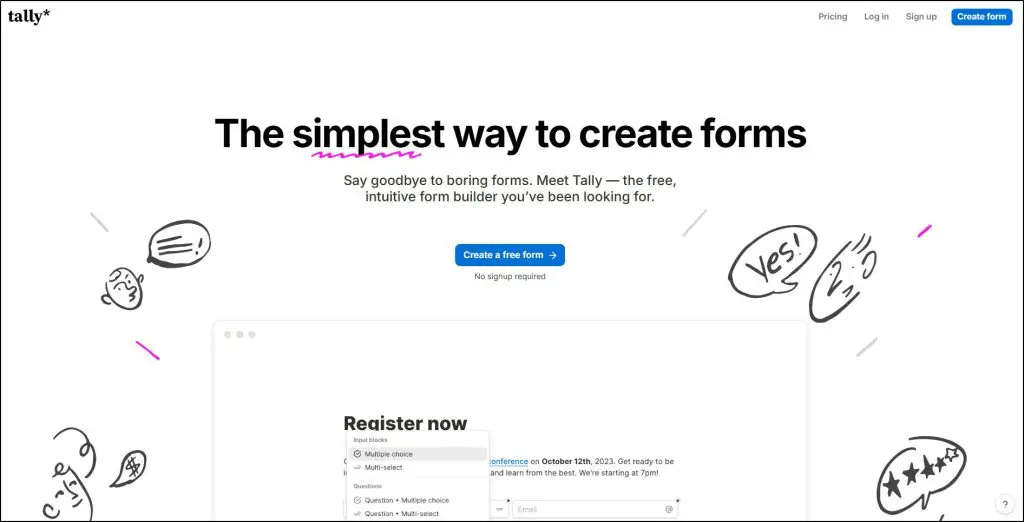
Tally is a form builder that feels like typing in a document, and its free plan includes unlimited forms and submissions. Course creators use it for signup forms, waitlists, application forms, and short surveys before a launch.
For example, a coach can build a coaching application form with conditional logic that asks different questions based on budget, then send every answer to Kit and a Google Sheet. A course creator can collect pre-launch survey answers and tag subscribers by the topic they want most.
Tally has no official AI builder or MCP server. A community-built MCP server lets AI assistants like Claude create and edit Tally forms, but Tally doesn’t support it, so treat it as an experiment.
Tally collects emails but doesn’t show popups or exit-intent offers. Pair it with a popup tool if your traffic needs a nudge.
My verdict: Start with Tally if you need forms and have no budget, then add a popup tool later.
| Pros | Cons |
|---|---|
| Unlimited forms and submissions free | No popups or exit intent |
| Fast, document-style editor | No official AI tools |
| Conditional logic on the free plan | Branding removal requires Pro |
| Connects to Zapier, Make, and webhooks | Basic design options |
Tally pricing:
| Plan | Billed monthly | Billed annually (per year) | Key limits |
|---|---|---|---|
| Free | $0 | $0 | Unlimited forms and submissions (fair use) |
| Pro | $29 | $290 | Removes branding, custom domains, partial submissions, unlimited team members |
| Business | $89 | $890 | Email verification, data retention controls, 90-day version history |
Tally’s free plan includes unlimited forms and submissions, which is rare. Pay for Pro only to remove branding or use your own domain.
Tally features by plan:
| Feature | Free | Pro | Business |
|---|---|---|---|
| Unlimited forms and submissions | ✓ | ✓ | ✓ |
| Conditional logic and file uploads | ✓ | ✓ | ✓ |
| Remove Tally branding | ✗ | ✓ | ✓ |
| Custom domains | ✗ | ✓ | ✓ |
| Partial submissions | ✗ | ✓ | ✓ |
| Respondent email verification | ✗ | ✗ | ✓ |
| Version history | ✗ | 30 days | 90 days |
| Automatic submission data retention | ✗ | ✗ | ✓ |
Read my guide to selling digital downloads
8. Poptin
- Best for: Free popups on a small site
- Not for: Advanced targeting and A/B testing
- Works with: Major email tools, plus its own autoresponder
- Starting price: Free plan, paid from $25/mo
- Key features: Popups, embedded forms, exit intent, targeting rules, autoresponders, and templates
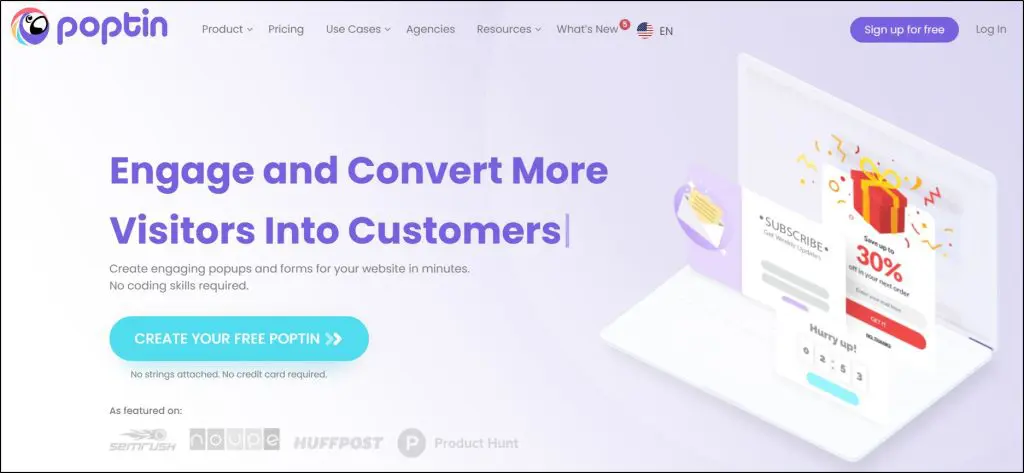
Poptin is a popup and form builder with a free plan that suits small sites testing popups for the first time. Campaign options include lightbox popups, slide-ins, full-screen overlays, countdown popups, and embedded forms, with exit intent and page targeting.
Paid plans add built-in autoresponder emails, so a small site can deliver a lead magnet without connecting an email platform at first. Most creators should still connect Kit or another email tool once they start sending sequences.
Poptin doesn’t advertise AI features, so you’ll write your own popup copy. Capterra reviewers rate it 4.8 out of 5 from 351 reviews, with value and the free plan cited most often.
Costs rise quickly if you run several sites, since domains and visitor caps climb with each plan.
My verdict: Use Poptin’s free plan to test popups on a small site before paying for OptinMonster.
| Pros | Cons |
|---|---|
| Free plan for small sites | 1,000-visitor cap on the free plan |
| Exit intent and targeting included | No AI features |
| Built-in autoresponder on paid plans | Costs climb with domains |
| Highly rated on Capterra | Less advanced testing than OptinMonster |
Poptin pricing:
| Plan | Billed monthly | Key limits |
|---|---|---|
| Free | $0 | 1,000 visitors/mo, 1 domain |
| Basic | $25 | 10,000 visitors/mo, 1 domain |
| Pro | $59 | 50,000 visitors/mo, 4 domains |
| Agency | $119 | Unlimited domains |
The free plan shows Poptin branding and caps you at 1,000 visitors a month, so growing sites move to Basic quickly.
Poptin features by plan:
| Feature | Free | Basic | Pro | Agency |
|---|---|---|---|---|
| Visitors a month | 1,000 | 10,000 | 50,000 | Not listed |
| Domains | 1 | 1 | 4 | Unlimited |
| Unlimited popups and forms | ✓ | ✓ | ✓ | ✓ |
| Autoresponder emails | ✗ | 1,000 | 5,000 | 200,000 |
| Remove Poptin branding | ✗ | ✓ | ✓ | ✓ |
9. Getsitecontrol
- Best for: Cheap popups with built-in email
- Not for: Landing pages and quizzes
- Works with: Its own email tool, plus Zapier and email integrations
- Starting price: $19/mo plus email usage
- Key features: Popups, forms, sticky bars, surveys, email campaigns, automations, and templates
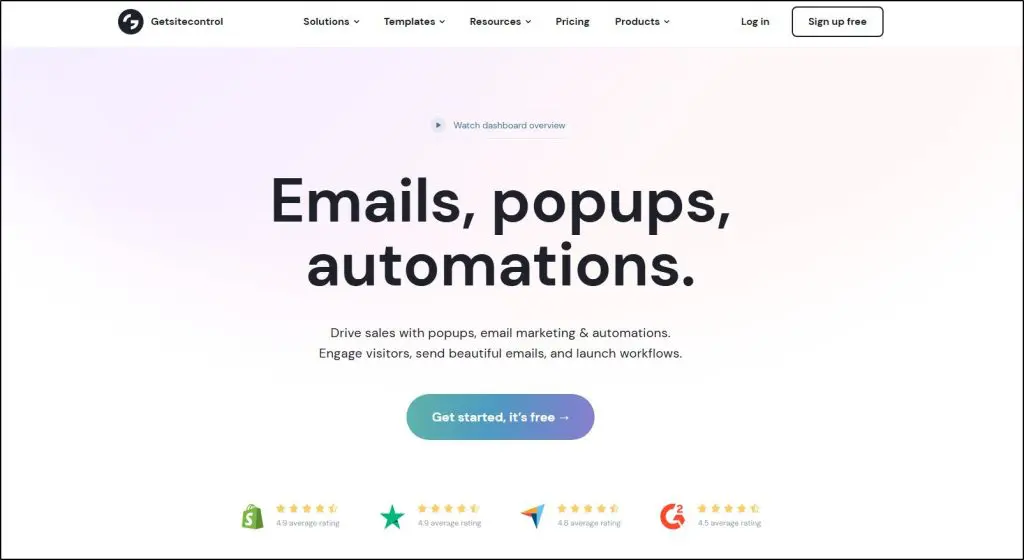
Getsitecontrol combines popups and forms with a basic email tool, so a small site can capture and email subscribers from one account. The widgets include popups, slide-ins, sticky bars, contact forms, and surveys, with display rules by page, time, and scroll.
The pricing works differently from most tools here, with a low monthly plan price plus a usage charge for emails you send, which suits small lists and grows with your audience.
Getsitecontrol doesn’t advertise AI features. For creators who already use Kit or another email platform, the built-in email tool adds little, and a dedicated popup tool makes more sense.
My verdict: Choose Getsitecontrol if you want cheap popups and basic email in one bill, and skip it if you already use Kit.
| Pros | Cons |
|---|---|
| Low starting price | Email usage adds to the bill |
| Popups, forms, and email in one tool | No AI features |
| Simple display rules | Basic email compared with Kit |
| Usage pricing suits small lists | No landing pages or quizzes |
Getsitecontrol pricing:
| Plan | Billed monthly | Key limits |
|---|---|---|
| Pro | $19 | Plus usage for emails sent |
| Pro Max | $29 | Plus usage for emails sent |
Each plan adds a usage charge for emails sent, about $2 per 1,000 emails, so your bill grows with your list.
Getsitecontrol features by plan:
| Feature | Pro | Pro Max |
|---|---|---|
| Popups, forms, bars, and surveys | ✓ | ✓ |
| Email campaigns and automations | ✓ | ✓ |
10. Carrd
- Best for: A one-page site or waitlist in an hour
- Not for: Multi-page sites and blogs
- Works with: Kit, Mailchimp, and other email tools on Pro
- Starting price: Free, Pro from about $9 a year
- Key features: One-page sites, signup forms, payment widgets, custom domains, and templates
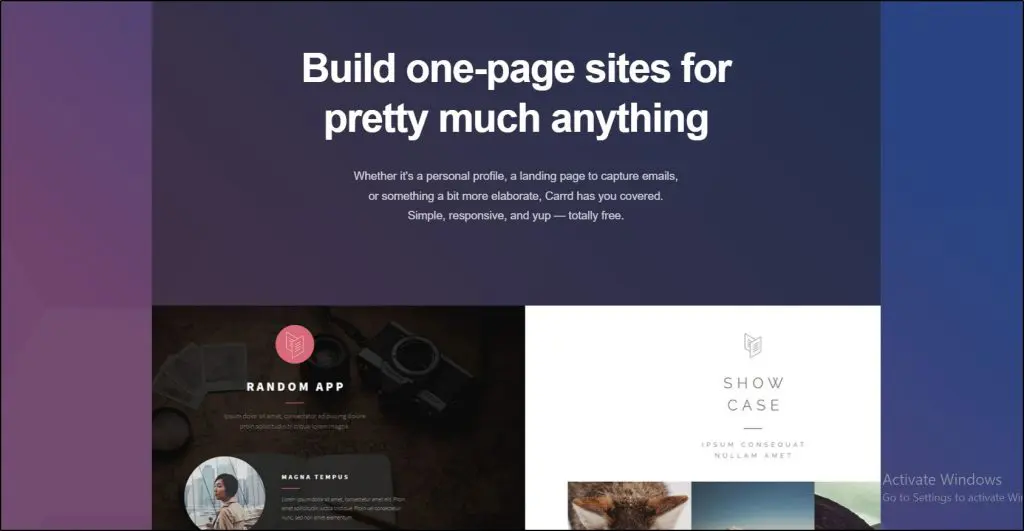
Carrd builds simple one-page websites, and it’s the fastest way to put a waitlist, pre-sale page, or link-in-bio page online. A new edupreneur can launch a course waitlist in an hour, collect emails through a Carrd form, and send them to Kit or Mailchimp.
Carrd costs almost nothing. Pro plans run from about $9 to $49 a year, which makes it the cheapest paid tool on this list by far.
Carrd has no AI builder, and it builds one page per site, so it won’t replace a full website or a course platform’s sales pages.
My verdict: Use Carrd for a waitlist, pre-sale page, or link-in-bio page you need live today.
| Pros | Cons |
|---|---|
| Pro plans from about $9 a year | One page per site |
| Fast to learn and publish | No AI tools |
| Forms connect to major email tools | Forms and domains need Pro |
| Good templates for waitlists and bios | No popups or A/B testing |
Carrd pricing:
| Plan | Billed annually (per month) | Key limits |
|---|---|---|
| Free | Free | 3 sites, Carrd branding |
| Pro Lite | $0.75 | 3 sites, no branding |
| Pro Standard | $1.58 | 10 sites, custom domains, forms |
| Pro Plus | $4.08 | 25 sites, advanced forms |
Carrd bills yearly, and Pro Standard is the plan you need for custom domains and signup forms.
Carrd features by plan:
| Feature | Free | Pro Lite | Pro Standard | Pro Plus |
|---|---|---|---|---|
| Sites | 3 | 3 | 10 | 25 |
| Remove Carrd branding | ✗ | ✓ | ✓ | ✓ |
| Premium templates | ✗ | ✓ | ✓ | ✓ |
| Custom domains with SSL | ✗ | ✗ | ✓ | ✓ |
| Forms, including signup and payment forms | ✗ | ✗ | ✓ | Advanced |
| Widgets and embeds (Stripe, PayPal, Gumroad) | ✗ | ✗ | ✓ | ✓ |
| Analytics and tracking | ✗ | ✗ | ✓ | ✓ |
| Password protection, redirects, and site downloads | ✗ | ✗ | ✗ | ✓ |
11. beehiiv

- Best for: Growing a newsletter through referrals
- Not for: Course delivery and complex funnels
- Works with: Its own newsletter platform
- Starting price: Free up to 2,500 subscribers, paid from $49/mo billed annually
- Key features: Signup forms, landing pages, referral program, Recommendations, Boosts, Copilot AI, and newsletter website
beehiiv is a newsletter platform with growth tools built in, and it fits creators whose free newsletter is the main lead magnet. Subscribe forms, landing pages, and a newsletter website come with every plan.
Growth tools come built in. The referral program rewards readers who bring in friends, Recommendations lets publications suggest each other at signup, and Boosts lets you pay other newsletters to recommend yours, or earn money recommending theirs.
Copilot, beehiiv’s AI operator launched in July 2026, analyzes your audience and performance, drafts campaigns, sets up workflows, and points out revenue opportunities.
beehiiv focuses on newsletters rather than course funnels. For tagging by lead magnet and selling courses through sequences, Kit or your course platform fits better.
My verdict: Choose beehiiv if a free newsletter is your main lead magnet and you want subscribers to recruit subscribers.
| Pros | Cons |
|---|---|
| Free up to 2,500 subscribers | Built for newsletters more than course funnels |
| Referral program and Recommendations built in | Paid plans rise with subscriber count |
| Boosts can pay for growth or earn money | Fewer tagging options than Kit |
| Copilot AI analyzes and drafts | No popup targeting |
beehiiv pricing:
| Plan | Billed monthly | Billed annually (per month) | Key limits |
|---|---|---|---|
| Free | $0 | $0 | Up to 2,500 subscribers, 1 team seat, 1 publication |
| Lite | $49 | $49 | Up to 100,000 subscribers, 2 team seats, 3 publications |
| Pro | $109 | $95 | Up to 250,000 subscribers, 10 team seats, 10 publications |
| Enterprise | Custom | Custom | Custom subscriber count, available at every tier |
The free Launch plan covers up to 2,500 subscribers with the referral program, Recommendations, and signup forms. Paid plans rise with your subscriber count.
beehiiv features by plan:
| Feature | Free | Lite | Pro | Enterprise |
|---|---|---|---|---|
| Subscribers | Up to 2,500 | Up to 100,000 | Up to 250,000 | Custom |
| Email sends | Unlimited | Unlimited | Unlimited | Unlimited |
| Team members | 1 | 2 | 10 | Unlimited |
| Publications | 1 | 3 | 10 | Custom |
| Website, custom domain & link-in-bio | ✓ | ✓ | ✓ | ✓ |
| Recommendation network | ✓ | ✓ | ✓ | ✓ |
| API access | ✓ | ✓ | ✓ | ✓ |
| Paid subscriptions (0% beehiiv take) | ✗ | ✓ | ✓ | ✓ |
| Ad network & programmatic ads | ✗ | ✓ | ✓ | ✓ |
| Digital products | ✓ | ✓ | ✓ | ✓ |
| Automations | ✗ | ✓ | ✓ | ✓ |
| A/B testing, surveys & polls | ✗ | ✓ | ✓ | ✓ |
| Referral program | ✗ | ✓ | ✓ | ✓ |
| Community (discussions & DMs) | ✓ | ✓ | ✓ | ✓ |
| Podcast episodes per month | 1 | 4 | Unlimited | Unlimited |
| AI credits per day | 10 | 25 | 50 | 100 |
| Remove beehiiv branding | ✗ | ✗ | ✓ | ✓ |
| RSS to send, audio newsletters, dynamic content | ✗ | ✗ | ✓ | ✓ |
| Send API | ✗ | ✗ | ✓ | ✓ |
| Dedicated IP & SSO | ✗ | ✗ | ✗ | ✓ |
| Support | AI assistant | Human support | 24/7 priority | Account manager |
| Guest authors | 1 | 3 | Unlimited | Unlimited |
| Analytics history | 30 days | 12 months | Unlimited | Unlimited |
| Webinars & coaching | ✗ | ✗ | ✓ | ✓ |
Read my guide to monetizing your email newsletter
Tools I Removed From This List
I removed three tools from earlier versions of this article.
- Sleeknote: A good popup tool, but it focuses on ecommerce stores and starts well above OptinMonster and Poptin.
- Growform: Multi-step forms still work, but Tally covers the same lead qualification job with a free plan.
- Beacon: I couldn’t find recent product updates or user reviews newer than 2022, so I can’t recommend it with confidence.
How to Build a List for a Course or Coaching Business
Tools come last. Here’s the order I recommend.
- Pick one lead magnet that previews your paid offer: A free lesson, checklist, or scorecard should solve a small piece of the problem your course or coaching solves.
- Set up one capture point on your best traffic source: Use a landing page for ads and social traffic, a popup for blog traffic, or a quiz for mixed audiences.
- Write a welcome sequence before you launch: A sequence of three to five emails should deliver the lead magnet, share a story, and make a clear offer.
- Tag subscribers by interest: Use quiz results or lead magnet topics to send each group the right course or program.
- Measure sales as well as signups: A smaller list that buys beats a large list that never opens.
For the full process, read my guide on how to build an email list and my guide to email sequences.
Final Verdict | Which List Building Tool Is Best?
Overall I recommend Kit as the best list building tool for most course creators. Its free plan covers forms, landing pages, and email for up to 10,000 subscribers, which means you can capture leads and deliver a lead magnet without paying for anything else.
Add OptinMonster once your site gets steady traffic, Leadpages if you run ads or webinars to dedicated pages, and ScoreApp if you sell coaching or consulting. Choose Tally and Poptin if you need to start for free.
Whatever you pick, keep it to two tools at first and spend your time on the lead magnet and the welcome sequence, because that’s where subscribers turn into students.

Jeff Cobb, Founder of Learning Revolution
Jeff Cobb is an expert in online education and the business of adult lifelong learning. Over the past 20+ years he has built a thriving career based on that expertise – as an entrepreneur, a consultant, an author, and a speaker. Learning Revolution is a place where Jeff curates tips, insights, and resources to help you build a thriving expertise-based business. Learn more about Jeff Cobb here.
Frequently Asked Questions (FAQs)
Here are answers to the questions people ask me most often about list building tools.
What is the best email list building tool for course creators?
For most course creators, Kit is the best list building tool because its free plan includes forms, landing pages, and email for up to 10,000 subscribers. Add a popup tool like OptinMonster once your site has traffic, or a quiz tool like Interact if you sell several courses.
What is a lead magnet?
A lead magnet is a free resource offered in exchange for an email address, such as a checklist, template, mini-course, quiz result, or workshop recording. The best lead magnets for course creators solve one small part of the problem the paid course solves, so subscribers already trust your teaching.
Do I need a separate list building tool if I have an email platform?
Many creators don’t at first, since Kit, beehiiv, and most course platforms include signup forms and landing pages. Add a separate tool when you need something your email platform lacks, such as exit-intent popups, quizzes, scorecards, or calculators that segment subscribers by their answers.
Are quizzes good lead magnets?
Quizzes make strong lead magnets because people want to see their result, and each answer tells you what they need. Course creators can tag subscribers by result and send a matching course offer. Use Interact for personality-style quizzes and ScoreApp for scored assessments with reports.
Which list building tools are free?
Tally offers unlimited forms and submissions for free, Poptin offers free popups for up to 1,000 visitors a month, Carrd offers free one-page sites, and Kit and beehiiv offer free email plans. Outgrow has a free plan for forms and surveys, but calculators require a paid plan.
Do popups hurt the user experience?
Popups annoy visitors when they appear instantly, cover content on mobile, or keep returning. Timed, scroll-based, or exit-intent popups that offer something useful perform better and cause fewer complaints. Show each visitor one offer at a time, and match the offer to the page they’re reading.
How many list building tools should I use?
Most course creators need two tools at first. Use an email platform with built-in forms and landing pages, then add one capture tool for your biggest traffic source. More tools mean more subscriptions and setup, and rarely more subscribers without a strong lead magnet.
Can AI help me build an email list?
AI now handles much of the setup. Leadpages builds pages from a description, InteractAI and ScoreApp draft quizzes, OptinMonster writes popup copy, and Kit’s MCP server lets Claude or ChatGPT manage subscribers and forms, but a lead magnet people want still matters most.
Table of Contents
Related Posts
How to Find The Right Affiliates for Your Online Course: 8 Qualities to Check
YouTube Advertising for Coaches & Course Creators | How To Create Winning Ads (2026)
The Complete Guide To Pricing A Masterclass (2026) | Free Pricing Calculator