

TL;DR | What Is Kit (formerly ConvertKit) And Should Creators Use It? (2026)
Kit is an audience-building and email marketing platform made for creators, especially course sellers, coaches, YouTubers, writers, and newsletter publishers. It helps you grow your list, send engaging emails, automate marketing, sell digital products, and now connect AI tools directly to your subscriber data, all from one dashboard.
Pricing & Free Plan
1. Free Plan: Up to 10,000 subscribers, includes 1 automation, 1 sequence, unlimited emails, landing pages, and product sales.
2. Creator Plan: Starts at $39/month, adds unlimited automations, Kit MCP, paid recommendations, and chat support.
3. Creator Pro: Starts at $79/month, includes advanced A/B testing, advanced analytics, engagement scoring, and referral tools.
14-day free trial and 30-day money-back guarantee on paid plans.
Best For:
✅ Course creators, coaches, YouTubers, authors, and educators building a personal brand.
✅ Digital entrepreneurs who sell info products, memberships, or paid newsletters, and want to connect AI assistants to their subscriber data.
Not Right For:
❌ Large eCommerce stores selling physical products.
❌ Marketers needing complex team collaboration or a full LMS for course delivery.
Main Capabilities | What You Can Do with Kit
1. Build your audience using customizable landing pages, forms, and opt-ins.
2. Create and send newsletters from a built-in editor with your own public newsletter feed.
3. Automate your marketing with a visual builder, setting triggers, drip campaigns, and multi-step funnels.
4. Segment subscribers with tags, conditional logic, and engagement tracking for personalized messaging.
5. Sell digital products and memberships directly through Kit Commerce with built-in payments.
6. Earn more through newsletter sponsorships and Paid Recommendations from other creators.
7. Connect Claude, ChatGPT, or Gemini directly to your Kit account through Kit MCP, so an AI assistant can draft broadcasts and trigger workflows using your real subscriber data.
8. Connect your favorite tools through the Kit App Store, including Canva, Thinkific, Circle, and SavvyCal.
9. Track performance with deliverability insights, engagement scoring, and analytics dashboards.
In short, Kit replaces your email software, link tool, landing page builder, and payment processor with one creator-friendly system, and now adds an AI layer on top that most competitors have not built yet.
Try Kit For Free Now
I have been using Kit for over a decade, back when it launched as ConvertKit, a simple email marketing tool created by Nathan Barry, who was a blogger at the time.
Today, Kit is one of the most popular audience building platforms for creators. It has evolved from a basic email service into what the company calls an “email-first operating system for serious creators.”
Think of Kit as a platform that makes your existing list work harder for you, surfacing which subscribers matter most and helping you earn more from every send.
Authors, coaches, YouTubers, and online course creators who want to grow their audience, automate engagement, and sell digital products should enjoy using Kit for email marketing.
However, Kit is not perfect for everyone. It can be a complete misfit for your business in specific situations.
So how do you decide?
In this Kit review, I will break down what the platform offers, who should use it, and whether it delivers on its promises.
Read: The best email marketing platforms for course sellers
Kit Product Snapshot (2026) | What This Email Marketing Platform Offers
Before going any further, let me give you a bird’s eye view of what Kit offers and how you can use it for your business.
| Category | What You Can Do With Kit |
|---|---|
| Free Plan (Newsletter Plan) | Manage up to 10,000 subscribers for free. Includes 1 basic automation, 1 email sequence, unlimited landing pages, forms, broadcasts, tagging, segmentation, and digital product sales. |
| Paid Plans | Creator Plan: $39/mo or $390/yr (up to 1,000 subs), unlimited automations, Kit MCP, paid recommendations, app integrations, and chat support. Creator Pro: $79/mo or $790/yr (up to 1,000 subs), advanced A/B testing, analytics dashboards, Subscriber Signals, referral systems, and engagement scoring. |
| Email Marketing | Send unlimited emails, automate campaigns, personalize content, and segment your audience based on behavior or interests. |
| Visual Automations | Use the drag-and-drop builder to welcome subscribers, nurture leads, or trigger emails based on actions like purchases or link clicks. |
| Landing Pages & Forms | Build no-code pages and opt-in forms to collect leads, deliver freebies, and grow your email list fast. |
| Commerce & Payments | Sell digital products, subscriptions, and memberships directly through Kit using Stripe (3.5% + 30 cents fees). |
| Kit MCP | Connect Claude, ChatGPT, or Gemini directly to your Kit account so AI tools can act on real subscriber data instead of generic advice. |
| Subscriber Signals | Early access feature on Creator Pro that surfaces demographic, industry, and social reach data on individual subscribers. |
| Paid Recommendations | Earn per subscriber by promoting other creators’ newsletters through Kit’s recommendation network. |
| Newsletter Referral System | Get a free SparkLoop plan on the Creator Pro plan to build a reward-based referral program for list growth. |
| App Store Integrations | Connect 100+ creator tools, including Canva, Thinkific, Circle, Linktree, GIPHY, and SavvyCal, to streamline your workflow. |
| Analytics & Insights | Access detailed dashboards, subscriber scoring, deliverability reports, and open-rate analytics. |
| Free Migrations | Included with any paid plan. Lists under 10,000 subscribers get subscribers, tags, and segments moved. Lists over 10,000 also get forms, automations, and templates rebuilt for you. |
| Trial & Guarantee | 14-day free trial on paid plans plus a 30-day money-back guarantee. No credit card needed to start. |

What is Kit and How Is It Different From Other Creator Platforms
Kit Overview
Kit is an email marketing and audience-building platform for individual creators rather than businesses. It competes most directly with ActiveCampaign, Mailchimp, and, at the lighter end, Beehiiv and Substack. It is best known for creator-specific monetization tools like Recommendations and paid newsletters, and as of 2026, for Kit MCP, its direct connection between AI tools and a creator’s actual subscriber data. It is weakest on cross-channel attribution beyond email and on deep design customization, both of which push toward Mailchimp or ActiveCampaign once a business outgrows a single-creator setup.
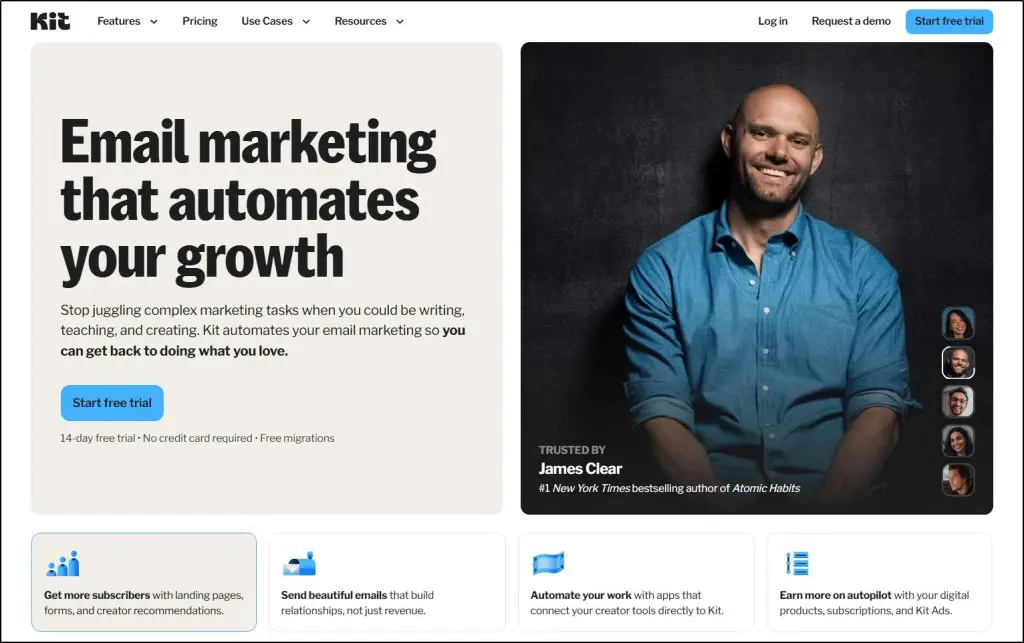
Kit is an email marketing, automation, and audience building platform for creators such as authors, podcasters, YouTubers, coaches, and online course sellers. More than 100,000 creators actively use it today, according to founder Nathan Barry.
It helps you grow your audience, send personalized emails, sell digital products or memberships, and now layer AI directly on top of your subscriber data, without juggling multiple tools.
The company was founded in 2013 by Nathan Barry, a creator himself who wanted a simpler way to manage email marketing and automate sales.

What started as ConvertKit has evolved into Kit, an email-first operating system for creators who want more control over their audience and income. Barry has explained the rename was not just cosmetic. Saying “ConvertKit” out loud creates an awkward collision between the “t” and the “K,” friction that adds up across a decade of every customer hearing or saying the name. One of ConvertKit’s early customers, blogger Leo Babauta of Zen Habits, told Barry he did not want the name appearing anywhere on his site because it made his readers feel funneled toward a sale rather than helped.
Some of the world’s most successful creators, including Ali Abdaal, Nisha Vora, and James Clear, use Kit to connect with their email subscribers and grow their businesses.
Unlike traditional marketing tools like Mailchimp or ActiveCampaign, Kit focuses on the specific needs of solo creators and small creative businesses. It is intentionally simple, with clear pricing, creator-focused monetization options, and a clean interface that does not overwhelm you with unnecessary complexity.
Here is what Kit brings together in one place:
- Email marketing and automation with a visual workflow builder
- Landing pages and opt-in forms to grow your list
- Audience segmentation with tags and conditional logic
- Commerce tools to sell digital products, subscriptions, and paid newsletters
- Recommendations and referrals to cross-promote and reward growth from other creators
- Newsletter sponsorships for monetization
- An AI connection layer through Kit MCP that plugs your subscriber data into tools like Claude or ChatGPT
- App Store integrations with tools like Canva, Thinkific, and Circle
In short, Kit gives creators a single, easy-to-use system to build, engage, and monetize their audience, without coding or managing multiple platforms.
Read: Email marketing best practices for online course creators
Kit (ConvertKit) Pricing & Free Plan | How Much Does It Cost?
Kit offers both a free plan and paid plans, depending on where you are in your creator journey.
All paid plans come with a 14-day free trial, no credit card required, and a 30-day money-back guarantee if you decide to cancel.
Newsletter Plan (Free), $0/month for up to 10,000 subscribers Creator Plan, starts at $39/month or $390/year for up to 1,000 subscribers Creator Pro Plan, starts at $79/month or $790/year for up to 1,000 subscribers
Kit Pricing Comparison (2026)
| Plan | Price (Monthly) | Subscriber Limit | Key Features | Best For |
|---|---|---|---|---|
| Newsletter (Free) | $0 | Up to 10,000 | 1 automation, 1 email sequence, unlimited landing pages & forms, tagging, segmentation, basic analytics, digital product sales, free recommendations | Beginners building an audience or testing Kit |
| Creator | $39 | Up to 1,000 | Unlimited automations & sequences, Kit MCP, paid recommendations, Smart Recommendations, basic A/B subject-line testing, remove Kit branding, polls, SMS marketing, RSS campaigns, App Store access, 24/7 email & chat support | Small creators ready to automate, monetize, and connect AI tools |
| Creator Pro | $79 | Up to 1,000 | All Creator features plus advanced A/B testing on subject lines and content, engagement scoring, Subscriber Signals, analytics dashboard, Facebook custom audiences, newsletter referral system, edit links in sent emails, priority support | Established creators and online businesses scaling email operations |
Pricing increases as your subscriber count grows, and many in my Learning Revokution community (including myself) feel this becomes a problem as you scale.
The jump feels manageable in the first few thousand subscribers, then starts to sting once a list scales past that, especially for creators who signed up when Kit was priced lower and have watched their bill climb as their list grew rather than as they added new tools or usage.
You can pay monthly or yearly and save with annual billing, which helps, but it does not offset the underlying trend.
The Newsletter Plan is generous for a free tier. It is enough to run a small newsletter or early-stage coaching business.
The Creator Plan adds serious automation, AI connectivity through Kit MCP, and monetization features.
Creator Pro focuses on growth and optimization with deeper analytics, subscriber-level intelligence, and advanced targeting tools.
How a Coach or Course Seller Might Use Kit
Let me give you general idea of the role Kit plays in your business as an edupreneur. You’re mainly using this platform to convert your audience into email subscribers and then monetize them by selling products.
That’s the core idea. But a lot goes into it.
Say you are a coach with a signature framework and no email list yet. You start in Kit by building a landing page with a single opt-in form tied to a free lead magnet, a short PDF, a template, a five-minute assessment, anything that solves one specific problem for your ideal client.
You embed that form on your website or point people to the Kit-hosted landing page directly from your Instagram bio or a podcast guest spot. That single page does the actual work of turning strangers into subscribers.
Once someone signs up, Kit tags them automatically based on which lead magnet or form they came through. If you run more than one offer, a course on public speaking and a separate one on pricing strategy, those tags let you target each segment with unique messaging.
Once a subscriber joins your list, you can create a weekly newsletter and define who receives it.
But don’t make it like a weekly sales pitch.
Each issue should feel like something your best client would forward to a colleague, a specific insight, a client story with the names changed, a short teardown of something in your field.
Kit’s editor handles this without friction, and because the newsletter lives on its own public feed, new visitors can browse past issues before they ever subscribe, which does some of your selling for you before you say a word.
Next, you can configure an automated welcome email sequence to kick start your subsriber relationship. A new subscriber gets two or three emails over their first week that introduce you, share your best free content, and set expectations for what is coming.
As the relationship with your subscribers grows, you can use Kit’s monetization tools to drive sales. For example, you can sell your course, a coaching package, or a paid membership directly through Kit Commerce, with the checkout, delivery, and follow-up automation already connected to the same tags and segments you built earlier.
Some coaches also add a paid newsletter tier for people who want more than the free content, or lean on Recommendations to get in front of other creators’ audiences without paying for ads.
None of this requires touching a separate landing page tool, a separate automation platform, and a separate payment processor. That is the actual pitch behind Kit for a coach or course seller, and the sections below walk through each of these pieces in more depth.
Kit Features | Email Marketing Tool Designed For Creators
Kit gives you tools for every stage of your creator journey.
It starts with your Creator Profile, a mini website that becomes your home base. From there, you can create newsletters, grow your audience, automate your email marketing, sell digital products or subscriptions, and connect AI assistants that act on your subscriber data directly, all in one place.
It replaces the messy stack of tools most creators juggle for landing pages, forms, email automation, and digital sales, and gives you a single system to build, engage, and monetize your audience.
Here is a closer look at each of those core capabilities.
Feature #1: Email Designer & Broadcasts
Kit comes with a drag and drop email designer which you can use to create eye-catching HTML email designs or send plain text emails to your subscribers.
It targets non-technical users, so you do not need any coding skills to create email campaigns. Simply create an email broadcast and add elements such as images, files, and videos to your email content.

Kit’s email designer allows you to add and edit different content blocks in real time. It also lets you upload your brand logo and other frequently used images to your image library for instant access.

Its built-in integration with Unsplash gives you free access to thousands of high-resolution images to use in your emails.
Every image, video, and content block in the Kit email designer is fully customizable, and if you are familiar with HTML you can switch to the HTML editing mode for advanced editing.
However, in my recent experience, getting a custom-coded form or template to display correctly on page builders like Wix takes real trial and error, and the design flexibility feels thin once you move past Kit’s own templates.
Other than that, you can also add animated counters and call-to-action buttons to drive more conversions from your emails. And you can create unlimited email templates for different email types so you do not need to build new messages from scratch.
Read: The best list building tools for creators
Feature #2: Newsletters — Build, Publish, and Grow Your Audience
At its core, Kit is still an email marketing platform. But newsletters are where it truly shines.
You can create and publish your newsletter directly inside Kit without needing WordPress, Substack, or any third-party platform.
Each creator gets a public newsletter feed and website, automatically generated from your email broadcasts. This acts as your online home base where new readers can browse past issues, subscribe, and share your content.

Kit’s newsletter tools include a built-in editor for writing and formatting your issues, plus customizable landing pages and opt-in forms to grow your list.
You can add links, polls, or recommendations directly in your emails, and track open rates, clicks, and subscriber growth as you go. If you want to turn free readers into paying members, you can layer a paid newsletter on top of all of it.
You can send unlimited newsletters on any plan, even the free one, up to 10,000 subscribers.
For creators running multiple newsletters, Kit’s tagging and segmentation system makes it easy to manage separate audiences and tailor your content for each.
Feature #3: Advanced Subscriber Management
Kit allows you to manage your email subscribers like a pro without unnecessary complexity. It is a subscriber-centric tool that uses tags and segments instead of lists for subscriber management.
Instead of creating new lists for every project, which causes contact duplication and other problems, you tag your subscribers based on their behavior and engagement with your content.
Then you use Kit’s advanced segmentation filters to organize your subscribers in any way you want. You can segment based on location, last activity, lead source, specific lead magnets, or any other behavior.

A subscriber can have multiple tags and be part of multiple segments since Kit maintains a central subscriber profile with complete activity history.
Based on these subscriber tags, you can create new email campaigns, automation sequences, lead magnet deliveries, and other messaging strategies.
Feature #4: Marketing Automation, Sales Funnels, and Drip Campaigns
Marketing automation is critical to building an online course business. With Kit, you can create multi-step marketing sequences that target your subscribers in different stages of their buying journey.
In addition, you can create sales funnels to convert your subscribers into customers and brand advocates.
The best part is that once you automate everything with these funnels, you can run a nearly hands-off business that keeps your subscribers engaged and drives passive income from your email list.
You do all of this using Kit’s visual automation builder.

Here’s what you can do with Kit’s automation.
1. Assign Tags And Segments
With Kit, you can create rules to automatically assign tags to new or existing subscribers and segment them based on predefined conditions.

This saves you countless hours by organizing your subscribers and giving you ready-to-use audience segments for your campaigns.
2. Create And Trigger Drip Campaigns
Kit allows you to create multi-step drip campaigns using if-then-else conditions. A drip campaign is a series of scheduled emails sent to specific subscriber segments based on predefined triggers.
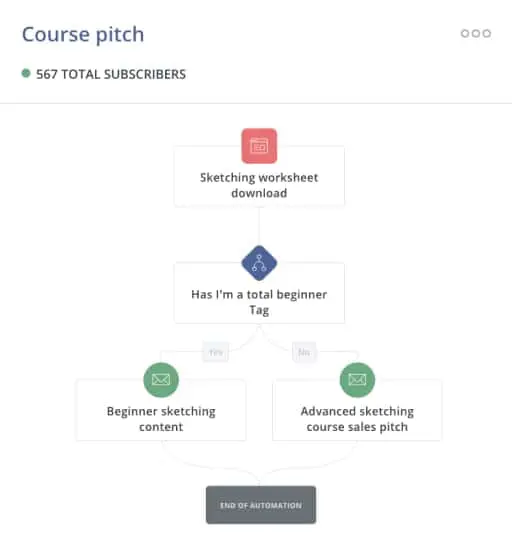
Using tags and segments, you can create long and complex email automations to be sent to any subscribers that meet your conditions.
3. Build Sales Funnels
With Kit’s visual funnel builder, you can create complete email journeys for your subscribers and transform them from strangers to customers and brand advocates on autopilot.
A funnel is a series of conditional steps in which you can serve different content types, including multiple drip campaigns, to your subscribers based on their actions.
Since funnels are often long and complex, you can use Kit’s funnel template library, which contains plug-and-play funnel templates for all kinds of email journeys.
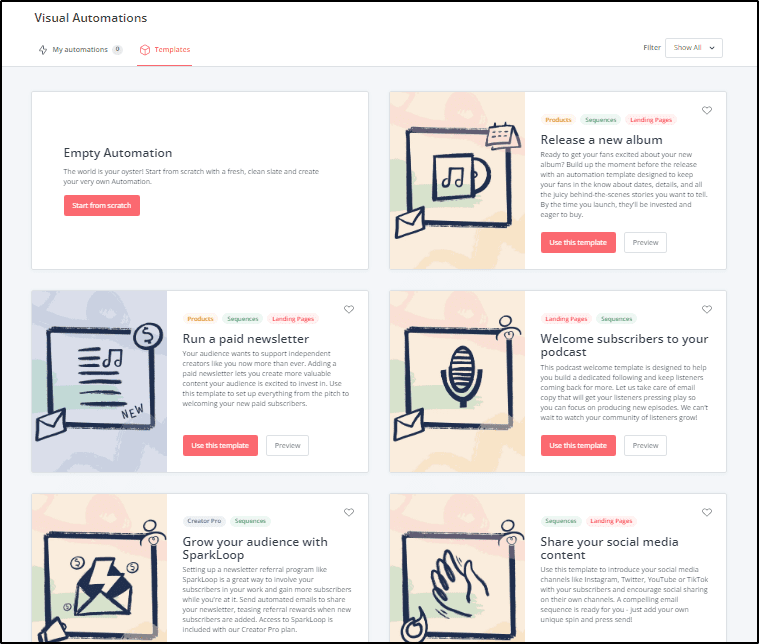
Alternatively, you can create a funnel from scratch using the visual funnel builder and offer it as a template to other Kit users.
4. Landing Page Builder And Opt-in Forms
You need high-converting landing pages and custom-designed opt-in forms to generate relevant and high-quality subscribers and leads for your business. Kit’s landing page designer offers both.
You can add or remove content blocks to your landing page using its drag and drop interface and edit any element you want.
You also get access to thousands of high-resolution Unsplash images to make your landing pages more attractive.

You can also create customizable opt-in forms to gather more information about your subscribers and segment them accordingly.
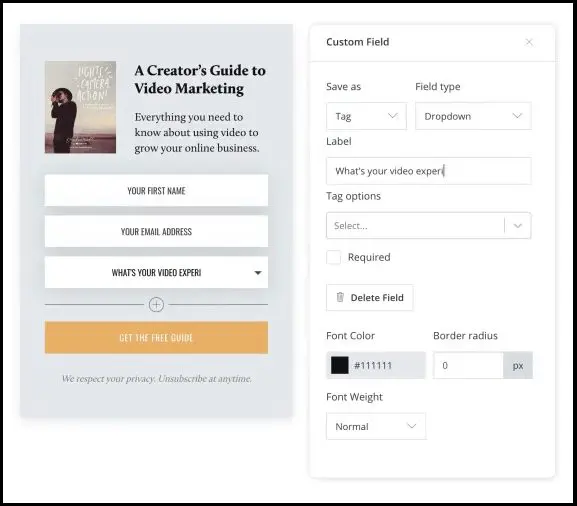
For example, you can add a dropdown to your opt-in form with multiple choices that describe your audience segments. Then, when a subscriber chooses one of those options, you can automatically apply specific tags and segment them for personalized targeting.
So, let’s say you’re building an email list for your freelancing course. To gather more specific information about your subscribers, you can add this dropdown to your opt-in form.
“What’s your expertise?”
“I’m a graphic designer
I’m a content writer
I’m a programmer
I’m a fiction writer
I’m a sales copywriter”
Knowing this would help you create different messaging strategies for writers, copywriters, designers, etc.
Feature #5: Kit MCP, Connect AI Tools Directly To Your Subscriber Data
Kit MCP is the feature that most changes how you interact with the platform day to day. It lets you connect Claude, ChatGPT, Gemini, and other AI tools directly to your Kit account, so any AI analysis or action pulls from your real business data instead of generic advice.
Once connected, you can ask an AI tool to tag subscribers, draft a broadcast, summarize engagement trends, or trigger a workflow, all from a single conversation.
You can also build a landing page this way, describing what you want to Claude or ChatGPT and having it generate the page using context from your actual subscribers and business. It works through the same permission-based connection model MCP servers use elsewhere, meaning you set what the AI can access and can revoke that access at any time.
Instead of exporting subscriber data or copying numbers into a chat window to get advice, you point the AI directly at your Kit account and it works with your actual list, actual tags, and actual send history.
But the quality of what you get out of it depends heavily on how specific your prompts are and how clean your existing tagging system already is.
Feature #6: Creator Profile, Your All-in-One Link Hub
Kit’s Creator Profile replaces the old link page feature and acts as your public home base, a mini website where your audience can explore everything you offer in one place.
You can showcase your newsletter, digital products, courses, and social profiles on a single customizable page.
It is perfect for adding to your Instagram bio, YouTube description, or email signature, giving your audience a clear next step wherever they find you.
Unlike traditional bio link tools, your Creator Profile connects directly to your Kit email list, product store, and automation workflows, making it easy to turn casual visitors into subscribers or customers.
You can personalize it with your brand colors, images, and call-to-action buttons, and update it anytime from your Kit dashboard.
For most creators, it is an instant, no-code alternative to a website that stays simple, fast, and directly tied to your audience-building system.
Feature #7: eCommerce Tools To Sell Digital Products, Newsletters, and Subscriptions
Beyond audience growth, Kit helps you monetize your email list directly, with no third-party tools needed.
You can sell digital products, paid newsletters, subscriptions, and coaching sessions, or accept tips through virtual tip jars.
Every product you sell lives inside your Creator Profile and connects seamlessly with your email automations and subscriber segments, so your marketing and sales always stay in sync.
You can set flexible pricing options including one-time payments, installments, subscriptions, or pay-what-you-want.
Stripe handles all transactions securely, and Kit charges a flat 3.5% plus 30 cents per sale, lower than many popular creator platforms.
Whether you are selling your first ebook or running a paid membership, Kit gives you a clean, integrated way to grow your income, without juggling Gumroad, Substack, and multiple payment tools.
Feature #8: Recommendations, Referrals, and the Creator Network
One of Kit’s most powerful growth features is its Creator Network, which helps you get discovered by new audiences through Recommendations.
You can recommend other creators in your email confirmation pages or newsletters, and in return, get recommended to their subscribers, creating an organic growth loop.
The feature includes both Free Recommendations, which help you grow your list, and Paid Recommendations, which pay you for referring subscribers. You can choose which creators to feature, track results inside your dashboard, and combine it with automations to instantly welcome new subscribers.
On top of that, the Pro plan includes a free SparkLoop plan worth $99 a month, which gives you a reward-based referral program on top of the recommendation network. It works differently from Recommendations because it rewards your own readers for sharing your newsletter directly, rather than routing you through other creators’ audiences.
For small and mid-sized creators, stacking Recommendations with this referral system on Pro can quickly become a consistent way to grow your list without relying on paid ads or complex funnels.
Feature #9: Newsletter Sponsorships
Newsletter sponsorships are one of the more direct ways to earn from your list. They connect you with brands that want to sponsor creator newsletters, so you can start generating revenue even with a small or mid-sized audience.
Once you join the program, Kit automatically matches you with relevant advertisers. You get to review and approve sponsorships, add ad placements to your newsletters, and get paid directly through your Kit account.
This feature integrates smoothly with Kit’s email designer and analytics. You insert ads just like any other content block and track impressions or engagement within your dashboard.
For many creators, this turns a regular newsletter into a consistent income stream, without needing to pitch brands or manage external sponsorship tools directly.
Feature #10: App Store & Integrations
Kit’s App Store turns the platform into a true creator hub, letting you connect your favorite tools for course creation, memberships, analytics, and design without touching a single line of code.
Inside the App Store, you will find direct integrations with platforms like Canva, Thinkific, Circle, Gumroad, Shopify, and Teachable, plus dozens of other apps covering automation, analytics, and design. TeachKit, Kit’s own free course builder, now lives here as an app rather than as a standalone dashboard feature, which is a slight demotion in visibility even though the tool itself still works the same way.
You can design a newsletter banner in Canva and insert it directly into your email editor, sync Thinkific or Teachable courses to automatically tag new students, or connect Circle or Slack to send automated welcome emails when someone joins your community.
All integrations connect through your Kit dashboard, so you can see how each app contributes to your subscriber growth and revenue.
For creators who previously had to juggle tools like Zapier, Mailchimp, and ConvertFlow, Kit’s App Store makes everything simpler, letting you build a connected, automated system that runs smoothly in the background.
Feature #11: Deliverability, Analytics, and Subscriber Signals
No matter how beautiful your emails are, they only matter if they reach your audience. Kit has built a strong reputation for email deliverability, meaning your messages are far less likely to land in spam or promotions folders compared to many competitors.
Behind the scenes, Kit handles technical essentials like DKIM, SPF, and domain authentication, helping maintain a positive sender reputation for every creator.
You also get transparent deliverability metrics including open rates, click-throughs, bounce rates, and unsubscribes, letting you track exactly how your emails perform over time. Kit added attribution-by-source and cohort-based engagement views, which closes part of the multi-channel gap creators used to flag.
It still will not trace a sale back through two or three other channels before it reached your inbox, so for that depth you will still end up piping data into a separate analytics tool, but the native reporting covers more ground than it did a year ago.
Every plan, including the free one, lets you A/B test subject lines on two variants at once.
On the Creator Pro plan, you get access to subscriber engagement scoring, an analytics dashboard, and advanced A/B testing that stretches to five subject line variants or full content tests, which shows which emails or automations are driving the most conversions.
The newer piece here is Subscriber Signals, in early access on Creator Pro. It pulls demographic, industry, and social reach data on individual subscribers, so instead of a flat list of email addresses you can see who is actually behind them.
In an email to his public list, Kit’s founder Nathan Barry has pointed to an early user, Terry Rice, as proof of what this can surface. Running Signals on his list showed Terry that most of his subscribers were parents, a pattern he had never noticed, and within days he launched a product for that audience and picked up coverage in Forbes.
That is a real result, but it is still one example from early access. The accuracy of the data depends heavily on what public signals exist for a given subscriber, which will vary across your list, so spot-check a sample before you build a sponsorship pitch entirely around the numbers it gives you.
Kit Pros and Cons: What Are Its Strengths & Weaknesses?
| Pros | Cons |
|---|---|
| Excellent deliverability (99.8%) that keeps your emails out of spam folders and actually reaching subscribers | No mobile app yet, so managing campaigns on the go still means using a browser |
| Kit MCP connects AI tools directly to your real subscriber data, ahead of most competitors in this space | Kit MCP is new and still limited to tagging, drafting, and workflow triggers rather than deep strategic analysis |
| Free plan for up to 10,000 subscribers, including automations, product sales, and newsletters | Subscriber Signals is early access on Pro only, and its accuracy will vary depending on how much public data exists for each subscriber |
| Visual automation builder that makes complex automations and funnels easy for non-technical users | TeachKit is a basic course builder, fine for testing an idea but missing quizzes, progress tracking, or certificates |
| All-in-one creator platform combining email, automations, landing pages, digital product sales, sponsorships, recommendations, and free recording studios in three cities | Not ideal for physical product sellers because it has no shipping or catalog support |
| Transparent and simple pricing with no hidden fees beyond the 3.5% plus 30 cents transaction fee on product sales | Free migration is included on any paid plan, but lists under 10,000 subscribers get a lighter version that skips rebuilding forms and automations |
Kit vs. Mailchimp: What’s the Difference?
People often compare Kit and Mailchimp because both offer email marketing and automation. But they serve entirely different users.
Mailchimp is a general-purpose marketing platform designed for small businesses, eCommerce stores, and agencies. It comes with features like ads, social posting, and CRM tools that make sense for companies managing multiple clients or product lines.
Kit, on the other hand, serves creators like authors, YouTubers, coaches, and online course sellers who want to grow an audience, nurture relationships, and sell digital products.
The overlap between the two shows up in how people move between them. A meaningful share of new Kit customers come over from Mailchimp, and when creators eventually outgrow Kit, ActiveCampaign is the most common next stop, not Mailchimp. The reasoning lines up with each platform’s actual focus. Mailchimp serves a broader small-business use case from the start, while Kit and ActiveCampaign both lean toward audience-first, automation-heavy workflows once you need more horsepower than Kit’s simplicity can offer.
| Feature | Kit | Mailchimp |
|---|---|---|
| Focus | Built for creators, course sellers, and coaches | Built for small businesses and eCommerce stores |
| Free plan | Up to 10,000 subscribers | Up to 500 contacts |
| Automation | Visual builder, tag-based logic, easy workflows | Complex but harder to learn |
| AI integration | Kit MCP connects Claude, ChatGPT, and Gemini directly to your account data | No equivalent direct AI-to-data connection |
| Monetization | Built-in product sales, paid newsletters, sponsorships | Primarily focused on lead nurturing |
| Commerce tools | Sell digital products, memberships, and courses | Integrates with Shopify and WooCommerce for physical products |
| Recommendations & referrals | Yes, grow with cross-promotions and a built-in referral system | No built-in creator recommendation network |
| Analytics | Solid reporting plus subscriber-level Subscriber Signals data in early access | More advanced general reporting and A/B testing |
| Best for | Individual creators and educators | Small businesses and marketing teams |
If you are a creator selling digital products or courses, Kit is the better fit. It is simpler, faster, and gives you the right tools to grow and monetize an audience.
If you run a physical eCommerce store or need advanced reporting and design flexibility, Mailchimp might be more suitable.
Kit Review Verdict | Is It the Best Email Marketing Software for Course Sellers?
Kit has come a long way since its early days as ConvertKit. What started as a simple email marketing tool is now a full creator platform that lets you grow your audience, automate sales, and earn directly from your subscribers, all in one place.
It serves creators who sell knowledge, whether through courses, coaching, memberships, or newsletters. The interface is simple, the automation builder is powerful, and the addition of Kit MCP genuinely puts it ahead of most competitors on the AI front.
That said, Kit is not for everyone.
If you are an advanced marketer who needs deep A/B testing, sophisticated reporting, or rich design customization, you might outgrow it fast. And if you sell physical products, Kit is not the right fit at all.
But if your business revolves around your expertise, audience, and content, Kit is one of the most creator-friendly email marketing platforms you can use.
It delivers everything most course sellers and digital entrepreneurs need, without overwhelming you with features you will never touch.
Frequently Asked Questions
1. Why did ConvertKit change its name to Kit?
ConvertKit rebranded to Kit to reflect its broader mission as an email-first operating system for creators. It is no longer just an email tool. Kit now includes digital product sales, newsletter sponsorships, recommendations, and a direct AI connection layer through Kit MCP.
2. Who founded Kit, and why is it called Kit?
Nathan Barry founded the company in 2013 as ConvertKit. He has said the name change to Kit fixed a real problem, saying “ConvertKit” out loud creates an awkward collision between the “t” and the “K,” friction that compounds across every customer interaction over time.
3. Does Kit offer AI tools or automation assistance?
Yes. Kit MCP connects Claude, ChatGPT, and Gemini directly to your Kit account so these tools can tag subscribers, draft broadcasts, and trigger workflows using your real data. It is available starting on the Creator plan and you control what access it has at all times.
4. Can I run multiple newsletters with one Kit account?
Yes. Kit uses tags and segments instead of separate lists, so you can manage multiple newsletters or audiences under one account. One list can serve your course subscribers while another gets your weekly newsletter, all automated within the same dashboard.
5. Is Kit good for selling online courses?
Yes, especially for creators selling smaller courses or digital lessons. TeachKit lets you deliver course content via email or private pages, though it lives inside the App Store now and is still limited compared to full LMS platforms. For larger courses, integrate Kit with Thinkific or Teachable.
6. How does Kit handle payments and fees?
Stripe processes all payments, and Kit charges a 3.5% plus 30 cents transaction fee per sale. You pay no extra charges for paid newsletters, memberships, or digital product sales.
7. Can I use Kit with my existing website or blog?
Yes. You can embed Kit’s opt-in forms, landing pages, and newsletters directly into WordPress or any other CMS. Kit also provides a free Creator Profile page that works like a mini website if you do not already have one.
8. What makes Kit better than Substack or Beehiiv?
Kit gives you full ownership of your audience and email list, with flexible design, automations, direct product sales, and now direct AI connectivity through Kit MCP. Substack and Beehiiv are great for publishing newsletters, but Kit adds more business tools around monetization and automation.
9. Does Kit integrate with other creator tools like Canva or Circle?
Yes. Kit’s App Store connects you with 100+ creator tools, including Canva, Circle, Thinkific, Linktree, SavvyCal, and Transistor.fm. You can design assets, sync communities, and embed podcasts, all from inside your Kit account.
10. What kind of analytics does Kit provide?
You get detailed performance tracking for open rates, click-throughs, deliverability, and conversions. Creator Pro users also get subscriber engagement scores, an insights dashboard, and early access to Subscriber Signals for subscriber-level demographic data.
11. Does Kit support team accounts or collaboration?
Yes, but with limits. The Newsletter plan supports one user, the Creator plan allows two, and Creator Pro offers unlimited users. It does not suit large marketing teams, but it works well for solo creators or small teams managing a shared brand.
12. Can I migrate from Substack or Mailchimp to Kit?
Yes, and it comes free with any paid plan. If you have under 10,000 subscribers, Kit’s team moves your subscribers, tags, and segments over in a few business days. Past 10,000, they also rebuild your forms, automations, and templates for you.
13. Is Kit GDPR and privacy compliant?
Yes. Kit is fully GDPR-compliant and offers double opt-in forms, subscriber data export options, and clear unsubscribe controls to help creators manage email privacy legally and ethically.
14. Does Kit support A/B testing?
Yes, on every plan. The Free and Creator plans let you test two subject line variants per email. Creator Pro extends this to advanced A/B testing, up to five subject line variants or a full content test, so you can see which version drives clicks, not just opens.

Jeff Cobb, Founder of Learning Revolution
Jeff Cobb is an expert in online education and the business of adult lifelong learning. Over the past 20+ years he has built a thriving career based on that expertise – as an entrepreneur, a consultant, an author, and a speaker. Learning Revolution is a place where Jeff curates tips, insights, and resources to help you build a thriving expertise-based business. Learn more about Jeff Cobb here.
Table of Contents
Related Posts
Camtasia Review (2026) – Is It The Best Screen Recording & Editing Tool | Pricing, Pros & Cons
110 Email Marketing Statistics for Marketers and Creators (2026)
21+ Best ChatGPT Prompts for Course Creators [With Examples]