

TL;DR: What Is Descript AI and Do I Recommend It?
Descript is a text-based AI audio and video editor that’s ideal for non-technical users. For course creators, coaches, and educational content creators, it brings recording, editing, AI generation, and repurposing into one tool, with Underlord (its internal AI assistant) handling tasks you describe in plain language.
Descript starting price: $24 per person/month with monthly billing, or $16 per person/month billed annually.
Free plan: An ongoing free plan includes 1 media hour a month, 100 one-time AI credits, with export restrictions.
Core features in Descript
Text-based editing and AI transcription: Turn recordings into text, then delete or rearrange passages to edit the matching audio and video.
Video, screen, and remote recording: Record lessons, demonstrations, and guest interviews.
Underlord AI co-editor: Request edits, layouts, and clips through written instructions.
Studio Sound and cleanup tools: Improve speech clarity, remove filler words and retakes, and shorten pauses.
AI video generation: Build videos from prompts, scripts, presentation PDFs, or articles using narration and visuals.
AI voices and avatars: Generate spoken narration and optionally add a virtual presenter.
Captions and reusable layouts: Add readable subtitles and consistent designs across lessons and social videos.
Create Clips: Turn longer recordings into shorter videos for social platforms.
Regenerate: Replace short spoken passages, with supported video corrections that also adjust mouth movements.
Translation and dubbing: Adapt content with translated subtitles or generated speech in another language.
ChatGPT and Claude integration: Connect through MCP so your assistant can perform supported Descript tasks for you.
Try Descript for Free Now
I’m seeing a clear trend across industries, and if you keep a close eye on social media, you’ve probably noticed it too.
Consultants, coaches, and even regular corporate professionals who used to stay mostly quiet online, have suddenly started posting tons of text content on LinkedIn, Facebook, and other platforms.
But many don’t realize they’re hurting their credibility instead of building it.
Their posts read like unedited AI output, copied and pasted without much thought. Once you recognize the patterns, they’re hard to miss.
In my experience, a much better way to stand out is through engaging videos where you share advice, explain strategies, or demonstrate something your audience wants to learn. People get to hear you think through an idea and see what you bring to the subject.
Video can support learning, too. In a 2025 study, 94.9% of respondents said videos helped reinforce concepts.
Of course, turning your expertise into online course lessons, YouTube videos, or LinkedIn clips takes editing time you may not have.
Descript can simplify that work with text-based editing and AI tools. I’ve been using it for several years and it has gradually evolved into a strong AI video generation and editing platform.
In this review, I’ll explain what it does, where it helps, and whether it’s right for your business.

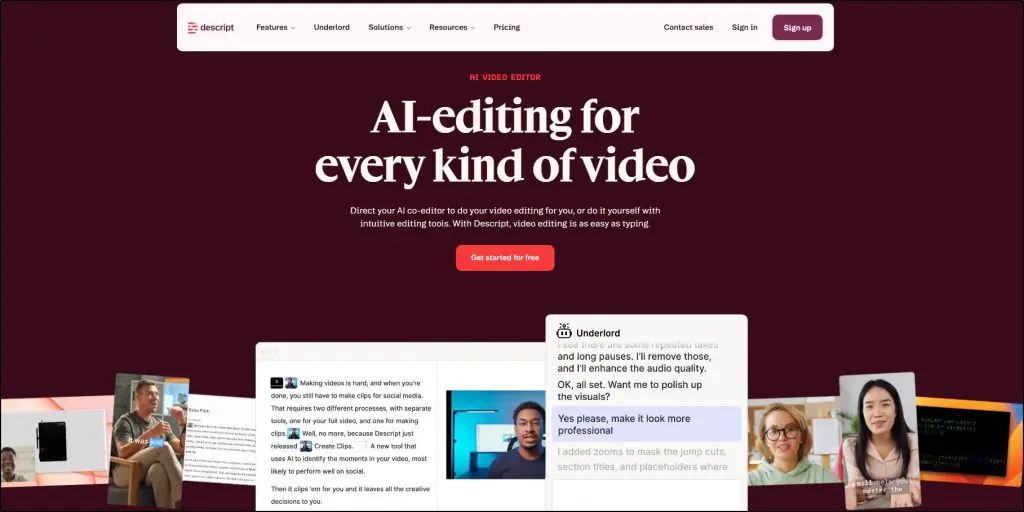
Descript Product Snapshot: What Exactly Does It Offer
| Core capability | What it offers | Main limitation or consideration |
| What is Descript? | An AI-powered audio and video creation tool combining recording, text-based editing, visual design, and generated media. | It doesn’t replace every specialized animation or post-production tool. |
| Main use case for edupreneurs | Create and polish course lessons, tutorials, interviews, and videos that share your expertise on YouTube, LinkedIn, and Instagram. | It helps produce content. You still need a platform to sell and deliver your courses. |
| Starting price | Hobbyist starts at $16 per person/month, billed annually, or $24 billed monthly. | Compare media allowances, AI credits, and feature access before choosing a plan. |
| Free plan or trial? | A $0 free plan lets you explore the editor and try AI tools before upgrading. | Usage and export restrictions apply. This is different from a temporary trial of a paid plan. |
| Recording and importing | Record lessons, screen tutorials, and remote interviews, or import existing recordings. | Your microphone, camera, and recording environment still affect source quality. |
| Transcript and timeline editing | Remove passages by deleting transcript text, then use the timeline for finer adjustments. | Correcting a transcript typo doesn’t change the spoken audio. Detailed edits require learning the controls. |
| Audio and video enhancement | Clean up speech, shorten pauses, adjust eye contact, and change backgrounds. | Review results for unnatural cuts, voice changes, or visual distortions. |
| AI-assisted editing | Ask Underlord to organize content, make edits, and adapt layouts using written instructions. | Results depend on your instructions and project content. Review the changes before publishing. |
| AI video generation | Start with a prompt or script to create videos with narration and visuals, including avatar presentations and animated content. Generate individual clips for larger projects, then edit the results in Descript. | Prompt-based generation differs from detailed control over character animation, complex effects, or cinematic sequences. Expect to refine the output; feature access and AI credits apply. |
| AI voices, avatars, and images | Generate narration, pair a voice with a visual presenter, or create supporting images for lessons and other content. | Access and usage limits vary by plan. Check pronunciation, accuracy, and how well the results fit your message. |
| Repurposing, sharing, and exports | Turn longer recordings into clips, draft supporting copy, share for feedback, and export finished content. | Check that clips preserve context. Export options depend on your plan, and direct publishing supports selected destinations. |
What Is Descript AI and What Does It Do for Content Creators?
Descript is an AI-powered audio and video editor and generator that brings recording, editing, visual design, and AI content creation tools into one place.
If you’re a coach, consultant, or online course creator, you can use Descript to turn your knowledge into course lessons, YouTube tutorials, interviews, podcasts, and short videos for social media.
I’m talking about videos like this one edited with Descript.
There are two main ways to get started.
- You can record yourself, your screen, or a conversation, then edit and polish that recording to turn it into an engaging and modern piece of content.
- Or you can start with a script or prompt and use AI to generate narration, visuals, or an avatar presentation.
Its text-based editing is probably the easiest way to understand how it works.
Say you record a lesson and spend two minutes explaining something before realizing you’ve already covered it. Descript turns your recording into a written transcript. Select that repeated passage, delete it, and the matching audio and video are removed too.
You can then add captions, images, music, and graphics, or ask its AI assistant, Underlord, to help with editing tasks.
Descript includes visual effects, transitions, animated elements, and AI video generation. Those capabilities can help you create polished educational and promotional content.
But it doesn’t have detailed character animation, complex cinematic effects, or precise control over every visual movement like more advanced professional video editors. It’s not built for that kind of video creation or editing.
Descript Features List
- Video, screen, and remote recording: Record yourself, a screen demonstration, or remote guests to create lessons, tutorials, and interviews.
- Transcription and text-based editing: Turn recorded speech into text, then delete or rearrange passages to edit the matching audio and video.
- Timeline and multitrack editing: Fine-tune cuts and adjust separate audio and video tracks, such as muting an interruption while keeping your guest’s response.
- Audio cleanup and pacing tools: Reduce background noise, remove filler words, and shorten long pauses to make your explanations easier to follow.
- Multicamera editing: Switch between recorded speaker views automatically or manually to give interviews and video podcasts more visual variety.
- Captions, layouts, and visual elements: Add subtitles, reusable designs, images, and graphics to clarify your message and keep your videos visually consistent.
- Underlord AI assistance: Give written instructions to help organize your content, make edits, and adapt layouts without handling every adjustment yourself.
- AI speech, avatars, and generated media: Create narration, virtual presenters, images, and video from scripts or prompts to build content or supplement your recordings.
- Clips and publishing support: Turn longer recordings into short videos and draft titles, descriptions, and social posts to support regular publishing.
- Sharing and export options: Share drafts for feedback and export video, audio, transcripts, or subtitles for use on your course platform and other channels.
Descript Pricing and Trial
Descript offers a free plan with no credit card required, so you can try its editing workflow before paying. It includes 1 media hour a month, 100 one-time AI credits. Those credits let you experiment with AI features, but they don’t renew monthly on the free plan.
There are four paid plans, including a custom-priced Enterprise option. Prices are per person.
- Hobbyist: $16/month on annual billing or $24/month paid monthly. For solo creators who need basic production tools and watermark-free videos.
- Creator: $24/month on annual billing or $35/month paid monthly. For regular publishing with more AI capacity and higher-resolution exports.
- Business: $50/month on annual billing or $65/month paid monthly. For teams needing shared branding and additional production features.
- Enterprise: Custom pricing. For organizations with larger production, security, and support requirements.
| Plan | Main features | Best for |
| Free | 1 media hour a month, 100 one-time AI credits. Text-based editing | Trying the workflow with a short recording |
| Hobbyist | 10 media hours, 400 AI credits a month. Watermark-free 1080p exports | Solo coaches and consultants publishing occasional lessons or videos |
| Creator | 30 media hours, 800 AI credits a month. 4K exports, stock library, and usage top-ups | Course creators and experts publishing regularly |
| Business | 40 media hours, 1,500 AI credits a month. Brand Studio, translation, and custom avatars | Small teams producing branded content at greater volume |
| Enterprise | Custom allowances, organizational controls, and dedicated support | Larger education businesses and production teams |
Here’s the full plan-by-plan comparison.
| Feature | Free | Hobbyist | Creator | Business | Enterprise |
|---|---|---|---|---|---|
| Media hours a month | 1 | 10 | 30 | 40 | Custom |
| AI credits a month | 100 (one-time) | 400 | 800 | 1,500 | Custom |
| Export quality | 720p, watermarked | 1080p, no watermark | 4K, no watermark | 4K, no watermark | 4K, no watermark |
| Underlord AI co-editor | Limited | ✓ | Full access | Full access | Full access |
| AI Speech with custom voice clones | ✗ | ✓ | ✓ | ✓ | ✓ |
| Generate video with the latest AI models | ✗ | ✗ | ✓ | ✓ | ✓ |
| Custom avatars | ✗ | ✗ | ✗ | ✓ | ✓ |
| Royalty-free stock media library | ✗ | ✗ | Unlimited | Unlimited | Unlimited |
| Translate and dub in 30+ languages | ✗ | ✗ | ✗ | ✓ | ✓ |
| Brand Studio | ✗ | ✗ | ✗ | ✓ | ✓ |
| SSO, SCIM, and audit logs | ✗ | ✗ | ✗ | ✗ | ✓ |
Media minutes cover imported or recorded content processed in Descript. AI credits cover AI tasks.
Your finished video’s length alone won’t tell you how much allowance you need.
I’d start with the free plan and edit something you actually intend to publish. That will give you a better sense of which paid features you need than experimenting with an empty project.
What Do Descript’s AI Credits Actually Cover?
Think of AI credits as your allowance for asking Descript’s AI to do work. 400 credits doesn’t mean 400 videos or 400 minutes of editing. Different tasks consume different amounts.
Here’s how that works:
| What you do | How it affects your allowance |
| Record a 30-minute interview in Rooms | Uses 30 media minutes, regardless of the number of participants. This is separate from AI credits. |
| Apply Studio Sound manually | Uses AI credits, with a maximum charge of 30 credits per file for that application. |
| Remove filler words manually through the tool | Uses AI credits, also capped at 30 credits per file for that application. |
| Generate narration, images, or video | Credit use varies with the output and model selected. |
| Ask Underlord to edit your project | Uses credits for its work and any chargeable tools it runs. Even chat messages consume credits. |
For example, applying Studio Sound and filler-word removal once each to the same recording would use at most 60 credits when you run those tools directly. Asking Underlord to handle the job also involves its own credit usage.
My advice is to finish one typical lesson or video, then check Settings → Usage.
That gives you a practical starting point for estimating your needs, although Underlord’s costs can vary between similar requests.
Descript Pros and Cons
| Pros | Cons |
| You can make basic cuts by editing text. Delete a repeated explanation or mistake from the transcript, and Descript removes that part of your recording. | Precise editing is possible, but it gets more complex. You’ll need to learn controls for separate speakers, scenes, and visual layers. That takes time and effort, so these edits aren’t as simple as editing a text document. |
| You can record and edit in the same place. Record a screen tutorial or invite guests through Rooms, then edit the footage without moving it into another app. | Slow responses can hold up your work. Editing changes and AI tasks can take time to process, so you may spend part of your session waiting rather than editing. |
| You can clean up common speaking mistakes without fixing each one manually. Studio Sound reduces background noise, while other tools remove filler words and shorten long pauses. | These cleanup tools use AI credits. Your subscription doesn’t give you unlimited AI editing. Cleaning recordings uses credits you might also need for narration, generated visuals, or Underlord. |
| You can reuse your designs across lessons and videos. Save your fonts, colors, speaker labels, and intro layouts instead of building them again for every recording. | Getting your first custom design right takes work. You still need to arrange the text and images, set when they appear, and check how they look throughout the video. |
| You can ask Underlord to make specific changes for you. For example, it can mark where new topics begin or change your layouts for vertical social clips. | You can’t reliably translate credits into a fixed number of edits. Underlord’s charges vary with the work it performs, and even chat messages use credits. Check your usage after a typical project before choosing a plan. |
| You can create social clips from an existing recording. Choose a passage yourself or ask Descript to find clips of roughly the length you want. | You still need to decide whether each clip is worth publishing. Watch it on its own to check that the opening makes sense, the ending feels complete, and the edit preserves your point. |
| You can correct some spoken mistakes without recording again. Regenerate can replace a short passage, while AI speech lets you create narration from a script. | Replacement speech may need another attempt. Listen for pronunciation, tone, and changes in how your voice sounds before adding it to a finished lesson. |
| You can export content for different uses. Download video for your course or YouTube channel, audio for a podcast, and transcripts or subtitles to accompany them. | Your plan limits what you can produce and export. Check its recording allowance, AI credits, export resolution, and watermark restrictions before committing to a course or regular publishing schedule. |
Descript Examples & Use Cases: My Experience of What You Can Do With It
I’ve been using Descript since 2022 and have watched it grow from a useful text-based video editor into an AI-powered editing and generation suite.
I recommend it to course creators, coaches, and consultants because it fits the kind of content we produce: lessons, tutorials, interviews, and videos where we explain something on camera. You can make that content look professional without spending hours adjusting every cut and graphic.
That’s why I recommend it to the Learning Revolution community. It gives you a practical way to polish your knowledge and put it in front of people.
If you have time, watch this video that shows exactly how you can make an ordinary video recording look like a million dollars with simple edits in Descript.
I wouldn’t choose it for a project built around complex cinematic effects or detailed character animation. Its appeal is much clearer when you’re teaching, explaining, interviewing, or sharing advice.
I particularly like the ready-made layouts and visual elements. You can add styled captions, speaker name labels, split-screen interviews, and branded intros without designing everything yourself.
The tools for turning longer recordings into social clips also show that Descript understands how its audience publishes.
Here are the uses I find most relevant.
Create and Update Course Lessons
If you teach through presentations, screen demonstrations, or recorded explanations, Descript gives you the tools to turn that material into a finished lesson.
Say you’re demonstrating a process and realize halfway through that your explanation is getting confusing. You can try again while recording, then remove the first attempt afterward. Add captions and a few helpful visuals, and you have a lesson that’s easier to follow.
I also see value in being able to update individual passages. You may be able to replace an outdated explanation without recording the entire lesson again. If the demonstration itself has changed, though, you’ll still need fresh footage.
Build a YouTube Channel Around Your Expertise
The questions clients ask you are a useful starting point for YouTube content. Each one gives you a subject you already understand and a reason for someone to watch.
A consultant could explain how to avoid a common business mistake. A coach could demonstrate an exercise they use with clients. Descript helps you tighten that recording and add screenshots, captions, or on-screen points where they make the explanation clearer.
For me, the benefit is making a repeatable format. Once you’ve settled on your layout and style, you can reuse them and spend more of your attention on what you want to say.
Publish Knowledge-Based Videos on LinkedIn and Instagram
You don’t need a long presentation every time you want to share an idea. A short explanation of something you’ve noticed in your work can give people a useful introduction to your thinking.
Descript lets you present that idea with captions, a clear title, and a layout that suits the platform. Those details matter when someone encounters your video while scrolling and needs to understand the subject quickly.
I’d keep these videos focused on one point. Give people an explanation or example they can use, then let your growing collection of content show the depth of your expertise.
Record Interviews and Podcasts
Interviews let you bring other perspectives into your content and explore questions your audience cares about.
You could invite another practitioner to discuss a shared challenge, interview someone about their experience, or build a recurring series around your area of expertise.
Descript combines remote recording with tools for editing the conversation, showing different speakers, and adding names or topic labels.
I like having those tasks together. You can work toward a finished episode and prepare shorter excerpts from the same project, giving the conversation a life beyond its original release.
Repurpose Webinars and Longer Recordings
A webinar may contain several useful explanations that deserve to reach people who didn’t attend. Descript helps you pull those passages into separate clips and adapt their layouts for different platforms.
You can also draft descriptions, summaries, and social posts to accompany them.
This is one of its most useful business applications in my view. You’ve already done the work of preparing and explaining the material. Repurposing gives you more ways to share it.
But watch each clip on its own before publishing.
Someone seeing it on LinkedIn won’t have the context of the previous twenty minutes. You may need to add an introduction or trim the ending.
Create Narrated or Avatar-Led Videos
Sometimes you need to explain something without appearing on camera. You might be preparing a narrated walkthrough, a short introduction to a resource, or supporting material for a lesson.
Descript lets you start with a script and generate narration, add visuals, or use an avatar as the presenter. That gives you another production option when recording yourself is impractical.
For a coaching or consulting business, I’d use this selectively.
Your voice, personality, and way of explaining things are part of what people are choosing when they work with you. Generated presenters can serve a purpose, but I’d still make room for videos where your audience gets to know you.
How Descript Works? My Experience of Its Main Features
You can start using Descript with a recording you already have, record something new, or create a video from a script or prompt. From there, Descript brings the transcript, audio, visuals, and editing tools into one project.
That’s what makes it useful for the kind of content I recommend creating like lessons, demonstrations, interviews, and short videos that show people how you think.
With Descript, you can handle much of the production yourself, with AI assistance where it helps.

Let me walk you through its core features and how they work
1. Underlord: Descript’s AI Co-Editor
Underlord is Descript’s AI assistant that stays with you while you’re using the platform. It gives you a way to ask for changes without finding every editing control yourself. It’s a chat assistant inside Descript, but its role goes beyond answering questions. It can perform supported editing tasks on your project.
For example, you might ask it to turn part of an interview into a vertical clip, add captions, or improve the layout. It can also help develop a script and assemble scenes with narration and supporting visuals.
Think of it as a way to describe the result you want instead of figuring out every step yourself. You still have access to the editor when you want to make changes directly.
For example, I asked it to develop a script and generate an AI avatar for me.

I wanted the avatar to look more realistic.
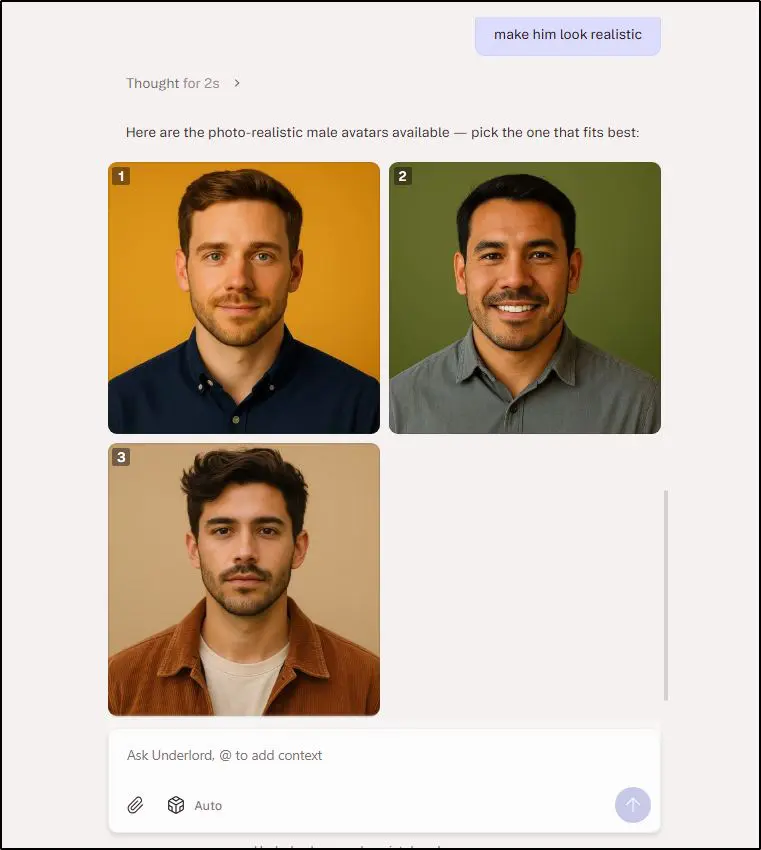
I decided to take them into the editing timeline and Underlord came along with me.
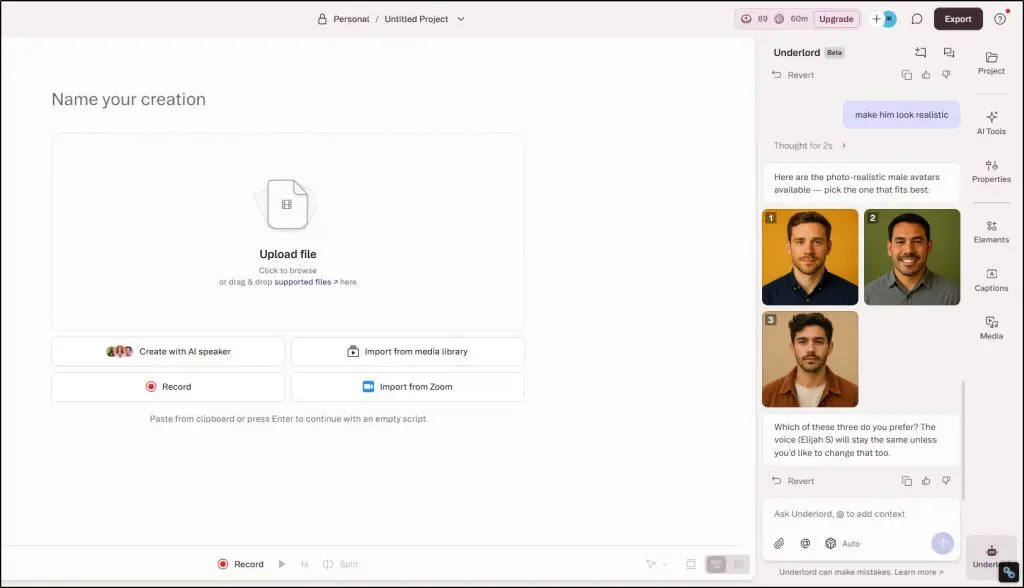
The more specific your request, the easier it is to judge the result. For a coaching video, I’d give it a direction such as:
“Shorten this answer by removing repetition. Keep the practical example and the explanation that follows it.”
That tells it more than “make this better.” It also establishes what matters to you.
Underlord needs something to work with. If you want feedback on a recording, you need to add the recording first. If you’re starting from scratch, you need to supply an idea or script.
I’d treat its work as a draft you review. It can remove a passage you wanted, choose an unsuitable visual, or misunderstand an instruction.
You can ask for another change or use the manual controls. Its requests also consume AI credits, so repeated revisions affect your allowance.
Let ChatGPT or Claude Use Descript for You
Underlord is Descript’s internal AI assistant. But if you already use Claude or ChatGPT, you can let them handle Descript for you instead of doing everything yourself.
Descript’s MCP integration lets you connect your account to ChatGPT or Claude and give that AI assistant permission to operate Descript for you.
That means you can describe what you want in ChatGPT or Claude, and the assistant can find your project and request edits through Underlord. You don’t have to carry out every instruction yourself.
For example, you could say:
“Find my webinar about course pricing. Create a 60-second clip explaining why charging too little can hurt sales. Keep the practical example, clean up the sound, and add captions.”
The assistant can use Descript’s supported tools to work toward that result. You then review the clip and request changes.
For a beginner, this can remove a substantial part of the learning barrier. You can start by explaining what you want to achieve, without first learning where every editing control lives.
I see this as a powerful option for coaches and consultants who already use ChatGPT or Claude to develop content. The same conversation can move from planning a video to getting editing work done.
2. Editing an Existing Recording
Descript lets you edit videos like a text document in the sense that when you remove or edit a section in your video’s transcript, it automatically reflects in your video or audio as well.
Let me explain.
Suppose you’ve recorded a lesson explaining your method, but you repeated a few points, paused to gather your thoughts, and went off-topic halfway through.
After you import the recording, Descript creates a transcript. You can read through it, delete the sections you don’t want, and remove the matching audio and video. You can also move passages if the explanation would make more sense in a different order.
This is the part I find easiest to recommend. Editing an explanation by reading it feels more familiar than hunting through a video timeline.
However, correcting a transcription error doesn’t change what you actually said. If Descript mishears a name, you can fix the text. If you said the wrong name, you need a new recording or a speech replacement tool such as Regenerate, then check the result.
Once the explanation is tight, you can improve its presentation:
- Studio Sound helps clean up speech and reduce background noise.
- Filler-word and pause tools help remove verbal clutter and shorten gaps.
- Captions and layouts give you a starting point for readable text and a consistent look.
- Images, screenshots, and other visuals let you show the example you’re explaining.
For on-camera recordings, tools such as Eye Contact and background removal can also help adjust your appearance. I’d preview these carefully; an effect is only useful if the finished video still looks natural.
If you’re teaching software, you can record your screen directly in Descript instead of importing a finished recording.
More precise work takes more effort.
For example, keeping a screenshot visible for exactly the right sentence or adjusting an awkward cut may require Descript’s timeline editor. Descript can do that work, but you’ll need to learn those controls. This part isn’t always as simple as editing a document.
3. Generating a Video From a Script or Prompt
Descript can also help turn a script or prompt into a video with narration and visuals. You can use an AI voice to read the script and optionally add an avatar for onscreen presence.
AI narration doesn’t require an avatar, it’s just an option. You can pair the voice with screenshots, text, stock media, or generated images and video as well.
Underlord can help assemble that material into scenes, which are sections of your video with their own visual arrangements. You can then change the wording, replace media, and adjust the presentation.
But you should review the narration, facts, and visuals before publishing.
Descript also offers an animated-video workflow, but I wouldn’t confuse that with the detailed control of dedicated animation software. Generating illustrated or animated content from prompts is different from directing every character movement and effect.
For personal-brand content, I’d use generation selectively.
It can help you produce supporting material, but I’d still make room for your actual face, voice, and examples. People considering your coaching or consulting services benefit from seeing how you explain things yourself.
4. Recording and Editing a Podcast or Interview
Interviews give you a way to share useful knowledge without having to deliver every idea yourself. Descript’s Rooms supports remote recording, and you can bring the conversation into the editor afterward.
You can also import recordings made elsewhere.
Separate speaker tracks are particularly useful here. Each person’s recording sits on its own layer, so you can adjust one without necessarily changing the other.
For example, if you interrupt while your guest is finishing a useful explanation, you can silence your interruption while keeping their answer, provided the speakers were recorded separately.
For video interviews, you can choose between showing the active speaker, both people together, or another layout. Automatic multicamera editing can help choose the views, while manual controls let you change those choices.
I like having both options.
You may want to show a guest’s reaction while you’re speaking, or keep both faces visible during a lively exchange. Choosing those moments manually is an editorial preference, not necessarily a sign that automation failed.
You can add speaker names, an introduction, and reusable layouts to give each episode a consistent appearance. Then export the finished conversation as audio or video.
5. Turning a Longer Video Into Social Clips
This is one of the most useful workflows if you already record webinars, interviews, or longer YouTube videos.
Descript can find potential highlights and help turn them into shorter clips for Instagram Reels, TikTok, or YouTube Shorts.
You can also select a passage yourself and use it to create a separate edited version within your project.
You can also change the video’s shape for a vertical format, adjust the layout, and add styled captions. Underlord can help adapt the presentation, but check that faces, text, and supporting visuals remain properly framed.
The main job is making each clip understandable on its own. A passage might sound excellent inside your webinar but leave a new viewer wondering what “this approach” refers to. You may need to include an earlier sentence or add a short introduction.
Descript can also draft titles, descriptions, and social copy to accompany the clip. I’d edit those into your own voice, particularly if the purpose is to build recognition for your expertise.
Used this way, one substantial recording can supply several useful pieces of content. You still choose what to publish, but you don’t have to start a new recording every time you want to share an idea.
Other Useful Descript Tools and Features
Descript has many other useful tools and features to help with your day-to-day content creation needs.
| Feature | What Does It Do |
|---|---|
| Text-to-speech (AI narration) | Turns your written script into spoken audio using an AI voice, so you can narrate lessons, presentations, or explainers without recording every line yourself. |
| AI transcription (audio and video to text) | Converts recorded speech into a written transcript you can correct, export, or use to edit the recording. Useful for lesson transcripts, interview notes, and captions. |
| Slides-to-video | Turns a presentation PDF into video scenes with AI narration and an optional avatar. You could use an existing workshop deck as the starting point for a course lesson. |
| Article-to-video | Converts an article or newsletter into a video summary with narration and supporting visuals, giving your written ideas another format for reaching people. |
| Teleprompter | Displays your script while you record, so you can deliver a prepared explanation without memorizing it or looking down at notes. |
| Remove Retakes | Uses AI to remove repeated attempts at a sentence or explanation. You can keep recording after a mistake, then review which takes Descript keeps. |
| Edit for Clarity | Cuts filler words and unnecessary chatter to tighten your explanation. Check that it preserves the examples and details your audience needs. |
| Chapter Generator | Suggests chapter names and markers for longer recordings, helping you organize a lesson, webinar, or interview into topics. |
| Audiograms | Turns audio excerpts into shareable videos with captions and visuals such as animated sound waves. Useful for promoting a podcast when you haven’t recorded video. |
| Video-to-blog drafts | Turns your recorded content or script into a blog draft. I’d use it as a starting point, then edit the wording and structure before publishing. |
| Translation and dubbing | Creates translated subtitles or spoken audio in another language, with lip-sync options for video. This can help you adapt lessons for a different audience, but the translation needs checking. |
| Video Regenerate | Replaces a word or short phrase and adjusts your mouth movements to match. Useful for correcting a date or updating a statement without recording the entire lesson again. |
Descript Alternatives: When I’d Consider Another Tool
I’d recommend using Descript for lessons, interviews, and videos built around your expertise. But I’d consider the following alternatives for more specific needs.
| Alternative | When I’d Use It Instead of Descript |
| Camtasia | When most of my content is screen tutorials and I want tools for highlighting the cursor, zooming into details, and showing students exactly where to click. |
| Pictory | When I want faceless videos built from a script, blog post, or slide deck with stock footage and AI narration. I compare the two in Pictory vs Descript. |
| Riverside | When remote interviews are the main production task. I’d consider its recording setup, which captures each participant locally on separate tracks, especially if I plan to edit elsewhere. |
| CapCut | When I’m making short social videos and want ready-made effects and templates to give them a particular visual style. |
| Adobe Premiere Pro or DaVinci Resolve | When I need detailed control over cuts, color, sound, and effects, and I’m willing to spend more time learning the software. I’d consider these for more demanding productions. |
Final Verdict: Is Descript Worth It for Your Business?
I recommend Descript if you’re a coach, consultant, or course creator who wants to publish useful videos regularly and handle much of the editing yourself. It’s a strong fit for course lessons, talking-head videos, interviews, and turning longer recordings into social content.
For me, its value comes down to how often you’ll use it. If you’re producing lessons or publishing every week, bringing those tasks into one tool can justify the subscription. If you only edit an occasional video, you may struggle to get the same value.
Your budget also needs to account for AI usage, especially if you rely heavily on generated content or Underlord.
Try Descript’s free plan with one real piece of content like a lesson, a client question you’ve answered on camera, or an interview excerpt.
If you’re still planning what to publish, our free creator tools can help you plan and price your content.
Take it through to export, then judge the editing time, finished result, and credits used.
That will tell you whether it adds any value to your business or not.
Frequently Asked Questions About Descript
Is Descript an AI video editor or an AI video generator?
Descript does both. You can edit existing recordings through their transcripts and timelines, or generate videos from scripts, prompts, slides, and articles. It’s suited to lessons, explainers, interviews, and social content. For detailed character animation or complex cinematic effects, I’d consider specialized software.
Is Descript free, or does it only offer a trial?
Descript has an ongoing free plan. It includes 1 media hour a month, 100 one-time AI credits. The credits don’t renew monthly, and export restrictions apply. I’d use it to finish a short, real project before choosing a paid plan.
Can I turn a PowerPoint presentation into a video with Descript?
Yes. Descript’s slides-to-video template starts with a PDF of your presentation. It turns the slides into scenes and generates a script and AI narration, with an optional avatar. You can then edit the result. Review the explanation carefully, especially when your slides contain brief notes that need additional context.
Can Descript transcribe audio and video without creating a video?
Yes. You can import an audio or video recording, generate a transcript, correct errors, and export the text. You don’t need to produce a finished video. This is useful for interview transcripts, lesson notes, and turning spoken ideas into written material.
Can Descript change spoken words just by editing the transcript?
Correcting transcript text alone doesn’t change the recorded speech. Deleting or rearranging passages edits the matching recording, while replacing spoken words requires a tool such as Regenerate. Video Regenerate can also adjust mouth movements for supported short corrections. Always review the replacement before publishing.
Can I create course videos without recording my own voice or face?
Yes. You can use text-to-speech for narration and pair it with slides, screenshots, supporting visuals, or an optional avatar. For a coaching or consulting business, I’d still include some recordings of yourself so potential clients can get to know how you teach.
Can ChatGPT or Claude use Descript for me?
Yes. Connecting your Descript account through MCP lets ChatGPT or Claude perform supported tasks in your projects, such as requesting edits through Underlord, adding captions, and creating highlights. You describe the result you want, then review the work. Available tools depend on the connector, and Descript’s usage limits still apply.
Can Descript translate my course videos into other languages?
Descript offers translated subtitles and AI dubbing, which creates spoken audio in another language. It also offers lip-sync options for video. These tools can help you adapt lessons for another audience, but have someone fluent in the language check technical terms and meaning before release.
Does Descript host and sell online courses?
Descript helps you produce course content and share videos, but it doesn’t replace an online course platform. You’ll still need a platform to organize lessons, enroll students, accept payments, and manage access to your course.
Do manual edits use Descript’s AI credits?
Ordinary manual edits, such as deleting a passage yourself, don’t use AI credits. AI tasks such as Studio Sound, generated narration, and Underlord requests can consume credits. Importing or recording content uses a separate media allowance, so consider both when estimating your needs.
Table of Contents
Related Posts
Pictory vs Descript (2026) | Which Is The Best AI Video Generator & Editor?