

TL;DR: Kartra vs Kajabi: Which All-In-One Platform Is Right For You? (2026)
I’ve used Kajabi since 2017 and I’ve reviewed Kartra in depth. They look alike on a features page, and they’re built for different jobs.
Kartra is an all-in-one marketing and lead generation platform. It’s built around funnels, email and SMS, automation, and video marketing, and it also delivers courses and memberships.
Kajabi is an all-in-one platform built for edupreneurs and knowledge businesses. It has strong marketing tools too, and it adds a much better learning experience, community, coaching, and a mobile app.
Pricing & Free trial
Kartra starts at $52/month on annual billing ($59 monthly) with a 5% transaction fee. Starter at $99/month removes the fee.
Kajabi starts at $143/month on annual billing ($179 monthly), with no platform fee when you use Kajabi Payments.
Choose Kartra if marketing is your main job, and courses are one of several things you sell through funnels.
Choose Kajabi if your product is knowledge, and the quality of the learning experience decides whether customers stay.
Try Kartra for Free | Try Kajabi for Free
Kartra and Kajabi both call themselves all-in-one platforms, and both can run your funnels, email, checkout, and courses from one account.
But they come at the job from opposite directions.
Kartra is a marketing and lead generation platform that also lets you sell courses and memberships. Learning depth isn’t its core.
Kajabi was created for edupreneurs and knowledge businesses. It has excellent marketing and sales features, and its learning features are far ahead of Kartra’s.
I rank Kajabi among the best online course platforms, and I’ve covered Kartra in a full review. In this comparison I cover what each one costs at real revenue levels, how their core features differ, and which one fits your business.
Kartra vs Kajabi: The Main Differences
Both platforms market and sell well. Kartra goes deeper on lead generation, and Kajabi goes deeper on everything that happens after the sale.
| Kartra | Kajabi | |
|---|---|---|
| Built for | Marketers, coaches, and consultants who sell through funnels | Edupreneurs and knowledge businesses that sell courses, memberships, and coaching |
| Core strength | Funnels, email and SMS, behavior tagging, and video marketing | Learning experience, community, coaching, and AI, with strong marketing |
| Starting price | $52/mo on annual billing ($59 monthly) | $143/mo on annual billing ($179 monthly) |
| Transaction fees | 5% on Essentials, 0% on Starter and above | 0% with Kajabi Payments. 2% (Basic), 1% (Growth), 0.5% (Pro) with a third-party provider |
| Product limits | 1 product on Essentials, unlimited from Starter | 5 products on Basic, 50 on Growth, unlimited on Pro |
| Contacts included | 500, 2,500, 12,500, or 25,000 | 2,500, 25,000, or 100,000 |
| Course features | Membership portal with drip, lesson comments, and progress tracking | Lesson locking, graded quizzes, certificates, and cohort courses |
| Community | Comment sections under lessons | Channels, live rooms, challenges, and leaderboards |
| AI tools | Kartra AI writing assistant for pages, emails, and SMS | Cofounder assistant, AI credits on Growth and Pro, and an MCP connection |
| SMS and helpdesk | SMS marketing from Starter, helpdesk from Growth | No SMS or helpdesk built in |
| Mobile app | None | Kajabi app on every plan, branded app included on Pro |
| Free trial | 14 days, plus a 30-day money-back guarantee | 14 days as standard, 30 days with our link |
Read: The best online course platforms right now
Kartra vs Kajabi Overview
Both platforms replace a stack of separate tools. Here’s what each one is and what it includes.
What Is Kartra?
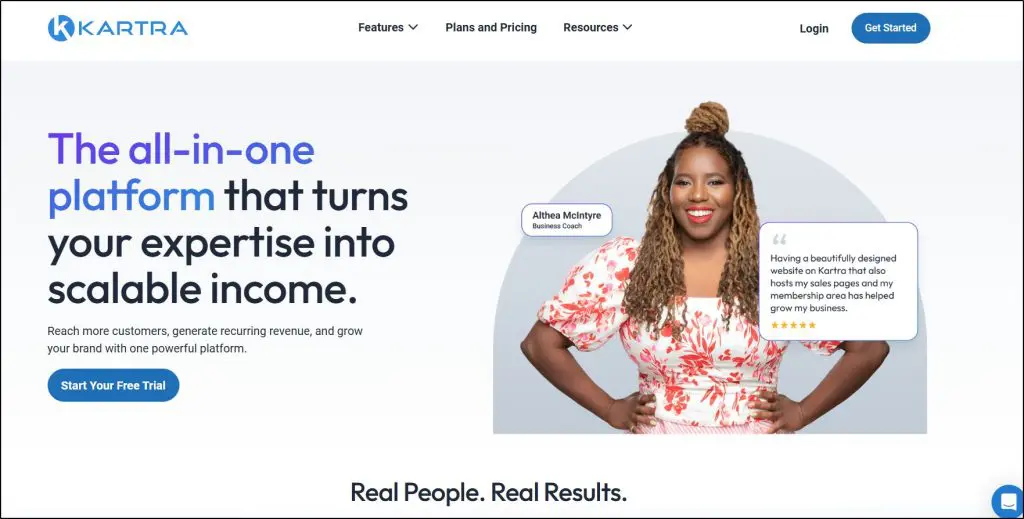
Kartra is an all-in-one marketing and lead generation platform. It combines a page builder, funnels, email and SMS, checkouts, video hosting, calendars, a helpdesk, and affiliate management in one account.
Everything in Kartra is connected to its contact database.
It tracks what each lead opens, clicks, watches, and buys, and it lets you tag people and trigger follow-ups from any of those actions. That makes it an impressive tool for anyone who sells through funnels.
Courses and memberships are part of the package, and they work. But they’re built as a delivery area for what you sell, with little of the structure a dedicated learning platform gives you.
In other words, you can call Kartra a marketing platform that online course creators can use.
Read my full Kartra review for a closer look.
Main Kartra Features
- Drag-and-drop page builder with hundreds of templates
- Funnels and campaigns, plus a Funnel Mapper and Simulator
- Email and SMS marketing with tags, lists, and automated sequences
- Membership portal for courses, with drip content and lesson comments
- Surveys and quizzes with branching, auto-tagging, and score-based certificates
- Video hosting with in-video calls to action and viewer tagging
- Calendars for paid bookings, with Google Calendar sync
- Helpdesk with tickets, a wiki, and a self-service billing portal
- Kartra AI writing assistant
- Affiliate management from the Growth plan

What Is Kajabi?
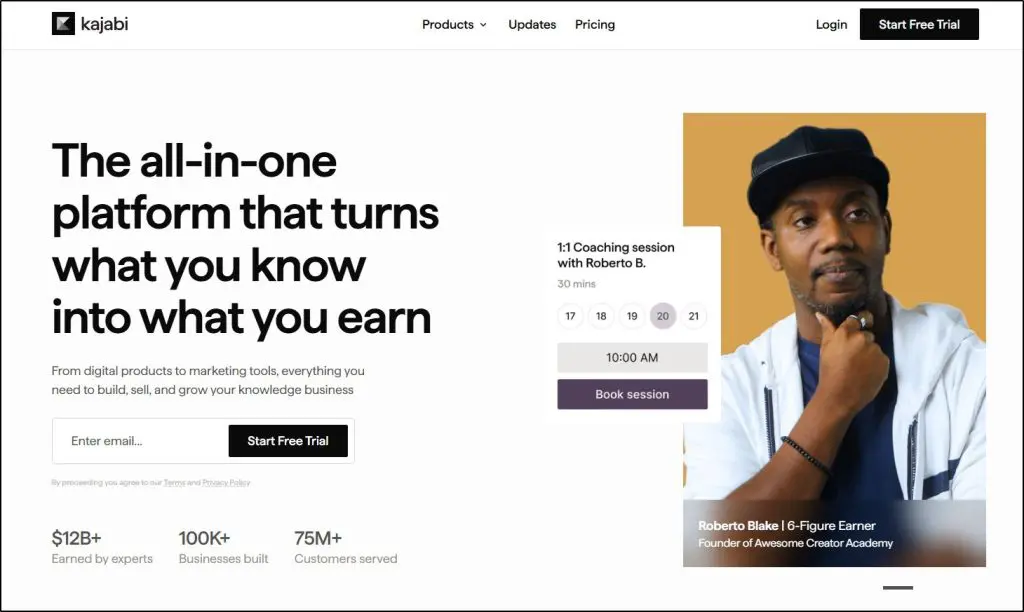
Kajabi is an advanced all-in-one platform for knowledge businesses. It combines course hosting, coaching, community, a website builder, email marketing, sales funnels, and automation in one account.
What sets it apart from Kartra is where it started.
Kajabi was built for people who sell what they know. So the course player, the community, the coaching tools, and the mobile app are all first-class products, and the marketing tools exist to sell them.
Kajabi can carry a customer along the full Value Ramp, from a free lead magnet to a course, a membership, and a high-ticket coaching offer, with email and automation connecting each step.
But its entry plan is tight, with only 5 products.
Read my full Kajabi review for more detail.
Main Kajabi Features
- Course builder with video, drip, lesson locking, graded quizzes, and certificates
- Email marketing with broadcasts, sequences, tagging, and behavior-based automations
- Unlimited funnels, landing pages, and marketing emails on every plan
- Coaching with a native scheduler, built-in video, and automatic session recordings
- Community with channels, live rooms, challenges, and leaderboards
- Cofounder AI assistant and an MCP connection to Claude or ChatGPT
- A mobile app for customers on every plan
- Affiliate program on Growth and above

Kartra vs Kajabi Pricing: How Much Do They Cost
Kartra has the cheaper entry point, and that plan is very limited. From the second tier up, the two platforms cost about the same.
Kartra Pricing
Kartra has four plans. You get a 14-day free trial and a 30-day money-back guarantee, and Kartra’s terms limit refunds to your first payment.
- Essentials: $52/month billed annually ($59 billed monthly), 5% transaction fee
- Starter: $99/month billed annually ($119 billed monthly), no transaction fee
- Growth: $189/month billed annually ($229 billed monthly), no transaction fee
- Professional: $429/month billed annually ($549 billed monthly), no transaction fee
| Feature | Essentials | Starter | Growth | Professional |
|---|---|---|---|---|
| Transaction fee | 5% | 0% | 0% | 0% |
| Contacts | 500 | 2,500 | 12,500 | 25,000 |
| Emails & SMS | 10,000/mo | Unlimited | Unlimited | Unlimited |
| Custom domains | 1 | 1 | 3 | 5 |
| Pages | 5 | Unlimited | Unlimited | Unlimited |
| Products | 1 | Unlimited | Unlimited | Unlimited |
| Memberships & courses | 1 | Unlimited | Unlimited | Unlimited |
| Kartra AI uses | 30 | 100 | 250 | 250 |
| Team members | 0 | 5 | 10 | At least 10 (not listed) |
| Surveys & quizzes | ✗ | ✗ | ✓ | ✓ |
| Affiliate management | ✗ | ✗ | ✓ | ✓ |
| Advanced automations | ✗ | ✗ | ✓ | ✓ |
| API access & custom code pages | ✗ | ✗ | ✓ | ✓ |
| Helpdesk | ✗ | ✗ | Tickets | Tickets + live chat |
| Real-time funnel analytics | ✗ | ✗ | ✗ | ✓ |
Essentials is a starter plan in the narrowest sense. It allows 1 product, 5 pages, 500 contacts, and 10,000 emails a month, and it leaves out surveys and quizzes.
Starter is the real entry point, with unlimited products, pages, emails, and SMS. But affiliate management, advanced automations, the helpdesk, and API access all wait on Growth.
Kajabi Pricing
Kajabi has three plans and no free plan. The standard trial is 14 days with a card on file, and our link extends it to 30 days. Every plan also carries a 30-day money-back guarantee.
- Basic: $143/month billed annually ($179 billed monthly)
- Growth: $199/month billed annually ($249 billed monthly)
- Pro: $399/month billed annually ($499 billed monthly)
| Feature | Basic | Growth | Pro |
|---|---|---|---|
| Products (courses, coaching, downloads) | 5 | 50 | Unlimited |
| Contacts | 2,500 | 25,000 | 100,000 |
| Communities | 1 | 1 | 3 |
| Websites | 1 | 1 | 3 |
| Admin users | 2 | 11 | 26 |
| AI credits | 0 | 500 | 1,000 |
| Cohort courses | ✗ | ✓ | ✓ |
| Affiliate program | ✗ | ✓ | ✓ |
| Advanced automations & webhooks | ✗ | ✓ | ✓ |
| Remove Kajabi branding | ✗ | ✓ | ✓ |
| Custom code editor | ✗ | ✗ | ✓ |
| API access | ✗ | ✗ | Yes ($25/mo value) |
| Branded mobile app | ✗ | ✗ | Included ($199/mo value) |
| Kajabi Payments fee | 2.9% + $0.30 | 2.8% + $0.30 | 2.7% + $0.30 |
| Fee with 3rd-party gateway | 2% | 1% | 0.5% |
| Kajabi MCP | ✓ | ✓ | ✓ |
| Marketing emails, landing pages and funnels | Unlimited | Unlimited | Unlimited |
Basic is tighter than its price suggests. It allows 5 products and 2,500 contacts, and it leaves affiliates, cohort courses, advanced automations, and AI credits to Growth. Extra contacts cost $125 a month for each block of 25,000.
I cover each plan in my Kajabi pricing guide.
Kartra vs Kajabi Pricing Comparison
Here’s how the comparable plans line up. Prices are per month on annual billing.
| Kartra | Kajabi | |
|---|---|---|
| Entry plan | Essentials at $52 | No equivalent |
| First full plan | Starter at $99 | Basic at $143 |
| Mid plan | Growth at $189 | Growth at $199 |
| Top plan | Professional at $429 | Pro at $399 |
| Platform fee | 5% on Essentials, none above | None with Kajabi Payments |
| Card processing | Your gateway’s rates, 2.9% + 30¢ with Stripe in the US | 2.9% + 30¢ on Basic, 2.8% on Growth, 2.7% on Pro |
| Products | 1 on Essentials, unlimited above | 5, 50, or unlimited |
| Contacts | 500, 2,500, 12,500, or 25,000 | 2,500, 25,000, or 100,000 |
| Free trial | 14 days | 14 days, or 30 with our link |
Kartra vs Kajabi: Real Cost at $10,000 and $50,000 a Month
Plan prices tell you little once you’re selling. So I worked out what each plan costs in a month where you sell $10,000 and one where you sell $50,000.
I’ve assumed a $200 average sale, annual billing, US cards, Stripe on the Kartra side, and Kajabi Payments on the Kajabi side. The totals include the plan price, card processing, and any transaction fee.
| Plan | Cost at $10,000/month | Cost at $50,000/month |
|---|---|---|
| Kartra Essentials | $857 | $4,077 |
| Kartra Starter | $404 | $1,624 |
| Kartra Growth | $494 | $1,714 |
| Kartra Professional | $734 | $1,954 |
| Kajabi Basic | $448 | $1,668 |
| Kajabi Growth | $494 | $1,674 |
| Kajabi Pro | $684 | $1,824 |
Kartra Essentials is the most expensive plan here at both levels, at $857 and $4,077, because its 5% fee takes $500 of every $10,000 you sell. It’s a plan for testing one offer, and you should leave it once you have steady sales.
Above that, the two platforms are close. Kartra Starter costs $404 at $10,000 a month and Kajabi Basic costs $448, a difference of $44. On the mid plans, Kartra Growth and Kajabi Growth both cost $494 at $10,000.
At $50,000 a month, Kajabi Growth costs $1,674 and Kartra Growth costs $1,714. Kajabi comes out $40 cheaper because its processing rate drops to 2.8%.
So price won’t decide this for most businesses. The limits will.
Kartra Starter gives you unlimited products, and Kajabi Basic stops at 5. Kajabi gives you more contacts as you move up, with 25,000 on Growth against 12,500 on Kartra Growth, and 100,000 on Pro against 25,000 on Kartra Professional.
You can check the processing math on your own prices with my Stripe fee calculator.
Kartra vs Kajabi Features: How They Compare
I’ve compared the two platforms on the six features that matter most to an expertise business.
| Feature | Winner | Why |
|---|---|---|
| Course creation and learning structure | Kajabi | Lesson locking, graded quizzes, cohorts, and a mobile app |
| Community | Kajabi | A full community product against lesson comments |
| Coaching | Kajabi | Built-in video and automatic recordings |
| AI features | Kajabi | An assistant for the whole business, plus an MCP connection |
| Email marketing and automation | Kartra | SMS, behavior tagging from video and quizzes, and split testing |
| Other marketing and sales features | Kartra | Funnel Mapper, in-video calls to action, and a helpdesk |
Kajabi wins four of the six.
But look at which two Kartra wins. If generating and converting leads is the hard part of your business, those are the two that matter most.
Feature #1: Course Creation and Learning Structure
The course builder shapes how students experience your product and whether they finish it. This is where the two platforms differ most, and I’ve included memberships because both use them to package courses.
Kartra
Kartra delivers courses through its membership portal builder. You organize content into categories and posts, add video, audio, text, and downloads, and drip it on a schedule or by days since signup. Students get an email when new content unlocks.
A few things work well. Members can comment under lessons, and you can moderate those comments. One portal can hold all your courses with a single login, and it shows members the programs they haven’t bought yet. Video hosting is unlimited from Starter.
What’s missing is learning structure. Kartra’s quizzes are a separate tool built for surveys and lead profiling, and they can issue a certificate at a set score. I haven’t found lesson locking tied to a pass mark, cohort courses, or a student mobile app. Lesson pages also look more like blog posts than a classroom.
Kajabi
Kajabi’s course builder was made for teaching. You organize lessons into modules, add video, audio, and text, and drip content on a schedule. Product templates give you a starting structure, which helps when you’re creating an online course for the first time.
It gives you the progress controls Kartra leaves out. You can lock a lesson until the student completes the previous one, grade quizzes against a pass mark, and issue completion certificates. Cohort courses come with Growth. Students can learn in the Kajabi mobile app on every plan.
The limits hold it back. Basic allows only 5 products, and Kajabi has no formal exam or native assignment tool, so it still trails a dedicated learning platform. My Kajabi vs Thinkific comparison covers that gap. Memberships are products you build from courses, community access, and coaching.
Winner: Kajabi. It gives students a structured classroom, progress controls, and a mobile app. Kartra delivers content well and stops short of teaching tools.
Feature #2: Community
Community keeps members engaged between lessons and gives you a recurring product to sell. Only one of these platforms treats it as a product.
Kartra
Kartra has no dedicated community feature. What it offers is a comment section under each lesson or post in your membership portal, which Kartra describes as forums.
Those comments are useful for course Q&A. You can approve, hold, or remove comments, and you can give a team member a profile with admin rights to moderate for you. Membership analytics also show your most active members and your churn.
But that’s where it ends. Kartra has no member feed, no chat, no live rooms, no events, and no gamification. Most Kartra users who want a community run it in a Facebook group or pair Kartra with a dedicated community platform. That means another login for members and another place for you to manage.
Kajabi
Kajabi’s community is a full product. You create channels for topics or member groups and control access through unlimited access groups. Members get direct messaging, live rooms, meetups, challenges, and leaderboards.
You can sell the community by itself or bundle it with courses and coaching. A comment-to-DM feature turns public replies into private conversations, which helps with sales and support. Members use it on the web and in the Kajabi app.
The limit is the number of communities. Basic and Growth include one, and Pro includes three, so you organize everything through channels and access groups until you reach the top plan. For a single brand that’s rarely a problem, and it’s far more than Kartra offers on any plan.
Winner: Kajabi. It has a real community with live rooms, challenges, and an app. Kartra has lesson comments.
Feature #3: Coaching
Coaching usually carries your highest price, so how a platform books, delivers, and records sessions affects your best offer.
Kartra
Kartra handles the booking side well through Kartra Calendars. You set your availability, take payment at booking, and offer one-off sessions, recurring meetings, or multi-day events. It syncs both ways with Google Calendar.
Its advantage is scale. You can add unlimited hosts or coaches, and each one connects their own calendar. Automated reminders go out before a session and follow-ups go out after it. For a firm with several coaches, that’s a real strength.
The session itself happens somewhere else. Kartra has no built-in video room, so calls run on Zoom or a similar tool and recordings are yours to manage. It also has no client workspace for notes and resources. You’d build that as a membership area by hand.
Kajabi
Kajabi handles the whole coaching workflow in-house. Kajabi Scheduler manages your availability, buffers, and reminders, and calls run on Kajabi Live, its built-in video tool. You don’t need Calendly or Zoom.
After each call, the recording uploads to the client’s session automatically. You can ask onboarding questions at checkout, set cancellation policies, and sell coaching as single sessions or packages. Each client gets a workspace that holds sessions, notes, and resources.
Coaching also connects to the rest of Kajabi. A purchase can start an email sequence and add the client to your community, and a funnel can offer coaching to course buyers. Each coaching offer counts toward your product limit, which matters on Basic with its cap of 5.
Winner: Kajabi. It runs and records the call and gives each client a workspace. Kartra is the better scheduler for a team of coaches.
Feature #4: AI Features
AI can now draft a course, write your emails, and answer questions about your sales. Both platforms have built it in, at different depths.
Kartra
Kartra AI is a writing assistant inside the page builder and the email tool. You set up a business profile with your brand voice, audience, and goals, and it uses that profile every time it writes.
It can generate a full landing page or write section by section, and it drafts email broadcasts and SMS messages. For a marketer who produces a lot of pages and sequences, that saves real time. Kartra has been adding to it steadily.
But its usage is capped by plan, at 30 uses a month on Essentials, 100 on Starter, and 250 on Growth. And it stays inside marketing copy. I haven’t found Kartra AI tools for building course content, or a way to connect your Kartra account to Claude or ChatGPT.
Kajabi
Kajabi goes further. Cofounder is an AI assistant inside the dashboard that drafts sales pages, emails, and course outlines. Growth includes 500 AI credits a month and Pro includes 1,000, and Basic includes none.
Every plan also has an MCP connection, which lets you run parts of your account from Claude or ChatGPT. Kajabi lists Expert Agents, which answer buyer and student questions, as coming soon. I cover the full set in my Kajabi AI review.
None of this picks your offer or your audience for you. AI makes the execution cheap once you’ve made those calls. The weak point is Basic, where you get the MCP connection and no credits for Cofounder unless you buy them.
Winner: Kajabi. Its AI covers courses, marketing, and account data, and it connects to outside AI tools. Kartra AI is a good copywriter with a monthly cap.
Feature #5: Email Marketing and Automation
Email turns leads into buyers and buyers into repeat customers. Both platforms are strong here, and this is where Kartra pulls ahead.
Kartra
Kartra includes unlimited email and SMS from the Starter plan. You can send broadcasts, build automated sequences, and organize contacts with lists and custom tags. Split testing is built in.
Its edge is behavior tracking. Kartra can tag a lead for watching a set share of a video, for a quiz score, or for an answer to a single survey question, and then start a different sequence for each. Surveys can also branch based on answers, which makes them a strong tool for qualifying leads.
Every asset shares one contact record, so a page visit, a purchase, a helpdesk ticket, and a calendar booking can all trigger follow-up. The catch is that advanced automations need Growth, and all of this takes time to learn. Kartra isn’t a platform you set up in an afternoon.
Kajabi
Kajabi includes unlimited marketing emails on every plan. You can send broadcasts, build multi-step sequences, tag contacts, and segment by behavior and purchase history. It’s a full email marketing system.
Automations connect everything. A purchase can trigger an onboarding sequence, grant community access, and tag the buyer for a later offer. Advanced automations and webhooks need Growth. Contact limits are 2,500 on Basic, 25,000 on Growth, and 100,000 on Pro.
Kajabi is easier to use, and it covers what most knowledge businesses need. But it has no SMS marketing built in, and its triggers are tied mostly to purchases, forms, and course activity. It can’t match Kartra’s tagging from video and quiz behavior.
Winner: Kartra. SMS, split testing, and tagging from video and quiz behavior give a marketer more to work with. Kajabi is simpler and includes larger contact limits.
Feature #6: Other Marketing and Sales Features
Beyond email, a platform has to bring in leads and convert them. Here I compare funnels, pages, video marketing, checkout, and support tools.
Kartra
This is Kartra’s home ground. Its page builder has hundreds of templates, and its funnels connect pages, emails, and checkouts into complete campaigns. A marketplace lets you buy ready-made funnels or sell your own.
Two tools stand out. Funnel Mapper lets you lay out a whole funnel on a canvas, and Funnel Simulator projects revenue, cost per lead, and return before you launch. Kartra’s video player can show a call to action or an opt-in form inside the video, as a page embed or a pop-up.
Kartra also covers the support side. The helpdesk on Growth adds ticketing, a wiki, and a billing portal where customers update their own cards, and Professional adds live chat. Affiliate management starts on Growth, and you can connect several payment gateways.
Kajabi
Kajabi gives you a website builder with themes, a blog, unlimited landing pages, and unlimited funnels. A funnel links an opt-in page, emails, and a checkout into one flow, and Kajabi supplies templates for common goals such as a lead magnet or a webinar.
Checkout supports upsells, order bumps, coupons, and payment plans. You can also host a podcast and publish a newsletter from the same account, which Kartra doesn’t offer. The affiliate program and the option to remove Kajabi branding both start on Growth.
Kajabi’s marketing tools are good enough for almost any knowledge business, and they’re easier to learn. But Kajabi has no funnel simulator, no in-video calls to action, and no helpdesk. Its strength is how smoothly a funnel hands a buyer to a course, a community, or a coaching offer.
Winner: Kartra. Funnel planning, video marketing, and a built-in helpdesk give it more selling tools. Kajabi wins on content tools such as the blog, podcast, and newsletter.
Kartra vs Kajabi: Pros and Cons
These are the practical strengths and weaknesses you’ll notice once you’re running a business on each platform.
Kartra Pros and Cons
| Pros | Cons |
|---|---|
| Deep funnel tools, with a mapper, a simulator, and a funnel marketplace | Course area lacks lesson locking, cohorts, and a classroom feel |
| Email and SMS in one place, unlimited from Starter | No dedicated community, only lesson comments |
| Tags leads from video, quiz, and survey behavior | No mobile app for students |
| Unlimited products, pages, and video from Starter | Essentials is limited to 1 product and charges 5% |
| Helpdesk with tickets, wiki, and billing portal on Growth | Affiliates, advanced automations, and helpdesk need Growth |
| Calendars with unlimited hosts and Google Calendar sync | Steep learning curve, and Kartra AI uses are capped each month |
Kajabi Pros and Cons
| Pros | Cons |
|---|---|
| Built for knowledge businesses, with a strong learning experience | Basic is tight, with 5 products and 2,500 contacts |
| Full community with live rooms, challenges, and leaderboards | No SMS marketing or helpdesk built in |
| Built-in coaching video with automatic recordings | Less detailed behavior tagging than Kartra |
| Cofounder AI assistant and an MCP connection | Affiliates, cohort courses, and advanced automations need Growth |
| Mobile app on every plan | No AI credits on Basic |
| No platform fee, and processing rates drop on higher plans | Third-party payment providers carry a surcharge of up to 2% |
Kartra vs Kajabi Verdict: Which One Should You Choose
Both are impressive platforms, and they cost about the same once you’re past the entry tier. What you sell and how you sell it should decide this.
- Courses, memberships, or cohorts are your main product: choose Kajabi. The learning experience is what your customers pay for, and Kartra’s is basic.
- You want a paid community or a community around your courses: choose Kajabi. Kartra has no community product.
- You sell coaching and want sessions recorded and organized: choose Kajabi.
- Your students learn on their phones: choose Kajabi for its mobile app.
- You’re a marketer, consultant, or agency, and courses are a side product: choose Kartra. Its funnel, tagging, and video tools go further.
- You rely on SMS, quizzes, or video to qualify leads: choose Kartra Starter or Growth.
- You sell many products and want no cap on them: choose Kartra Starter. Kajabi Basic stops at 5.
- You run a team of coaches or need a helpdesk: choose Kartra Growth.
For most edupreneurs, I’d choose Kajabi.
Its marketing tools are strong enough to run a full Value Ramp, and its learning, community, and coaching features are what keep customers after the sale. Kartra can out-market it, but a knowledge business rarely fails for lack of a funnel simulator.
I’d choose Kartra only if marketing were the business and the course were one more thing in the funnel.
If neither fits, my Kajabi vs Teachable and Podia vs Kajabi comparisons cover cheaper and simpler options.
Both offer free trials, so test the one that matches your business. Start with Kartra if lead generation comes first, or start with Kajabi if the learning experience does.
Kartra vs Kajabi: Frequently Asked Questions
What is the main difference between Kartra and Kajabi?
Kartra is a marketing and lead generation platform that also delivers courses and memberships. Kajabi is built for knowledge businesses, so it pairs strong marketing tools with a much better course experience, a full community, coaching tools, and a mobile app. Kartra goes deeper on funnels, SMS, and behavior tagging.
Is Kajabi better than Kartra for online courses?
Yes. Kajabi offers lesson locking, graded quizzes, completion certificates, cohort courses, and a mobile app for students. Kartra delivers course content through a membership portal with drip scheduling and lesson comments, and it lacks most of the structure a learning platform provides.
Is Kartra cheaper than Kajabi?
Kartra’s entry plan is cheaper, at $52 a month on annual billing against $143 for Kajabi. That plan allows 1 product and charges a 5% transaction fee. On comparable plans the two cost about the same, and at $10,000 a month in sales their mid plans cost the same.
Do Kartra and Kajabi offer free trials?
Yes. Kartra offers a 14-day free trial and a 30-day money-back guarantee that applies to your first payment. Kajabi offers a 14-day free trial that needs a card, extended to 30 days through our link, plus a 30-day money-back guarantee. Neither has a free plan.
Do Kartra and Kajabi charge transaction fees?
Kartra charges 5% on its Essentials plan and nothing on Starter, Growth, or Professional. Kajabi charges no platform fee through Kajabi Payments, and adds 2%, 1%, or 0.5% by plan if you use a third-party provider other than PayPal. Card processing applies on both.
Does Kartra have a community feature?
Kartra doesn’t have a dedicated community. It offers moderated comment sections under lessons and posts in your membership portal. Kajabi includes a full community with channels, direct messages, live rooms, challenges, and leaderboards on every plan.
Does Kartra or Kajabi have a mobile app?
Kajabi has a mobile app for customers on every plan, and its Pro plan includes a branded app under your own name. Kartra’s membership sites are mobile optimized, and Kartra doesn’t offer a mobile app for students.
Which has better AI features, Kartra or Kajabi?
Kajabi does. Its Cofounder assistant drafts sales pages, emails, and course outlines, and every plan has an MCP connection to Claude or ChatGPT. Kartra AI is a writing assistant for pages, emails, and SMS, with monthly use caps of 30 to 250 by plan.
Which is better for marketing and funnels, Kartra or Kajabi?
Kartra is better for pure marketing. It includes SMS, split testing, a funnel mapper and simulator, in-video calls to action, and tagging based on video and quiz behavior. Kajabi’s funnels and email are easier to use and are enough for most knowledge businesses.
Can I use Kartra for coaching?
Yes. Kartra Calendars handles paid bookings, reminders, Google Calendar sync, and unlimited hosts. The session runs on Zoom or another video tool. Kajabi goes further with a built-in video room, automatic recordings, and a workspace for each client.
What are the best alternatives to Kartra and Kajabi?
Thinkific is the strongest alternative for structured courses with exams and assignments. Teachable is a simpler learning platform with tax handling. Podia is a low-cost all-in-one for early-stage creators. ClickFunnels and HighLevel are the closest alternatives to Kartra for funnel-led businesses.
See also:

Jeff Cobb, Founder of Learning Revolution
Jeff Cobb is an expert in online education and the business of adult lifelong learning. Over the past 20+ years he has built a thriving career based on that expertise – as an entrepreneur, a consultant, an author, and a speaker. Learning Revolution is a place where Jeff curates tips, insights, and resources to help you build a thriving expertise-based business. Learn more about Jeff Cobb here.
Table of Contents
Related Posts
10 Best Udemy Alternatives To Sell Online Courses
Kartra Review (2026): Pricing, Features And Pros & Cons
Zenler Review (2026) | Are Its Pricing & Features Worth It? [Examples + Tips]