

TL;DR: Kajabi Integrations (2026): Native Apps, Zapier, Webhooks, And MCP
Kajabi connects to other tools in five ways. Native integrations cover email, analytics, and payments, while Zapier links thousands of apps and webhooks pass data directly. Kajabi MCP connects Claude and ChatGPT, and custom code lets you embed almost anything on a page.
• Native integrations. Kit, Mailchimp, ActiveCampaign, Drip, AWeber, Google Analytics, the Meta Pixel, Segment, Stripe, and PayPal. Free on every plan.
• Zapier and webhooks. Both need Growth or Pro. On Basic, purchases and form submissions can’t trigger outside apps.
• What Zapier can do. Start a workflow when someone buys, submits a form, or completes an assessment, and grant or revoke access to an offer from another app.
• Zapier cost. A free plan covers simple two-step Zaps. Professional starts at $19.99/month on annual billing.
• Best uses. Selling through another checkout, text reminders, coaching onboarding, team sales, and syncing sales to a spreadsheet.
• Before you connect anything. Check whether Kajabi already does the job. Kajabi already includes email, checkout, upsells, affiliates, and a member app.
Try Kajabi For Free
Kajabi sells itself as an all-in-one platform, and for many businesses it is. You can build a website, send emails, collect payments, and deliver courses without leaving it.
Some business still have one or two tools they don’t want to give up. It might be the email platform that holds ten years of subscribers, the checkout that handles your tax rules, or the spreadsheet your accountant asks for each month.
Integrations decide whether those tools work with Kajabi or create extra admin.
I’ve been a Kajabi customer for years. In this guide, I’ll explain each way Kajabi connects to other software, what each one costs, and the practical workflows that make an integration worth setting up. I’ll also tell you when you don’t need one at all.

Kajabi Integrations Snapshot (2026)
| Method | What it does | Plan needed | Extra cost |
|---|---|---|---|
| Native integrations | Connects email tools, analytics, and payment processors inside Kajabi settings | Every plan | None |
| Zapier | Links Kajabi to thousands of apps with no code | Growth or Pro | Free plan, or Professional from $19.99/month |
| Webhooks | Sends or receives data directly, with no middleman | Growth or Pro | None, though you need a tool to receive the data |
| Kajabi MCP | Lets Claude or ChatGPT build drafts in your account | Every plan | Your AI tool subscription |
| Custom code and embeds | Adds widgets, forms, and scripts to your pages | Every plan | Depends on the tool |
Quick Verdict | Do You Need Kajabi Integrations?
Most Kajabi users need fewer integrations than they expect. Kajabi already handles email marketing, checkout, upsells, affiliates on Growth, a community, and a member app. Each of those used to require a separate tool.
You do need integrations in three situations. You sell through a checkout other than Kajabi’s. You run part of your business in another tool you won’t replace, such as a CRM or an accounting system. Or you want a channel Kajabi doesn’t offer, such as text messages.
The biggest catch is the plan. Zapier and webhooks both require Growth or Pro. If you’re on Basic and your plans depend on automation with outside apps, budget for the upgrade.
What Are Kajabi Integrations And Why You Need Them
An integration is a connection between two pieces of software that lets them share information and trigger actions in each other. Without one, you move data by hand. You export a list from one tool, clean it up, and import it into another. With an integration, the tools pass that information across the moment something happens.
A Kajabi integration connects your Kajabi account to another app. Two examples show how that works in practice.
- Email marketing. Connect Kajabi to Kit, and every person who submits a Kajabi form or buys an offer lands in your Kit account automatically. Your existing welcome sequence starts for them without you touching a spreadsheet.
- An outside checkout. Connect Kajabi to ThriveCart through Zapier, and a sale in ThriveCart grants the buyer access to the matching Kajabi course within moments. A refund in ThriveCart can remove that access again.
Why You Need Kajabi Integrations
The first reason is time. Every manual handoff in your business, such as adding a buyer to a list, granting course access, or logging a sale for your bookkeeper, takes a few minutes. Spread across hundreds of customers a year, those minutes add up to days. An integration does the same job in seconds and never forgets a step.
The second reason is accuracy. People make mistakes when they copy data between tools. A buyer who never receives access to the course they paid for is far more likely to ask for a refund than one who gets in right away.
Integrations also let you get more out of Kajabi.
You can keep the tools you already rely on and still run your products on Kajabi. You can add channels Kajabi lacks, such as text messages. And you can sell in ways Kajabi doesn’t support on its own.
For example, a coach can text a reminder before every session, a trainer can sell 20 course seats to a company from one spreadsheet, and an author can sell a printed workbook on Shopify that unlocks a course in Kajabi.
That said, more integrations aren’t always better. Each one is another tool to pay for and another place where something can break. The goal is to connect only what Kajabi doesn’t already do well, and the rest of this guide will help you tell the difference.
The Five Main Types Of Kajabi Integrations And How They Work
Kajabi lets you integrate other applications with your account in five different ways. Let me quickly explain each.
1. Native Kajabi Integrations
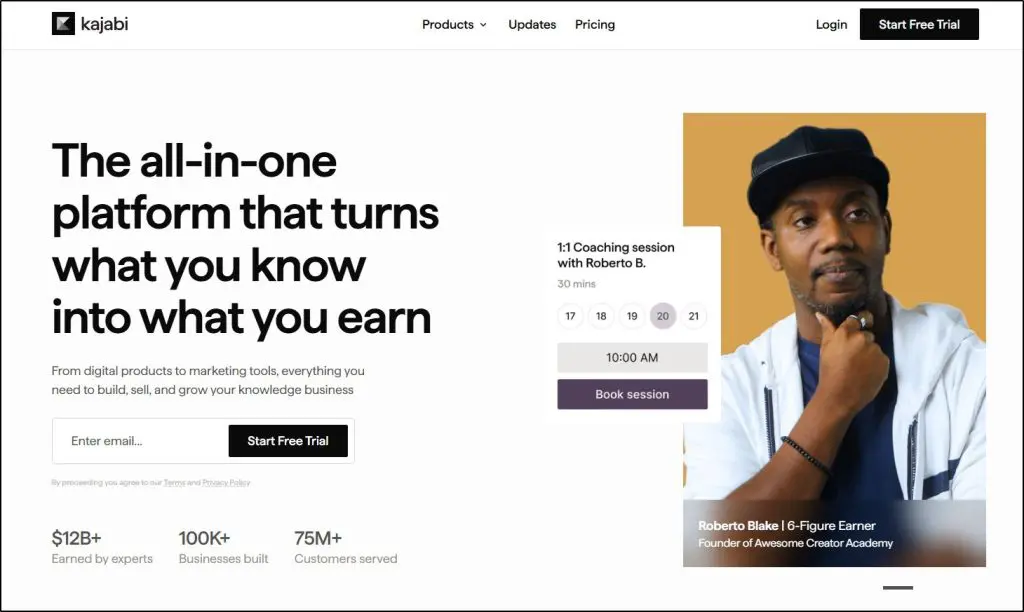
Native integrations live in your Kajabi settings and work without any third-party tool. Kajabi lists these groups.
| Category | Tools | What the connection does |
|---|---|---|
| Email marketing | Kit (ConvertKit), Mailchimp, ActiveCampaign, Drip, AWeber | Sends contact details to the email tool when someone submits a form or buys an offer |
| Analytics | Google Analytics, Meta Pixel, Segment | Adds tracking code to your pages so you can measure traffic and conversions |
| Payments | Stripe, PayPal | Processes payments if you don’t use Kajabi Payments |
The email integrations matter most. If you have years of history in Kit or ActiveCampaign, you can keep that tool and still sell on Kajabi. My comparison of email marketing platforms covers the strongest options, and my Kit review goes deeper on one of them.
Where it falls short. The native list is short. The email integrations send contacts one way, into the email tool, so data from that tool doesn’t flow back into Kajabi. Kajabi also adds an extra fee of up to 2% when you use an outside payment processor where Kajabi Payments is available. Everything beyond this list needs Zapier, webhooks, or custom code.
2. Kajabi Integrations via Zapier
Zapier connects apps through simple “when this happens, do that” workflows called Zaps. Kajabi has an official Zapier app, so you can connect it to thousands of tools without writing code.
Kajabi can start a Zap, and a Zap can act on Kajabi.
| Kajabi triggers (Kajabi starts the Zap) | Kajabi actions (the Zap acts on Kajabi) |
|---|---|
| New Purchase, when someone buys an offer | Grant Access to an Offer, for a new or existing member |
| Cart Purchase, when someone checks out a Kajabi cart | Revoke Access to an Offer |
| New Payment, including subscription renewals | Create Form Submission, which also opts the contact in to email |
| New Form Submission | |
| Assessment Completed | |
| Tag Added and Tag Removed, as listed on Zapier |

To connect them, copy your API key and secret from Kajabi’s account settings and paste them into Zapier. Then pick your site and the offer or form you want to use. Run a test purchase or form submission first so Zapier has sample data.
Zapier has a free plan with 100 tasks a month and two-step Zaps, which suits a simple workflow. Multi-step Zaps need Professional, which starts at $19.99/month on annual billing or $29.99/month paid monthly. I explain how Zapier works more broadly in my guide to growing your business with Zapier.
Where it falls short. Kajabi’s help center says Zapier relies on webhooks, which only Growth and Pro include. The list of actions is also short. A Zap can’t create a contact without a form, apply a tag directly, or deactivate and reactivate an offer. Kajabi grants an offer only once per member, and offer grant emails reach members only if they haven’t unsubscribed from those messages.
3. Kajabi Webhooks
Webhooks pass data between Kajabi and another app directly. They do the same job as Zapier for a handful of events, without a monthly Zapier bill.
- Inbound webhooks: Every offer has an activation URL that grants access and a deactivation URL that removes it. Another system can call these when someone pays or cancels.
- Outbound webhooks: Kajabi sends data out when someone makes a purchase, when a cart purchase succeeds, or when any payment succeeds, including renewals.
- Form webhooks: Kajabi sends form submissions to another app as they come in.
Use webhooks when the other tool accepts them directly, such as many checkout platforms and CRMs. You avoid paying for Zapier tasks, and the data moves instantly.
Where it falls short. Webhooks need Growth or Pro, and they take more technical comfort than Zapier. Inbound calls fail if they leave out the name, email, or external user ID. The purchase event also skips cart orders and later subscription payments, so choose the right event for what you want to track.
4. Kajabi MCP for AI Tools | Integrating With Claude & ChatGPT
Kajabi MCP is the newest kind of integration. It connects your Kajabi account to AI tools such as Claude and ChatGPT, which can then build pages, emails, offers, and course content as drafts in your account. It comes with every plan.
It doesn’t replace Zapier. MCP works when you ask for something, while Zapier runs automatically in the background. I cover MCP in detail in my Kajabi AI review.
5. Integration via Custom Code And Embeds
Kajabi lets you add code to the header of your site and to individual pages. That opens the door to tools with an embed code, such as a scheduling widget, a chat widget, a review widget, or a form from another platform.
Where it falls short. An embed shows a tool on your page, and the data stays in that tool. If you need the information inside Kajabi, pair the embed with Zapier or a webhook.
10 Practical Ways To Use Kajabi Integrations
Here are ten ways I’d use Kajabi integrations to run my course or coaching business.
1. Sell Through Another Checkout And Deliver In Kajabi
Good for: Creators who need a payment method or checkout Kajabi doesn’t support
Why bother. You may sell in a country where Kajabi Payments isn’t available, need a local payment method, or already run a checkout tool with your tax and affiliate setup. You can keep that checkout and still deliver the course in Kajabi.
How to set it up. Use the Grant Access to an Offer action, triggered by a purchase in your checkout tool. Zapier has ready-made templates for ThriveCart and Stripe. Add the matching Revoke Access step for refunds and cancellations.
Watch out for. Kajabi grants an offer only once per member, so test with fresh data each time.
2. Send Text Reminders For Live Sessions
Good for: Coaches, cohort courses, and anyone who runs live calls
Why bother. Emails get buried, and a text a few hours before a call can lift attendance. Kajabi has no built-in text messaging, so this needs an integration.
How to set it up. Collect a phone number on your form or checkout, then send it to an SMS tool such as ClickSend or Twilio through Zapier. Trigger the welcome text from New Purchase and use the SMS tool’s scheduling for reminders.
Watch out for. Get clear consent before you text anyone, and check the rules for marketing texts in your members’ countries.
3. Sell Courses To Teams And Organizations
Good for: Experts who sell training to companies, associations, or schools
Why bother. A buyer pays once for 20 seats and sends you a list of names. Adding each person by hand is slow and error-prone. Group sales are also where a lot of training revenue sits.
How to set it up. Put the names and emails in a Google Sheet, then use a Zap that grants the offer to each new row. When the contract ends, a second Zap can revoke access.
Watch out for. Kajabi doesn’t offer group seat management or reporting for a team buyer, so you’ll track seats in the sheet yourself.
4. Bundle A Physical Product With A Course
Good for: Creators who sell a workbook, kit, or book alongside a course
Why bother. Kajabi sells digital products. A store such as Shopify handles shipping, stock, and physical orders. Linking the two lets one order deliver both.
How to set it up. Trigger a Zap from a new Shopify order for the bundle and grant the matching Kajabi offer.
Watch out for. You now run two storefronts. Keep the bundle on one checkout so customers don’t pay twice.
5. Register Webinar Attendees Automatically
Good for: Anyone who sells through webinars hosted outside Kajabi
Why bother. Kajabi’s webinar funnel handles registration pages and emails, and the event itself runs in another tool. Passing registrants across saves you from exporting lists.
How to set it up. Use New Form Submission to add each registrant to WebinarJam, Demio, or Zoom. You can send attendance data back by tagging contacts in Kajabi. My list of the best webinar platforms covers the options.
Watch out for. Test the full path with a real registration before you promote the event.
6. Issue Certificates After An Assessment
Good for: Professional training, continuing education, and compliance courses
Why bother. Learners in professional fields often need proof of completion for an employer or a licensing body. Kajabi’s assessments can trigger that step.
How to set it up. Use the Assessment Completed trigger to send the learner’s details to a certificate tool, or log the result in a spreadsheet for your records.
Watch out for. Check how you’ll handle a learner who fails and retakes the assessment, so you don’t issue a certificate too early.
7. Automate Coaching Onboarding
Good for: Coaches selling one-on-one or small-group programs
Why bother. Kajabi’s coaching tools don’t include contracts or e-signatures, and many coaches keep client notes elsewhere. Automating the first steps makes a new client feel looked after from minute one.
How to set it up. When someone buys a coaching offer, send them an agreement through an e-signature tool, create a client folder in Google Drive or Notion, and add them to your client tracker. My Kajabi Coaching review covers what Kajabi handles natively.
Watch out for. Each step is a Zap task, so a busy month can push you past your Zapier allowance.
8. Send A Personal Thank-You Video
Good for: Creators with high-priced programs or a small number of buyers
Why bother. A short personal video after purchase builds goodwill and reduces refund requests. It works best when you have time to record each one.
How to set it up. Zapier has a template that creates a task in Bonjoro for every new Kajabi purchase. You record the video from your phone when the task appears.
Watch out for. It stops scaling once you have dozens of buyers a day, so reserve it for premium offers.
9. Keep A Clean Record Of Every Sale
Good for: Anyone who reports revenue to a bookkeeper, partner, or client
Why bother. Kajabi’s reports serve marketing well. A spreadsheet or accounting tool gives your bookkeeper what they need and lets you build your own reports.
How to set it up. Send each New Payment to a Google Sheet or your accounting software. Include renewals so subscription income shows up.
Watch out for. Refunds don’t appear as a separate Kajabi trigger on Zapier, so reconcile them from your payment processor.
10. Turn Ad Leads Into Kajabi Subscribers
Good for: Creators running lead ads or using a separate landing page builder
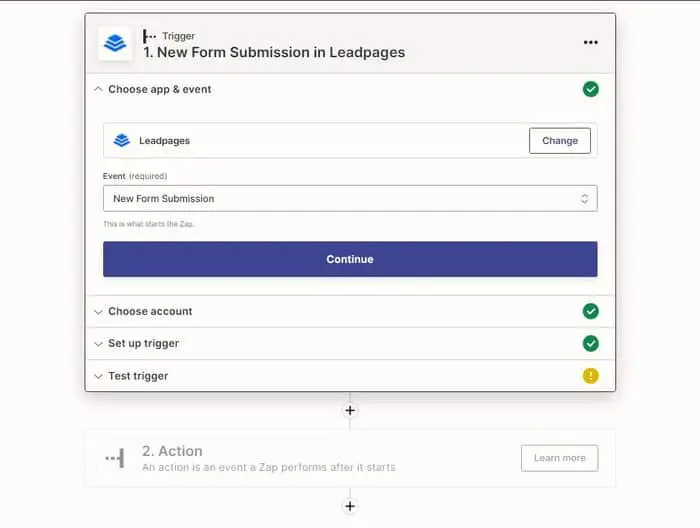
Why bother. Leads from a Facebook lead ad or a Leadpages form need to reach your Kajabi email sequence right away. A lead who waits a day often forgets why they signed up.
How to set it up. Use the Create Form Submission action. It adds the contact to a Kajabi form, which opts them in and can start your nurture sequence. My guide on building an email list covers the sequence itself.
Watch out for. A form submission opts the contact in to email, so only send people who agreed to hear from you.
5 Tips For Setting Up Kajabi Integrations
1. Check What Kajabi Already Does
Before you connect a new tool, look for the feature inside Kajabi. Upsells, order bumps, affiliates, email sequences, and funnels are all built in now. Every integration you avoid is one less thing that can break.
2. Use The Email Address As The External User ID
Kajabi’s grant and revoke actions need an external user ID. Using the buyer’s email keeps it consistent across tools and makes revoking access later straightforward.
3. Test With A Real Purchase
Make a low-priced test offer, buy it yourself, and run the whole workflow. Check that access arrives, the email sends, and the data lands where it should. Then refund yourself and confirm the revoke step works too.
4. Name And Document Every Zap
Give each Zap a clear name, such as “ThriveCart purchase grants Course A,” and keep a short list of what each one does. When something breaks a year from now, you’ll know where to look.
5. Watch Your Task Count
Every action in a Zap uses a task. A five-step coaching onboarding Zap uses five tasks per client. Check your Zapier usage monthly, and switch high-volume workflows to webhooks where the other tool supports them.
What Kajabi Integrations Cost
Native integrations and MCP work on every Kajabi plan. Zapier and webhooks need Growth or Pro.
- Basic: $143/month on annual billing or $179/month paid monthly. Native integrations, MCP, and embeds only
- Growth: $199/month on annual billing or $249/month paid monthly. Adds Zapier and webhooks
- Pro: $399/month on annual billing or $499/month paid monthly. Adds the code editor and higher limits
| Feature | Basic | Growth | Pro |
|---|---|---|---|
| Products (courses, coaching, downloads) | 5 | 50 | Unlimited |
| Contacts | 2,500 | 25,000 | 100,000 |
| Communities | 1 | 1 | 3 |
| Websites | 1 | 1 | 3 |
| Admin users | 2 | 11 | 26 |
| AI credits | 0 | 500 | 1,000 |
| Cohort courses | ✗ | ✓ | ✓ |
| Affiliate program | ✗ | ✓ | ✓ |
| Advanced automations & webhooks | ✗ | ✓ | ✓ |
| Remove Kajabi branding | ✗ | ✓ | ✓ |
| Custom code editor | ✗ | ✗ | ✓ |
| API access | ✗ | ✗ | Yes ($25/mo value) |
| Branded mobile app | ✗ | ✗ | Included ($199/mo value) |
| Kajabi Payments fee | 2.9% + $0.30 | 2.8% + $0.30 | 2.7% + $0.30 |
| Fee with 3rd-party gateway | 2% | 1% | 0.5% |
| Kajabi MCP | ✓ | ✓ | ✓ |
| Marketing emails, landing pages and funnels | Unlimited | Unlimited | Unlimited |
Add Zapier on top if you use it. Free costs nothing, Professional starts at $19.99/month on annual billing, and Team starts at $69/month on annual billing. Kajabi offers a 14-day free trial and a 30-day money-back guarantee. My Kajabi pricing guide covers each plan in detail.
| Feature | Free | Professional | Team | Enterprise |
|---|---|---|---|---|
| Multi-step Zaps | ✗ | ✓ | ✓ | ✓ |
| Premium apps | ✗ | ✓ | ✓ | ✓ |
| Webhooks by Zapier | ✗ | ✓ | ✓ | ✓ |
| Users | 1 | 1 | 25 | Unlimited |
Kajabi Integrations Pros And Cons
| Pros | Cons |
|---|---|
| Native email, analytics, and payment integrations on every plan | Short native list compared with platforms that have an app store |
| Official Zapier app connects thousands of tools | Zapier and webhooks need Growth or Pro |
| Grant and revoke access from any checkout or system | Few Zapier actions, with no direct tagging or contact creation |
| Inbound and outbound webhooks with no middleman | Webhooks take some technical comfort |
| Kajabi MCP connects Claude and ChatGPT on every plan | Email integrations send data one way only |
| Custom code lets you embed almost any widget | Extra fee of up to 2% for outside payment processors |
Who Needs Kajabi Integrations?
- You run everything inside Kajabi. You may need none beyond analytics, so use the built-in tools first.
- You sell through another checkout or in another currency. Zapier or webhooks are essential, and you need Growth or Pro.
- You coach clients one-on-one. A few Zaps for contracts, folders, and reminders will save hours each month.
- You sell to organizations. Spreadsheet-based seat granting makes team sales workable.
- You depend on many outside tools. Compare Kajabi with platforms that offer an app store or a fuller API, such as the options in my guide to the best online course platforms.
Overall, Kajabi’s integrations cover the common needs well, provided you’re on Growth or Pro. The bigger win often comes from removing tools, because Kajabi now does much of what people once connected it for. For the full platform, read my Kajabi review, and plan your offer with our free creator tools.
Kajabi Integrations FAQs
Does Kajabi integrate with Zapier?
Yes. Kajabi has an official Zapier app. Kajabi can trigger Zaps when someone buys, submits a form, or completes an assessment, and Zaps can grant or revoke access to an offer or create a form submission in Kajabi.
Which Kajabi plan do I need for Zapier?
Zapier relies on Kajabi’s webhooks, which come with the Growth and Pro plans. The Basic plan doesn’t include them.
What native integrations does Kajabi have?
Kajabi connects natively to Kit, Mailchimp, ActiveCampaign, Drip, and AWeber for email, to Google Analytics, the Meta Pixel, and Segment for analytics, and to Stripe and PayPal for payments.
Can I sell on ThriveCart or Stripe and deliver courses in Kajabi?
Yes. Use Zapier or an inbound webhook to grant a Kajabi offer when someone buys in the other tool, and revoke it when they cancel or get a refund.
Does Kajabi have webhooks?
Yes, on the Growth and Pro plans. Inbound webhooks grant or revoke offers, and outbound webhooks send data when someone makes a purchase, a cart purchase succeeds, or a payment succeeds.
Can Kajabi send text messages?
Kajabi has no built-in text messaging. You can connect an SMS tool such as ClickSend or Twilio through Zapier and trigger texts from purchases or form submissions.
Is Zapier free to use with Kajabi?
Zapier has a free plan with 100 tasks a month and two-step Zaps. Multi-step workflows need a paid Zapier plan. You also need Kajabi’s Growth or Pro plan.
Does Kajabi have an API?
Kajabi provides an API key and secret for connecting Zapier, and its Pro plan lists API access. For most creators, Zapier and webhooks cover most of what creators would use an API for.
Can I connect Kajabi to ChatGPT or Claude?
Yes. Kajabi MCP connects your account to Claude, ChatGPT, and other AI tools that support MCP. It comes with every plan and creates drafts you review before publishing.
Can I keep my email marketing tool and use Kajabi?
Yes. Kajabi integrates natively with Kit, Mailchimp, ActiveCampaign, Drip, and AWeber, and sends contacts to them when they submit a form or buy an offer.

Jeff Cobb, Founder of Learning Revolution
Jeff Cobb is an expert in online education and the business of adult lifelong learning. Over the past 20+ years he has built a thriving career based on that expertise – as an entrepreneur, a consultant, an author, and a speaker. Learning Revolution is a place where Jeff curates tips, insights, and resources to help you build a thriving expertise-based business. Learn more about Jeff Cobb here.
Table of Contents
Related Posts
Kajabi Pricing (2026): Use Fee Calculator To Find Actual Cost
Kajabi Mobile App Types And How to Use Them
Kajabi Communities (2026) | Is It A Reliable Online Community Platform?